

P2702 on 2018-2023 Ford Mustang: Transmission Friction Element 'C' Apply Time Fault Guide
On a 2018-2023 Mustang with the 10R80 automatic transmission, code P2702 almost always indicates an internal transmission issue, often related to the main control valve body or, in some cases, the CDF clutch drum. This is a known issue covered by multiple Ford Technical Service Bulletins (TSBs). The fix typically requires a valve body overhaul or replacement by a professional, and sometimes a more involved repair of the CDF drum.
- P2702 on a 2018-2023 Mustang points to a problem with the 'C' clutch application time in the 10R80 10-speed automatic transmission.
- Common symptoms are harsh shifts, delayed gear engagement, and a lit Check Engine Light.
- This is a well-documented issue. Ford's primary recommended fix, per multiple TSBs, is an overhaul of the transmission's main control valve body.
- Due to the complexity of the repair, this is not a DIY-friendly job and should be handled by a professional technician familiar with Ford transmissions.
- Before major repairs, ensure the transmission fluid is at the correct level and in good condition, and that the transmission's control module has the latest software.
What's Unique About the 2018-2023 Ford MUSTANG
The 2018-2023 Mustang uses the 10-speed 10R80 automatic transmission, co-developed with GM. It is known for experiencing issues like harsh or delayed shifts. Ford has released numerous Technical Service Bulletins (TSBs) that specifically group P2702 with other codes related to these symptoms. The problem is often traced back to the main control valve body, where valves can stick or solenoids can fail. A more serious, but also documented, cause is the axial movement of the CDF clutch cylinder sleeve, which can cause internal hydraulic leaks and require a more significant teardown to repair.
Diagnostic Flowchart
Tap your situation to follow the diagnostic path that matches what you're seeing on this vehicle.
Symptoms You May Notice
- Harsh or abrupt shifts, particularly the 3-4, 4-5, or 5-6 shifts.
- Delayed engagement when shifting into Drive or Reverse, followed by a clunk or lurch.
- Transmission slipping or flaring (RPMs jump) between gears.
- Shuddering or jerking during gear changes, can feel like driving over rumble strips.
- Illuminated Malfunction Indicator Lamp (Check Engine Light).
- Transmission may enter a fail-safe or 'limp' mode.
- Banging or clunking noise when starting the vehicle or shifting.
- Replacing only the input or output speed sensors without diagnosing the underlying hydraulic or mechanical fault.
- Assuming a complete transmission rebuild is needed when only the valve body is at fault.
- Performing only a software update or adaptive learn reset when a mechanical issue (valve body or CDF drum) is present, leading to the problem returning quickly.
Most Likely Causes
- Main Control Valve Body Failure 🔴 High Probability → Shop Transmission Valve Body Multiple Ford TSBs (most notably 23-2250) point to sticking valves within the 10R80 valve body as a primary cause for these symptoms and codes.
How to confirm: A technician will follow the diagnostic procedure in TSB 23-2250, which involves checking codes, attempting software updates, and then inspecting the valve body if symptoms persist.
Typical fix: Overhaul or replacement of the main control valve body assembly. After replacement, the TCM must be updated with the new solenoid strategy and an adaptive learning drive cycle must be performed.
Est. part cost: $700-$1500 - Low or Degraded Transmission Fluid 🟡 Medium Probability → Shop Transmission Assembly The 10R80 is very sensitive to fluid level and condition. It requires a specific Motorcraft MERCON ULV fluid. Low or contaminated fluid affects hydraulic pressure, preventing clutch packs from engaging correctly.
How to confirm: Check the transmission fluid level and condition according to the manufacturer's procedure. The fluid should be clean, at the correct level, and not smell burnt. Many owners report these transmissions are underfilled from the factory.
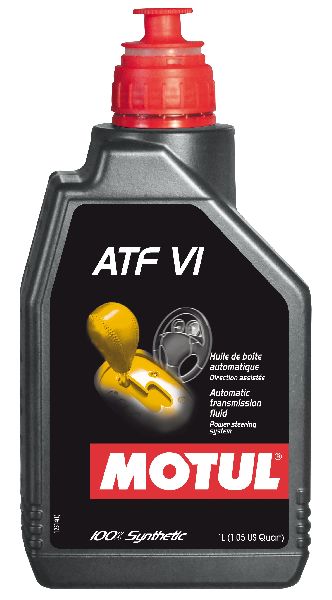
Typical fix: Perform a transmission fluid and filter change using only Motorcraft MERCON ULV fluid (Part # XT-12-QULV). If the level is low, the source of the leak must be identified and repaired.
Est. part cost: $150-$300 - Faulty Transmission Control Module (TCM) or Software ⚪ Low Probability → Shop Transmission Assembly Early TSBs focused on software updates to correct the adaptive learning strategy. While a software flash is often the first step, it is now understood to be a temporary fix if the underlying cause is a mechanical issue with the valve body or CDF drum.
How to confirm: A Ford dealer or qualified shop can check if the TCM has the latest software calibration using an IDS scan tool. Diagnosing a faulty module involves ruling out all other possibilities.
Typical fix: Reprogramming the PCM/TCM and performing an adaptive learning drive cycle. 🎬 Watch: How to disable adaptive learning and fix shift issues. If the module itself is faulty, it will need to be replaced and programmed.
Est. part cost: $500-$1200
Rare But Worth Checking
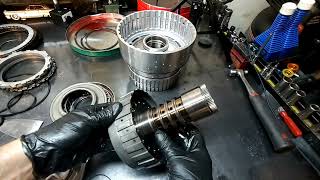
- CDF Clutch Cylinder Sleeve Movement: → Shop Automatic Transmission Coast Clutch Hub A significant and known issue where a sleeve inside the CDF (Clutch D/F) drum walks out of position, uncovering oil passages and causing a major hydraulic leak. This starves clutches of pressure, causing erratic shifts, flares, and eventually setting codes like P2702. TSB 23-2250 includes instructions to inspect for this. The fix requires transmission removal and replacement of the CDF drum with an updated part that has a machined lip to prevent the sleeve from moving. 🎬 See what a failed CDF drum looks like inside.
- Worn Internal Transmission Components: → Shop Transmission Assembly Although less common than a valve body issue, a worn or burnt 'C' clutch pack or failing internal seals can cause this code. This is usually indicated by finding excessive metal or clutch material in the transmission fluid pan.
Diagnosis Steps
- Scan the TCM for all stored diagnostic trouble codes and review freeze frame data to see the conditions under which the code was set.
- Check for any available Technical Service Bulletins (TSBs). TSB 23-2250 is the most current and comprehensive bulletin for this issue.
- Follow the diagnostic procedure outlined in TSB 23-2250. This begins with checking for DTCs and vehicle build date.
- If directed by the TSB, reprogram the PCM/TCM to the latest calibration and perform the Adaptive Learning Drive Cycle.
- Adaptive Learning Drive Cycle: After clearing adaptive tables with a scan tool, warm the vehicle to operating temperature. Accelerate lightly (15% throttle) so shifts 1-8 occur between 1300-1600 RPM. Continue to 55 mph to allow 9-10 shifts. Gently brake to a complete stop and hold for 5 seconds. Shift N-R-N-D with 1-2 second pauses. Repeat this entire drive/stop cycle 6 more times.
- If symptoms persist after the software update and relearn, the TSB directs the technician to overhaul the main control valve body.
- During the valve body service, the TSB also provides instructions to inspect the CDF clutch cylinder for sleeve movement. If movement is found, the transmission must be removed for CDF drum replacement.
- Check the transmission fluid level and condition. If the fluid is low, dark, or smells burnt, it indicates a problem that may require more than just a valve body.
Parts You'll Likely Need
- Main Control Valve Body
(OEM #JL3Z-7A100-B (superseded by JL3Z-7A100-D))— This is the most common point of failure for this code on the 10R80 transmission, as identified in multiple Ford TSBs.
Trusted brands: Motorcraft
OEM price range: $800-$1500
Aftermarket price range: $600-$1200 - Automatic Transmission Fluid and Filter Kit
(OEM #Fluid: XT-12-QULV (Motorcraft MERCON ULV))— Required for any service involving the valve body or as a first step if the fluid is old or contaminated. The 10R80 must use MERCON ULV fluid.
Trusted brands: Motorcraft
OEM price range: $150-$250
Aftermarket price range: $100-$180 - CDF Clutch Drum Assembly
(OEM #L1MZ-7H351-B)— If the internal sleeve has shifted, the entire drum must be replaced with the updated version. This is a major repair requiring transmission removal.
Trusted brands: Motorcraft
OEM price range: $300-$500
Related Codes That Often Appear With This One
- P0751 - P0772 — These codes relate to the performance of other shift solenoids (A, B, D, E, F). They are frequently stored alongside P2702 as part of the same fault condition described in Ford's TSBs. [TSB 26-2046, TSB 22-2428, TSB 25-2018, TSB 24-2254]
- P0729 - P0736 — These codes indicate incorrect gear ratios. They are triggered when the TCM detects a slip (a mismatch between engine RPM and output shaft speed) in various gears, which is a direct consequence of the clutch apply time issue. [TSB 26-2046, TSB 22-2428, TSB 25-2018, TSB 24-2254]
Technical Service Bulletins (TSBs) & Recalls
- TSB 26-2046: Mentions P2702 in a list of DTCs related to transmission issues in 2021 models.
- TSB 22-2428: Lists P2702 with other codes for harsh/delayed shifts. This TSB was later superseded by 23-2250.
- TSB 25-2018: Cites P2702 in relation to harsh/delayed shifts for 2019 models.
- TSB 24-2254: Groups P2702 with other transmission codes for shift quality issues in 2021 models.
- TSB 23-2250: Supersedes previous TSBs (like 22-2428), identifying the cause as potential software issues, sticking valves in the main control body, or CDF clutch cylinder sleeve movement. This is the primary guiding document for diagnosis.
- TSB 23-2123: Provided a detailed service procedure to overhaul the main control valve body to correct the harsh shifting conditions associated with P2702. This TSB's procedures were largely integrated into the more comprehensive TSB 23-2250.
Platform-Specific Known Issues
- Ford has issued multiple TSBs, with TSB 23-2250 being the most current, for 2018-2023 Mustangs with the 10R80 transmission that exhibit harsh/delayed shifts and store code P2702 among others.
- The TSB identifies three primary potential causes: outdated software, sticking valves in the main control valve body, and axial movement of the CDF clutch cylinder sleeve.
- The official Ford repair procedure is a step-by-step process: first, attempt a PCM/TCM software update and adaptive learning drive cycle. If that fails, the next step is to overhaul the main control valve body. During this process, an inspection for CDF drum sleeve movement is required.
Mechanic-Grade Diagnostic Values
- Shift Solenoid (A-F) Resistance — expected: 5.0 - 5.4 Ohms at 20°C (68°F). Failure: Readings outside this range indicate a faulty solenoid coil.
- Torque Converter Clutch (TCC) Solenoid Current — expected: Proportional operation: Low current (approx. 50 mA) results in low pressure; high current (approx. 850 mA) results in high pressure.. Failure: Current readings that do not correspond with commanded pressure or are stuck at one end of the range.
- Line Pressure Control (LPC) Solenoid Current — expected: Inversely proportional operation: Low current (approx. 50 mA) results in high pressure; high current (approx. 850 mA) results in low pressure.. Failure: Current readings that do not correspond with commanded pressure or are stuck at one end of the range.
Scan Tool Commands That Help
- Ford IDS / FORScan: Clear Transmission Adaptive Tables — This is a mandatory step after any transmission repair, software update, or as a first diagnostic step to see if learned bad habits are causing the issue.
- Ford IDS: Transmission Characterization / Solenoid Body Strategy — This function is required after replacing the main control valve body. It involves entering the 13-digit strategy number from the new valve body into the PCM/TCM to ensure correct solenoid operation.
- Ford IDS: PCM - Transmission Accelerated Main Control Break In — Mentioned in TSB 20-2403, this is a guided routine to help new valve body components break in and adapt more quickly than a standard drive cycle.
- FORScan: Stop Use of Transmission Adaptive — Some owners have used this function to prevent the transmission from re-learning the harsh shift behavior after clearing the adaptive tables, reporting smoother long-term performance.
Wiring & Ground Locations
- C175T — This is the designator for the main Powertrain Control Module (PCM) connector, typically located on the firewall.. While pinouts vary by engine and year, knowing this connector ID is the starting point for any circuit testing between the PCM and the transmission harness for issues like opens, shorts, or high resistance.
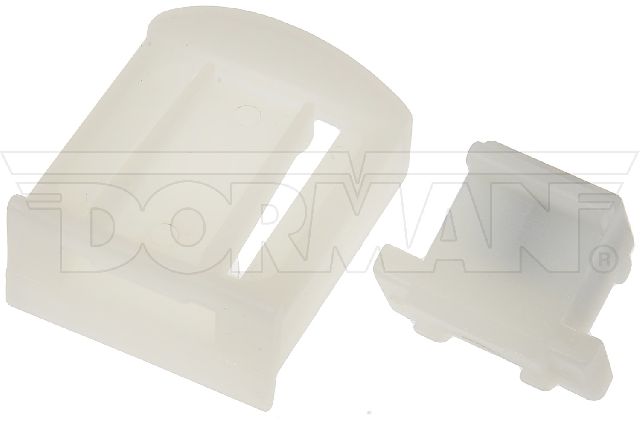
- Internal Transmission Harness Connector — Located on the transmission case where the main vehicle harness connects.. This connector can be difficult to release. It has a red locking tab that must be pulled out, followed by lifting a white lever to disengage. Applying excessive force can break the lever, complicating service.
Real Owner Repair Stories
- Reddit user in r/Mustang (2018 Mustang GT, out of warranty) — Rough, clunky, lurching shifts in Sport mode, particularly in gears 1-5, since the vehicle was new.
❌ Tried (didn't work) Living with the issue after being told it was 'normal aggressive shift tuning'.
✅ What actually fixed it The owner used a FORScan OBD adapter to first run the 'Clear Transmission Adaptive Tables' function, and then immediately ran the 'Stop Use of Transmission Adaptive' function. They reported a 'night and day' difference, with Sport mode becoming smooth for daily use.
When the Usual Fixes Don't Work
- While software updates and adaptive learning resets are the first steps in the official diagnostic procedure, they often provide only temporary relief if at all. Many owners and technicians report that the harsh shifting symptoms return quickly. This is because the root cause is frequently a mechanical or hydraulic issue, such as sticking valves in the main control body or the migrating sleeve in the CDF drum. The software cannot compensate for a physical blockage or a major hydraulic leak, making the mechanical repair (valve body or CDF drum replacement) the ultimate and permanent solution.
OEM Part Supersession History
JL3Z-7A100-B→JL3Z-7A100-D— The updated part likely contains revised valves or solenoids to address the sticking issues outlined in Ford's TSBs.Unknown (Original design CDF Clutch Drum)→L1MZ-7H351-B— The new CDF drum assembly features a machined lip that acts as a hard stop, preventing the internal bushing/sleeve from 'walking' out of position and causing hydraulic leaks.
Heads up: This is the mandatory replacement part for any vehicle experiencing the CDF drum sleeve failure.
Model Year Variations Within This Range
- 2018 - Late 2022: Vehicles produced before approximately December 23, 2022, are more likely to have the original CDF drum design, which is prone to the internal sleeve walking out. Vehicles produced after this date are more likely to have the revised drum from the factory.
- 2017-2020: A software bug existed in Ford IDS version 122.05 that could cause an 'Unable To Communicate With The Module' error when performing the 'Transmission Characterization/Solenoid IDN' procedure. A temporary workaround required uninstalling IDS and using the older v122.01 to complete the programming.
Helpful Videos

We Have This Part in Stock


The information in this article is provided for general reference and educational purposes only. Vehicle specifications, procedures, and part compatibility can vary by production date, trim level, and region. Always consult your vehicle's factory service manual and verify part numbers before purchasing or performing repairs. Safety-critical components such as airbags, seat belts, and braking systems should be installed by a qualified professional.
- Ford MUSTANG:
- 🧭 Diagnostic Flowchart
- 🎬 Helpful Videos
- 🛍️ Shop This Part
- What's Unique About the 2018-2023 Ford MUSTANG
- Symptoms You May Notice
- Most Likely Causes
- Rare But Worth Checking
- Diagnosis Steps
- Parts You'll Likely Need
- Related Codes That Often Appear With This One
- Technical Service Bulletins (TSBs) & Recalls
- Platform-Specific Known Issues
- Mechanic-Grade Diagnostic Values
- Scan Tool Commands That Help
- Wiring & Ground Locations
- Real Owner Repair Stories
- When the Usual Fixes Don't Work
- OEM Part Supersession History
- Model Year Variations Within This Range
- 🎟️ Get 5% Off