

P2703 on 2018-2023 Ford Mustang: Transmission Clutch 'D' Apply Time Fault Guide
On a 2018-2023 Ford Mustang, code P2703 indicates a problem with the 10R80 transmission's Clutch 'D' application time. This is often caused by a faulty main control valve body or a failing CDF drum. The fix typically involves overhauling or replacing the valve body, a complex job best left to professionals. In some cases, internal transmission work is required.
- P2703 on a 2018-2023 Mustang is a serious transmission code indicating a problem with a specific clutch's engagement time.
- The most likely cause is a faulty main control valve body, a known issue with the 10R80 transmission.
- Do not ignore this code. Continued driving can lead to severe transmission damage.
- This is not a DIY-friendly repair. Seek professional service from a qualified transmission shop or a Ford dealership.
- Ensure any repair includes using the correct Motorcraft MERCON ULV transmission fluid and performing the adaptive learning procedure.
What's Unique About the 2018-2023 Ford MUSTANG
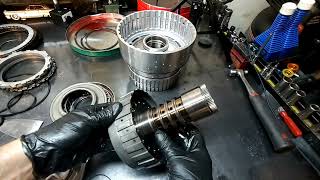
The 2018-2023 Mustang uses the 10-speed 10R80 automatic transmission, co-developed by Ford and GM. This transmission is known for its complexity and has been the subject of numerous Technical Service Bulletins (TSBs) for harsh or delayed shifting. 🎬 Watch: A Ford technician explains these common 10-speed issues. Code P2703 is frequently linked to these known issues, often pointing towards problems within the main control valve body, such as sticking valves made of soft aluminum alloy or cross-leaks in the separator plate. Another major, well-documented failure point is the C-D-F clutch drum assembly, where a bushing can walk out of place, causing a loss of hydraulic pressure to half the transmission.
Diagnostic Flowchart
Tap your situation to follow the diagnostic path that matches what you're seeing on this vehicle.
Symptoms You May Notice
- Harsh, clunky, or delayed gear shifts.
- Transmission slipping, where engine RPMs flare up without an increase in vehicle speed.
- Vehicle entering "Limp Mode," often stuck in a single gear.
- Illuminated Malfunction Indicator Lamp (Check Engine Light).
- A feeling of the transmission shuddering or jerking.
- Sudden, unexpected downshift from a high gear (like 10th) to a very low gear (like 1st) at highway speeds.
- Delayed engagement when shifting from Park to Drive.
- Replacing only the input or output speed sensors. While these sensors provide data, they are rarely the root cause of a specific clutch apply-time fault like P2703.
- Assuming a fluid flush will fix the problem. If the fluid is burnt, it's a symptom of a larger issue like clutch wear or a failing CDF drum, and simply changing the fluid won't resolve the root cause.
Most Likely Causes
- Faulty Main Control Valve Body 🔴 High Probability → Shop Transmission Valve Body The 10R80 transmission is known for issues with sticking valves or faulty solenoids within the valve body, as documented in multiple Ford TSBs. The valves are made from a low-cost aluminum alloy susceptible to bore wear, and the separator plate can cause unfavorable oil flow, leading to hydraulic leaks and pressure loss.
How to confirm: A technician will use a high-end scan tool to monitor solenoid performance and hydraulic pressures. The ultimate confirmation is often visual inspection of the valve body for sticking valves, contamination, or performing a vacuum test on the valve bores.
Typical fix: Overhaul or complete replacement of the main control valve body assembly. Ford TSBs often recommend overhauling the valve body as the primary solution.
Est. part cost: $800-$1500 - Low or Contaminated Transmission Fluid 🟡 Medium Probability → Shop Transmission Assembly The 10R80 transmission is very sensitive to fluid level and condition. It requires a specific fluid, Motorcraft MERCON ULV. Using the wrong fluid or running it low, which can happen as many of these transmissions were found to be underfilled from the factory, can cause hydraulic pressure issues.
How to confirm: Check the transmission fluid level and condition according to the manufacturer's procedure. The fluid should be clean and at the correct level. Burned-smelling or dark fluid indicates a problem.
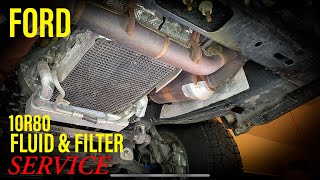
Typical fix: Perform a transmission fluid and filter change using only the specified Motorcraft MERCON ULV fluid. If the fluid is heavily contaminated, a full flush may be needed, but this may not solve an underlying mechanical issue.
Est. part cost: $150-$300 - Worn Internal Friction Elements (Clutch Pack 'D') ⚪ Low Probability While less common than valve body issues, internal wear can occur, especially on higher mileage or aggressively driven vehicles. Aftermarket companies offer upgraded single-sided clutch packs for the 'D' clutch to improve durability and heat resistance.
How to confirm: This is typically diagnosed after all other possibilities (fluid, valve body, software) have been ruled out. It requires a complete transmission teardown and inspection.
Typical fix: A complete transmission rebuild, including the replacement of the worn clutch packs, seals, and other internal components.
Est. part cost: $500-$1200 (for rebuild kit) - TCM Software/Calibration Issue ⚪ Low Probability Ford has issued software updates to address the adaptive learning strategy of the transmission, which can sometimes fail to adapt to normal hardware break-in. A reset of the adaptive learning tables is a common first step, but often does not solve a persistent mechanical or hydraulic fault.
How to confirm: A Ford dealership or qualified shop can check if the vehicle's Powertrain Control Module (PCM) or TCM has the latest software calibration.
Typical fix: Reprogramming the PCM/TCM with the latest software update and performing an adaptive learning drive cycle.
Est. part cost: $0-$200 (labor for reprogramming)
Rare But Worth Checking
- CDF Clutch Drum Failure: → Shop Transmission Clutch Pressure Plate
Diagnosis Steps
- Verify the code with a professional OBD-II scanner capable of reading transmission data.
- Check the transmission fluid level and condition. Ensure it is clean, full, and does not smell burnt. Use only Motorcraft MERCON ULV fluid. Many vehicles were underfilled from the factory.
- Check for any available Technical Service Bulletins (TSBs) related to your vehicle's VIN. Several TSBs exist for this issue, with the primary fix being a valve body overhaul.
- Use a scan tool to check for software updates for the PCM/TCM. If available, perform the update and reset the transmission adaptive learning tables.
- Perform a complete diagnostic scan to check for other related transmission codes, as they often appear in groups.
- With an advanced scan tool, command the clutch solenoids on and off to test their function and monitor apply times.
- If symptoms persist and TSBs suggest it, inspect and test the main control valve body for sticking valves or failed solenoids. This may involve vacuum testing the valve bores.
- If the valve body is confirmed to be good, the next likely culprit is the CDF drum. This requires transmission removal and disassembly to check for a walked bushing or other internal damage.
Parts You'll Likely Need
- Main Control Valve Body
(OEM #L1MZ-7A100-K)— This is the most frequent cause of P2703 and related shift quality issues in the 10R80 transmission, as identified in multiple Ford TSBs. The original part L1MZ-7A100-A has been superseded multiple times.
Trusted brands: Motorcraft
OEM price range: $800-$1500
Aftermarket price range: $600-$1200 - Automatic Transmission Fluid
(OEM #XT-12-QULV)— The transmission requires this specific Ultra-Low Viscosity (ULV) fluid. A fluid and filter change is a necessary step during diagnosis and repair.
Trusted brands: Motorcraft
OEM price range: $15-$25 per q
Related Codes That Often Appear With This One
- P2700 — Relates to Transmission Friction Element 'A' and indicates a broader issue within the transmission's hydraulic control system.
- P2701 — Relates to Transmission Friction Element 'B', often set alongside other friction element codes due to a systemic problem like a faulty valve body or low fluid.
- P2702 — Relates to Transmission Friction Element 'C', pointing to a widespread shifting problem.
- P2704 — Relates to Transmission Friction Element 'E'. The provided TSBs from NHTSA frequently group P2703 with P2704 and many others, indicating a common cause, usually the main control valve body or CDF drum failure. [TSB 26-2046, TSB 22-2428, TSB 25-2018, TSB 24-2254, TSB 23-2123].
Technical Service Bulletins (TSBs) & Recalls
- TSB 26-2046: Mentions P2703 in a long list of DTCs related to transmission issues in 2021 models.
- TSB 22-2428: Lists P2703 among DTCs for shift quality issues in 2020 models.
- TSB 25-2018: Cites P2703 as a possible code for harsh or delayed shifts in 2019 models.
- TSB 24-2254: Includes P2703 in a group of codes related to shift issues.
- TSB 23-2123: Supersedes previous TSBs, covering 2018-2021 Mustangs, and recommends overhauling the main control valve body for a list of codes including P2703.
- TSB 24-2046: A significant TSB that identifies three main causes for shift issues: solenoid strategy, sticking valves in the main control body, and axial movement of the CDF clutch cylinder sleeve.
Platform-Specific Known Issues
- Multiple TSBs (including TSB 23-2123, 22-2428, and 24-2046) have been issued by Ford for harsh/delayed shifts on the 10R80 transmission, listing P2703 as a potential code. The common prescribed fix is to first check software, then overhaul or replace the main control valve body and perform an adaptive learning drive cycle. If issues persist, TSBs point toward internal inspection for issues like a failed CDF clutch cylinder.
- Owner experiences on forums like Mustang6G.com frequently describe dealers replacing the valve body to fix shifting issues, sometimes with recurring problems, indicating a deeper issue like the CDF drum. One user on an F-150 forum with P2703 described a sudden downshift from 10th to 1st gear, with the shop quoting a full replacement due to burnt fluid, ultimately opting for a rebuild with upgraded CDF parts for $6500.
Mechanic-Grade Diagnostic Values
- Shift Solenoid Resistance — expected: 5.0 - 5.4 Ohms at 68°F (20°C). Failure: A reading outside this range indicates a faulty solenoid coil.
Scan Tool Commands That Help
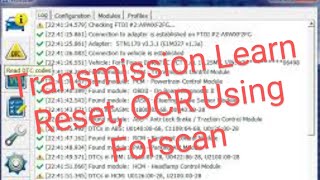
- Ford IDS, FORScan, or equivalent: Clear Transmission Adaptive Tables / Reset KAM — This function should be used after a transmission repair, fluid change, or when addressing shift quality complaints. It erases the learned shift strategy, forcing the TCM to relearn. A specific, multi-step drive cycle must be performed afterward for the relearn to be effective.
- Ford IDS: Transmission Characterization / Solenoid IDN — This is a critical function required when replacing the valve body or the entire transmission. The technician must input the 13-digit solenoid body strategy number (etched on the valve body) into the TCM. Failure to do so will result in improper transmission operation and potential damage.
- Ford IDS, FORScan, or equivalent: Halt Transmission Adaptive Learning — Some users with modified vehicles or persistent shift quality issues choose to disable the adaptive learning feature. This can provide more consistent shift feel but may mask underlying mechanical problems and is generally not recommended by Ford.
Wiring & Ground Locations
- Main Engine/Chassis Grounds — On the S550 Mustang, the primary engine-to-chassis grounds are located on the studs of the driver's side motor mount.. While not a direct cause of a specific clutch fault, poor grounds can cause a wide range of unpredictable electronic issues, including erratic sensor readings and TCM communication problems. Ensuring these main grounds are clean and tight is a fundamental step in any electrical diagnosis.
- Passenger Compartment Ground Stud — Underneath the glove box area, there is a threaded M6 stud on a transverse steel bar that serves as a factory ground point.. This ground location is relevant for the Body Control Module (BCM) and other interior electronics. While less likely to cause a P2703 code directly, verifying all cabin grounds is good practice when chasing intermittent electrical faults.
- Trunk Ground Point — Behind the rearmost interior trunk panel, there is a factory ground point used for various rear-body electronics.. This ground is not directly related to the powertrain control system but is useful to know for overall vehicle electrical health.
Real Owner Repair Stories
- Mustang6G.com forum user (2019 Ford Mustang EcoBoost) — Harsh shifting and other unspecified transmission issues.
❌ Tried (didn't work) Initial dealer visit claimed everything was normal.
✅ What actually fixed it A second dealership replaced the transmission valve body and reflashed the computer, which resolved the issue for about a month before it returned. The final resolution was not posted. - Mustang6G.com forum user (2018 Ford Mustang GT (Boosted)) — Started with a 5-6 shift flare at light throttle, progressed to hard 3-4 downshifts, and rapid 3-4-3-4 hunting in drag mode.
❌ Tried (didn't work) The user replaced the valve body which cost $1,325 total. This did not provide a permanent fix.
✅ What actually fixed it The transmission ultimately failed completely a week after the valve body replacement, indicating the root cause was a more severe internal mechanical failure (likely the CDF drum or clutches) that the valve body replacement could not solve. - Reddit user on r/f150 (2019 F-150 Lariat 2.7L 4x4) — Delayed engagement (2-3 seconds) when shifting from Park to Drive/Reverse. Previously had harsh up/downshifts fixed by a TSB.
❌ Tried (didn't work) After the CDF drum was replaced, the engagement delay was fixed, but the truck developed a new issue: very hard shifts into 3rd gear. The valve body assembly was then replaced.
✅ What actually fixed it The user reported that even after the valve body replacement, the hard shifting persisted until the transmission was warm. The user was dissatisfied and considering getting rid of the truck, implying the combination of CDF drum and valve body replacement did not fully resolve the drivability issues.
OEM Part Supersession History
L1MZ-7A100-A→L1MZ-7A100-E, then L1MZ-7A100-K— Revisions to address valve body issues like sticking valves and cross-leaks that cause shift quality problems and DTCs.
Heads up: The latest part number, L1MZ-7A100-K, is the recommended replacement for all earlier versions.
Model Year Variations Within This Range
- 2018-approx 2021: Early production 10R80 transmissions were more susceptible to the CDF drum bushing 'walking' out of place. Ford later introduced an updated drum with a machined lip to physically prevent the bushing from moving. While a 2022 or 2023 model can still experience valve body failure, the likelihood of the original CDF drum design flaw is lower compared to an early 2018 model.
Helpful Videos



We Have This Part in Stock


The information in this article is provided for general reference and educational purposes only. Vehicle specifications, procedures, and part compatibility can vary by production date, trim level, and region. Always consult your vehicle's factory service manual and verify part numbers before purchasing or performing repairs. Safety-critical components such as airbags, seat belts, and braking systems should be installed by a qualified professional.
- Ford MUSTANG:
- 🧭 Diagnostic Flowchart
- 🎬 Helpful Videos
- 🛍️ Shop This Part
- What's Unique About the 2018-2023 Ford MUSTANG
- Symptoms You May Notice
- Most Likely Causes
- Rare But Worth Checking
- Diagnosis Steps
- Parts You'll Likely Need
- Related Codes That Often Appear With This One
- Technical Service Bulletins (TSBs) & Recalls
- Platform-Specific Known Issues
- Mechanic-Grade Diagnostic Values
- Scan Tool Commands That Help
- Wiring & Ground Locations
- Real Owner Repair Stories
- OEM Part Supersession History
- Model Year Variations Within This Range
- 🎟️ Get 5% Off