

P2703 on 2020-2023 Lincoln Aviator: Transmission Apply Time Fault Causes & Fixes
On a 2020-2023 Lincoln Aviator, code P2703 almost always points to an internal transmission problem, most commonly sticking valves in the main control valve body. This is a known issue with the 10R80 transmission, addressed by multiple Ford/Lincoln TSBs. This is not a DIY fix and typically requires professional service, with costs for a valve body replacement often exceeding $1,500. In some cases, a more severe internal failure of the CDF drum may be the cause, leading to a full transmission reb
- P2703 on a 2020-2023 Aviator is a serious transmission code indicating a clutch timing failure.
- The most likely cause, confirmed by Lincoln's own service bulletins, is a faulty main control valve body inside the transmission.
- This is not a DIY repair. It requires professional diagnosis and specialized service.
- Do not ignore this code. Driving with these symptoms can lead to much more severe and expensive internal transmission damage.
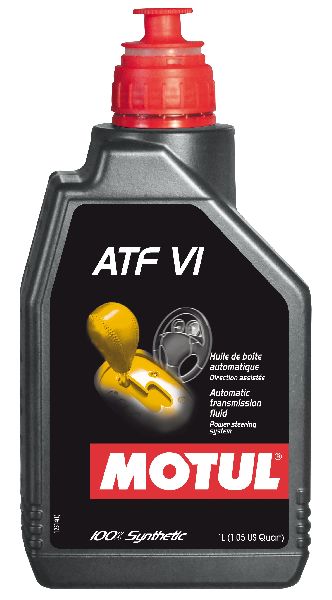
- Ensure any repair shop uses the correct Motorcraft MERCON ULV transmission fluid, as using the wrong fluid can cause further issues.
What's Unique About the 2020-2023 Lincoln AVIATOR
The 2020-2023 Aviator uses the Ford 10R80 10-speed automatic transmission, which is known for specific vulnerabilities. Unlike a simple sensor failure, P2703 on this platform is frequently a symptom of a known mechanical or hydraulic issue. Lincoln has issued multiple Technical Service Bulletins (TSBs) that directly link this code to sticking valves within the transmission's main control valve body, confirming this is a recognized pattern of failure for this specific transmission. Another widely documented failure point for the 10R80 is the CDF drum, where an internal bushing can walk out of place, causing a catastrophic pressure loss and erratic shifting.
Diagnostic Flowchart
Tap your situation to follow the diagnostic path that matches what you're seeing on this vehicle.
Symptoms You May Notice
- Harsh, jerky, or clunky gear shifts.
- Delayed engagement when shifting into Drive or Reverse.
- Sudden, violent downshifts, sometimes to a very low gear at highway speeds.
- Transmission slipping, where the engine revs up without a corresponding increase in speed.
- Illuminated Malfunction Indicator Lamp (Check Engine Light) or Wrench Light.
- Vehicle may enter 'Limp Mode' to prevent further damage.
- A 'rumble strip' vibration felt between 40-60 mph, which can indicate torque converter shudder.
- Replacing a single shift solenoid when the entire valve body is faulty or clogged. The solenoids are often not the point of failure; the valves within the body are.
- Assuming the entire transmission needs to be replaced without first diagnosing the more common and less expensive valve body issue.
- Performing only a fluid change when there are clear symptoms of mechanical failure. Fresh fluid will not fix a failed CDF drum or a stuck valve.
Most Likely Causes
- Sticking Valves in the Main Control Valve Body 🔴 High Probability → Shop Transmission Valve Body This is a well-documented issue for the 10R80 transmission. Lincoln TSBs like 21-2434, 22-2102, and 24-2046 explicitly state this as the cause for P2703 and a host of other transmission codes. Debris or manufacturing tolerances can cause valves to stick.
How to confirm: A technician will follow TSB procedures, which may first involve using a diagnostic tool (like Ford's FDRS) to run a 'Transmission Accelerated Main Control Break In' routine up to 3 times to try and free the sticking valves. If this fails, the valve body requires replacement.
Typical fix: Replacement of the entire main control valve body assembly. After installation, the new solenoid body strategy information that comes with the part must be programmed into the PCM, followed by a transmission adaptive learning drive cycle.
Est. part cost: $700-$1200 - Internal CDF Drum Failure 🟡 Medium Probability The 10R80 transmission has a known design weakness in the CDF (Clutch C-D-F) drum, where an internal bushing can move or 'walk' out of place. This uncovers a fluid passage, causing a major hydraulic pressure leak that affects clutch application and leads to erratic shifting and codes like P2703. TSB 24-2101 also addresses this specific failure.
How to confirm: This requires a complete transmission teardown and inspection by a qualified technician. The failure is visually obvious once the drum is removed, as the sleeve will have slid down, exposing oil holes. A technician can also verify the hydraulic leak per TSB 24-2252 using a special pressure transducer kit.
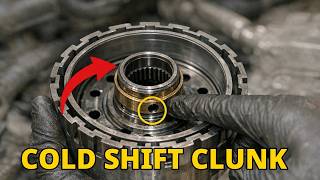
Typical fix: The transmission must be removed and disassembled to replace the faulty CDF drum. Ford has released updated versions of the drum (such as L1MZ-7H351-B) with a machined lip to prevent the sleeve from moving, 🎬 See how the updated CDF drum fixes the bushing issue. which is considered a permanent fix. This repair is often part of a full transmission rebuild.
Est. part cost: $300-$500 (part only, labor is extensive) - Low or Degraded Transmission Fluid ⚪ Low Probability → Shop Transmission Assembly While less likely to be the root cause on its own, low or burnt fluid can cause or exacerbate shifting problems. A sudden failure like a violent downshift often results in burnt fluid, which is a symptom of a larger mechanical failure rather than the cause. The 10R80 does not have a traditional dipstick, so checking the fluid is a service procedure.
How to confirm: A technician must check the fluid level and condition via the check/fill plug on the transmission case, following a specific temperature and vehicle level procedure. Dark, burnt-smelling fluid indicates significant internal wear.
Typical fix: Perform a transmission fluid and filter change using the correct Motorcraft MERCON ULV fluid. This is often a first step but is unlikely to solve a P2703 code if a mechanical fault like a bad valve body or CDF drum exists.
Est. part cost: $150-$300
Rare But Worth Checking
- Faulty Powertrain Control Module (PCM) or Software: While less common than mechanical issues, a software glitch can cause shifting problems. TSB 20-2354 addresses harsh shifting on some Aviator hybrids via a PCM reprogram, showing that software can be a factor. A faulty module is also a possibility, but all mechanical causes should be ruled out first.
Diagnosis Steps
- Check for and document all stored DTCs in the PCM and TCM. Note any other transmission-related codes.
- Check for any applicable TSBs (e.g., 21-2434, 22-2102, 24-2252) based on the vehicle's VIN and build date.
- If a TSB for sticking valves applies, use a professional scan tool (Ford FDRS) to perform the 'PCM - Transmission Accelerated Main Control Break In' routine as specified in the TSB. This may resolve the issue without parts replacement.
- If the break-in routine fails or does not apply, check the transmission fluid level and condition. This requires the vehicle to be level and the transmission at a specific operating temperature.
- Inspect the transmission electrical connector and wiring harness for any signs of damage, corrosion, or loose connections.
- If fluid and wiring are okay, the next step is to drop the transmission pan to inspect for excessive metal debris and gain access to the valve body. Glitter in the pan points to planetary or clutch steel wear.
- If the valve body is suspected per the TSBs, it is replaced as an assembly. The new solenoid strategy must be programmed into the PCM.
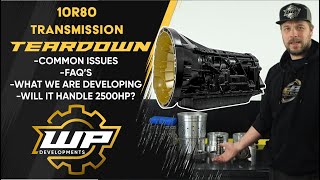
- If problems persist or symptoms were extremely severe (e.g., violent shifts, significant debris), a full transmission teardown is required to inspect 🎬 Watch: A complete teardown and inspection of the 10R80 transmission. internal components like the CDF drum and clutch packs for failure.
Parts You'll Likely Need
- Automatic Transmission Main Control Valve Body
(OEM #L1MZ-7A100-C (Note: Part numbers for the 10R80 valve body are frequently superseded. Examples include JL3Z-7A100-B, JL3Z-7A100-D. Always verify with VIN.))— This is the most common cause of P2703 on this vehicle, as identified in multiple manufacturer TSBs. It contains the solenoids and valves that direct hydraulic fluid.
Trusted brands: Motorcraft
OEM price range: $800-$1200
Aftermarket price range: $600-$900 - Automatic Transmission Fluid and Filter Kit
(OEM #XT-12-QULV (Fluid), L1MZ-7A098-A (Filter for 10R80))— Required for any service involving the valve body or internal transmission components. Using the correct Ford/Motorcraft MERCON ULV fluid is critical for the 10R80 transmission.
Trusted brands: Motorcraft
OEM price range: $150-$250
Aftermarket price range: $100-$180
Related Codes That Often Appear With This One
- P2700, P2701, P2702, P2704, P2705 — These codes relate to the apply time of other friction elements (A, B, C, E, F). Their presence alongside P2703 strongly suggests a systemic hydraulic issue, such as the valve body or CDF drum, rather than an isolated clutch problem.
- P0729, P0731-P0736 — These are gear ratio error codes. They indicate the transmission is slipping in a specific gear, which is a direct consequence of a clutch failing to apply correctly—the root issue that P2703 also points to. TSBs for the valve body issue list these codes alongside P2703.
Technical Service Bulletins (TSBs) & Recalls
- TSB 21-2434: Cites P2703 as potentially being caused by sticking valves in the main control valve body for 2020-2022 Aviators. It prescribes a 'break-in' routine before resorting to overhauling the valve body.
- TSB 22-2102: Also identifies sticking valves in the main control valve body as a cause for P2703 and other codes, providing a similar diagnostic procedure to TSB 21-2434.
- TSB 20-2403: An earlier TSB for 2020 models that also points to sticking valves in the main control valve body as the cause for P2703 and other shift-related DTCs.
- TSB 23-2250 / 22-2428: Superseding bulletins that cover a wide range of 10R transmissions and list P2703. They address harsh/delayed shifts caused by software, sticking valves, or CDF drum issues.
Platform-Specific Known Issues
- Multiple Technical Service Bulletins (TSBs), including TSB 21-2434 and TSB 22-2102, have been issued by the manufacturer for the 2020-2023 Aviator, indicating that a range of transmission codes, including P2703, can be caused by sticking valves in the main control valve body.
- The 10R80 transmission in these vehicles is also known for a failure in the CDF drum, where a bushing can migrate and cause internal hydraulic leaks, leading to shifting problems and related codes.
- TSB 20-2403 notes that for some 2020 vehicles, the shifting condition may improve on its own and no longer be present after the first 5,000 miles (8,000 km) of driving as the transmission adapts. However, this is less likely for a persistent code like P2703.
Mechanic-Grade Diagnostic Values
- Shift Solenoid Resistance — expected: 5.0 - 5.4 ohms at 68°F (20°C). Failure: A reading outside this range indicates a faulty solenoid coil.
- D-Clutch Apply Time — expected: Typically 150-250 milliseconds. Failure: Values significantly outside this range, such as over 500ms or under 100ms, will trigger the P2703 code.
Scan Tool Commands That Help
- FORScan: Clear Transmission Adaptive Tables — This service procedure resets the transmission's learned shift patterns. It can be used as a first step to see if harsh shifting is due to learned behavior rather than a hard mechanical fault. It is often required after a repair.
- FORScan: Stop Use of Transmission Adaptive / Halt Transmission Adaptive Learning — Some owners use this function to disable the adaptive learning feature entirely, reporting that it provides more consistent shift quality, especially if the learning process is causing undesirable behavior. This is not a factory-recommended repair but a user-driven modification.
- Ford FDRS: PCM - Transmission Accelerated Main Control Break In — This is a dealer-level function specified in TSBs for sticking valves. It cycles the solenoids to attempt to free them without disassembly. This should be performed before replacing the valve body.
Wiring & Ground Locations
- Main Transmission Case Connector — On the exterior of the transmission case, where the main vehicle harness connects to the transmission's internal wiring.. This 32-pin connector is the single point for all electronic commands to the transmission, including power and control signals for the shift solenoids (like the 'D' solenoid). Corrosion or a loose connection here can interrupt signals and cause apply time faults. Pin 26 is specifically listed as the ground control for Shift Solenoid D.
Real Owner Repair Stories
- Reddit user in r/f150 (2019 Ford F-150 with 128k miles) — Truck violently downshifted on the highway, then the transmission was 'all over the place'. Scanned and found code P2703. Fluid smelled burnt.
❌ Tried (didn't work) Disconnecting the battery to reset the computer. The truck ran great for 30 miles, then the issue returned.
✅ What actually fixed it The owner was quoted $9,800 for a full replacement by one shop. A local transmission shop diagnosed it as a common 10R80 failure and performed a rebuild, including the updated CDF drum parts, for $6,500.
OEM Part Supersession History
Unknown early versions→L1MZ-7H351-B (CDF Clutch Cylinder)— The original CDF drum design allowed an internal bushing/sleeve to 'walk' out of position, uncovering hydraulic passages. The updated part has a machined lip that acts as a hard stop, preventing the sleeve from moving.
Model Year Variations Within This Range
- 2020-2022 (built on or before 15-Aug-2022): Vehicles built in this range are more susceptible to the CDF clutch cylinder sleeve movement. TSB 24-2252 specifically calls out this date range for inspection and potential replacement of the CDF drum with the updated part if hydraulic leaks are found.
Helpful Videos

We Have This Part in Stock


The information in this article is provided for general reference and educational purposes only. Vehicle specifications, procedures, and part compatibility can vary by production date, trim level, and region. Always consult your vehicle's factory service manual and verify part numbers before purchasing or performing repairs. Safety-critical components such as airbags, seat belts, and braking systems should be installed by a qualified professional.
- Lincoln AVIATOR:
- 🧭 Diagnostic Flowchart
- 🎬 Helpful Videos
- 🛍️ Shop This Part
- What's Unique About the 2020-2023 Lincoln AVIATOR
- Symptoms You May Notice
- Most Likely Causes
- Rare But Worth Checking
- Diagnosis Steps
- Parts You'll Likely Need
- Related Codes That Often Appear With This One
- Technical Service Bulletins (TSBs) & Recalls
- Platform-Specific Known Issues
- Mechanic-Grade Diagnostic Values
- Scan Tool Commands That Help
- Wiring & Ground Locations
- Real Owner Repair Stories
- OEM Part Supersession History
- Model Year Variations Within This Range
- 🎟️ Get 5% Off