

P2703 on 2018-2023 Lincoln Navigator: Transmission Clutch 'D' Apply Time Fault
P2703 on a 2018-2023 Lincoln Navigator indicates a performance issue with an internal transmission clutch, often causing harsh or delayed shifts. The most common cause is a known issue with the CDF clutch drum assembly inside the 10R80 10-speed transmission, a repair that can cost several thousand dollars. This issue is widespread across many Ford and Lincoln models with this transmission.
- P2703 on a 2018-2023 Navigator is a serious code pointing to an internal transmission problem, not a simple sensor failure.
- The issue is very common on the 10R80 transmission and is well-documented in Ford's own service bulletins.
- The first step in diagnosis should be checking for software updates, but be prepared for a major mechanical repair.
- The most likely mechanical failure is the CDF clutch drum or the main valve body.
- This is not a DIY-friendly repair; it requires professional service and specialized knowledge.
What's Unique About the 2018-2023 Lincoln NAVIGATOR
The 2018-2023 Navigator uses the Ford 10R80 10-speed automatic transmission, which was co-developed with GM. This transmission has become notorious for a variety of shift quality issues, leading to numerous Technical Service Bulletins (TSBs) and multiple class-action lawsuits alleging the defect 🎬 Watch: A mechanic explains the four most common 10R80 failures. makes the vehicles unreasonably dangerous. A primary weak point identified in Ford's own TSBs is the CDF clutch drum, where a bushing can move out of place ("walk out"), causing a hydraulic pressure leak to the clutch pack and setting codes like P2703. This design flaw makes the Navigator and its platform mates (F-150, Expedition, etc.) particularly susceptible to this set of faults.
Diagnostic Flowchart
Tap your situation to follow the diagnostic path that matches what you're seeing on this vehicle.
Symptoms You May Notice
- Harsh, clunky, or delayed gear shifts, sometimes feeling like being rear-ended.
- Vehicle jerking or lunging during shifts, especially when cold or at low speeds.
- Illuminated Malfunction Indicator Lamp (Check Engine Light) or Wrench Light.
- Transmission slipping, flaring, or a feeling of power loss between gears.
- Sudden, unexpected downshifts, in some cases from 10th gear to 1st gear at highway speeds.
- Hesitation or refusal to take off from a stop, as if stuck in a higher gear.
- Replacing only the transmission speed sensors. While speed sensors provide crucial data, the P2703 code is about the mechanical/hydraulic application time of a clutch, not typically the sensor itself. The sensors are often part of the molded leadframe, which may be replaced during a larger repair, but they are not the root cause of P2703.
- Assuming any harsh shift is 'normal'. While the 10R80 has some characteristic shifting behavior, dealers have sometimes dismissed legitimate complaints as normal operation. A persistent, repeatable harsh shift accompanied by a fault code is not normal.
Most Likely Causes
- Failed CDF Clutch Drum Assembly 🔴 High Probability → Shop Transmission Assembly A widely documented design flaw where a sleeve/bushing in the CDF clutch cylinder can move axially, uncovering a hydraulic port and causing a pressure loss. Ford issued multiple TSBs (like 24-2254) for this exact problem and introduced an updated part with a lip to prevent the sleeve from moving.
How to confirm: This is an internal component. A technician confirms this failure after ruling out software and valve body issues, often by performing a specific hydraulic pressure test outlined in TSB 24-2254. Final confirmation requires a complete transmission teardown, where grooves worn by the F-clutch into the drum may also be visible.
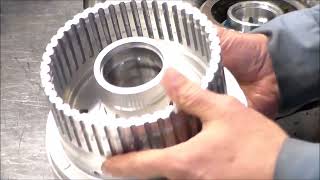
Typical fix: Replacement of the CDF clutch drum assembly with the updated part (OEM Part #: JL3Z-7H351-B). 🎬 Watch: See how the updated CDF clutch drum prevents failure. This is a major repair requiring transmission removal and disassembly.
Est. part cost: $400-$700 - Main Control Valve Body Failure 🟡 Medium Probability → Shop Transmission Valve Body Sticking valves or cross-leaks within the main control (valve body) are cited as a potential cause in Ford's TSBs for these symptoms. Debris in the fluid can cause valves to operate slowly or incorrectly, affecting clutch apply times.
How to confirm: A technician can perform pressure tests and solenoid function tests with a high-level scan tool. Sometimes a valve body replacement is performed as a diagnostic step before condemning the entire transmission.
Typical fix: Replacement of the entire main control valve body assembly. Part numbers vary by vehicle configuration (e.g., JL3Z-7A100-C for F-150/Expedition column shift, JL1Z-7A100-A for Expedition/Navigator electronic shift).
Est. part cost: $700-$1500 - Powertrain/Transmission Control Module (PCM/TCM) Software Issue 🟡 Medium Probability → Shop Transmission Assembly Ford has issued multiple TSBs that involve reprogramming the PCM or TCM to improve shift strategy and correct harsh shifting complaints. This is often the first step a dealer will take, as poor shift logic can mimic a mechanical fault.
How to confirm: A Ford/Lincoln dealership or a well-equipped independent shop can check the current software calibration against the latest available version using the Ford Diagnostic & Repair System (FDRS).
Typical fix: Reprogramming the PCM/TCM to the latest software version. This is often followed by a transmission adaptive learning drive cycle to allow the TCM to relearn clutch apply characteristics.
Est. part cost: $0 (if under warranty) - $250 - Low or Contaminated Transmission Fluid (ATF) ⚪ Low Probability → Shop Transmission Assembly While not specific to the Navigator, degraded fluid can cause hydraulic pressure issues in any automatic transmission. On the 10R80, fine metallic contamination can cause valves in the complex valve body to stick.
How to confirm: Checking the fluid level and condition on the 10R80 is complex as there is no traditional dipstick. It must be checked via a plug on the side of the transmission case while the fluid is at a specific temperature (typically 195-205°F).
Typical fix: Perform a transmission fluid drain-and-fill or flush using the correct Motorcraft MERCON ULV ATF. This is not a simple DIY job on this vehicle.
Est. part cost: $150-$400
Diagnosis Steps
- Check for any Technical Service Bulletins (TSBs) related to the vehicle's VIN. TSBs like 24-2254 are highly relevant and provide a specific diagnostic path.
- Use a professional scan tool (like Ford's FDRS) to check for the latest PCM/TCM software calibration. If outdated, reprogram the module(s) as the first step.
- Perform a transmission adaptive learning drive cycle as specified by Ford. This step is crucial after any software or hardware changes.
- Check the transmission fluid level and condition. This must be done at a specific temperature (195-205°F) using the fill plug on the transmission case. Low or burnt fluid indicates a larger problem.
- If TSB 24-2254 applies, perform the specified hydraulic pressure test using a pressure transducer kit to check for leaks in the CDF clutch circuit. This test will determine if the valve body or the CDF drum is the likely culprit.
- If the pressure test fails or if the TSB does not apply and other causes are ruled out, the next step is typically to inspect and/or replace the main control valve body.
- If the valve body replacement does not fix the problem, or if the pressure test directly condemned it, the transmission must be removed and disassembled to inspect and replace the CDF clutch drum assembly. 🎬 See this quick overview of the CDF drum replacement process.
Parts You'll Likely Need
- CDF Clutch Cylinder / Drum Assembly (Updated)
(OEM #JL3Z-7H351-B)— This is the most cited mechanical failure point for harsh shifting and related codes on the 10R80 transmission. The updated part has a lip to prevent the internal sleeve from walking out.
Trusted brands: Motorcraft
OEM price range: $400-$700
Aftermarket price range: $300-$500 - Main Control Valve Body Assembly
(OEM #JL1Z-7A100-A (For Navigator w/ Electronic Shift) or JL3Z-7A100-C (For column shift models))— Sticking valves in the valve body are another primary cause identified by Ford for these symptoms. Replacement is often the next step if a software update doesn't work.
Trusted brands: Motorcraft
OEM price range: $700-$1500
Aftermarket price range: $500-$1200 - Motorcraft MERCON ULV Automatic Transmission Fluid
(OEM #XT-12-QULV)— This is the only specified fluid for the 10R80 transmission. Using any other fluid can cause shifting issues and internal damage. A full service requires approximately 8-9 quarts for a drain and fill.
Trusted brands: Motorcraft
OEM price range: $15-$25 per quart
Related Codes That Often Appear With This One
- P0751 - P0772 — These codes relate to the performance of other shift solenoids (A, B, C, E, F). They often appear with P2703 because the underlying issue (valve body, CDF drum, software) affects multiple hydraulic circuits.
- P0729 - P0736 — These codes indicate incorrect gear ratios for gears 1 through 6. A slipping or slow-to-apply clutch (like the one indicated by P2703) can cause the transmission to register an incorrect gear ratio.
- P0766 — This code for 'Shift Solenoid D Performance/Stuck Off' is very commonly seen with P2703, as they both point to issues with the same hydraulic circuit.
Technical Service Bulletins (TSBs) & Recalls
- TSB 24-2254: Supersedes previous bulletins. Details a specific diagnostic procedure involving a hydraulic pressure test to isolate the fault between the valve body and the CDF clutch cylinder due to the known 'sleeve walking' issue.
- TSB 22-2428: An earlier, now superseded, bulletin that detailed the primary causes for harsh/delayed shifts, including software, the valve body, and the CDF clutch cylinder sleeve.
- TSB 20-2117: Addresses DTCs P0741 and P1744 on earlier 10R80 models due to a sticking torque converter clutch (TCC) valve in the main control valve body, recommending valve body replacement.
- TSB 23-2062: This TSB was investigated but found to be unrelated to the transmission; it concerns a rear seat backrest latching issue on the Ford Ranger.
Platform-Specific Known Issues
- Multiple TSBs (including TSB 22-2428, 24-2254) have been issued by Ford to address harsh/delayed shifting in the 10R80 transmission, specifically citing software, the main control valve body, and the CDF clutch cylinder sleeve as potential causes.
- Numerous consumer complaints and class-action lawsuits have been filed against Ford regarding the performance and reliability of the 10R80 transmission in vehicles including the Lincoln Navigator, F-150, and others.
Mechanic-Grade Diagnostic Values
- Shift Solenoid Resistance — expected: 5.0 - 5.4 ohms at 68°F (20°C). Failure: A reading outside of this range indicates a faulty solenoid coil.
Scan Tool Commands That Help
- Ford FDRS / FORScan: Clear Transmission Adaptive Tables — This function resets the transmission's learned shift strategy. It should be performed after any transmission repair, fluid change, or software update. It is often the first step in addressing shift quality complaints.
- Ford FDRS / FORScan: Transmission Adaptive Learning Drive Cycle — This is a specific, multi-step driving procedure that must be performed after clearing the adaptive tables to allow the TCM to relearn clutch fill times and shift pressures for smooth operation. Skipping this can result in the return of harsh shifting.
- FORScan: Stop Use of Transmission Adaptive Learning — Some owners, particularly those with modified vehicles or persistent issues, use this function to disable the adaptive learning feature entirely. This can provide a more consistent shift feel but prevents the transmission from adjusting to wear or different driving styles.
Wiring & Ground Locations
- Transmission Internal Connector C177, Pin 11 — This connector is located inside the transmission oil pan and connects the main control valve body to the internal wiring harness.. Pin 11, with a Brown/White wire, is the specific control circuit for Shift Solenoid D. A technician would test for continuity and voltage at this pin to diagnose a wiring issue within the transmission.
- Transmission Case Connector, Pin 26 — The main 34-pin connector on the outside of the transmission case where the external vehicle harness connects.. Pin 26 (BN-WH wire) is the ground control for Shift Solenoid D. Testing at this pin can help determine if a fault is in the external harness, the TCM, or inside the transmission itself.
- Engine Wiring Harness Chafe Points — Potential contact points include the ECM/TCM bracket, driver-side upper control arm, and shock tower.. While not a direct cause of P2703, a chafed engine harness can cause a wide range of erratic electronic behaviors, including communication errors with the TCM, which could potentially manifest as transmission fault codes. This is an edge case to consider if direct transmission diagnostics are inconclusive.
Real Owner Repair Stories
- f150forum.com user (2019 F-150 Lariat 2.7L 4x4) — Initially had harsh upshifts/downshifts. After a dealer reflash, it developed a 2-3 second delay when shifting from Park to Drive/Reverse.
❌ Tried (didn't work) A PCM/TCM reflash per a TSB only temporarily fixed the initial harsh shifting and led to a new symptom (delayed engagement).
✅ What actually fixed it The delayed engagement issue was fixed by replacing the CDF clutch drum under warranty. However, 900km later, a new symptom of a very hard shift into 3rd gear appeared, which was then addressed by replacing the main valve body assembly.
OEM Part Supersession History
HL3Z-7H351-A→JL3Z-7H351-A, then JL3Z-7H351-B— The original CDF clutch drum assembly was prone to an internal sleeve/bushing migrating out of position. The final revision, JL3Z-7H351-B, incorporates a machined lip to physically prevent the sleeve from moving, providing a permanent mechanical fix.Unknown→JL1Z-7A100-A— Supersession for the main control valve body for 2018-2021 Expedition/Navigator models with electronic floor shift. Revisions often address sticking valves or improve hydraulic performance.
Heads up: This part is specific to models with the electronic floor shifter. Column shift models use a different part number (e.g., JL3Z-7A100-C).
Model Year Variations Within This Range
- 2017 - Mid-2022: Vehicles produced before approximately August 2022 were built with the earlier design of the CDF clutch drum, which is prone to the bushing walking out and causing harsh shifts or engagement delays.
- 2018+: Ford's diagnostic software changed around 2018. Older vehicles use the Integrated Diagnostic System (IDS), while newer vehicles (2018+) use the Ford Diagnostic & Repair System (FDRS). A technician will use FDRS on a 2018-2023 Navigator.
Helpful Videos

We Have This Part in Stock


The information in this article is provided for general reference and educational purposes only. Vehicle specifications, procedures, and part compatibility can vary by production date, trim level, and region. Always consult your vehicle's factory service manual and verify part numbers before purchasing or performing repairs. Safety-critical components such as airbags, seat belts, and braking systems should be installed by a qualified professional.
- Lincoln NAVIGATOR:
- 🧭 Diagnostic Flowchart
- 🎬 Helpful Videos
- 🛍️ Shop This Part
- What's Unique About the 2018-2023 Lincoln NAVIGATOR
- Symptoms You May Notice
- Most Likely Causes
- Diagnosis Steps
- Parts You'll Likely Need
- Related Codes That Often Appear With This One
- Technical Service Bulletins (TSBs) & Recalls
- Platform-Specific Known Issues
- Mechanic-Grade Diagnostic Values
- Scan Tool Commands That Help
- Wiring & Ground Locations
- Real Owner Repair Stories
- OEM Part Supersession History
- Model Year Variations Within This Range
- 🎟️ Get 5% Off