

P2704 on 2020-2023 Ford Transit: Transmission Shift Problem Causes and Fixes
P2704 on a 2020-2023 Ford Transit with the 10R80 transmission almost always indicates a problem with the main control valve body. The most common fix is replacing the valve body, which is a professional job costing between $800 and $2,500. A secondary, but well-known, cause is a failed bushing in the CDF drum, which requires a more intensive repair.
- P2704 on a 2020-2023 Transit is a serious transmission code, almost always caused by an issue with the main control valve body.
- Ford has acknowledged this problem through multiple Technical Service Bulletins.
- The standard professional repair is to replace the valve body assembly, not just individual solenoids.
- This is not a DIY-friendly repair; it requires specialized tools and computer relearn procedures.
- Do not ignore this code. Prompt repair can prevent more severe and costly damage to the rest of the transmission.
What's Unique About the 2020-2023 Ford TRANSIT
On the 2020-2023 Transit, which uses the 10R80 10-speed automatic transmission, this code is very specifically addressed by Ford through multiple Technical Service Bulletins (TSBs). The TSBs, including the comprehensive TSB 22-2428, point directly to sticking valves within the main control valve body and a potential design flaw in the CDF clutch drum as the primary culprits for this code 🎬 Watch: A breakdown of the four most common 10R80 failures. and related harsh shifting complaints. While other issues can affect the 10R80, Ford has clearly identified a widespread valve body and CDF drum problem for this specific model and year range.
Diagnostic Flowchart
Tap your situation to follow the diagnostic path that matches what you're seeing on this vehicle.
Symptoms You May Notice
- Harsh or delayed engagement when shifting into Drive or Reverse.
- Abrupt, harsh, or jerky gear shifts while driving, sometimes described as a 'clunk' or 'slam'.
- Check Engine Light or illuminated Malfunction Indicator Lamp (MIL).
- Wrench light may appear on the dashboard.
- Vehicle may feel like it's in neutral when put in gear, or fail to move.
- Slipping sensation where engine RPMs rise without a corresponding increase in speed.
- Replacing individual shift solenoids. The issue is typically with the bores and valves in the valve body itself, not just one solenoid.
- Assuming a complete transmission rebuild is needed immediately. The TSBs point to a specific component (the valve body or CDF drum) that should be addressed first.
- Blaming the Transmission Control Module (TCM) or software without first addressing the known mechanical/hydraulic issues. While software updates are part of some TSBs, they are often paired with a mechanical repair.
Most Likely Causes
- Sticking Valves in Main Control Valve Body 🔴 High Probability → Shop Transmission Valve Body This is a known issue documented by Ford in multiple Technical Service Bulletins (TSB 21-2321, 21-2377, 22-2428) for this specific vehicle and transmission combination. Fine metallic debris can contaminate the fluid and cause the precision-machined valves to stick in their bores.
How to confirm: A technician will use a Ford diagnostic scan tool (FDRS) to check for codes and follow the TSB diagnostic procedure. For low-mileage vehicles, a 'transmission accelerated main control break-in routine' may be attempted first. If the issue persists, or the vehicle has over 5,000 miles, diagnosis points to valve body replacement.
Typical fix: Replace the main control valve body assembly and perform a computer-based adaptive learning drive cycle.
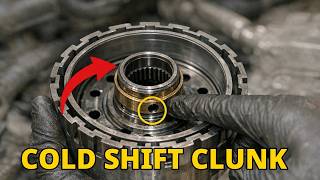
Est. part cost: $400-$900 - Worn or Failed CDF Drum Bushing 🟡 Medium Probability The 10R80 transmission family is known for an issue where a bushing in the CDF (Clutch 'D'/'F') drum can 'walk' out of position, blocking hydraulic fluid passages and causing erratic shifting and codes like P2704. TSB 22-2428 explicitly identifies this as a potential cause.
How to confirm: This requires a partial transmission teardown to visually inspect the CDF drum. It is often diagnosed after a valve body replacement fails to resolve the symptoms. TSB 22-2428 provides a procedure to verify the hydraulic leak before a full teardown.
Typical fix: Replace the CDF drum with an updated part (JL3Z-7H351-B) that has a machined lip to prevent the bushing from moving. 🎬 See how the updated CDF drum fixes harsh shifting issues. This is a partial transmission rebuild.
Est. part cost: $150-$300 - Low or Dirty Transmission Fluid ⚪ Low Probability → Shop Transmission Assembly While less common as the root cause for a specific code like P2704, low or degraded fluid can cause a wide range of shifting problems by affecting hydraulic pressure 🎬 Learn more about common 10R80 and 10R140 transmission problems. and contributing to valve body contamination. The 10R80 is very sensitive to fluid type and condition, requiring Motorcraft ULV fluid.
How to confirm: Check the transmission fluid level and condition according to the manufacturer's procedure. The fluid should be at the correct level and not appear dark, burnt, or contain excessive debris.
Typical fix: Perform a transmission fluid and filter change using the correct Ford-specified fluid (Motorcraft ULV). This is often done as part of a valve body replacement.
Est. part cost: $150-$300
Rare But Worth Checking
- Engine Misfire:
Diagnosis Steps
- Verify the code with a professional OBD-II scanner capable of reading transmission codes.
- Check the transmission fluid level and condition. Note any signs of burning or contamination.
- Follow the diagnostic procedure outlined in the most current Ford TSB, such as TSB 22-2428.
- For vehicles with under 5,000 miles, a technician may first perform a 'transmission accelerated main control break-in routine' with a Ford scan tool.
- If the break-in procedure fails or the vehicle has higher mileage, the next step is to inspect and likely replace the main control valve body.
- If valve body replacement does not fix the issue, the next logical step is to inspect the CDF drum for the known bushing issue, following the diagnostic steps in TSB 22-2428 or 24-2254.
- After any repair, clear all codes and perform the transmission adaptive learning drive cycle to allow the computer to relearn shift points, as noted in the TSBs.
Parts You'll Likely Need
- Main Control Valve Body
(OEM #L1MZ-7A100-K (supersedes L1MZ-7A100-A, L1MZ-7A100-E))— This is the most common failure point for P2704 on this vehicle, as identified by multiple Ford TSBs.
Trusted brands: Motorcraft (OEM)
OEM price range: $350-$700 (plus core charge) - CDF Drum Assembly
(OEM #JL3Z-7H351-B)— This is the updated part for a known design flaw in the 10R80 transmission that can cause this and other shifting codes. It's the next likely culprit if a valve body replacement doesn't work.
Trusted brands: Motorcraft (OEM)
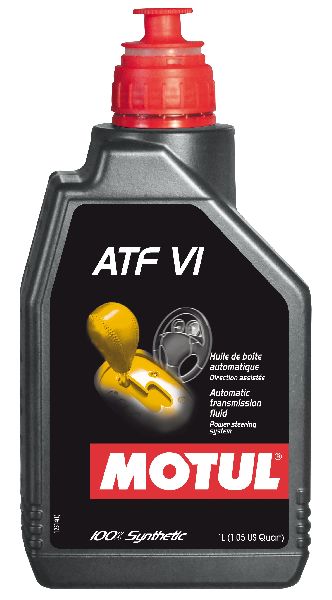
OEM price range: $150-$300 - Automatic Transmission Fluid (Motorcraft MERCON ULV)
(OEM #XT-12-QULV)— The transmission must be drained to replace the valve body, requiring a refill with the correct, specific fluid. Using the wrong fluid can cause damage.
Trusted brands: Motorcraft
OEM price range: $8-$15 per quart
Related Codes That Often Appear With This One
- P0772 — This code for 'Shift Solenoid 'E' Stuck On' is frequently cited alongside P2704 in the same Ford TSBs (like 21-2321), as both relate to the same hydraulic circuit and valve body issues.
- P0729, P0731-P0736 — These are codes for incorrect gear ratios. They can be triggered when the underlying valve body or CDF drum issue causes the transmission to slip or fail to engage a gear correctly. TSB 22-2428 lists this entire family of codes.
- P2700, P2701, P2702, P2703, P2705 — These codes relate to the apply time performance of other friction elements (A, B, C, D, F). They are often listed together with P2704 in TSBs because a systemic issue like a faulty valve body can affect multiple hydraulic circuits.
Technical Service Bulletins (TSBs) & Recalls
- TSB 22-2428: A comprehensive TSB superseding many earlier ones. It covers 2020-2023 Transits and identifies sticking valves, PCM/TCM software, and axial movement of the CDF clutch cylinder sleeve as causes for harsh shifts and a long list of DTCs including P2704.
- TSB 21-2377: Superseded by 22-2428, but specifically listed P2704 among codes caused by sticking valves in the main control valve body for 2020-2021 Transits.
- TSB 21-2321: Also superseded, but focused on harsh engagement into drive with codes P0772 and/or P2704, pointing to sticking valves in the main control valve body.
- TSB 20-2226: An earlier TS
Platform-Specific Known Issues
- Ford has issued multiple, superseding Technical Service Bulletins (TSBs) related to harsh shifting and this specific trouble code. TSB 22-2428 is a key document that covers the 2020-2023 Transit and points to both the main control valve body and the CDF drum sleeve as potential causes.
- The diagnostic path is mileage-dependent according to early TSBs like 20-2226; vehicles under 5,000 miles were first given a software-based 'break-in' routine, while higher-mileage vehicles went straight to valve body replacement.
Mechanic-Grade Diagnostic Values
- Transmission Fluid Temperature (TFT) Sensor Resistance — expected: 16K-5k Ohms @ 105°F-158°F (40°C-70°C); 5K-2.7k Ohms @ 159°F-194°F (70°C-90°C); 2.7K-1.5k Ohms @ 195°F-230°F (90°C-110°C). Failure: Readings significantly outside the expected range for a given temperature can indicate a faulty sensor, affecting shift calculations.
Hidden / Shadow Codes Worth Checking
- Solenoid Body Strategy Number: This is not a trouble code, but a 13-digit number etched on the main control valve body that must be programmed into the TCM. If this number in the TCM does not match the hardware installed, it can cause erratic shifting and codes like P2704. A mismatch can occur if a valve body was replaced without the proper programming procedure. (see via A Ford-specific scan tool like IDS or FDRS is required to read the Solenoid Body ID and Strategy numbers from the TCM to compare them against the physical part.)
Scan Tool Commands That Help
- Ford FDRS/IDS: Transmission Strategy Download — This function is required after replacing the main control (valve body) assembly. It downloads the specific calibration file from Ford's servers that matches the unique hydraulic characteristics of the new valve body to the TCM. Failure to perform this step will likely result in poor shift quality.
- Ford FDRS/IDS or FORScan: Clear All Transmission Adaptive Tables — This should be performed after a mechanical repair like a valve body or CDF drum replacement. It erases the learned shift adjustments, forcing the TCM to start a fresh learning process with the new components. It can also be used as a temporary diagnostic step to see if symptoms improve, but the issue will return if there is an underlying mechanical fault.
- Ford FDRS/IDS: Transmission Adaptive Learning Drive Cycle — After clearing the adaptive tables, the vehicle must be driven in a specific manner to allow the TCM to relearn clutch fill times and shift pressures. The scan tool often guides the technician through the specific steps, which involve a series of light-to-medium accelerations and decelerations.
Wiring & Ground Locations
- C168B, Pin B2 — This is a pin on the main 26-pin transmission case connector (external).. This specific pin is the 'Shift Solenoid E Ground Control' circuit. The wire color is typically Yellow-Violet (YE-VT). A technician can perform continuity or voltage tests at this pin to check the integrity of the wiring between the TCM and the solenoid, helping to rule out a wiring fault.
- C177 — This is the 14-pin connector for the internal transmission wiring harness, connecting the main control to the solenoids.. The 'Shift Solenoid E Control' wire (Yellow-Violet) passes through this internal connector. While less accessible, a problem here (like a bent pin or corrosion) could cause the P2704 code and would only be found during an internal inspection.
Real Owner Repair Stories
- Gears Magazine (2019 Ford F-150 3.5L (10R80 Transmission)) — Check engine light with codes P0735 (Gear Ratio Error in 5th) and P2704. Transmission slipped in 5th gear.
❌ Tried (didn't work) Complete transmission teardown and inspection, which found no visible faults., Re-assembly of the transmission with a brand new OEM valve body., Replacement of the CDF drum with the updated version.
✅ What actually fixed it After replacing the most common failure parts did not resolve the slip, the shop suspected a fault in the Powertrain Control Module (PCM) itself or the command signal from the PCM to the 'E' solenoid. The final fix was not detailed in the article, but the story highlights that even with classic symptoms, the root cause can be electronic rather than purely mechanical/hydraulic. - F-150 & Transit Owner Forums (Various 2017+ Ford vehicles with 10R80 transmission) — Harsh, clunking shifts, especially when cold during 1-3 and 3-5 upshifts, or when shifting from Park to Drive. Codes like P2704 are often present.
❌ Tried (didn't work) Clearing the transmission adaptive learning tables using FORScan or by disconnecting the battery. This provided only temporary relief for a few days or weeks before the harsh shifting returned.
✅ What actually fixed it The permanent fix was the mechanical replacement of the CDF clutch drum with the updated part (JL3Z-7H351-B) which has a machined lip to prevent the internal bushing from 'walking' out and blocking fluid passages. This repair requires transmission removal and partial disassembly.
"I Checked Everything" — The Actual Cause
- In a documented case, a 10R80 with P2704 underwent a full teardown where the CDF drum and 'E' clutch pack were found to be in perfect condition. The valve body was also replaced as a precaution. Despite these common fixes, the transmission continued to slip and set the code. This indicated the problem was not a hydraulic leak or a failed mechanical part, but likely an issue with the electronic control signal from the PCM to the solenoid, demonstrating a scenario where standard mechanical inspection reveals no faults.
When the Usual Fixes Don't Work
- While the vast majority of P2704 codes on the 10R80 are resolved by replacing the main control valve body or the CDF drum, there are documented cases where these repairs do not solve the problem. In one instance involving an F-150, a shop replaced both the valve body and the CDF drum, yet the transmission continued to slip in 5th gear and set the P2704 code. This forced the diagnosis to move away from the common mechanical failures and toward the electronic control system, with the PCM's command signal to the shift solenoid becoming the primary suspect. This serves as a critical reminder that if the high-probability mechanical fixes fail, a deeper electrical diagnosis is required.
OEM Part Supersession History
L1MZ-7A100-A, L1MZ-7A100-E→L1MZ-7A100-K— Part revision to address valve sticking issues and improve durability.
Heads up: The new part requires a 'Transmission Strategy Download' using a Ford scan tool to program its unique hydraulic characterization into the TCM for proper operation.HL3Z-7H351-A, JL3Z-7H351-A→JL3Z-7H351-B— The original CDF drum design allowed an internal bushing to 'walk' out of place, blocking hydraulic passages. The updated '-B' part has a machined retention lip that acts as a hard stop, preventing the bushing from moving.
Model Year Variations Within This Range
- 2020 - Mid-2022: Vehicles built on or before August 15, 2022, are specifically called out in TSB 24-2254 as being prone to the CDF drum bushing movement issue. While later models can still experience valve body problems, vehicles built after this date are more likely to have the updated CDF drum from the factory, making it a slightly less probable cause compared to the valve body.
Helpful Videos


We Have This Part in Stock


The information in this article is provided for general reference and educational purposes only. Vehicle specifications, procedures, and part compatibility can vary by production date, trim level, and region. Always consult your vehicle's factory service manual and verify part numbers before purchasing or performing repairs. Safety-critical components such as airbags, seat belts, and braking systems should be installed by a qualified professional.
- Ford TRANSIT:
- 🧭 Diagnostic Flowchart
- 🎬 Helpful Videos
- 🛍️ Shop This Part
- What's Unique About the 2020-2023 Ford TRANSIT
- Symptoms You May Notice
- Most Likely Causes
- Rare But Worth Checking
- Diagnosis Steps
- Parts You'll Likely Need
- Related Codes That Often Appear With This One
- Technical Service Bulletins (TSBs) & Recalls
- Platform-Specific Known Issues
- Mechanic-Grade Diagnostic Values
- Hidden / Shadow Codes Worth Checking
- Scan Tool Commands That Help
- Wiring & Ground Locations
- Real Owner Repair Stories
- "I Checked Everything" — The Actual Cause
- When the Usual Fixes Don't Work
- OEM Part Supersession History
- Model Year Variations Within This Range
- 🎟️ Get 5% Off