

P2705 on 2018-2023 Ford Expedition: Transmission Friction Element 'F' Apply Time Causes and Fixes
On a 2018-2023 Ford Expedition, code P2705 almost always points to a serious internal issue with the 10R80 transmission, most commonly a failed CDF drum bushing. This is a major repair requiring a transmission specialist to replace the drum with an updated part (JL1Z-7H351-B), with costs ranging from $5,000 to over $9,000.
- P2705 on a 2018-2023 Expedition is a serious code that points to a major internal transmission problem, not a simple sensor or fluid issue.
- The most likely cause is a well-known design flaw in the 10R80 transmission's CDF clutch drum, which requires a transmission rebuild with an updated part to permanently fix.
- Do not continue to drive the vehicle. This can cause catastrophic transmission failure and significantly increase repair costs.
- This is not a DIY-friendly repair. It requires a transmission specialist with experience on the Ford 10R80.
- Repair costs are very high, typically ranging from $5,000 to $9,500 for a full rebuild or replacement.
What's Unique About the 2018-2023 Ford EXPEDITION
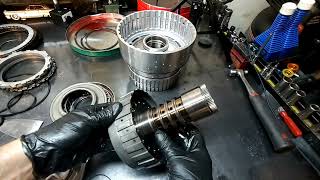
The 2018-2023 Expedition uses the Ford 10R80 10-speed automatic transmission, which is known for a specific design flaw. A bushing inside the 'CDF' clutch drum can walk, or migrate, out of its intended position, uncovering oil passages 🎬 Watch: See exactly how the CDF drum bushing fails and causing a critical loss of hydraulic pressure. This widespread issue leads to erratic shifting, and P2705 is one of many codes that can result from this single, common failure point. Ford has issued multiple Technical Service Bulletins (TSBs) and even updated the CDF drum design (Part No. JL1Z-7H351-B) with a machined lip or staked bushing to prevent this movement in later models and service parts.
Diagnostic Flowchart
Tap your situation to follow the diagnostic path that matches what you're seeing on this vehicle.
Symptoms You May Notice
- Harsh, jerky, or delayed shifts, sometimes feeling like being rear-ended.
- Vehicle lunging or clunking between gears, especially when cold.
- Transmission slipping, where the engine RPMs flare up without an increase in speed.
- Getting stuck in a single gear (limp mode).
- Illuminated Malfunction Indicator Lamp (Check Engine Light) or Wrench Light.
- Noticeable delay when shifting from Park to Drive or Reverse.
- Replacing only the shift solenoids without addressing the root cause, which is often the mechanical failure of the CDF drum or valve body.
- Performing a transmission fluid flush expecting it to fix a mechanical or hydraulic leak issue. A fluid change will not repair a worn bushing.
- Only performing a TCM software update or adaptive learning reset. While this is a valid first step per some TSBs, it often fails to resolve the issue when the underlying mechanical fault (CDF drum) is present.
Most Likely Causes
- Worn or Migrated CDF Clutch Drum Bushing 🔴 High Probability → Shop Transmission Clutch Pressure Plate This is a well-documented design flaw in early 10R80 transmissions. The bushing's axial movement causes a hydraulic leak, which starves the C, D, and F clutch packs of pressure.
How to confirm: A technician must perform a specific hydraulic pressure test as outlined in Ford's TSB 24-2254. Visual confirmation requires transmission disassembly, where the migrated bushing and often a dislodged or damaged Teflon seal will be visible.
Typical fix: The transmission must be removed and at least partially disassembled to replace the CDF clutch drum with the updated part (OEM Part No. JL1Z-7H351-B) that has a machined lip to prevent the bushing from moving. Most shops will perform a more comprehensive rebuild at this time.
Est. part cost: $200-$400 for the drum itself, but it's part of a larger rebuild. - Main Control Valve Body Failure 🟡 Medium Probability → Shop Transmission Valve Body Sticking valves or contaminated solenoids within the valve body can prevent correct hydraulic pressure from being routed to the clutch packs. Debris from the failing CDF drum can also contaminate the valve body, necessitating its replacement.
How to confirm: Diagnosis involves testing solenoids and performing hydraulic pressure tests at the transmission. Often replaced as a precaution during a CDF drum-related rebuild.
Typical fix: Replacement of the entire main control valve body assembly. Some TSBs call for a valve body overhaul as a first step.
Est. part cost: $450-$900. A common part number is JL3Z-7A100-C, but it should be verified by VIN. - Low or Contaminated Transmission Fluid ⚪ Low Probability → Shop Transmission Assembly While less common as a root cause, low fluid levels will starve the system of hydraulic pressure, causing shifting errors. Burnt or debris-filled fluid is a symptom of a larger mechanical failure, like the CDF drum.
How to confirm: Check the transmission fluid level and condition according to the manufacturer's procedure. This transmission does not have a traditional dipstick and must be checked from underneath the vehicle.
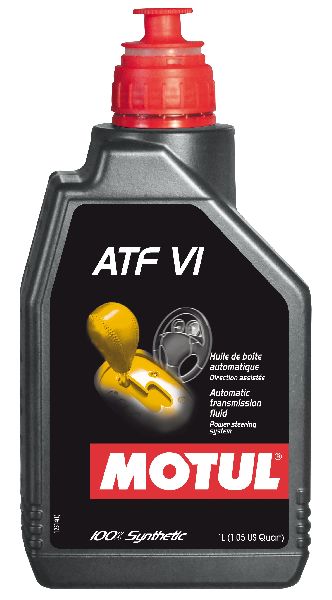
Typical fix: Perform a fluid drain and fill with the correct Motorcraft ULV fluid. If the fluid is burnt or full of debris, it indicates a larger mechanical failure is present.
Est. part cost: $150-$250 for fluid
Rare But Worth Checking
- Transmission Control Module (TCM) Failure: → Shop Transmission Assembly A software glitch or internal TCM fault can cause the code, but mechanical issues are far more common with the 10R80. Often a software update or adaptive learning reset is attempted first.
- Damaged Internal Wiring Harness: The wiring inside the transmission can become damaged, but this is usually found during a rebuild for a mechanical fault.
Diagnosis Steps
- Verify the transmission fluid level and condition. Note that this requires the vehicle to be lifted and level, and there is no dipstick.
- Use an advanced scan tool to check for all DTCs in the TCM and PCM. Note all codes present, as they are crucial clues.
- Review the live data from the scan tool to monitor shift commands and solenoid performance.
- Consult Ford's Technical Service Bulletins (TSBs), especially TSB 24-2254, which directly addresses this issue.
- Perform hydraulic pressure tests as outlined in TSB 24-2254 to confirm or rule out a leak in the CDF clutch circuit. This requires specialized tools.
- If tests indicate an internal leak, the transmission must be removed and disassembled for inspection of the CDF drum, valve body, and other internal components. The migrated bushing on the CDF drum is the primary component to inspect.
Parts You'll Likely Need
- CDF Clutch Drum (Updated)
(OEM #JL1Z-7H351-B)— This is the most common point of failure. The original design allows a bushing to migrate, causing hydraulic leaks. The replacement part is an updated design with a machined lip to prevent this.
Trusted brands: Motorcraft, Suncoast
OEM price range: $200-$400
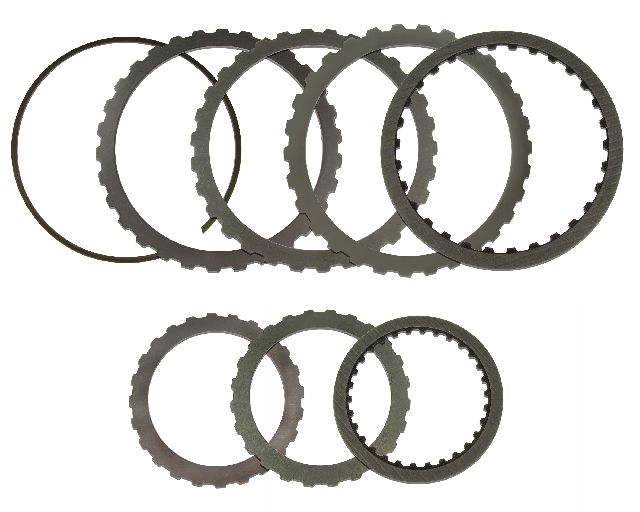
Aftermarket price range: $200-$350 - Transmission Overhaul Kit — Required for any transmission rebuild. It includes all necessary gaskets, seals, and clutches that should be replaced once the transmission is disassembled.
Trusted brands: Motorcraft
OEM price range: $800-$1400
Aftermarket price range: $600-$1000 - Main Control Valve Body
(OEM #JL3Z-7A100-C)— Often replaced during a rebuild due to contamination from the initial failure or because of sticking valves, which also cause shifting issues. Verify part number with VIN.
Trusted brands: Motorcraft
OEM price range: $600-$900
Aftermarket price range: $500-$800 - Motorcraft MERCON ULV Automatic Transmission Fluid
(OEM #XT-12-QULV)— This is the specific, required fluid for the 10R80 transmission. Using any other fluid can cause damage. A full rebuild requires 10-13 quarts.
Trusted brands: Motorcraft
OEM price range: $12-$20 per quart
Related Codes That Often Appear With This One
- P0751-P0772 — These are codes for other shift solenoids ('A', 'B', 'C', 'D', 'E'). The CDF drum issue causes widespread hydraulic pressure loss that can trigger faults across multiple clutch circuits, especially C, D, and E.
- P0729-P0736 — These codes indicate incorrect gear ratios. When a clutch fails to apply correctly (like the 'F' clutch), the TCM detects a mismatch between engine speed and output speed, logging a gear ratio error.
- P2700-P2708 — This is a range of codes for apply time performance for different friction elements. Seeing P2705 with others like P2704 ('E') or P2702 ('C') strongly points to the systemic CDF drum or valve body failure.
Technical Service Bulletins (TSBs) & Recalls
- TSB 24-2254: Supersedes previous TSBs. Mentions P2705 and directly links it to axial movement of the CDF clutch cylinder sleeve causing hydraulic leaks. It provides a detailed diagnostic procedure to test for the pressure loss before authorizing transmission removal.
- TSB 22-2428: An earlier TSB that also lists P2705 among a host of codes related to harsh/delayed shifts due to internal transmission issues, specifically mentioning the CDF clutch housing. A Reddit user identifying as a Ford transmission tech called this out as the key TSB for this issue.
- TSB 21-2357: This bulletin suggests that harsh shifts and codes like P2705 may be due to adaptive calibration incompatibility. It recommends overhauling the main control valve body and performing an adaptive learning drive cycle as a potential fix.
Platform-Specific Known Issues
- CDF Drum Bushing Migration: The most significant issue for the 10R80 transmission. TSB 24-2254 directly addresses this, stating that harsh/delayed shifts and numerous DTCs (including P2705) may be due to "axial movement of the CDF clutch cylinder (7H351) sleeve causing hydraulic circuit leaks." Ford has since released an updated drum (JL1Z-7H351-B) with a machined lip to prevent this movement.
- Class Action Lawsuit: Multiple class-action lawsuits have been filed concerning the 10R80 transmission in Ford Expeditions and other models, such as 'Singleton et al. v. Ford Motor Company' and 'McCabe v. Ford Motor Company'. These lawsuits allege that the transmissions are defective and can shift harshly, lunge, and hesitate, creating a safety issue.
- Repair Story from Owner: On expeditionforum.com, a user with a 2019 Expedition at 41k miles reported harsh shifting and a pause when engaging 5th gear. After an initial failed attempt with a software reflash, the dealer diagnosed a CDF drum failure under TSB 23-2250. The work order noted 'Found axial movement of CDF
Mechanic-Grade Diagnostic Values
- Shift Solenoid (A-F) Resistance — expected: 5.0 - 5.4 Ohms at 68°F (20°C). Failure: A reading outside this range indicates a faulty solenoid coil.
- Transmission Fluid Temperature (TFT) for Level Check — expected: 206°F - 215°F (96°C - 101°C). Failure: Checking the fluid level outside this temperature range will result in an inaccurate reading, either too high or too low.
Scan Tool Commands That Help
- FORScan / Ford IDS: Clear Transmission Adaptive Tables — This service function should be performed after any major transmission repair, such as replacing the valve body or CDF drum, to erase the old shift strategy. It forces the TCM to relearn clutch fill times and pressures with the new components.
- FORScan / Ford IDS: Adaptive Learning Drive Cycle — This is a specific, multi-step driving procedure that must be performed after clearing the adaptive tables. It provides a baseline for the TCM's learning process, ensuring smooth shifts with the new or repaired hardware. Skipping this can result in continued poor shift quality.
- Ford IDS: Solenoid Strategy Programming — This is required when replacing the valve body, transmission assembly, or TCM/PCM. The new component's specific solenoid characterization data must be programmed into the control module for proper operation.
Wiring & Ground Locations
- Main Transmission Case Connector (C175T) — The 26-pin main electrical connector on the side of the 10R80 transmission case.. This is the primary interface between the TCM and all internal transmission components, including the shift solenoids. A visual inspection for corrosion, damage, or pushed-out pins is a valid preliminary step before condemning internal parts. Pin 26, for example, is for Shift Solenoid D control.
- G104 — A primary engine ground, typically located under the intake manifold area.. Poor ground connections can cause erratic behavior in electronic components, including the TCM and the solenoids it controls. While not a common cause for this specific code, verifying major grounds is part of a thorough electrical diagnosis.
- Passenger Compartment Fuse Box — Located in the passenger-side footwell area.. Fuse 14 (10A) in this panel provides run/start power to the Transmission Control Module (TCM). A loss of power from this fuse would cause a no-communication issue and multiple codes, not just P2705, but is a key power source to verify.
Real Owner Repair Stories
- Reddit user on r/f150 (2019 F-150 Lariat 2.7L 4x4) — Initially harsh upshifts/downshifts. Later developed a 2-3 second delay when shifting from Park to Drive or Reverse.
❌ Tried (didn't work) A software reflash and swapping some parts per a TSB did not fix the initial harsh shifting.
✅ What actually fixed it The dealer first replaced the CDF drum, which fixed the engagement delay. However, 900 km later, a very hard shift into 3rd gear appeared. The dealer then replaced the main control valve body assembly, which resolved the remaining issues, although cold shifts remained noticeable. - Ford F150 Forum user (2018 F-150) — 3-5/3-4 shift flare when cold. The issue had been fixed once before the updated part was available.
❌ Tried (didn't work) A previous transmission rebuild using the old-style CDF drum.
✅ What actually fixed it The user had the transmission rebuilt a second time, but this time with the updated CDF drum part. The user noted that others have had to have the work done again, highlighting the importance of using the revised part.
OEM Part Supersession History
HL3Z-7H351-A, JL3Z-7H351-A→JL1Z-7H351-B (also appears as JL3Z-7H351-B in many listings)— The original CDF drum design allowed an internal bushing/sleeve to 'walk' or migrate, blocking hydraulic passages. The updated part has a machined lip that acts as a physical stop, preventing the bushing from moving.
Heads up: The older part numbers should be avoided. Any repair should exclusively use the updated 'B' revision to ensure a permanent fix.
Model Year Variations Within This Range
- 2018-2022: Vehicles manufactured on or before August 15, 2022, are more likely to have the original, faulty CDF drum design. Vehicles manufactured after this date, including most 2023 models, should have the updated CDF drum with the retaining lip from the factory.
Helpful Videos
We Have This Part in Stock


The information in this article is provided for general reference and educational purposes only. Vehicle specifications, procedures, and part compatibility can vary by production date, trim level, and region. Always consult your vehicle's factory service manual and verify part numbers before purchasing or performing repairs. Safety-critical components such as airbags, seat belts, and braking systems should be installed by a qualified professional.
- Ford EXPEDITION:
- 🧭 Diagnostic Flowchart
- 🎬 Helpful Videos
- 🛍️ Shop This Part
- What's Unique About the 2018-2023 Ford EXPEDITION
- Symptoms You May Notice
- Most Likely Causes
- Rare But Worth Checking
- Diagnosis Steps
- Parts You'll Likely Need
- Related Codes That Often Appear With This One
- Technical Service Bulletins (TSBs) & Recalls
- Platform-Specific Known Issues
- Mechanic-Grade Diagnostic Values
- Scan Tool Commands That Help
- Wiring & Ground Locations
- Real Owner Repair Stories
- OEM Part Supersession History
- Model Year Variations Within This Range
- 🎟️ Get 5% Off