

P2705 on 2017-2023 Ford F-150: Transmission Friction Element 'E' Apply Time Fixes
P2705 on a 2017-2023 Ford F-150 with the 10R80 transmission indicates a problem with an internal clutch pack's engagement time. This is often caused by a faulty main valve body or a known issue with the CDF drum, requiring professional diagnosis and internal transmission repair. The issue is so widespread that multiple TSBs have been issued and class-action lawsuits have been filed.
- P2705 on a 2017-2023 F-150 is a serious transmission code, not a simple sensor issue.
- The most likely causes are well-documented issues with the 10R80 transmission: a faulty main valve body or a failed CDF clutch drum.
- This is not a DIY-friendly repair. It requires professional diagnosis with specialized tools and likely involves major internal transmission work.
- Referencing Ford's Technical Service Bulletins (TSBs) is crucial, as they provide a clear diagnostic path for this known issue.
- Do not ignore this code. Continued driving will lead to more severe and costly transmission damage.
What's Unique About the 2017-2023 Ford F-150

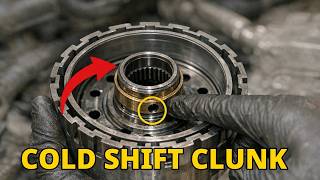
The 2017-2023 F-150 primarily uses the Ford/GM co-developed 10R80 10-speed automatic transmission. This specific transmission has well-documented, widespread issues that can lead to P2705 and a host of other related codes. A primary culprit is the main control valve body, where debris or design flaws can cause valves to stick. An even more notorious problem is with the 'CDF drum' (which houses the C, D, and F clutches), where an internal sleeve can walk out of position, causing a significant hydraulic leak that starves clutches of pressure. Ford has issued a series of superseding Technical Service Bulletins (TSBs), most recently TSB 23-2210, that group P2705 with many other codes, pointing directly to these specific hardware issues rather than simple sensor failures. The problems are so prevalent that class-action lawsuits have been filed concerning the 10R80 transmission's reliability.
Diagnostic Flowchart

Tap your situation to follow the diagnostic path that matches what you're seeing on this vehicle.
Generation note: This range covers the end of the 13th generation (2017-2020) and the beginning of the 14th generation (2021-2023) F-150. The key component is the 10R80 transmission, which is used across these years and is the primary focus for this code. The underlying mechanical issues are common to the 10R80 regardless of the F-150 generation, though Ford has made running changes to parts like the CDF drum in later model years.
Symptoms You May Notice

- Harsh, abrupt, or clunky shifts between gears.
- Delayed shifts or a noticeable lag/flare in RPMs during acceleration.
- Transmission getting stuck in one gear (limp mode).
- Shuddering or vibration, especially under light load in gears 3-6.
- Sudden downshift to a very low gear (like 1st) at highway speeds.
- Hesitation or failure to engage when shifting from Park to Drive.
- Illuminated Malfunction Indicator Lamp (Check Engine Light) or Wrench Light.
- Replacing only a single shift solenoid. The issue is often systemic within the valve body (sticking valves) or a major hydraulic leak from the CDF drum, not an individual solenoid failure.
- Assuming it's just a software issue. While software updates and adaptive learning resets are part of the diagnostic process outlined in TSBs, P2705 coupled with shift quality issues almost always indicates a mechanical or hydraulic problem that software cannot fix.
- Performing only a fluid change. If the CDF drum has failed or the valve body is sticking, fresh fluid will not resolve the underlying mechanical fault.
Most Likely Causes

- CDF Clutch Drum Sleeve Failure 🔴 High Probability → Shop Transmission Clutch Pressure Plate A widely documented design flaw on early 10R80 transmissions is the bushing/sleeve inside the CDF drum walking out of position. This uncovers hydraulic ports, causing a major pressure leak that affects multiple clutch packs, including the 'E' clutch.
How to confirm: This requires transmission disassembly to inspect the drum. A technician will suspect this based on the group of codes present and symptoms aligning with TSBs like 23-2210. The failed drum will have a sleeve that has visibly moved, whereas the updated part has a machined lip or 'dam' to prevent this movement.
Typical fix: Replacement of the CDF drum with an updated part (Part No. JL3Z-7H351-B) that has a machined lip to prevent the sleeve from moving. This requires a full transmission teardown and rebuild. 🎬 See a teardown showing the common CDF drum bushing failure.
Est. part cost: $150-$400 for the drum, plus rebuild components - Sticking Valves in Main Control Valve Body 🔴 High Probability → Shop Transmission Valve Body The 10R80's complex valve body is prone to issues where small metallic debris or wear causes valves to stick in their bores. This disrupts the precise hydraulic pressure and timing needed for smooth shifts, triggering apply time codes.
How to confirm: A technician uses a scan tool to monitor solenoid commands and pressures. Often, the diagnostic procedure in Ford's TSBs will lead to a valve body overhaul or replacement if other causes are ruled out. A Reddit user reported a dealer replacing the valve body on their '21 F-150 to resolve shifting problems.
Typical fix: Overhaul or replacement of the main control valve body. An overhaul involves disassembling the valve body, cleaning it, and replacing any sticky valves or worn components.
Est. part cost: $500-$1200 for a remanufactured or new OEM unit. - Low or Contaminated Transmission Fluid 🟡 Medium Probability → Shop Transmission Assembly While not specific to the F-150, low fluid levels will cause pressure drops and shifting issues in any automatic transmission. Contaminated fluid can cause valve body valves to stick. The 10R80 requires Mercon ULV fluid, and using incorrect fluid can cause damage.
How to confirm: Check the transmission fluid level and condition according to the manufacturer's procedure. The fluid level should be checked when the transmission is at operating temperature (206–215°F). Look for a burnt smell or excessive metallic debris in the fluid or on the pan magnet.
Typical fix: Perform a transmission fluid and filter change. Address any leaks found. Note that a fluid change will not fix an existing mechanical issue like a failed CDF drum.
Est. part cost: $100-$250 - Worn or Damaged Friction Element (Clutch Pack 'E') ⚪ Low Probability This is often a consequence of other issues like low pressure from a faulty valve body or CDF drum, which leads to clutch slippage and premature wear. The 'E' clutch is particularly susceptible due to its high cycle rate during normal driving.
How to confirm: Confirmed during transmission disassembly by inspecting the clutch plates for burning, glazing, or excessive wear.
Typical fix: Transmission rebuild, including replacement of all worn clutches and seals. Aftermarket kits are available that increase the clutch count in the 'E' drum for greater durability.
Est. part cost: $400-$800 (as part of a larger rebuild)
Rare But Worth Checking
- Faulty Transmission Control Module (TCM) or Powertrain Control Module (PCM): → Shop Transmission Assembly While possible, control module failure is far less common than the mechanical and hydraulic issues known to affect the 10R80. All mechanical causes, especially those outlined in Ford's TSBs, should be ruled out first.
Diagnosis Steps
- Check and verify the transmission fluid level and condition. Note if the fluid is cold or at operating temperature.
- Use a Ford-specific scan tool (like FORScan) to check for all DTCs in the PCM and TCM. Note all codes present, as they are crucial for diagnosis.
- Check for any available TSBs related to the transmission symptoms and codes. TSB 23-2210 (and its predecessors) is the most relevant document.
- Follow the diagnostic procedures outlined in the relevant TSB. This typically involves software updates and an adaptive learning drive cycle first. 🎬 Watch: How to fix harsh cold shifts and CDF bushings.
- If symptoms persist, the TSB procedure will guide a technician toward either a valve body overhaul/replacement or an internal inspection for CDF drum failure.
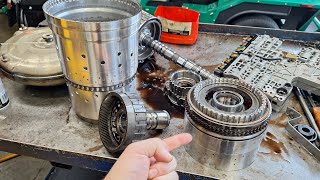
- If internal transmission inspection is required, the primary focus should be on the CDF drum for a displaced sleeve and the clutch packs for signs of excessive wear or heat.
Parts You'll Likely Need
- CDF Clutch Cylinder/Drum (Updated)
(OEM #JL3Z-7H351-B)— This is the updated part from Ford that corrects the sleeve 'walking' issue. It features a machined lip to hold the sleeve in place. This is the permanent fix for the most common and severe 10R80 failure.
Trusted brands: Motorcraft
OEM price range: $150-$400 - Main Control Valve Body
(OEM #HL3Z-7A100-B (supersedes HL3Z-7A100-A))— Often the source of sticking valves causing pressure and timing errors, as identified in multiple TSBs. Replacement is often performed before a full teardown to rule out hydraulic control issues.
Trusted brands: Motorcraft
OEM price range: $500-$1200
Related Codes That Often Appear With This One
- P0751, P0756, P0761, etc. — These are codes for other shift solenoids (A, B, C, etc.). Ford TSBs group P2705 with a large family of other transmission codes, indicating a widespread hydraulic or control issue, often pointing to the valve body or CDF drum.
- P0729, P0731, P0732, etc. — These are gear ratio error codes (Incorrect Gear Ratio for 6th, 1st, 2nd, etc.). They often appear with P2705 because the clutch's failure to apply correctly causes the transmission to slip, leading to a mismatch between engine speed and output speed for a given gear.
- P2703, P2704 — These are codes for other friction elements ('D' and 'F'). Their presence alongside P2705 strongly points to a systemic failure like the CDF drum, which affects multiple clutches, or a faulty valve body.
Technical Service Bulletins (TSBs) & Recalls
- TSB 23-2210: The most recent bulletin, superseding many others. It points to sticking valves in the main control valve body or a displaced CDF clutch cylinder sleeve as the primary causes for a long list of DTCs, including P2705.
- TSB 22-2428: A predecessor to 23-2210, also identifying the valve body and CDF drum as the culprits for harsh shifting across a wide range of Ford models with the 10R80.
- TSB 22-2139: Superseded bulletin that also pointed to valve body overhaul or adaptive learning as potential fixes for the shift quality issues and associated codes.
- TSB 26-2046: Mentions P2705 in a list of DTCs related to MIL illumination on 2022 models.
- TSB 25-2018: Lists P2705 with delayed/harsh shift symptoms on 2020 models.
- TSB 25-2302: Cites P2705 among DTCs for MIL on 2022 models.
Platform-Specific Known Issues
- NHTSA Technical Service Bulletin #TSB 23-2210 (and its predecessors like TSB 22-2139) addresses harsh/delayed shifts and a long list of DTCs including P2705. The cause is identified as sticking valves in the main control valve body and/or axial movement of the CDF clutch cylinder sleeve.
- An owner of a 2020 F-150 reported a P2705 code and mentioned a fix where a valve was found to be sticking and was worked manually to unstick it (ODI #11635117).
- Another owner complaint for a 2019 model lists P2705 along with other transmission codes, highlighting the known transmission failures on these trucks (ODI #11634937).
- A class-action lawsuit has been filed against Ford regarding the 10R80 transmission, citing erratic and harsh shifting, hesitation, and safety concerns, which are all symptoms related to the failures that cause P2705.
Mechanic-Grade Diagnostic Values
- Shift Solenoid Resistance — expected: 5.0 - 5.4 Ohms at 68°F (20°C). Failure: Readings outside this range indicate a faulty solenoid coil.
- Transmission Line Pressure (at pressure test port) — expected: Approximately 110-120 psi at idle/no throttle and 230-260 psi at wide-open throttle in gear.. Failure: Significantly lower pressure indicates a hydraulic leak (e.g., CDF drum), a failing pump, or a stuck pressure control solenoid.
Scan Tool Commands That Help
- FORScan / Ford IDS: Reset All Adaptations (Transmission Adaptive Tables) — This procedure should be performed after any transmission repair, such as replacing the valve body or rebuilding the transmission. It clears the learned shift strategy, forcing the TCM to relearn clutch apply pressures and timing. It is often the first step in diagnosis but will not fix an underlying mechanical or hydraulic fault.
- Ford IDS: Solenoid Body Strategy Data Download — When the main control valve body (solenoid body) is replaced, the unique 13-digit strategy number from the new part must be programmed into the TCM. Failure to do so will result in incorrect shift pressures and potential damage.
Wiring & Ground Locations
- PCM Grounds — Located on the firewall in the engine bay. There may be one or two ground points depending on the model year and engine.. A poor ground for the Powertrain Control Module (PCM) can cause erratic sensor readings and incorrect command signals to the transmission, potentially mimicking internal faults.
- Main Battery Ground — Located in the engine bay, just in front of the washer fluid reservoir.. The primary ground for the entire electrical system. Corrosion or a loose connection here can cause widespread issues, including problems with the transmission's electronic controls.
- Transmission Case Connector (C175T) — The main electrical bulkhead connector on the transmission case itself.. This is the single point of connection for all solenoids and sensors inside the transmission. Corrosion or pushed-back pins in this connector can interrupt signals for the 'E' clutch solenoid or its related sensors, directly causing apply time faults.
Real Owner Repair Stories
- Reddit user lobsterChief17 on r/f150 (2021 F-150 3.5L EcoBoost Lariat 4x4) — Harsh shifting and other transmission abnormalities starting at only 1,000 miles.
❌ Tried (didn't work) Resetting the adaptive learning tables.
✅ What actually fixed it The dealership replaced the main control valve body to resolve the shifting problems. The user was awaiting pickup to confirm the final result. - Reddit user on r/MechanicAdvice (2016 F-150 5.0L V8 with 6R80 (Note: Not 10R80, but similar symptoms)) — Sudden downshift to 5th then 3rd gear on the highway, getting stuck in 3rd gear (limp mode), and wrench light with code P0722 (Output Speed Sensor Circuit No Signal).
❌ Tried (didn't work) The owner was presented with two options by a transmission shop after they found dark fluid.
✅ What actually fixed it The shop diagnosed a bad lead frame and valve body, quoting $2250 for the repair, but also warned that a full remanufactured transmission ($5800) might be needed due to the fluid condition, indicating potential internal damage beyond the valve body.
OEM Part Supersession History
HL3Z-7H351-A, JL3Z-7H351-A→JL3Z-7H351-B— The original CDF drum designs allowed an internal sleeve/bushing to 'walk' out of position, uncovering hydraulic ports and causing pressure loss. The updated 'B' version includes a machined lip that physically prevents the sleeve from moving.
Model Year Variations Within This Range
- 2017 - Mid-2022: Vehicles produced before approximately August 15, 2022, are highly susceptible to the original CDF drum failure where the sleeve walks out. Models built after this date are more likely to have the updated drum (JL3Z-7H351-B) from the factory, which has a machined lip to prevent the failure.
- 2017-2020 vs 2021+: Owners and technicians report that the shift logic and software tuning on later model year (2021+) F-150s feel more refined and less prone to the erratic 'gear skipping' behavior that was common on earlier 10R80s. While the core mechanical issues can still occur, some drivability complaints were addressed through software updates in later years.
Helpful Videos


The information in this article is provided for general reference and educational purposes only. Vehicle specifications, procedures, and part compatibility can vary by production date, trim level, and region. Always consult your vehicle's factory service manual and verify part numbers before purchasing or performing repairs. Safety-critical components such as airbags, seat belts, and braking systems should be installed by a qualified professional.
- Ford F-150:
- 🧭 Diagnostic Flowchart
- 🎬 Helpful Videos
- What's Unique About the 2017-2023 Ford F-150
- Symptoms You May Notice
- Most Likely Causes
- Rare But Worth Checking
- Diagnosis Steps
- Parts You'll Likely Need
- Related Codes That Often Appear With This One
- Technical Service Bulletins (TSBs) & Recalls
- Platform-Specific Known Issues
- Mechanic-Grade Diagnostic Values
- Scan Tool Commands That Help
- Wiring & Ground Locations
- Real Owner Repair Stories
- OEM Part Supersession History
- Model Year Variations Within This Range
- 🎟️ Get 5% Off