

P2705 on 2018-2023 Ford Mustang: Causes and Fixes for Transmission Friction Element 'F' Fault
P2705 on a 2018-2023 Mustang with the 10R80 10-speed automatic transmission almost always indicates a serious internal failure, most commonly a faulty CDF drum. This is a well-documented design flaw where an internal sleeve moves, causing a hydraulic leak. The repair requires a transmission rebuild or replacement with an updated CDF drum (Part No. JL3Z-7H351-B). This is a complex and expensive repair, with shop costs typically ranging from $3,500 to over $7,000.
- P2705 on a 2018-2023 Mustang is a serious code that points to a significant internal transmission problem, not a simple sensor fix.
- The most probable cause is a well-documented failure of the CDF drum inside the 10R80 transmission, which requires a full rebuild to correct.
- This is not a DIY repair. You will need to take your vehicle to a qualified transmission shop.
- Do not delay the repair. Continued driving will lead to more severe transmission damage and higher costs.
- Ensure the repair includes the updated CDF drum from Ford to prevent the issue from recurring.
What's Unique About the 2018-2023 Ford MUSTANG
The 2018-2023 Ford Mustang uses the 10R80 10-speed automatic transmission, which is known for a specific and widespread issue. A component called the CDF (Clutch 'F' / Direct Drive) drum is prone to a failure where an internal sleeve moves axially (or 'walks') out of position, uncovering fluid ports and causing a major hydraulic leak. This single point of failure is the root cause for a cascade of transmission problems and a long list of trouble codes, including P2705. Ford has acknowledged this issue through multiple Technical Service Bulletins (TSBs), and the updated OEM replacement drum features a machined lip to prevent the sleeve from moving. Vehicles built after August 15, 2022, are more likely to have the revised part from the factory.
Diagnostic Flowchart
Tap your situation to follow the diagnostic path that matches what you're seeing on this vehicle.
Symptoms You May Notice
- Harsh, abrupt, or delayed shifts, especially on the 3-5 upshift.
- Slipping between gears.
- Illuminated Malfunction Indicator Lamp (Check Engine Light) or Wrench Light.
- Delayed or harsh engagement when shifting from Park to Drive or Reverse.
- Vehicle may enter a "limp mode" with reduced power and limited gears.
- Clunking noises during shifts.
- A noticeable 2-3 second delay when shifting between P-R-D in a parking lot.
- Replacing only the transmission fluid and filter. This will not solve the mechanical or hydraulic issue causing the code.
- Replacing a single shift solenoid. The issue is more often systemic due to the CDF drum or contamination in the entire valve body, which affects multiple circuits.
- Performing only a TCM software update. While required after a repair, a software update alone cannot fix the internal hydraulic leak from a failed CDF drum.
Most Likely Causes
- Failed CDF Clutch Drum 🔴 High Probability → Shop Transmission Clutch Pressure Plate This is a well-documented design flaw in early 10R80 transmissions. The sleeve within the drum can move, causing a loss of hydraulic pressure to the 'F' clutch pack. Ford has released an updated part with a machined lip to prevent this movement. This issue affects vehicles built before August 16, 2022.
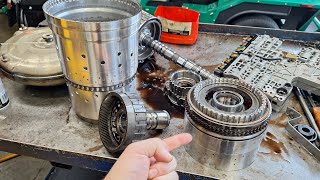
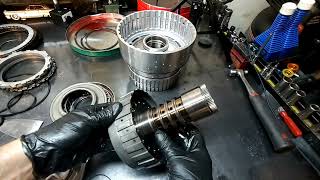
How to confirm: This requires transmission disassembly and visual inspection of the drum for a moved sleeve. 🎬 See exactly how the CDF drum fails in this close-up. TSB 24-2254 outlines a specific hydraulic/vacuum pressure test that can confirm a leak in the CDF clutch circuit before disassembly.
Typical fix: Replace the CDF drum with the updated OEM part (JL3Z-7H351-B) and rebuild the transmission with new seals, gaskets, and clutches. Aftermarket solutions like the Sonnax CDF Drum Saver Kit (129910-01K) also exist to repair a damaged drum.
Est. part cost: $150-$350 for the updated CDF drum itself; $800-$1500 for a full rebuild kit including the drum. - Faulty Main Control Valve Body 🟡 Medium Probability → Shop Transmission Valve Body Sticking solenoids or internal leaks within the valve body can cause pressure control issues leading to apply-time faults. Debris from the failing CDF drum and clutches often contaminates the valve body, causing secondary failures. Some owners report needing a valve body replacement shortly after a CDF drum repair if it wasn't addressed during the initial rebuild.
How to confirm: A technician can perform specific pressure tests and electrical checks on the solenoids. Often diagnosed by elimination or when shifting problems persist after a CDF drum replacement.
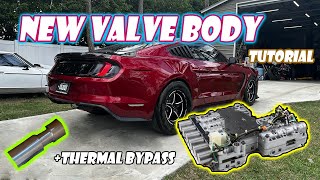
Typical fix: Overhaul or replace the entire valve body assembly (mechatronic unit). Aftermarket companies offer upgraded valve bodies with improved components. A PCM reprogram and adaptive learning reset is required after replacement. 🎬 Watch: Step-by-step guide to replacing the valve body yourself.
Est. part cost: $700-$1400 for an OEM or remanufactured valve body assembly. - Low or Contaminated Transmission Fluid ⚪ Low Probability → Shop Transmission Assembly This is almost always a symptom, not the root cause. The CDF drum failure introduces clutch material and metallic debris into the fluid, causing it to become contaminated and burnt. Low fluid levels from a leak will exacerbate any hydraulic issue. The normal operating temperature for the 10R80 is high, between 206-215°F (97-102°C), and low fluid can cause overheating.
How to confirm: Check the transmission fluid level and condition. The 10R80 uses a specific procedure with a dipstick on the transmission case. Dark, burnt-smelling fluid with metallic particles is a sign of severe internal wear.
Typical fix: A fluid and filter change using only Motorcraft MERCON ULV fluid is a temporary measure at best and will not fix the underlying mechanical failure. It is a required step during a full transmission rebuild.
Est. part cost: $200-$400 for fluid and filter service.
Rare But Worth Checking
- Worn 'F' Clutch Pack: The friction plates themselves can burn out from slipping, often as a direct result of the hydraulic leak from the CDF drum. They are almost always replaced during a standard transmission overhaul.
- Faulty Transmission Control Module (TCM): → Shop Transmission Assembly While a software glitch can cause shifting issues, it is much less common than the mechanical failures in the 10R80. Often a PCM/TCM reprogram is the first step a dealer will try, but it rarely solves a P2705 code caused by the CDF drum.
Diagnosis Steps
- Verify the code with a professional OBD-II scanner that can read TCM data and history codes.
- Check for all related TSBs, especially TSB 24-2254, which details the CDF drum issue and supersedes previous bulletins.
- Inspect the transmission fluid level and condition. Note any burnt smell or metallic debris, which indicates internal damage.
- Follow the diagnostic procedure in TSB 24-2254, which involves specific hydraulic/vacuum pressure tests on the transmission case to confirm a leak in the CDF clutch circuit without full disassembly.
- If tests confirm a leak, the transmission must be removed from the vehicle for repair.
- Disassemble the transmission and inspect the CDF drum for a moved or displaced sleeve. Also inspect the clutch packs for burning/wear and the outer shell for grooves worn by the clutches.
- Thoroughly clean and inspect the valve body for contamination and test solenoids for proper function. Many shops recommend replacement or overhaul of the valve body during a rebuild.
Parts You'll Likely Need
- CDF Clutch Drum Assembly (Updated)
(OEM #JL3Z-7H351-B (replaces HL3Z-7H351-A and JL3Z-7H351-A))— This is the most common point of failure. The updated Ford part has a machined lip to prevent the internal sleeve from moving, providing a permanent fix.
Trusted brands: Motorcraft (OEM)
OEM price range: $150-$350 - Transmission Overhaul Kit
(OEM #e.g., HL3Z-7D062-A (part of a larger kit))— Required for rebuilding the transmission after it's removed. Includes all necessary gaskets, seals, O-rings, and often the friction/steel plates.
Trusted brands: Motorcraft (OEM), Precision International
OEM price range: $500-$800
Aftermarket price range: $400-$600 - Main Control Valve Body
(OEM #e.g., HL3Z-7A100-B)— Often replaced due to contamination from the initial failure or for sticking solenoids causing persistent shift issues.
Trusted brands: Motorcraft (OEM)
OEM price range: $700-$1400
Aftermarket price range: $600-$1200 (Remanufactured) - Motorcraft MERCON ULV Automatic Transmission Fluid
(OEM #XT-12-QULV)— This is the only specified fluid for the 10R80. Using any other fluid can cause damage. A full rebuild requires approximately 13 quarts for a dry fill.
Trusted brands: Motorcraft (OEM)
OEM price range: $15-$25 per quart
Related Codes That Often Appear With This One
- P0751, P0756, P0761, P0766, P0771 — These are performance codes for shift solenoids 'A' through 'E'. A major hydraulic leak from the CDF drum will cause erratic pressure throughout the system, affecting the operation and timing of other solenoids.
- P0729-P0736 — These codes indicate incorrect gear ratios for gears 1-6. When a clutch pack slips due to a hydraulic failure, the TCM detects a mismatch between engine speed and output speed, setting these codes.
- P2700-P2704, P2707, P2708 — These are apply time codes for other friction elements (A, B, C, D, E, G, H). A major hydraulic leak in the CDF ('F') drum circuit can affect the operation and pressure available to multiple clutch packs.
Technical Service Bulletins (TSBs) & Recalls
- TSB 24-2254: The most current and comprehensive bulletin. It addresses harsh/delayed shifts and a long list of DTCs including P2705, pointing to axial movement of the CDF clutch cylinder sleeve as the cause and providing a specific hydraulic test procedure.
- TSB 22-2428, TSB 25-2018, TSB 26-2046: Earlier or related bulletins that also group P2705 with other transmission codes related to shift quality issues in the 10R80 transmission, which are now largely superseded by TSB 24-2254.
Platform-Specific Known Issues
- The primary issue is the axial movement of the CDF clutch cylinder sleeve, which causes hydraulic circuit leaks. This is explicitly mentioned in Ford's TSB 24-2254 as the cause for a wide range of shifting DTCs, including P2705.
- Owner forums like Mustang6G.com and Reddit have numerous threads where owners of 2018+ Mustangs report harsh shifting and transmission failures that were ultimately traced back to the CDF drum.
- In one Mustang6G.com thread, a user describes the classic failure progression: "Took my car in this week... They have a new valve body on order... I have the same problems... The main problem for hard shifting is the CDF drum." This highlights the common misdiagnosis path of starting with the valve body.
Mechanic-Grade Diagnostic Values
- Shift Solenoid (A-F) Resistance — expected: 5.0 - 5.4 Ohms at 68°F (20°C). Failure: A reading outside of this range indicates a faulty solenoid coil.
- Transmission Fluid Temperature (TFT) Sensor Resistance — expected: 1.5k Ohms to 0.8k Ohms. Failure: This resistance range corresponds to a normal operating temperature of 231°F to 266°F (111°C to 130°C). Readings outside this range for a warm transmission may indicate a sensor fault.
- Normal Operating Fluid Temperature (Live Data) — expected: 206°F - 215°F (97°C - 102°C). Failure: Consistently higher temperatures may indicate low fluid, internal slipping, or a cooling system issue.
Scan Tool Commands That Help
- Ford IDS / FORScan: Clear Transmission Adaptive Tables — This procedure is required after any major transmission repair, such as replacing the valve body or rebuilding the transmission, to force the TCM to relearn shift pressures and timing from a baseline.
- Ford IDS / FDRS: Programmable Parameters > Transmission > Solenoid Body Strategy — This is a mandatory step when replacing the main control valve body. The 13-digit solenoid strategy number from the new valve body must be programmed into the TCM for it to control the solenoids correctly.
- FORScan: Halt Adaptive Learning — Some owners and technicians use this function after the adaptive learning drive cycle is complete and shift quality is good. It prevents the TCM from making further adjustments that could potentially lead to harsh shifting over time.
- Ford IDS / VCM: Live Data PID Monitoring (LINEDSD, RPM_DSD, SSF_AMP) — During diagnosis, a technician monitors desired line pressure (LINEDSD), desired engine RPM (RPM_DSD), and the amperage to the 'F' solenoid (SSF_AMP) to see if the TCM is commanding the clutch and if the system is responding as expected. This is part of the TSB 24-2254 diagnostic procedure.
Wiring & Ground Locations
- Main Transmission Case Connector — External connector on the side of the 10R80 transmission case.. This 26-pin connector is the single electrical interface for all internal solenoids and sensors. Pin 25 is the control circuit for Shift Solenoid 'F' (SSF). A poor connection or corrosion at this pin could theoretically cause a P2705, though it's far less likely than an internal mechanical failure.
- G104 — On the driver's side of the engine bay, near the battery.. This is a primary ground point that provides ground for the Data Link Connector (DLC). While not a direct cause, a poor ground here can interfere with scan tool communication, making diagnosis difficult.
- G300 — Inside the cabin, next to the parking brake assembly.. This ground point serves the Transmission Control Switch. Issues here could potentially affect how the TCM interprets gear selection.
Real Owner Repair Stories
- Reddit user on r/f150 (2019 F-150 Lariat 2.7L 4x4) — Initially had harsh upshifts/downshifts. After a reflash, it developed a 2-3 second delay when shifting from Park to Drive or Reverse.
❌ Tried (didn't work) Initial TCM reflash and replacement of some parts per a TSB.
✅ What actually fixed it The delayed engagement was fixed by replacing the CDF drum under warranty. However, 900km later, very hard shifts into 3rd gear developed, which then required a valve body assembly replacement to finally resolve the issues. - Mustang6G.com forum user (2018 Mustang GT (21k miles, supercharged)) — Started with a 5-6 flare at light throttle, progressed to hard 3-4 downshifts, and would sometimes bounce between 3rd and 4th gear in drag mode.
❌ Tried (didn't work) Fluid and filter change., KAM reset.
✅ What actually fixed it The owner ordered a new, VIN-appropriate valve body and had a transmission shop install it. Critically, they also requested the shop use a scan tool to disable/halt the Adaptive Learning Strategy after the repair. The combination of the new valve body and halting the learning process resulted in perfect shifts.
OEM Part Supersession History
HL3Z-7H351-A→JL3Z-7H351-A, then JL3Z-7H351-B— The original and first revision drums had an internal sleeve that could 'walk' out of position. The latest 'B' revision includes a machined lip that physically prevents the sleeve from moving, providing a permanent fix to the hydraulic leak issue.
Model Year Variations Within This Range
- 2018 - mid-2022: Vehicles built on or before August 15, 2022, were likely equipped with the earlier, failure-prone version of the CDF clutch drum. Vehicles built after this date are more likely to have the updated part (JL3Z-7H351-B) from the factory.
- 2018-2021 vs 2022-2023: Ford TSBs separate diagnostic procedures based on the model year. For example, TSB 23-2250 groups 2018-2021 Mustangs into 'Procedure Group A' and 2022-2023 models into 'Procedure Group B', which have different diagnostic steps and scan tool capabilities related to main control break-in.
Helpful Videos

We Have This Part in Stock


The information in this article is provided for general reference and educational purposes only. Vehicle specifications, procedures, and part compatibility can vary by production date, trim level, and region. Always consult your vehicle's factory service manual and verify part numbers before purchasing or performing repairs. Safety-critical components such as airbags, seat belts, and braking systems should be installed by a qualified professional.
- Ford MUSTANG:
- 🧭 Diagnostic Flowchart
- 🎬 Helpful Videos
- 🛍️ Shop This Part
- What's Unique About the 2018-2023 Ford MUSTANG
- Symptoms You May Notice
- Most Likely Causes
- Rare But Worth Checking
- Diagnosis Steps
- Parts You'll Likely Need
- Related Codes That Often Appear With This One
- Technical Service Bulletins (TSBs) & Recalls
- Platform-Specific Known Issues
- Mechanic-Grade Diagnostic Values
- Scan Tool Commands That Help
- Wiring & Ground Locations
- Real Owner Repair Stories
- OEM Part Supersession History
- Model Year Variations Within This Range
- 🎟️ Get 5% Off