

P2705 on 2020-2023 Lincoln Aviator: Causes, Fixes & Valve Body Issues
On a 2020-2023 Lincoln Aviator, code P2705 almost always indicates a problem with the transmission's main control valve body, specifically sticking valves. This is a known issue covered by multiple manufacturer TSBs. The fix requires professional service to repair or replace the valve body, and in some cases, address a related internal component known as the CDF drum.
- Code P2705 on a 2020-2023 Lincoln Aviator strongly points to a known issue with the transmission's main control valve body.
- Symptoms include harsh or delayed shifting, hesitation, and the illumination of the check engine light.
- This is not a DIY-friendly repair. Due to the complexity of internal transmission work, professional service is required.
- Before authorizing any repairs, ensure your mechanic is aware of the multiple TSBs Lincoln has issued for this problem.
- The most common and effective fix is the complete replacement of the valve body assembly, followed by a transmission adaptive learning procedure.
What's Unique About the 2020-2023 Lincoln AVIATOR
The 2020-2023 Lincoln Aviator uses a 10-speed automatic transmission (the 10R60 or 10R80, depending on the powertrain). This specific transmission has a well-documented history of issues related to its main control valve body and an internal component called the CDF (Clutch C/D/F) drum. Ford/Lincoln has issued numerous Technical Service Bulletins (TSBs) acknowledging that sticking valves in the valve body or axial movement of the CDF clutch cylinder sleeve can cause a wide range of shifting problems and trigger codes like P2705. Therefore, this code on an Aviator is highly likely to be related to these specific known component failures rather than a simple solenoid or fluid issue.
Diagnostic Flowchart
Tap your situation to follow the diagnostic path that matches what you're seeing on this vehicle.
Symptoms You May Notice
- Harsh, delayed, or erratic shifting, particularly between 3rd, 4th, and 5th gears.
- A noticeable 'bump' or 'jerk' from the rear of the vehicle when shifting, either accelerating or decelerating.
- Transmission slipping between gears.
- Vehicle hesitates or jerks at low speeds.
- Illuminated Check Engine Light or transmission warning lamp.
- Vehicle may enter 'limp-in' or reduced power mode. 🎬 Watch: Real-world symptoms of an Aviator transmission failure
- Delayed engagement when shifting from Park into Drive or Reverse.
- Replacing a single shift solenoid when the entire valve body is faulty.
- Unnecessarily rebuilding or replacing the entire transmission when only the valve body was the issue.
- Performing a fluid change to fix a harsh shift when the root cause is a mechanical issue like a sticking valve or a failing CDF drum.
Most Likely Causes
- Sticking Valves in the Main Control Valve Body 🔴 High Probability → Shop Transmission Valve Body This is a widely documented issue for the Ford/Lincoln 10-speed transmission. Multiple TSBs (TSB 21-2434, TSB 22-2102, and the superseding TSB 22-2428) directly state this as a primary cause for P2705 and related codes. The issue is so common that Ford has detailed procedures for technicians to overhaul or replace the valve body.
How to confirm: A technician will use a high-level scan tool to monitor transmission parameters and follow the diagnostic procedures outlined in the relevant TSBs. This often involves attempting a 'PCM - Transmission Accelerated Main Control Break In' routine. If the issue persists, the valve body is deemed faulty.
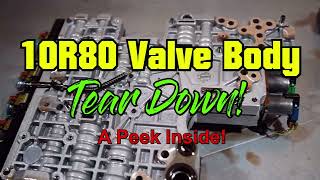
Typical fix: Replacement of the main control valve body assembly. 🎬 Watch: Step-by-step guide to replacing the 10R80 valve body In some cases, the TSB allows for an overhaul (cleaning and inspection) of the existing valve body.
Est. part cost: $350-$600, plus a potential core charge of around $200. - Low or Contaminated Transmission Fluid (ATF) 🟡 Medium Probability → Shop Transmission Assembly While not specific to this platform, low or dirty fluid is a common cause of hydraulic issues in any automatic transmission. The 10R80 is particularly sensitive to fluid type and condition, requiring Mercon ULV. Contamination can cause valves to stick, mimicking a component failure.
How to confirm: Check the transmission fluid level and condition according to the manufacturer's procedure. This transmission does not have a traditional dipstick, so the check must be performed by a technician from underneath the vehicle. The fluid should be at the correct level, red in color, and free of debris or a burnt smell.
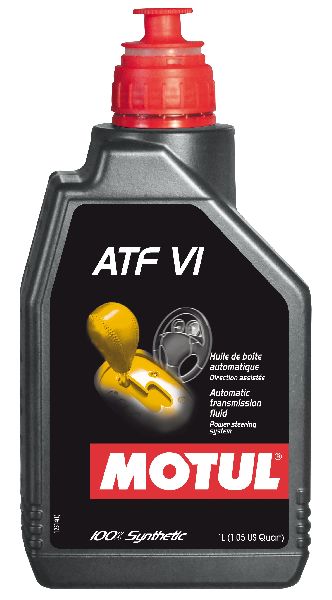
Typical fix: Perform a transmission fluid and filter change using the correct OEM-specified fluid (Mercon ULV).
Est. part cost: $100-$200 - Failed Shift Solenoid ⚪ Low Probability → Shop Transmission Valve Body While a single solenoid can fail, the TSBs for the Aviator point to a broader problem with the valve body assembly (sticking valves) or CDF drum, making the failure of an individual solenoid less likely to be the root cause. The solenoids are integrated into the valve body assembly.
How to confirm: A diagnostic scan tool can be used to command the specific solenoid and check its electrical resistance and function. Resistance for all shift solenoids should be between 5.0-5.4 ohms at 68°F (20°C).
Typical fix: Replacement of the faulty solenoid. However, since the solenoids are part of the valve body, the entire assembly is often replaced.
Est. part cost: $50-$150 (solenoid only)
Rare But Worth Checking
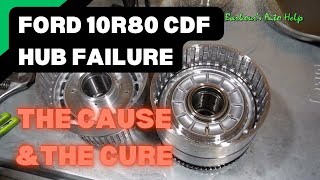
- Internal Transmission Mechanical Failure (CDF Drum): → Shop Transmission Assembly A known and severe failure point in the 10R80 is the CDF (Clutch C/D/F) drum assembly. A sleeve inside the drum can slide out of position, exposing fluid passages and causing severe, erratic shifting conditions and pressure loss. TSB 22-2428 and the newer TSB 24-2254 acknowledge this as a potential cause. This failure can also cause the F-clutch pack itself to wear grooves into its housing, leading to catastrophic failure. 🎬 See why the CDF drum fails and how to fix it This is a much more extensive and expensive repair, often requiring a partial or full transmission rebuild.
- Powertrain Control Module (PCM) Software or Hardware Issue: Outdated software can cause shifting issues, and various TSBs recommend reprogramming the PCM as a first step. In very rare instances, the PCM or TCM itself could have an internal driver circuit failure, but all other possibilities, especially the valve body and CDF drum, should be exhausted first.
Diagnosis Steps
- Verify the transmission fluid level and condition. This must be done by a professional as there is no dipstick. The correct fluid is Mercon ULV.
- Use a professional OBD-II scanner to check for P2705 and any other related transmission codes.
- Check for any applicable Technical Service Bulletins (TSBs) for the vehicle's VIN. Specifically, reference TSB 22-2428 or the more recent TSB 24-2254.
- Follow the diagnostic flowchart in the TSB. This will likely involve attempting to update PCM/TCM software first.
- If software updates do not resolve the issue, perform the 'PCM - Transmission Accelerated Main Control Break In' routine using a high-level scan tool as described in TSBs.
- If the condition persists after the break-in routine, the TSB directs the technician to overhaul or replace the main control valve body.
- During diagnosis, a technician may also perform hydraulic circuit leakage tests to inspect for signs of CDF drum failure, which TSB 24-2254 lists as a potential cause.
- After any component replacement (valve body or transmission), perform the solenoid strategy programming and the transmission adaptive learning procedure as specified by the manufacturer, which involves a specific drive cycle.
Parts You'll Likely Need
- Automatic Transmission Valve Body
(OEM #L1MZ-7A100-C)— This is the most common point of failure for code P2705 on the 2020-2023 Aviator, as documented in multiple manufacturer TSBs which cite sticking valves as the cause. Note: Part number L1MZ-7A100-C is specified for the Explorer Hybrid; ensure the correct part number is used for the specific Aviator powertrain.
Trusted brands: Motorcraft
OEM price range: $350-$550, plus a refundable core charge.
Aftermarket price range: $300-$500
Related Codes That Often Appear With This One
- P0729 - P0736 — These codes relate to incorrect gear ratios, which are often caused by the same underlying hydraulic issues (like a faulty valve body or CDF drum pressure loss) that trigger P2705. They are listed together in the same TSBs.
- P2700 - P2704 — These are codes for other friction elements ('A' through 'E'). It is common for multiple friction element apply-time codes to appear together, pointing to a systemic issue like the valve body or fluid pressure, as documented in TSB 22-2428.
Technical Service Bulletins (TSBs) & Recalls
- TSB 22-2428: Supersedes previous TSBs. Broadens the cause to include sticking valves, PCM/TCM software, and axial movement of the CDF clutch cylinder sleeve. Covers a wide range of Ford/Lincoln vehicles with the 10-speed transmission.
- TSB 24-2254: A 2024 bulletin that also addresses harsh shifts and DTCs including P2705, focusing on axial movement of the CDF clutch cylinder sleeve causing hydraulic leaks.
- TSB 21-2434: Explicitly states that DTCs including P2705 may be due to sticking valves in the main control valve body and provides a diagnostic procedure involving a 'break-in' routine before replacing the part.
- TSB 22-2102: Also directly links P2705 and other codes to sticking valves in the main control valve body and details the service procedure to overhaul the valve body if a break-in routine fails.
Platform-Specific Known Issues
- The 10-speed automatic transmission (10R60/10R80) used in the Aviator is known for having issues with the main control valve body, leading to a variety of shifting complaints and fault codes.
- Ford has issued multiple TSBs that group P2705 with many other transmission codes, indicating a known pattern of faults. The most current comprehensive TSBs are 22-2428 and 24-2254, which point to sticking valves, software issues, or a failing CDF clutch cylinder sleeve as the primary causes.
- A more severe, but related, known issue is the failure of the CDF drum, where an internal sleeve can move and cause major hydraulic leaks, leading to erratic shifting and eventual transmission failure.
Mechanic-Grade Diagnostic Values
- Shift Solenoid (A-F) Coil Resistance — expected: 5.0 - 5.4 Ohms at 20°C (68°F). Failure: A reading of infinite resistance (open circuit) or significantly outside the specified range indicates a failed solenoid coil.
- Torque Converter Clutch (TCC) Solenoid Current — expected: Proportional control: Low current (~50 mA) results in low pressure; high current (~850 mA) results in high pressure.. Failure: Pressure not responding correctly to commanded current from a scan tool.
- Line Pressure Control (LPC) Solenoid Current — expected: Inversely proportional control: Low current (~50 mA) results in high pressure; high current (~850 mA) results in low pressure.. Failure: Pressure not responding correctly to commanded current from a scan tool.
Hidden / Shadow Codes Worth Checking
- P163E: Transmission Control Module (TCM) Programming Error. This code often appears after replacing the main control valve body. (see via This code is stored in the PCM/TCM and is visible with a standard OBD-II scanner. It is caused by a software incompatibility between the new valve body's solenoid strategy and the vehicle's software. Per TSB 22-2339, the fix is to re-run the programming but ONLY enter the 13-digit solenoid strategy, leaving the 12-digit body ID blank.)
Scan Tool Commands That Help
- Ford IDS/FDRS: Clear Transmission Adaptive Tables — This must be performed after a transmission or valve body replacement, or as a diagnostic step to see if shifting issues improve. It forces the TCM to relearn clutch apply pressures.
- Ford IDS/FDRS: PCM – Transmission Strategy Download — This function is required when a new main control valve body or transmission is installed. It writes the unique characterization data of the new solenoids to the TCM.
- Ford IDS/FDRS: Adaptive Learning Drive Cycle — After clearing adaptive tables or replacing major components, this specific, multi-step driving procedure must be performed to allow the TCM to learn the new components and ensure smooth shifting.
Wiring & Ground Locations
- Main Transmission Connector — External connector on the transmission housing.. This is the primary interface between the TCM and all transmission solenoids and sensors. A visual inspection for corrosion, fluid contamination, or damage is a key first step. One half of the connector shell is typically brown, while the other is blue.
- Transmission Wiring Diagrams — Not a physical part, but a required resource.. Accurate diagnosis of a wiring issue requires a factory wiring schematic to trace circuits and identify pin numbers for testing. Official diagrams for the 2020 Aviator are available from Helm Inc.
Real Owner Repair Stories
- Reddit user in r/f150 (2021 Ford F-150 Powerboost (10R80 family)) — At light throttle, the truck would 'shutter or slam' into 3rd gear.
❌ Tried (didn't work) Initial diagnosis by the technician found no stored trouble codes.
✅ What actually fixed it The technician found and applied TSB 22-2428. This was a software/calibration update that took two days at the dealership to complete. The user reported the shifting was significantly improved and 'almost invisible' afterward. - Reddit user in r/fordexpedition (2020 model year vehicle) — Slams into Drive or Reverse, rough 4-5 shift, and one instance of a loud 'thud' from the rear on the highway followed by warning lights.
❌ Tried (didn't work) The user had the CDF drum replaced.
✅ What actually fixed it The CDF drum replacement did not fully resolve the issues. The user still reported firm engagement from 5-6 and harsh jerks when shifting into reverse, indicating the complexity of these transmission issues where one common fix may not be a complete solution. - Ford F150 Forum user (2018 Ford F-150) — Not applicable, this was a post-repair issue.
❌ Tried (didn't work) Using FORScan to program the new valve body solenoid strategy., Using the official Ford FJDS software with a J2534 interface.
✅ What actually fixed it This story highlights a common problem, not a fix. After installing a new valve body, the user was unable to program the new solenoid strategy. Both FORScan and the official Ford software returned a 'Solenoid Not Found' error from the Ford servers, preventing the repair from being completed. This is a critical real-world issue for DIY or independent shops.
OEM Part Supersession History
L1MZ-7A100-A, L1MZ-7A100-E→L1MZ-7A100-K— Part revision and improvement by the manufacturer.L1MZ-7A100-B→L1MZ-7A100-F— Part revision and improvement by the manufacturer.L1MZ-7A100-C→Unknown
Heads up: This part number is listed specifically for the Ford Explorer 3.3L Hybrid with the 10R80-MHT transmission. Using it on a non-hybrid Aviator may cause issues. Always verify the correct part number for the vehicle's specific powertrain via VIN.
Model Year Variations Within This Range
- 2020-2022: Vehicles built on or before August 15, 2022, are more prone to the CDF drum sleeve failure. TSB 22-2428 specifically targets vehicles built on or before this date, implying a production change was made to address the issue.
- 2023+: Later model year transmissions are believed to have the updated CDF drum from the factory, which includes a machined lip to prevent the internal sleeve from migrating. This makes the 2023+ models less susceptible to this specific catastrophic failure, though valve body issues may still occur.
Helpful Videos
We Have This Part in Stock


The information in this article is provided for general reference and educational purposes only. Vehicle specifications, procedures, and part compatibility can vary by production date, trim level, and region. Always consult your vehicle's factory service manual and verify part numbers before purchasing or performing repairs. Safety-critical components such as airbags, seat belts, and braking systems should be installed by a qualified professional.
- Lincoln AVIATOR:
- 🧭 Diagnostic Flowchart
- 🎬 Helpful Videos
- 🛍️ Shop This Part
- What's Unique About the 2020-2023 Lincoln AVIATOR
- Symptoms You May Notice
- Most Likely Causes
- Rare But Worth Checking
- Diagnosis Steps
- Parts You'll Likely Need
- Related Codes That Often Appear With This One
- Technical Service Bulletins (TSBs) & Recalls
- Platform-Specific Known Issues
- Mechanic-Grade Diagnostic Values
- Hidden / Shadow Codes Worth Checking
- Scan Tool Commands That Help
- Wiring & Ground Locations
- Real Owner Repair Stories
- OEM Part Supersession History
- Model Year Variations Within This Range
- 🎟️ Get 5% Off