

P2707 on 2018-2023 Ford Mustang: Shift Solenoid 'F' Stuck Off Guide
On 2018-2023 Mustangs with the 10R80 10-speed automatic, P2707 is a serious code indicating an internal transmission fault. The most likely cause is a faulty main control valve body or a failure in the CDF clutch drum assembly, both known issues covered by Ford TSBs. Expect a costly repair, often $2,000-$4,000+, that is not DIY-friendly.
- P2707 on a 2018-2023 Mustang is not a simple fix and indicates a serious internal transmission problem.
- The most common cause is a faulty main control (valve body), a known issue covered by multiple Ford TSBs.
- Do not simply replace the shift solenoid; the root cause is likely a larger hydraulic or mechanical failure within the transmission.
- This is not a DIY repair. It requires specialized tools and expertise, and is very expensive if the vehicle is out of warranty.
- If you experience harsh shifting or see this code, take it to a qualified transmission shop or a Ford dealer immediately to prevent further damage.
What's Unique About the 2018-2023 Ford MUSTANG
For the 2018-2023 Mustang, this code is almost exclusively associated with the 10-speed 10R80 automatic transmission. While P2707 points to a single solenoid, the root cause is often much deeper and is part of a well-documented pattern of failures in the 10R80. 🎬 See a breakdown of the four most common 10R80 failures. Ford has issued multiple Technical Service Bulletins (TSBs) that link this code to systemic issues. One major cause is 'axial movement of the CDF clutch cylinder sleeve', which creates internal hydraulic leaks that prevent the clutch from engaging properly. Another documented failure is the small plugs on the input shaft for the 'F' clutch circuit blowing out, causing a massive and direct hydraulic leak.
Diagnostic Flowchart
Tap your situation to follow the diagnostic path that matches what you're seeing on this vehicle.
Symptoms You May Notice
- Harsh, jerky, or delayed gear shifts, particularly noted by owners on 3-4, 3-5, and 5-6 shifts.
- A loud clunk or bang when the transmission attempts to shift, especially from Park to Drive.
- Check Engine Light or wrench-shaped Powertrain Fault light is on.
- Vehicle enters 'limp mode,' limiting available gears and engine power.
- Transmission slipping or flaring, where engine RPMs increase between shifts without a corresponding increase in speed.
- Hesitation or complete inability to shift into certain gears, sometimes resulting in a 'neutral out' condition.
- Replacing only the 'F' shift solenoid without addressing the underlying valve body or input shaft issue. The code will likely return.
- Performing only a fluid change without diagnosing the root hydraulic leak or control failure.
Most Likely Causes
- Faulty Main Control (Valve Body) Assembly 🔴 High Probability → Shop Transmission Valve Body This is a widely documented failure on the 10R80 transmission. Ford TSBs 23-2123, 23-2250, and others specifically call for overhauling or replacing the valve body to correct this and related codes due to issues like sticking valves or internal wear. One owner on Mustang6G.com reported a total cost of $1,325 for a valve body replacement at a transmission shop.
How to confirm: A technician will use a high-end scan tool to monitor solenoid commands vs. actual state and transmission pressures. Following the TSB diagnostic path is critical.
Typical fix: Overhaul or complete replacement of the main control valve body assembly, followed by a PCM/TCM reflash and adaptive learning drive cycle.
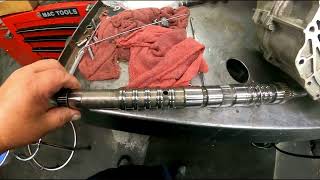
Est. part cost: $800-$1500 - Blown Plugs on Input Shaft / CDF Drum Failure 🟡 Medium Probability The input shaft for the 10R80 has several pressed-in plugs for hydraulic circuits. The plug for the 'F' clutch circuit has been known to fail and blow out, causing a complete loss of pressure that directly triggers the P2707 code. 🎬 Watch: A deep dive into diagnosing P2707 and P2708 codes. This is sometimes part of a larger failure of the CDF (Clutch F) drum assembly, where a bushing walks out and causes leaks.
How to confirm: This requires transmission removal and disassembly. A simple test involves sticking a coat hanger into the four holes on the tip of the input shaft; if it passes all the way through the 'F' clutch port (second from the tip), the plug is missing.
Typical fix: The transmission must be removed. The failed plug is typically welded shut by transmission specialists to create a permanent seal. In other cases, the entire input shaft or the CDF drum assembly is replaced.
Est. part cost: $200-$600 for a new shaft, plus significant labor for transmission R&R. - Failed Shift Solenoid 'F' ⚪ Low Probability → Shop Transmission Valve Body While the code directly names the solenoid, it's often a symptom of a larger problem (like a faulty valve body or pressure leak) rather than the root cause. The solenoid itself can fail, but it's less common than the other systemic issues on this platform.
How to confirm: A technician can test the solenoid's electrical resistance and try to command it with a scan tool. If the valve body is removed, the solenoid can be bench-tested.
Typical fix: Replacement of the individual shift solenoid. This is often done as part of a valve body service, but replacing only the solenoid often results in the code returning.
Est. part cost: $50-$100 - Low or Contaminated Transmission Fluid ⚪ Low Probability → Shop Transmission Assembly While possible, it's unlikely to be the root cause unless there is a significant leak. On the 10R80, this code usually points to a mechanical or hydraulic control failure rather than just fluid condition.
How to confirm: Check the transmission fluid level and condition per the manufacturer's procedure. The fluid should be at the correct level, have a reddish hue, and not smell burnt.
Typical fix: Perform a transmission fluid drain and fill, or a full fluid exchange, using the correct Motorcraft MERCON ULV fluid.
Est. part cost: $150-$250 for fluid
Rare But Worth Checking
- Wiring Harness Issue: Damage to the wiring leading to or inside the transmission can cause a loss of signal to the solenoid. This is worth checking before condemning expensive internal parts, but is less common than the valve body or CDF drum issues.
- TCM Failure or Software Glitch: In very rare cases, the Transmission Control Module (TCM) itself can fail. More commonly, a software glitch or outdated calibration can cause shifting issues. TSBs often involve a software reflash as a first step or after a hardware replacement.
Diagnosis Steps
- Verify the transmission fluid level and condition. Ensure it is clean, full, and does not smell burnt.
- Use a professional-grade scan tool to read all codes from the TCM and PCM. Note any other accompanying codes, as they are critical clues.
- Review the vehicle's service history for any related TSBs, especially TSB 23-2250 or its latest successor.
- Clear the codes and perform a test drive to see if the code immediately returns and under what conditions (e.g., which gear shift).
- With the scan tool, monitor the commanded state vs. the actual state of Shift Solenoid 'F' during operation.
- Follow the diagnostic procedure outlined in the relevant TSB. This may involve a PCM reflash first, followed by hydraulic pressure tests if the issue persists.
- If the TSB directs, drop the transmission pan and inspect the valve body. Look for debris in the pan.
- If an input shaft plug is suspected, the transmission must be removed. Inspect the input shaft by checking for a missing plug in the 'F' clutch circuit hole (second from the end) using a simple tool like a piece of a coat hanger.
Parts You'll Likely Need
- Main Control Valve Body Assembly
(OEM #JL3Z-7A100-C)— This is the most common repair recommended by Ford's own Technical Service Bulletins to fix the root cause of the hydraulic pressure loss. Part number may be superseded; always verify with VIN. Other related numbers include HL3Z-7A100-B.
Trusted brands: Motorcraft
OEM price range: $1000-$1500
Aftermarket price range: $700-$1100 - Transmission Fluid (MERCON ULV)
(OEM #XT-12-QULV)— Required anytime the transmission is serviced. Using the correct fluid is critical for the 10R80 transmission's performance.
Trusted brands: Motorcraft
OEM price range: $20-$30 per quart - Input Shaft / CDF Drum Assembly — Required if diagnosis confirms a blown internal plug or a failed CDF drum bushing, which cannot be repaired without transmission removal and disassembly.
Trusted brands: Motorcraft
OEM price range: $200-$600
Related Codes That Often Appear With This One
- P2700-P2705 — These codes relate to other shift solenoids (A, B, C, D, E). Multiple solenoid codes strongly point to a systemic failure in the valve body or a major hydraulic leak.
- P0751, P0756, P0761, etc. — These are also shift solenoid performance codes listed in the same Ford TSBs. Their presence alongside P2707 confirms a widespread transmission problem, often pointing directly to the valve body or CDF drum.
Technical Service Bulletins (TSBs) & Recalls
- TSB 23-2250: Supersedes many previous TSBs, linking P2707 and other codes to software, valve body issues, or 'axial movement of the CDF clutch cylinder sleeve'.
- TSB 23-2123: A widely referenced bulletin that recommends overhauling the main control valve body and performing an adaptive learning drive cycle for P2707 and other shift codes.
- TSB 22-2428: Also lists P2707 with other codes for an illuminated MIL and transmission issues, pointing to similar causes.
- TSB 24-2254: Connects P2707 to harsh shifts and notes the cause may be 'axial movement' leading to internal leaks in the CDF clutch cylinder.
Platform-Specific Known Issues
- Multiple Ford Technical Service Bulletins (including TSB 23-2123 and the superseding TSB 23-2250) address harsh or delayed shifting with code P2707 on 10R80-equipped Mustangs. The primary recommended fix is often to overhaul or replace the main control valve body.
- A known failure point is the press-fit plugs in the input shaft, which can dislodge and cause a complete loss of hydraulic pressure to the 'F' clutch circuit, directly causing a P2707 code.
- Another core issue identified in TSBs is the 'axial movement of the CDF clutch cylinder sleeve,' which was addressed with an updated part on vehicles built on or after August 16, 2022.
Mechanic-Grade Diagnostic Values
- Shift Solenoid (A-F) Resistance — expected: 5.0 - 5.4 Ohms at 68°F (20°C). Failure: A reading significantly outside this range, or an open/short circuit, indicates a failed solenoid coil.
Scan Tool Commands That Help
- Ford IDS, FORScan, or equivalent professional scanner: Clear Transmission Adaptive Tables / Reset KAM — This function must be performed after replacing the valve body, solenoids, or the entire transmission. It erases the learned hydraulic pressure and timing values, allowing the TCM to relearn the characteristics of the new components.
- N/A - this is a driving procedure: Adaptive Learning Drive Cycle — This specific, multi-step driving procedure is required immediately after clearing the adaptive tables to allow the TCM to properly learn the clutch fill times and shift points. It involves a series of light-throttle accelerations through the gears and specific shifting sequences between Neutral, Reverse, and Drive.
- Ford IDS, FORScan: Solenoid Strategy Programming — When the entire valve body (main control) assembly is replaced, the 13-digit solenoid strategy number and 12-digit solenoid ID from the new part must be programmed into the TCM. Failure to do so will result in poor shifting and potential damage.
Wiring & Ground Locations
- C175T — The main 26-way electrical connector on the outside of the 10R80 transmission case.. This is the primary connection point for all internal transmission electronics, including Shift Solenoid 'F'. A visual inspection for corrosion, damage, or pushed-out pins at this connector is a crucial first step before condemning internal components.
Real Owner Repair Stories
- YouTube channel 'Curmudgeon Transmission' (Vehicle with 10R80 transmission) — DTC P2707 or P2708, Shift Element 'F' Stuck Off/On.
❌ Tried (didn't work) The technician noted that attempting to install a cut plug to fix the leak failed because the hole had become enlarged, preventing a secure fit.
✅ What actually fixed it The root cause was a blown-out press-fit plug on the end of the input shaft for the 'F' clutch hydraulic circuit. This caused a massive, direct pressure leak. The permanent fix was to remove the transmission, disassemble it, and weld the hole for the 'F' clutch plug shut, then grind it flush.
"I Checked Everything" — The Actual Cause
- A common scenario for P2707 is that all electrical tests for Shift Solenoid 'F' will pass (correct resistance, voltage signal from TCM), yet the code persists. This often points away from an electrical issue and towards a mechanical or hydraulic failure. The definitive example is a blown-out plug on the input shaft for the 'F' clutch circuit. No amount of electrical testing will find this; it can only be confirmed by removing the transmission and physically inspecting the input shaft. A simple check with a piece of a coat hanger in the 'F' clutch port (second from the tip) will reveal if the plug is missing.
OEM Part Supersession History
JL3Z-7A100-A→JL3Z-7A100-C— Updated part, likely to address valve body wear and sticking valve issues.
Heads up: This part series is generally for the F-150 2.7L/3.0L/5.0L and Expedition/Navigator, but may be used in some Mustang configurations. Always verify with VIN.HL3Z-7A100-A→HL3Z-7A100-B— Updated part, likely to address valve body wear and sticking valve issues.
Heads up: This part series is generally for the F-150 3.5L. It is critical to use the correct part series for the vehicle's specific application.
Model Year Variations Within This Range
- 2018 - mid-2022: Vehicles built before August 16, 2022, are more susceptible to the CDF drum internal sleeve moving, which can cause hydraulic leaks and trigger P2707. Vehicles built after this date have an updated CDF drum from the factory with a machined lip to prevent this movement.
Helpful Videos

We Have This Part in Stock


The information in this article is provided for general reference and educational purposes only. Vehicle specifications, procedures, and part compatibility can vary by production date, trim level, and region. Always consult your vehicle's factory service manual and verify part numbers before purchasing or performing repairs. Safety-critical components such as airbags, seat belts, and braking systems should be installed by a qualified professional.
- Ford MUSTANG:
- 🧭 Diagnostic Flowchart
- 🎬 Helpful Videos
- 🛍️ Shop This Part
- What's Unique About the 2018-2023 Ford MUSTANG
- Symptoms You May Notice
- Most Likely Causes
- Rare But Worth Checking
- Diagnosis Steps
- Parts You'll Likely Need
- Related Codes That Often Appear With This One
- Technical Service Bulletins (TSBs) & Recalls
- Platform-Specific Known Issues
- Mechanic-Grade Diagnostic Values
- Scan Tool Commands That Help
- Wiring & Ground Locations
- Real Owner Repair Stories
- "I Checked Everything" — The Actual Cause
- OEM Part Supersession History
- Model Year Variations Within This Range
- 🎟️ Get 5% Off