

P2707 on 2020-2023 Ford Transit: Shift Solenoid 'F' Causes and Fixes
On a 2020-2023 Ford Transit, code P2707 almost always points to a significant internal transmission problem, not just a bad solenoid. Ford has issued multiple Technical Service Bulletins (TSBs) for this issue, which is often caused by a failing CDF clutch drum sleeve that moves out of position and causes a major hydraulic leak. This is a complex, professional-level repair requiring transmission disassembly.
- P2707 on a 2020-2023 Transit is a serious code indicating a likely internal transmission problem.
- The cause is rarely a simple solenoid failure; it is most often a failed CDF clutch cylinder sleeve as documented in Ford TSBs.
- Diagnosis requires specialized tools and knowledge of Ford's service bulletins to confirm the internal hydraulic leak.
- This is not a DIY-friendly repair. It requires professional service and partial transmission disassembly.
- Do not simply replace the shift solenoid; ensure a full diagnosis is performed to find the true root cause.
What's Unique About the 2020-2023 Ford TRANSIT
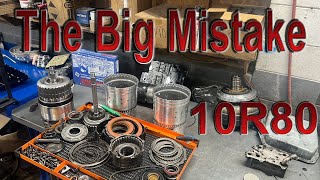
The 2020-2023 Ford Transit uses the 10R80 10-speed automatic transmission, which is known for a specific internal failure that triggers P2707 and a host of related codes. Multiple Ford TSBs point to a root cause of "axial movement of the CDF clutch cylinder sleeve, 🎬 Watch: See how the CDF drum sleeve fails internally." which causes internal hydraulic leaks. The sleeve, or bushing, inside the CDF drum can slide out of its intended position, uncovering fluid passages and causing a severe pressure loss in the 'F' clutch hydraulic circuit. This is a much more common cause on this platform than a simple solenoid failure, making proper diagnosis critical to avoid replacing the wrong parts.
Diagnostic Flowchart
Tap your situation to follow the diagnostic path that matches what you're seeing on this vehicle.
Symptoms You May Notice
- Harsh, abrupt, or delayed shifts, particularly 1-2 and 3-4 upshifts.
- Vehicle may return to Park after being shifted into Drive or Reverse.
- Check Engine Light or Malfunction Indicator Lamp (MIL) is on.
- Transmission slipping between gears or 'neutraling out' during shifts.
- Vehicle may enter "limp mode," limiting available gears and vehicle speed.
- A noticeable 'flare' or RPM jump between shifts.
- Delayed engagement when shifting from Park to Drive.
- Replacing only the Shift Solenoid 'F' without diagnosing the root cause. While the solenoid can fail, the prevalent issue on the 10R80 transmission is the internal hydraulic leak from the CDF clutch sleeve, which a new solenoid will not fix.
- Performing only a fluid change. While contaminated fluid can cause issues, it is usually a symptom of the internal mechanical wear, not the root cause of P2707. A fluid change will not fix a dislodged sleeve or plug.
Most Likely Causes
- CDF Clutch Cylinder Sleeve Failure 🔴 High Probability → Shop Automatic Transmission Coast Clutch Hub This is a well-documented design flaw in Ford's 10R80 transmission. Multiple TSBs (including TSB 24-2254) cite "axial movement of the CDF clutch cylinder sleeve causing hydraulic circuit leaks" as the primary cause. The sleeve walks out of position, exposing oil passages and causing a catastrophic loss of pressure for the clutches it controls.
How to confirm: A technician must perform a specialized hydraulic/vacuum test on the transmission's internal circuits as outlined in TSB 24-2254 to confirm leakage at the CDF clutch cylinder. This requires a special tool (Rotunda 164-R9833 Pressure Vacuum Transducer Kit). Visual inspection during disassembly will clearly show the sleeve has moved.
Typical fix: The transmission must be partially disassembled to replace the CDF clutch cylinder assembly with an updated part that features a lip or design that prevents the sleeve from walking out. The updated Ford part is often referred to as the CDF clutch drum hub assembly.
Est. part cost: $200-$400 for the clutch cylinder assembly - Sticking Valves in Main Control Valve Body 🟡 Medium Probability → Shop Transmission Valve Body Ford TSBs also list sticking valves in the valve body as a possible cause for these symptoms and codes. This can be due to fluid contamination from wearing parts (like the CDF drum) or manufacturing debris.
How to confirm: After ruling out the CDF clutch sleeve, a technician will inspect and test the main control valve body for proper operation of its valves and solenoids. This is often done after the primary CDF drum issue is suspected or confirmed.
Typical fix: The main control valve body may need to be overhauled or replaced. In many cases, this issue is secondary to debris generated by the primary CDF drum failure.
Est. part cost: $50-$150 for a single solenoid, $600-$1200 for a complete valve body assembly - Low or Contaminated Transmission Fluid ⚪ Low Probability → Shop Transmission Assembly
How to confirm: Check the transmission fluid level and condition. The fluid should be at the correct level and have a clean, reddish color without a burnt smell or excessive metallic particles ('glitter').
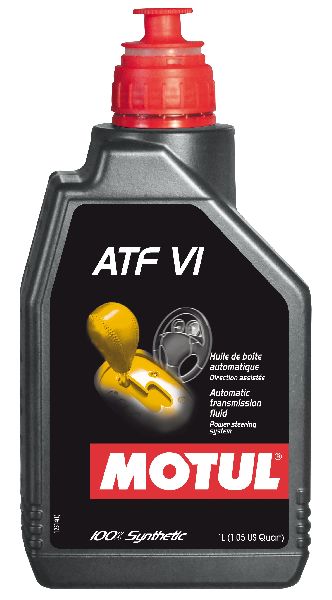
Typical fix: Perform a transmission fluid and filter change using the correct Motorcraft MERCON ULV fluid. This is unlikely to fix the issue if the CDF sleeve has failed but is a basic first step and necessary for any internal repair.
Est. part cost: $150-$250 for fluid and filter
Rare But Worth Checking
- Failed Input Shaft End Plug: In some 10R80 transmissions, a small cup plug inside the input shaft that seals the 'F' clutch circuit can fail and fall out, causing a massive hydraulic leak and a P2707 code. A technician can diagnose this by probing the holes at the tip of the input shaft with a piece of a coat hanger; if the hanger goes all the way through the 'F' circuit hole, the plug is missing. This requires transmission removal to inspect and repair, often by welding the hole shut.
- Faulty Transmission Control Module (TCM) or Wiring: → Shop Transmission Assembly While less common than the mechanical failures, a damaged wire in the harness leading to the transmission or an internal TCM fault can also trigger this code. This should be considered only after the common mechanical failures have been ruled out.
Diagnosis Steps
- Verify the code with a professional OBD-II scanner. Note all other transmission-related codes present.
- Check the transmission fluid level and condition. Ensure it is full and not burnt or contaminated with excessive metal.
- Consult Ford Technical Service Bulletins (TSBs) for the 10R80 transmission, specifically TSB 24-2254, which directly addresses this code group.
- Perform the specific diagnostic tests outlined in the TSBs, which involve removing the valve body and checking for hydraulic leaks at the CDF clutch cylinder using a specialized pressure/vacuum transducer kit (Rotunda 164-R9833).
- If the CDF clutch sleeve is the cause, proceed with transmission disassembly and replacement of the CDF clutch cylinder assembly.
- If no leak is found at the CDF clutch, inspect the main control valve body for sticking valves or faulty solenoids.
- As a rare possibility, inspect the input shaft for a missing 'F' circuit end plug.
- Test the wiring harness between the TCM and the transmission for continuity and shorts if all mechanical checks are inconclusive.
Parts You'll Likely Need
- CDF Clutch Cylinder Assembly
(OEM #JL3Z-7H351-B (updated part))— This is the most common point of failure according to multiple Ford TSBs for the 10R80 transmission. The original design allows a sleeve to move, causing the hydraulic leak that triggers P2707. The updated part prevents this movement.
Trusted brands: Motorcraft
OEM price range: $250-$450
Aftermarket price range: $200-$350 (aftermarket kits from Sonnax or other brands also exist) - Main Control Valve Body Assembly — If the issue is sticking valves that cannot be cleaned or repaired, or if it's damaged by debris from the CDF drum failure, the entire valve body assembly with solenoids is often replaced.
Trusted brands: Motorcraft
OEM price range: $800-$1200
Aftermarket price range: $500-$900 - Transmission Filter and Fluid Kit
(OEM #FT215 (Filter), XT-12-QULV (Fluid))— Required for any internal transmission service. Ford Transits with the 10R80 transmission require Motorcraft MERCON ULV automatic transmission fluid.
Trusted brands: Motorcraft
OEM price range: $150-$250
Aftermarket price range: $100-$180
Related Codes That Often Appear With This One
- P0751-P0772 — These are performance codes for other shift solenoids (A, B, C, D, E). They are often triggered along with P2707 because the underlying hydraulic leak from the CDF drum affects multiple clutch circuits.
- P2700-P2708 — This is a range of codes related to clutch apply time and solenoid performance. P2707 falls within this group, and seeing others like P2705 (Clutch Apply Time Range/Performance) points to the same common internal failures.
- P0729-P0736 — These codes indicate incorrect gear ratios. When a clutch fails to apply due to a hydraulic leak, the TCM detects a mismatch between the commanded gear and the actual gear ratio, setting these codes.
Technical Service Bulletins (TSBs) & Recalls
- TSB 26-2046: Addresses harsh/delayed shifts with DTC P2707 among others on 2023 models.
- TSB 24-2254: Supersedes earlier TSBs and provides the definitive diagnostic procedure for P2707 and related codes, citing "axial movement" of the CDF clutch cylinder sleeve as the cause and detailing the vacuum test procedure.
- TSB 22-2428: An earlier TSB, also listing P2707 in a group of codes related to shift quality issues, which pointed toward valve body cleaning and reprogramming before focusing on the CDF drum replacement.
Platform-Specific Known Issues
- A series of Ford Technical Service Bulletins (TSB 24-2254 and its predecessors) have been issued for the 10R80 transmission used in the 2020-2023 Transit. They all address customer complaints of harsh or delayed shifts accompanied by a long list of DTCs, including P2707. The primary cause identified is a design issue with the CDF clutch cylinder sleeve that allows it to move axially (slide out of place), causing internal hydraulic pressure loss. The official fix involves replacing the entire CDF clutch cylinder with an updated design
Mechanic-Grade Diagnostic Values
- Shift Solenoid Resistance — expected: 5.0 - 5.4 Ohms at 68°F (20°C). Failure: A reading outside of this range, or an open/short circuit, indicates a failed solenoid.
- Normal Operating Transmission Fluid Temperature — expected: 206°F - 215°F (97°C - 102°C). Failure: Temperatures consistently above this range can indicate issues like low fluid level or internal problems, and can contribute to component failure.
Scan Tool Commands That Help
- Ford IDS, FORScan, or equivalent J2534 tool: Clear Transmission Adaptive Tables — This must be performed after replacing the valve body or transmission assembly. The PCM has learned the timing and hydraulic characteristics of the old components, and these learned values must be erased to allow the system to relearn with the new parts. Failure to do so will result in poor shift quality.
- Ford IDS, FORScan, or equivalent J2534 tool: Transmission Characterization Update / Solenoid Strategy Programming — Required any time the valve body or entire transmission is replaced. The replacement component comes with a new 13-digit Solenoid Body Strategy number that must be programmed into the PCM/TCM. This number corresponds to the specific flow rates of the solenoids on that valve body. The vehicle will not shift correctly without the proper strategy programmed.
- Ford IDS or equivalent: Adaptive Learning Drive Cycle — After clearing adaptive tables or programming a new solenoid strategy, a specific drive cycle must be performed to allow the TCM to relearn shift points and clutch apply pressures. This typically involves a series of gentle accelerations through all gears and gentle braking to a stop, repeated multiple times. Ford advises customers that shifts may be firmer than normal for several days during this relearning process.
Wiring & Ground Locations
- Internal Transmission Connector C177, Pin 18 — This connector is located on the transmission itself, where the main vehicle harness connects to the internal transmission harness and lead frame.. Pin 18 is the control circuit for Shift Solenoid 'F'. The wire color is typically Blue/Gray. A technician can perform voltage and continuity checks at this pin to diagnose wiring issues between the TCM and the solenoid.
Helpful Videos


We Have This Part in Stock


The information in this article is provided for general reference and educational purposes only. Vehicle specifications, procedures, and part compatibility can vary by production date, trim level, and region. Always consult your vehicle's factory service manual and verify part numbers before purchasing or performing repairs. Safety-critical components such as airbags, seat belts, and braking systems should be installed by a qualified professional.
- Ford TRANSIT:
- 🧭 Diagnostic Flowchart
- 🎬 Helpful Videos
- 🛍️ Shop This Part
- What's Unique About the 2020-2023 Ford TRANSIT
- Symptoms You May Notice
- Most Likely Causes
- Rare But Worth Checking
- Diagnosis Steps
- Parts You'll Likely Need
- Related Codes That Often Appear With This One
- Technical Service Bulletins (TSBs) & Recalls
- Platform-Specific Known Issues
- Mechanic-Grade Diagnostic Values
- Scan Tool Commands That Help
- Wiring & Ground Locations
- 🎟️ Get 5% Off