

P2708 on 2020-2023 Ford Explorer: Shift Solenoid 'F' Stuck On Causes & Fixes
On a 2020-2023 Ford Explorer, code P2708 is almost always caused by an internal transmission failure, not just a simple bad solenoid. The most common culprits are a faulty main control valve body or a known issue with the CDF clutch drum sleeve. This is a complex repair requiring professional service and is covered by multiple Ford Technical Service Bulletins (TSBs).
- P2708 on a 2020-2023 Explorer is a serious code indicating a likely internal transmission problem, not just a bad sensor.
- The issue is well-documented by Ford in multiple Technical Service Bulletins, which point to a faulty main valve body or a failed CDF clutch drum.
- Do not continue to drive the vehicle. The shifting can become dangerously unpredictable, and you risk severe, costly damage to the transmission.
- This is not a DIY repair. The fix requires professional-level diagnostics and extensive labor, often including the complete removal of the transmission.
- Ensure your repair shop is aware of the specific Ford TSBs related to this issue to ensure the correct, updated parts are used.
What's Unique About the 2020-2023 Ford EXPLORER
The 2020-2023 Explorer uses the 10R60 or 10R80 10-speed automatic transmission 🎬 Watch: Overview of common failures in these 10-speed transmissions, which is known to have specific mechanical weaknesses that trigger this code. Ford has issued multiple Technical Service Bulletins (TSBs) acknowledging these problems. Unlike many other vehicles where this code might point to a simple solenoid swap, on this Explorer it frequently indicates a deeper issue, such as sticking valves within the main control valve body or a design flaw involving a sleeve in the CDF clutch drum that moves and causes internal hydraulic leaks.
Diagnostic Flowchart
Tap your situation to follow the diagnostic path that matches what you're seeing on this vehicle.
Symptoms You May Notice
- Harsh, abrupt, or delayed gear shifts.
- Vehicle getting stuck in a single gear (limp mode).
- Slipping out of gear or engine revving without acceleration.
- Inability to select Reverse or Drive, or a delayed, harsh engagement.
- Illuminated Check Engine Light or Transmission Warning Light.
- Vehicle jerking or lurching at low speeds.
- Replacing only the 'F' shift solenoid without investigating the valve body or CDF clutch drum. On this specific platform, the solenoid itself is often not the ultimate point of failure.
Most Likely Causes
- Axial Movement of CDF Clutch Cylinder Sleeve 🔴 High Probability → Shop Automatic Transmission Coast Clutch Hub This is a known mechanical fault in the 10R80/10R60 transmission, as documented by Ford in TSB 24-2254. The internal bushing/sleeve moves out of position, exposing fluid passages and causing hydraulic leaks that disrupt clutch operation. A technician video shows how this sleeve can slide, and notes that Ford has an updated part with a machined lip or groove to prevent this movement.
How to confirm: A technician must perform a specialized hydraulic/vacuum test on the transmission's internal circuits to confirm the leak, as outlined in TSB 24-2254. This requires transmission disassembly to visually inspect or replace the drum. 🎬 Watch: Detailed teardown showing the internal CDF drum components
Typical fix: The transmission must be removed and disassembled to replace the CDF clutch cylinder with an updated part (OEM Part # JL3Z-7H351-B). Some aftermarket companies, like Sonnax, offer a 'CDF Drum Saver Kit' that installs a new sleeve with a locking set screw to prevent movement.
Est. part cost: $200-$400 for the OEM drum assembly - Sticking Valves in Main Control Valve Body 🔴 High Probability → Shop Transmission Valve Body Ford TSB 20-2403 and its successor TSB 21-2046 directly identify sticking valves in the main control valve body as a cause for harsh shifting and numerous transmission codes, including P2708. 🎬 See a technician explain these specific P2708 fault codes This can be due to manufacturing debris or fluid contamination, and Ford notes the condition may improve after the first 5,000 miles as the transmission breaks in.
How to confirm: This is diagnosed after ruling out fluid and software issues. Per TSB 20-2403, if a 'Transmission Accelerated Main Control Break-In' routine fails to resolve the issue, the valve body is the likely culprit. This procedure involves using a Ford diagnostic tool to cycle the clutches while the vehicle is on a lift.
Typical fix: Replacement of the entire main control valve body assembly. The updated part number may be ML3Z-7A100-B, superseding previous versions.
Est. part cost: $800-$1500 for the OEM valve body assembly, though remanufactured units are available. - Low or Contaminated Transmission Fluid 🟡 Medium Probability → Shop Transmission Assembly The complexity and tight tolerances of the 10-speed transmission make it very sensitive to fluid level and quality. Contaminated fluid can cause valves and solenoids to stick. One owner on a forum reported getting code P2708 along with the inability to engage reverse after a fluid and filter change, highlighting the sensitivity to the correct level and procedure.
How to confirm: Check the transmission fluid level and condition. The fluid must be clean, red, and at the correct level per the manufacturer's procedure. This transmission has no dipstick and must be checked from underneath with the fluid at a specific temperature (around 200°F).
Typical fix: Perform a transmission fluid and filter change using the correct Motorcraft MERCON ULV fluid. A full flush may be necessary if the fluid is heavily contaminated.
Est. part cost: $150-$250 for fluid and filter - Failed Shift Solenoid 'F' ⚪ Low Probability → Shop Transmission Valve Body While the code directly names the solenoid, on this platform it is more often a symptom of a larger hydraulic or mechanical issue (like the CDF drum or valve body) rather than the root cause. The hydraulic pressure loss from a bad CDF drum sleeve or a sticking valve in the valve body prevents the solenoid from operating correctly, triggering the code.
How to confirm: After confirming the valve body and CDF drum are functioning correctly, a technician can test the solenoid's resistance and function directly.
Typical fix: Replace the individual shift solenoid. This is done by dropping the transmission pan and accessing the valve body.
Est. part cost: $50-$100 for a single solenoid
Rare But Worth Checking
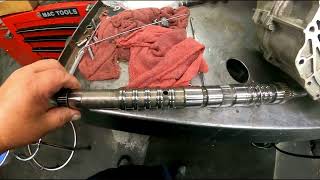
- Missing Hydraulic Circuit Plug in Input Shaft: A transmission technician documented a case on a 10R80 where a small plug for the 'F' clutch hydraulic circuit was missing from the end of the transmission input shaft, causing a direct pressure loss and triggering the code. This is a factory defect and requires transmission removal to diagnose and repair.
- TCM Software Corruption: An incomplete software update or file corruption can cause the TCM to command the solenoid incorrectly. Ford TSBs for various shifting issues often include reprogramming the PCM/TCM with the latest software as a first step.
Diagnosis Steps
- Verify the code with a professional OBD-II scanner capable of reading transmission-specific codes.
- Check the transmission fluid level and condition. This must be done by a professional as there is no dipstick and requires a specific temperature and procedure.
- Consult Ford's latest TSBs. TSB 24-2254 supersedes previous versions for the CDF drum issue, and TSB 21-2046 supersedes TSB 20-2403 for the valve body.
- Check for available PCM/TCM software updates and perform them as required by the TSBs. This is often the first step recommended by Ford for shift quality issues.
- If applicable based on TSB guidance (like TSB 20-2403), perform the 'Transmission Accelerated Main Control Break-In' routine. This requires a Ford diagnostic scan tool and involves cycling the clutches with the vehicle on a lift to free up sticking valves.
- If symptoms persist, the next step is diagnosing the main control valve body and/or performing vacuum/pressure tests as outlined in TSB 24-2254 to check for leaks at the CDF clutch cylinder sleeve.
- Based on test results, replace the main control valve body (Part # ML3Z-7A100-B or similar) or perform a full transmission overhaul to replace the CDF clutch drum assembly with the updated part (Part # JL3Z-7H351-B).
Parts You'll Likely Need
- Main Control Valve Body Assembly
(OEM #ML3Z-7A100-B (supersedes previous versions))— Identified by Ford TSBs as a primary cause of shifting issues due to sticking internal valves.
Trusted brands: Motorcraft
OEM price range: $800-$1500
Aftermarket price range: $600-$1200 - CDF Clutch Cylinder / Drum
(OEM #JL3Z-7H351-B (updated design))— A revised part is needed to fix the core mechanical flaw of the moving sleeve that causes hydraulic leaks, as identified in TSB 24-2254.
Trusted brands: Motorcraft
OEM price range: $200-$400
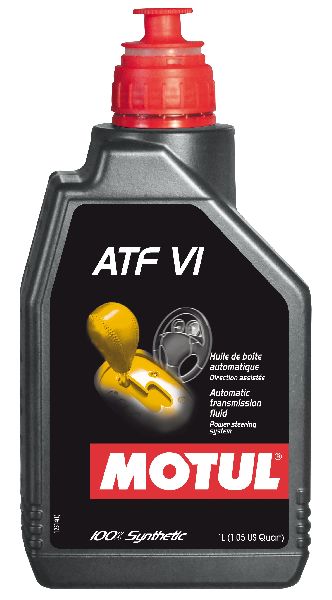
Aftermarket price range: N/A (Sonnax offers a repair kit for the original drum) - Automatic Transmission Fluid
(OEM #XT-12-QULV)— Required for any repair involving opening the transmission, such as replacing the valve body or filter. Must be MERCON ULV specification.
Trusted brands: Motorcraft MERCON ULV
OEM price range: $10-$15 per quart
Related Codes That Often Appear With This One
- P2707 — This code means 'Shift Solenoid F Stuck Off'. P2707 and P2708 often appear together or intermittently as they both relate to the function of the same solenoid and underlying hydraulic circuit.
- P07xx, P27xx — P2708 is part of a large family of transmission codes listed in Ford TSBs 24-2254 and 20-2403. Seeing it with other codes like P0751 (Shift Solenoid A Performance), P0731 (Gear 1 Incorrect Ratio), or P2700-P2705 (Clutch Apply Time) strongly points to the widespread hydraulic issues caused by the valve body or CDF drum failure.
Technical Service Bulletins (TSBs) & Recalls
- TSB 25-2302: Mentions P2708 in a list of DTCs related to power train issues in 2023 models. [Bulletin #TSB 25-2302]
- TSB 26-2046: Lists P2708 among DTCs for power train problems in 2022 models. [Bulletin #TSB 26-2046]
- TSB 24-2254: Connects P2708 and other codes to 'axial movement of the' CDF clutch cylinder sleeve. [Bulletin #TSB 24-2254]
- TSB 20-2403: Identifies sticking valves in the main control valve body as a cause for P2708 and other shift-related codes on 2020 models.
Platform-Specific Known Issues
- Multiple Ford Technical Service Bulletins (TSBs) have been issued for the 10R60 and 10R80 transmissions in these Explorers for harsh shifting, delayed engagement, and a wide range of trouble codes, including P2708. [Bulletin #TSB 25-2302, Bulletin #TSB 26-2046, Bulletin #TSB 24-2254]
- TSB 24-2254 and others point to a specific mechanical failure: 'axial movement of the CDF clutch cylinder sleeve causing hydraulic circuit leaks'. [9, Bulletin #TSB 24-2254]
- An earlier TSB for 2020 models, 20-2403, points to 'sticking valves in the main control valve body' as a primary cause.
Mechanic-Grade Diagnostic Values
- Shift Solenoid 'F' (and A-E) Operation Type — expected: Directly proportional linear force solenoid. Zero current equals zero hydraulic pressure; maximum current equals maximum pressure.. Failure: The code P2708 indicates the solenoid is commanded off (zero current) but remains mechanically or hydraulically stuck 'on'.
- Shift Solenoid Coil Resistance — expected: Approximately 10-15 Ω (general spec).. Failure: A reading significantly outside this range, or open/shorted, indicates a failed coil. However, electrical failure is less common than the mechanical/hydraulic issues on this platform.
Scan Tool Commands That Help
- Ford IDS/FJDS: Transmission Accelerated Main Control Break-In — As per TSB 20-2403, this routine is used on lower-mileage vehicles to attempt to free sticking valves in the main control valve body before opting for replacement.
- Ford IDS/FJDS: Solenoid Body Strategy Download — This is a mandatory procedure after replacing the main control valve body. The technician must enter the 12-digit identification and 13-digit strategy number from the new part into the TCM to ensure correct solenoid operation.
Wiring & Ground Locations
- Main Transmission Connector (C168A) — On the driver's side of the transmission case.. This is the primary electrical interface between the TCM and all transmission solenoids. Damage or corrosion at this connector or its pins can cause a wide range of solenoid-related fault codes.
- Gateway Module — Located behind the OBD-II connector, behind the driver-side fusebox.. This module routes CAN bus communications between the PCM/TCM and the rest of the vehicle. While not a direct cause, issues here can disrupt communication and cause erroneous codes.
Real Owner Repair Stories
- Curmudgeon Transmission YouTube Channel (Vehicle with 10R80 Transmission) — Codes P2707 (Shift Solenoid F Stuck Off) and P2708 appeared.
❌ Tried (didn't work) Initial diagnosis might point to the solenoid or valve body.
✅ What actually fixed it The root cause was a missing factory-installed plug in the input shaft for the 'F' clutch hydraulic circuit, causing a direct pressure loss. The technician's final repair was to weld the hole shut and grind it flush, permanently sealing the leak.
OEM Part Supersession History
HL3Z-7H351-A, JL3Z-7H351-A→JL3Z-7H351-B— The original CDF clutch drum design allowed an internal sleeve/bushing to 'walk' or move axially, exposing hydraulic passages and causing pressure loss. The updated JL3Z-7H351-B part features a machined lip that acts as a hard stop, preventing the sleeve from moving.L1MZ-7A100-A (10R80), L1MZ-7A100-B (10R60)→ML3Z-7A100-B (and other VIN-specific numbers)— Valve body assemblies are frequently updated by Ford to address shift quality issues and internal valve sticking problems.
Heads up: Valve body part numbers are highly specific to the vehicle's model, year, and transmission (10R60 vs 10R80). Using the wrong part will cause driveability issues. Always verify the correct part number via the vehicle's VIN.
Model Year Variations Within This Range
- 2020-2023: While the fundamental CDF drum and valve body issues affect this entire range, Ford has issued multiple TSBs with different updated part numbers for the CDF drum depending on the specific model (Explorer, F-150, etc.) and sometimes the model year. For example, TSB 23-2090 lists different part numbers for 2021+ F-150s versus older models. This underscores the necessity of using a VIN to source the correct, most current part.
Helpful Videos


We Have This Part in Stock


The information in this article is provided for general reference and educational purposes only. Vehicle specifications, procedures, and part compatibility can vary by production date, trim level, and region. Always consult your vehicle's factory service manual and verify part numbers before purchasing or performing repairs. Safety-critical components such as airbags, seat belts, and braking systems should be installed by a qualified professional.
- Ford EXPLORER:
- 🧭 Diagnostic Flowchart
- 🎬 Helpful Videos
- 🛍️ Shop This Part
- What's Unique About the 2020-2023 Ford EXPLORER
- Symptoms You May Notice
- Most Likely Causes
- Rare But Worth Checking
- Diagnosis Steps
- Parts You'll Likely Need
- Related Codes That Often Appear With This One
- Technical Service Bulletins (TSBs) & Recalls
- Platform-Specific Known Issues
- Mechanic-Grade Diagnostic Values
- Scan Tool Commands That Help
- Wiring & Ground Locations
- Real Owner Repair Stories
- OEM Part Supersession History
- Model Year Variations Within This Range
- 🎟️ Get 5% Off