

P2708 on 2017-2023 Ford F-150: Shift Solenoid F and CDF Drum Explained
P2708 on a 2017-2023 F-150 with the 10R80 transmission often points to a known internal issue with the CDF drum bushing, causing harsh or delayed shifts. While a faulty solenoid is possible, the most common underlying cause is a design flaw where a bushing walks out of place, leading to a loss of hydraulic pressure. This requires significant internal transmission repair, often costing between $4,000 and $8,000.
- P2708 on a 2017-2023 F-150 is a serious code that strongly suggests a known internal transmission problem, not just a simple solenoid failure.
- The most likely culprit is a failed bushing in the CDF drum, a well-documented issue with the 10R80 transmission.
- Do not ignore symptoms like harsh shifting or delayed engagement, as this can lead to more extensive and costly transmission damage.
- Repair is not a simple DIY job and requires transmission disassembly. Ensure any repair shop is aware of the specific TSBs related to the 10R80 CDF drum.
- Always use the specified Motorcraft MERCON ULV fluid for any service on this transmission.
What's Unique About the 2017-2023 Ford F-150

On the 2017-2023 F-150, this code is frequently linked to a well-documented design flaw in the 10-speed (10R80) automatic transmission. While the code directly names a shift solenoid, the root cause is often a worn or displaced bushing in the 'CDF drum' (Clutch D-E-F drum). This bushing, or sleeve, can 'walk' (move axially) out of its intended position, uncovering hydraulic fluid passages and causing a critical loss of pressure. This pressure loss mimics a solenoid fault and triggers codes like P2708, along with severe shifting problems. Ford has issued multiple Technical Service Bulletins (TSBs) and released an updated CDF drum with a machined lip to prevent the sleeve from moving.
Diagnostic Flowchart

Tap your situation to follow the diagnostic path that matches what you're seeing on this vehicle.
Generation note: This issue affects both the thirteenth generation (2017-2020) and the fourteenth generation (2021-2023) of the Ford F-150, as both utilize the 10R80 transmission. The underlying CDF drum issue is most prevalent in earlier models of this transmission (approx. 2017-2022), with revised parts being introduced to address the flaw. TSBs provided by Ford cover vehicles across both generations, indicating the problem is not isolated to one generation.
Symptoms You May Notice

- Harsh, clunking, or jarring shifts, especially the 3-5 upshift or when downshifting.
- Delayed engagement when shifting from Park into Drive or Reverse, sometimes taking several seconds.
- Inability to engage Reverse, requiring a vehicle restart to function.
- A feeling of the transmission slipping, flaring, or revving without acceleration, particularly between 3rd, 4th, and 5th gears.
- The vehicle entering 'limp mode', limiting available gears and locking out 10th gear.
- Illuminated Malfunction Indicator Lamp (Check Engine Light) or Wrench Light.
- Replacing only the 'F' solenoid without addressing the underlying cause. If the CDF drum bushing has failed, a new solenoid will not fix the pressure loss, and the problem will return.
- Assuming a fluid change will fix the problem. While correct fluid is critical, a simple fluid change cannot repair the mechanical displacement of the CDF drum sleeve.
Most Likely Causes

- Worn or Slipped CDF Drum Bushing 🔴 High Probability → Shop Automatic Transmission Clutch Drum This is a known design weakness in early 10R80 transmissions. The internal sleeve of the CDF drum was not properly secured and can move axially from heat cycles and hydraulic pressure. This movement exposes fluid ports, causing a pressure leak that starves the clutch packs of fluid, leading to shift flares, harsh engagement, and setting solenoid codes. Ford TSBs like 24-2254 directly cite this 'axial movement of the CDF clutch cylinder sleeve' as the cause for P2708 and a host of other codes.
How to confirm: A technician can perform a specialized pressure test using a VCMM (Vehicle Communication and Measurement Module) to calculate leakage in the CDF drum circuit, as outlined in TSB 24-2254. Visual inspection during a transmission teardown is the ultimate confirmation, where the displaced sleeve is clearly visible.
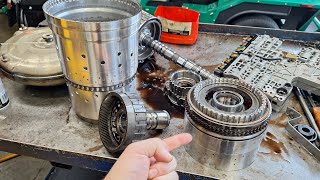
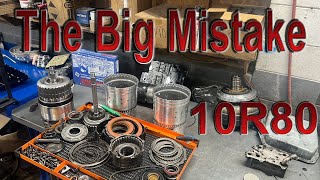
Typical fix: The transmission must be completely removed and disassembled to replace the original CDF drum with an updated part (JL3Z-7H351-B) that features a machined lip to prevent the sleeve from walking. 🎬 See how the updated CDF drum fixes shifting problems This is a major repair.
Est. part cost: $200-$400 for the updated CDF drum assembly. - Failed Main Control Valve Body (Solenoid Body) 🟡 Medium Probability → Shop Transmission Valve Body The valve body houses the shift solenoids and is prone to issues with sticking valves or internal wear, which can cause a variety of shifting problems. Debris from initial break-in or from other failing components can contaminate the valve body and cause solenoids to stick. Some TSBs, like 23-2123, detail procedures for overhauling the valve body to correct shift quality issues.
How to confirm: After checking fluid, a technician uses a high-level scan tool to command the solenoid on and off to check its response. The valve body may be removed for inspection, cleaning, and testing of individual solenoids and valves.
Typical fix: Replacement of the entire main control valve body assembly. In some cases, a valve body overhaul as described in Ford TSBs may resolve the issue.
Est. part cost: $800-$1,500 for a complete valve body assembly. - Low or Contaminated Transmission Fluid ⚪ Low Probability → Shop Transmission Assembly The 10R80 transmission is extremely sensitive to fluid level and condition. It requires a specific fluid, Motorcraft MERCON ULV. Incorrect fluid or low levels due to leaks can cause erratic hydraulic pressure and trigger various codes. However, with code P2708, this is more likely a symptom of a larger internal problem (like a damaged seal from the CDF drum issue) than the root cause.
How to confirm: Check the transmission fluid level and condition according to the manufacturer's procedure. The fluid should be red and clear, not brown, black, or smelling burnt. A burnt smell often indicates clutch material in the fluid from an internal failure.
Typical fix: Perform a transmission fluid and filter change using the correct OEM fluid. This is often a first step but is unlikely to solve the P2708 code if the CDF drum has failed.
Est. part cost: $150-$250 for fluid and a filter.
Rare But Worth Checking
- Damaged Wiring Harness: In some cases, rodents have been known to chew through the transmission wiring harness, causing a short circuit that can trigger this code. It's worth a visual inspection before authorizing major transmission work.
- TCM Software Corruption: Outdated or corrupt software in the Transmission Control Module (TCM) can cause a wide range of shifting problems. Ford has issued several software updates to improve shift quality and address harsh shifting. This is often the first step a dealer will take.
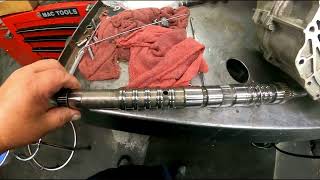
- Failed Input Shaft End Plugs: A less common but documented failure involves small plugs at the end of the input shaft becoming dislodged, creating an internal hydraulic leak. This can cause codes for specific solenoids, including P2707 and P2708. 🎬 Watch: Diagnosing P2707 and P2708 codes on the 10R80 The fix involves either replacing the input shaft or, in some specialist cases, welding the holes shut.
Diagnosis Steps
- Check and verify the transmission fluid level and condition. Ensure the correct Motorcraft MERCON ULV fluid is being used.
- Use a professional-grade scan tool to check for any other accompanying transmission codes and to review TCM data, such as solenoid command states and line pressure.
- Inspect the transmission external wiring harness and connectors for any visible damage, corrosion, or rodent activity.
- Consult Ford's Technical Service Bulletins (TSBs) for the specific vehicle. TSBs 24-2254 and 23-2250 are highly relevant. Many TSBs recommend a PCM/TCM software update and an adaptive learning drive cycle as a first step.
- If shift problems persist, perform the hydraulic circuit leakage test for the CDF drum as detailed in TSB 24-2254 using a VCMM and pressure transducer kit.
- If tests point to an internal failure, the transmission will need to be removed and disassembled to inspect the valve body and the CDF drum assembly for the displaced sleeve.
Parts You'll Likely Need
- CDF Drum Hub Assembly (Updated)
(OEM #JL3Z-7H351-B)— This is the most common root cause of P2708 and related shift issues on the 10R80 transmission. The updated part has a revised, machined lip that prevents the internal bushing/sleeve from walking out of position and causing a hydraulic leak. This part supersedes older versions like HL3Z-7H351-A and JL3Z-7H351-A.
Trusted brands: Motorcraft (Ford OEM)
OEM price range: $200-$400
Aftermarket price range: $150-$300 - Main Control Valve Body Assembly — If the CDF drum is intact or if issues persist after its replacement, the problem may lie within the valve body. Sticking valves or failed solenoids can cause erratic shifting. It is often replaced as a complete assembly to ensure reliability.
Trusted brands: Motorcraft (Ford OEM)
OEM price range: $1000-$1500
Aftermarket price range: $700-$1200 - Transmission Fluid and Filter Kit — Required for any internal transmission service. The 10R80 uses Motorcraft MERCON ULV fluid and has a specific filter. Using the correct fluid and a new filter is mandatory when replacing the CDF drum or valve body.
Trusted brands: Motorcraft (Ford OEM)
OEM price range: $150-$250
Aftermarket price range: $100-$200
Related Codes That Often Appear With This One
- P0751, P0756, P0761, etc. — These are codes for other shift solenoids (A, B, C, etc.). The provided NHTSA TSBs (like 24-2254 and 23-2250) list P2708 as part of a large group of solenoid and gear ratio codes that all point toward the same internal transmission faults, like the CDF drum or valve body issues.
- P0729, P0731, P0732, etc. — These are codes for incorrect gear ratios. They often appear with P2708 because the underlying hydraulic leak from the CDF drum prevents the transmission from properly engaging or holding a gear, leading to a mismatch between the commanded gear and the actual gear ratio.
Technical Service Bulletins (TSBs) & Recalls
- TSB 26-2046: Mentions P2708 in a list of DTCs related to power train issues.
- TSB 25-2018: Lists P2708 with other codes related to harsh shifts.
- TSB 25-2302: Associates P2708 with a group of DTCs for transmission problems.
- TSB 24-2254: Connects P2708 and other codes to potential axial movement of an internal component, hinting at the CDF drum issue.
Platform-Specific Known Issues
- TSB 24-2254: The Definitive CDF Drum Bulletin: → Shop Automatic Transmission Clutch Drum This TSB explicitly links harsh/delayed shifts and a long list of DTCs, including P2708, to the 'axial movement of the CDF clutch cylinder sleeve causing hydraulic circuit leaks' on 10R80 transmissions built on or before August 15, 2022. It provides a detailed service procedure to verify the leak with special tools and replace the CDF drum if necessary.
- TSB 23-2250: Comprehensive Shift Issue Diagnosis: This bulletin addresses harsh/delayed shifts across a wide range of Ford vehicles with the 10-speed transmission. It acknowledges multiple potential causes: PCM/TCM software, the solenoid ID strategy, sticking valves in the main control valve body, and the CDF clutch cylinder sleeve movement. This TSB shows the multi-faceted nature of diagnosing 10R80 issues.
- Adaptive Learning Strategy: These transmissions use an adaptive learning strategy. After a repair, fluid change, or even a battery disconnect, the transmission may shift harshly for several days as it relearns shift parameters. TSBs often require a dealer-performed adaptive learn drive cycle as the final step of the repair to ensure proper shift quality.
Mechanic-Grade Diagnostic Values
- Shift Solenoid Resistance — expected: 10-15 Ω. Failure: A reading outside this range indicates a faulty solenoid coil.
- Shift Solenoid Current Draw (Bench Test) — expected: 0.5 - 1.2 A. Failure: Incorrect current draw when 12V is applied indicates a faulty coil.
Scan Tool Commands That Help
- Ford IDS / FORScan: Clear Transmission Adaptive Tables — This function should be used after any transmission repair, including valve body or CDF drum replacement, or as a diagnostic step for resolving harsh shifting. It forces the TCM to relearn shift points from scratch. A specific Adaptive Learning Drive Cycle must be performed afterward for the transmission to function correctly.
- Ford IDS / FORScan: Solenoid Strategy Programming — This is mandatory when replacing the main control valve body or the entire transmission. A 12-digit identification and 13-digit strategy number from the new valve body must be programmed into the PCM/TCM. Failure to do so will result in incorrect operation and may set other codes like P163E.
Wiring & Ground Locations
- Engine-to-Firewall Ground Strap — Located on the back of the passenger side cylinder head, connected via a double-threaded stud that also holds the heater tube.. This is a primary ground for the engine and by extension the PCM. A poor connection here can cause a multitude of electrical issues, including erratic sensor readings and communication codes that could be misinterpreted as internal transmission faults.
- Body-to-Frame Ground Cable — Underneath the vehicle, often near the passenger side door area, connecting the cab body to the main frame rail.. This ground is known to corrode and fail, especially in salt-belt regions. A bad connection can cause communication codes between modules, including the TCM, and lead to various electrical gremlins that mimic component failure.
- External TCM Ground (if equipped) — On some F-150s, an external Transmission Control Module is mounted to the frame on the passenger side. It has a dedicated ground wire to the frame.. Similar to the body-to-frame ground, this specific TCM ground can rot and cause direct communication and operational issues with the transmission, potentially leading to solenoid codes.
Real Owner Repair Stories
- Curmudgeon Transmission, YouTube (Vehicle with a 10R80 transmission) — DTC P2707 (Shift Solenoid 'F' Stuck Off) - a related code to P2708.
❌ Tried (didn't work) Initial diagnosis pointed towards a solenoid or valve body issue.
✅ What actually fixed it The root cause was a missing plug in one of the four holes on the end of the input shaft. The 'F' circuit hole was open, causing a massive hydraulic leak. The technician's final fix was to weld the three non-lockup circuit holes shut and grind them flush to permanently seal the leak.
OEM Part Supersession History
HL3Z-7H351-A, JL3Z-7H351-A→JL3Z-7H351-B— The original CDF drum assembly design allowed an internal bushing/sleeve to 'walk' or move axially, uncovering hydraulic passages and causing pressure loss. The updated JL3Z-7H351-B part features a machined lip or 'dam' that acts as a physical stop, preventing the bushing from migrating.
Model Year Variations Within This Range
- 2017 - Mid-2022: Vehicles built on or before August 15, 2022, may have been assembled with the original, failure-prone CDF drum design. Vehicles manufactured after this date are expected to have the updated CDF drum (part JL3Z-7H351-B) from the factory, significantly reducing the likelihood of this specific failure.
Helpful Videos
We Have This Part in Stock


The information in this article is provided for general reference and educational purposes only. Vehicle specifications, procedures, and part compatibility can vary by production date, trim level, and region. Always consult your vehicle's factory service manual and verify part numbers before purchasing or performing repairs. Safety-critical components such as airbags, seat belts, and braking systems should be installed by a qualified professional.
- Ford F-150:
- 🧭 Diagnostic Flowchart
- 🎬 Helpful Videos
- 🛍️ Shop This Part
- What's Unique About the 2017-2023 Ford F-150
- Symptoms You May Notice
- Most Likely Causes
- Rare But Worth Checking
- Diagnosis Steps
- Parts You'll Likely Need
- Related Codes That Often Appear With This One
- Technical Service Bulletins (TSBs) & Recalls
- Platform-Specific Known Issues
- Mechanic-Grade Diagnostic Values
- Scan Tool Commands That Help
- Wiring & Ground Locations
- Real Owner Repair Stories
- OEM Part Supersession History
- Model Year Variations Within This Range
- 🎟️ Get 5% Off