

P2708 on 2018-2023 Ford Mustang: Shift Solenoid 'F' Stuck On Causes and Fixes
On 2018-2023 Ford Mustangs, code P2708 indicates the transmission's 'F' shift solenoid is stuck on. This is often caused by an internal failure in the 10R80 transmission's main control valve body or a related CDF clutch drum issue, as noted in Ford TSBs. This is a complex repair requiring professional service.
- P2708 on a 2018-2023 Mustang is a serious transmission code indicating Shift Solenoid 'F' is stuck on.
- The cause is frequently a known mechanical issue within the 10R80 transmission, specifically related to the CDF clutch cylinder, as documented in Ford TSB 24-2254.
- Do not simply replace the 'F' solenoid; the root cause is likely a more complex internal problem requiring a professional diagnosis.
- Symptoms include severe shifting problems like harshness, delays, and getting stuck in gear.
- This is not a DIY-friendly repair; it requires specialized tools and deep transmission knowledge.
What's Unique About the 2018-2023 Ford MUSTANG
The 2018-2023 Mustang uses the Ford 10R80 10-speed automatic transmission, which is known for experiencing harsh or delayed shifting issues. Ford has issued multiple Technical Service Bulletins (TSBs), including TSB 24-2254, that directly link P2708 and other shifting codes to a specific mechanical failure: axial movement of the CDF clutch cylinder sleeve. This sleeve movement causes internal hydraulic circuit leaks, which starve clutches of pressure. This indicates the problem is often more complex than a simple solenoid replacement and points to a known design flaw in early 10R80 transmissions, which was later addressed with a revised CDF drum part.
Diagnostic Flowchart
Tap your situation to follow the diagnostic path that matches what you're seeing on this vehicle.
Symptoms You May Notice
- Harsh, erratic, or delayed shifts, especially the 3-5 upshift
- Vehicle gets stuck in a single gear or fails to shift
- Illuminated Malfunction Indicator Lamp (Check Engine Light)
- Illuminated wrench light on the dashboard
- Slipping between gears or RPM flare during shifts
- Shuddering or vibrations during acceleration or at cruising speeds
- Delayed or harsh engagement when shifting from Park to Drive or Reverse
- Failure to go into Reverse, requiring a vehicle restart
- Replacing only the shift solenoid 'F' without addressing the underlying cause, such as a faulty valve body or the CDF clutch drum issue described in TSBs. The problem will likely return.
- Performing a fluid change or software update (adaptive learn reset) as a final fix. While these are often initial steps, they usually only provide a temporary improvement if the root cause is a mechanical failure like the CDF drum.
Most Likely Causes
- Internal Transmission Failure (CDF Clutch Cylinder) 🔴 High Probability → Shop Transmission Assembly Ford TSB 24-2254 explicitly states that axial movement of the CDF clutch cylinder sleeve can cause hydraulic circuit leaks, triggering P2708 and many other codes. This is a widely documented design flaw where the bushing inside the drum wears, allowing the sleeve to 'walk' or slide out of position, uncovering oil passages and causing a critical loss of hydraulic pressure.
How to confirm: A technician must perform a specialized hydraulic circuit leak test as outlined in TSB 24-2254. This requires specific tools like a Pressure Vacuum Transducer Kit. Visually, a damaged sealing ring on the drum is a clear indicator during disassembly.
Typical fix: Replacement of the entire CDF clutch cylinder drum assembly with the updated part (JL3Z-7H351-B for 5.0L), which features a machined lip to prevent the sleeve from moving. This requires transmission disassembly.
Est. part cost: $250-$500 - Failed Main Control Valve Body or Shift Solenoid 🟡 Medium Probability → Shop Transmission Valve Body The valve body is another known weak point on the 10R80, prone to sticking valves and internal cross-leaks that cause pressure loss and erratic shifting. While the solenoid itself can fail, it is often a symptom of a larger valve body or CDF drum issue.
How to confirm: A technician can use a high-level scan tool to command the 'F' solenoid and monitor its response. The valve body can be inspected for sticking spool valves or debris upon removal. All shift solenoids should have a resistance of 5.0-5.4 ohms at 68°F (20°C).
Typical fix: Replacement of the entire main control valve body assembly. 🎬 See this walkthrough on replacing the 10R80 valve body. After replacement, the 13-digit solenoid body strategy number must be programmed into the PCM/TCM using a tool like Ford IDS or FORScan.
Est. part cost: $50-$150 for a single solenoid, $700-$1300 for a valve body assembly. - Low or Contaminated Transmission Fluid ⚪ Low Probability → Shop Transmission Assembly While not specific to this platform, the 10R80 is highly sensitive to fluid condition and level. Many owners have reported their transmissions being underfilled from the factory. The correct fluid is Mercon ULV.
How to confirm: Check the transmission fluid level and condition according to the manufacturer's procedure, which involves getting the fluid to a specific temperature (around 205-215°F). The fluid should be clean and at the correct level.
Typical fix: Perform a transmission fluid and filter change using only the specified Mercon ULV fluid. If the fluid is heavily contaminated with metal, it indicates a more severe internal failure.
Est. part cost: $150-$300 for fluid and filter. - Wiring or Connector Issue ⚪ Low Probability Not a platform-specific issue, but damage to the transmission wiring harness can cause a short or open circuit, leading to solenoid codes. This is less common than the internal mechanical failures.
How to confirm: Visually inspect the wiring harness leading to the transmission for any signs of damage, corrosion, or loose connections. A multimeter can be used to check for continuity between the TCM and the solenoid connector.
Typical fix: Repair or replace the damaged section of the wiring harness or the connector.
Est. part cost: $20-$200 depending on the extent of the damage.
Rare But Worth Checking
- Faulty Transmission Control Module (TCM) or Powertrain Control Module (PCM): → Shop Transmission Assembly A software glitch or internal module failure can incorrectly command the solenoid or misinterpret its signals. Ford has issued several TSBs that involve reprogramming the PCM/TCM to correct shift strategies. This should be considered only after all mechanical and wiring issues have been ruled out.
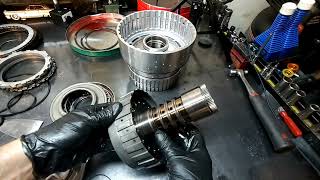
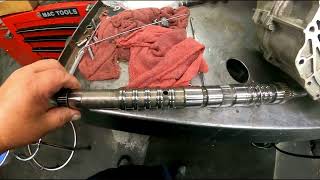
- Missing Input Shaft End Plug: In rare cases, a small ball plug inside the input shaft, which seals the end of the 'F' clutch hydraulic passage, can be missing from the factory. This causes a direct hydraulic leak for the 'F' clutch circuit, leading to codes like P2707 (Stuck Off) or P2708 (Stuck On). 🎬 Watch: Expert diagnosis of P2707 and P2708 shifting codes.
Diagnosis Steps
- Connect a professional OBD-II scanner to confirm code P2708 and check for any other related transmission codes.
- Review Ford Technical Service Bulletins (TSBs), especially TSB 24-2254, as it directly addresses this code and its root cause.
- Check the transmission fluid level and condition. Ensure it is clean, full, and the correct type (Mercon ULV). Note that this is a complex procedure requiring the vehicle to be level and the fluid at a high temperature.
- Inspect the transmission external wiring harness and connectors for any visible damage, corrosion, or loose pins.
- If indicated by TSB 24-2254, a technician should perform a hydraulic circuit leak test on the CDF clutch cylinder. This is a specialized procedure requiring dealer-level tools.
- If no TSB applies or tests are inconclusive, proceed to test the Shift Solenoid 'F' circuit. This involves checking resistance (spec: 5.0-5.4 Ohms @ 68°F/20°C) and voltage at the solenoid connector and using a scan tool to command the solenoid on and off.
- If the circuit is good, the next step is to remove the transmission pan to access and test the solenoid itself and inspect the valve body for contamination or damage.
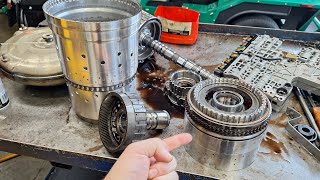
- If the solenoid and valve body appear functional, the issue is almost certainly a deeper internal mechanical problem like the CDF drum or a missing input shaft plug, requiring transmission disassembly for inspection and replacement. 🎬 Watch: Full 10R80 teardown showing the CDF drum bushing failure.
Parts You'll Likely Need
- CDF Clutch Cylinder
(OEM #JL3Z-7H351-B (supersedes HL3Z-7H351-A and JL3Z-7H351-A))— TSB 24-2254 identifies a fault with this component (specifically, its sleeve moving and causing leaks) as a primary cause for P2708 on this vehicle. The updated part has a machined lip to prevent the sleeve from 'walking'.
Trusted brands: Motorcraft
OEM price range: $230-$400
Aftermarket price range: $200-$350 - Transmission Main Control Valve Body
(OEM #JL3Z-7A100-C or M1PZ-7A100-A (part number varies by specific model/year/features))— The valve body houses the solenoids and is a known failure point on the 10R80 transmission, causing various shifting faults. It is often replaced as a complete assembly.
Trusted brands: Motorcraft
OEM price range: $800-$1300
Aftermarket price range: $600-$900 - Transmission Filter and Fluid Kit — Any internal transmission repair requires draining the fluid and removing the pan, making a filter and fluid replacement necessary. Only Mercon ULV fluid should be used.
Trusted brands: Motorcraft
OEM price range: $150-$300
Aftermarket price range: $100-$200
Related Codes That Often Appear With This One
- P0751, P0756, P0761, P0766, P0771, P2700-P2707 — These are all codes related to other shift solenoids (A, B, C, D, E) and clutch timing. Ford TSBs list them together with P2708, indicating a common root cause like a valve body or CDF drum failure affecting multiple hydraulic circuits.
- P0729, P0731-P0736 — These codes indicate incorrect gear ratios. They often appear with solenoid codes because a stuck solenoid or leaking clutch circuit prevents the correct gear from being engaged, causing a mismatch between engine speed and output shaft speed.
- P163E — This DTC can be stored in the PCM or TCM after replacing the main control valve body if the 12-digit solenoid body identification is entered instead of the required 13-digit solenoid body strategy during the programming procedure.
Technical Service Bulletins (TSBs) & Recalls
- TSB 24-2254: Harsh/Delayed Engagement And/Or Harsh/Delayed Shift due to CDF clutch cylinder sleeve movement.
- TSB 26-2046: Lists P2708 in relation to powertrain/transmission control module diagnostic trouble codes.
- TSB 25-2018: Lists P2708 with other DTCs related to shift quality issues.
Platform-Specific Known Issues
- TSB 24-2254: The Primary Culprit: This TSB, which supersedes several earlier versions, is the most relevant document for P2708. It explicitly identifies 'axial movement of the CDF clutch cylinder sleeve causing hydraulic circuit leaks' as the root cause for a long list of DTCs, including P2708, on 2021-2022 Mustangs and other models. The fix involves a specific hydraulic leak test and, if failed, replacement of the CDF clutch cylinder.
- CDF Drum Design Flaw: → Shop Automatic Transmission Clutch Drum The core issue is that the bushing/sleeve inside the original CDF drum was a press-fit part that could move due to heat cycles and pressure. This movement would eventually cut into the Teflon sealing rings and/or expose hydraulic passages, causing pressure loss to multiple clutches. The revised OEM part machines a lip into the drum to physically stop the sleeve from moving, providing a permanent fix.
Mechanic-Grade Diagnostic Values
- Shift Solenoid Resistance — expected: 5.0 - 5.4 Ω at 20°C (68°F). Failure: A reading outside this range indicates a faulty solenoid coil.
Scan Tool Commands That Help
- Ford IDS or FORScan: Clear Transmission Adaptive Tables — This procedure should be performed after any transmission repair, especially valve body or solenoid replacement, to force the TCM to relearn shift pressures and clutch fill times. It can also be used as a diagnostic step to temporarily resolve shift quality issues.
- Ford IDS or FORScan: Transmission Characterization Update / PCM - Transmission Strategy Download — This is required after replacing the main control valve body or the entire transmission. The 13-digit solenoid body strategy number from the new part must be entered to ensure the TCM uses the correct calibration for the new solenoids. Failure to do this will result in poor shifting and may set other codes.
- Ford IDS or FORScan: Stop Use of Transmission Adaptive / Resume Transmission Adaptive Learning — Some owners and shops have found that disabling the adaptive learning feature can resolve persistent harsh or erratic shifting behavior, locking in a more consistent shift feel. This is an advanced step and should be used after clearing the adaptive tables.
Wiring & Ground Locations
- C175T — This is one of the main connectors at the Powertrain Control Module (PCM).. The control wires for the transmission shift solenoids run from the PCM to the transmission through this connector. While a specific pin for Shift Solenoid 'F' on the Mustang is not identified in the search results, related solenoids (D and E) are listed at pins 10 and 11 respectively in some Ford applications, indicating the 'F' solenoid wire is also in this connector.
Real Owner Repair Stories
- Mustang6G.com forum user 'schmeky' (2018 Mustang GT, 21,000 miles) — 5-6 gear flare at light throttle, occasional hard 3-4 downshifts, rapid 3-4-3-4 hunting in drag mode. No DTCs were present.
❌ Tried (didn't work) KAM reset, Fluid and filter change (as a standalone fix)
✅ What actually fixed it The owner had a new, VIN-appropriate Ford valve body installed and, crucially, had the transmission shop disable the Adaptive Learning Strategy (ALS). The shop noted a 'halt' command was available in the ALS. This combination of parts and programming resulted in perfect shifting.
OEM Part Supersession History
HL3Z-7H351-A, JL3Z-7H351-A→JL3Z-7H351-B— The original CDF clutch cylinder drum design allowed an internal bushing/sleeve to 'walk' out of position, uncovering oil passages and causing hydraulic pressure loss to the clutches. The updated JL3Z-7H351-B part features a machined lip that physically prevents the sleeve from moving.
Model Year Variations Within This Range
- 2018-2023: The part number for the failure-prone CDF clutch cylinder varies depending on the engine. For the 5.0L V8 Mustang, the correct updated part is JL3Z-7H351-B. For the 2.3L EcoBoost Mustang, the correct part number is JR3Z-7H351-B.
Helpful Videos

We Have This Part in Stock


The information in this article is provided for general reference and educational purposes only. Vehicle specifications, procedures, and part compatibility can vary by production date, trim level, and region. Always consult your vehicle's factory service manual and verify part numbers before purchasing or performing repairs. Safety-critical components such as airbags, seat belts, and braking systems should be installed by a qualified professional.
- Ford MUSTANG:
- 🧭 Diagnostic Flowchart
- 🎬 Helpful Videos
- 🛍️ Shop This Part
- What's Unique About the 2018-2023 Ford MUSTANG
- Symptoms You May Notice
- Most Likely Causes
- Rare But Worth Checking
- Diagnosis Steps
- Parts You'll Likely Need
- Related Codes That Often Appear With This One
- Technical Service Bulletins (TSBs) & Recalls
- Platform-Specific Known Issues
- Mechanic-Grade Diagnostic Values
- Scan Tool Commands That Help
- Wiring & Ground Locations
- Real Owner Repair Stories
- OEM Part Supersession History
- Model Year Variations Within This Range
- 🎟️ Get 5% Off