

P2723 on 2011-2013 GMC Sierra: Pressure Control Solenoid 'E' Performance Fixes
On a 2011-2013 GMC Sierra, code P2723 indicates a problem with Pressure Control Solenoid 'E' inside the 6L80/6L90 transmission. The most common cause is debris clogging the valve body, often from an aftermarket filter or internal wear. The fix typically involves servicing or replacing the entire valve body/TEHCM assembly, which is a complex and costly repair.
- P2723 on a 2011-2013 Sierra is a serious transmission code that can leave you stranded and should be addressed immediately.
- The most likely cause is not a simple solenoid failure, but rather debris clogging the valve body, a known issue documented in GM service bulletins.
- The fix almost always involves invasive transmission work, requiring the removal of the valve body and likely the replacement of the entire TEHCM unit.
- This is not a DIY-friendly repair due to its complexity and the need for post-installation programming.
- Using only OEM-spec DEXRON-VI fluid and filters is critical to prevent contamination that can lead to this code.
What's Unique About the 2011-2013 Gmc SIERRA
The 2011-2013 Sierra uses the GM 6L80 or 6L90 transmission, which integrates the Transmission Control Module (TCM), solenoids, and pressure switches into a single unit inside the oil pan called the TEHCM (Transmission Electro-Hydraulic Control Module). This design makes the system very sensitive to fluid contamination and heat. As highlighted in manufacturer bulletins, debris from failing components or even aftermarket filters can clog passages in the valve body, leading directly to codes like P2723. [Bulletin #PIP5100A] Because the solenoids are not serviceable individually, a failure often requires replacing the entire TEHCM.
Diagnostic Flowchart
Tap your situation to follow the diagnostic path that matches what you're seeing on this vehicle.
Symptoms You May Notice
- Vehicle will not move in forward or reverse. [Bulletin #PIP5100, Bulletin #PIP5100A]
- Harsh or delayed shifting, especially the 2-3 shift.
- Transmission gets stuck in one gear (limp mode), potentially 5th gear.
- Check Engine Light is on.
- Transmission slipping, where engine RPMs rise without an increase in speed.
- Transmission overheating.
- Reduced fuel economy.
- Replacing only the TEHCM when the root cause is excessive wear or debris in the valve body passages, which will cause the new TEHCM to fail or not resolve the code.
- Assuming the entire transmission is bad and needs a full rebuild without first inspecting the TEHCM and valve body, which are the most common points of failure for this code.
Most Likely Causes
- Debris in Valve Body Separator Plate 🔴 High Probability → Shop Transmission Valve Body As noted in multiple GM Technical Service Bulletins, the valve body is prone to blockage from debris. TSB #PIP5100A specifically calls out debris from aftermarket spin-on filters as a cause for P2723. [Bulletin #PIP5100A] Worn check balls or bores in the valve body can also cause hydraulic leaks that trigger this code.
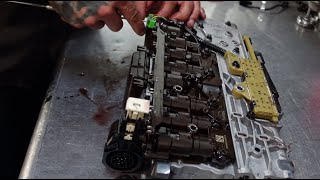
How to confirm: A technician must drop the transmission pan and remove the valve body to visually 🎬 Watch: Step-by-step 6L80 valve body tear down and inspection guide. inspect the separator plate orifices for blockage. [Bulletin #PIP5100, Bulletin #PIP5100A]
Typical fix: Cleaning the valve body passages or replacing the valve body separator plate. If valve bores are worn, the entire valve body assembly may need replacement.
Est. part cost: $50-$150 for a plate, $400-$600 for a remanufactured valve body assembly. - Failed Pressure Control Solenoid 'E' / TEHCM 🔴 High Probability → Shop Transmission Clutch Pressure Control Solenoid The solenoids are integrated into the TEHCM, which sits in hot transmission fluid, leading to heat-related electronic failures over time. A failure of the solenoid itself or the driver circuit within the module will trigger this code. Since individual solenoids are not serviceable, the entire unit must be replaced.
How to confirm: A professional scan tool can command the solenoid to activate and monitor the circuit's response. Resistance can be checked with a multimeter (should be around 5-6 ohms for PC solenoids), but forum experts note that a TEHCM can pass resistance tests and still be faulty due to internal hydraulic leaks or worn valve bores that the computer misinterprets as a solenoid failure.
Typical fix: Replace the entire TEHCM assembly. This part must be programmed to the vehicle's VIN.
Est. part cost: $500-$1200 for a new OEM unit, $280-$550 for a remanufactured unit. - Low or Contaminated Transmission Fluid 🟡 Medium Probability → Shop Transmission Assembly These transmissions require clean DEXRON-VI fluid to operate correctly. Low fluid levels can cause the pump to aerate the fluid, leading to pressure loss, while contaminated fluid can cause solenoids to stick and passages to clog.
How to confirm: Check the transmission fluid level and condition. The fluid should be at the correct level, red in color, and not smell burnt. Dark, burnt-smelling fluid indicates a more serious internal problem.
Typical fix: Perform a transmission fluid and filter change. If the fluid is heavily contaminated, a full flush may be recommended by a professional. This may not fix the code if damage has already occurred.
Est. part cost: $100-$250 - Cracked 1-2-3-4 / 3-5-R Clutch Housing ⚪ Low Probability A known issue on earlier 6L80 transmissions, as detailed in TSB #09-07-30-004J. A crack in the clutch housing weld can cause a hydraulic leak that prevents clutches from applying correctly, which can manifest as a solenoid performance code like P2723.
How to confirm: This requires significant transmission disassembly. The clutch housing must be removed and pressure tested by applying compressed air to the 3-5R clutch feed hole while checking the weld area with soapy water for bubbles to confirm a crack.
Typical fix: The clutch housing must be replaced. This is a major repair often done as part of a full transmission rebuild.
Est. part cost: $2500-$5000+ (for rebuild)
Rare But Worth Checking
- Wiring Harness Damage: The wiring harness leading to the transmission case connector can become damaged. While less common than internal failures, it's worth inspecting the external wiring for breaks or corrosion before condemning the expensive TEHCM.
Diagnosis Steps
- Check the transmission fluid level and condition. Ensure it is full and does not appear dark, burnt, or contaminated.
- Use a professional scan tool to check for other transmission-related codes. Note that P0700 is a generic code that will accompany P2723.
- Review live data on the scan tool to monitor the commanded state and feedback for Pressure Control Solenoid 'E' (PC Solenoid 5).
- Inspect the external transmission wiring harness and connector for any visible damage, corrosion, or loose pins.
- Drop the transmission oil pan and inspect for excessive metal debris. A small amount of fine grey material on the magnet is normal, but large flakes or chunks indicate a serious mechanical failure.
- Remove the valve body assembly (TEHCM) and inspect the separator plate and fluid passages for blockage or debris, as indicated by GM TSBs. [Bulletin #PIP5100, Bulletin #PIP5100A]
- While the TEHCM is out, perform resistance checks on the solenoids as a basic electrical health check. PC solenoids should be around 5-6 ohms.
- If no obvious debris is found and wiring is intact, the failure is most likely the TEHCM assembly itself or a non-obvious hydraulic leak within the valve body bores.
Parts You'll Likely Need
- Transmission Electro-Hydraulic Control Module (TEHCM)
(OEM #24256861 (common for 2010-2013, but always verify by VIN as part numbers are frequently superseded, e.g., to 19435614 or 24287422).)— This is the most common fix, as it contains the failing solenoid and the control module. It is often replaced as a complete unit with the valve body.
Trusted brands: ACDelco (OEM), Sonnax (Remanufactured), Street Smart Transmission (Remanufactured)
OEM price range: $600-$1200
Aftermarket price range: $300-$900 (often remanufactured) - Transmission Fluid Filter Kit — This is required whenever the transmission pan is removed for service.
Trusted brands: ACDelco, Wix
OEM price range: $40-$70
Aftermarket price range: $25-$50 - DEXRON-VI Automatic Transmission Fluid — This is the required fluid for all 6L80/6L90 transmissions. The system will need to be refilled after dropping the pan (typically 6-8 quarts for a pan drop).
Trusted brands: ACDelco
OEM price range: $8-$12 per quart
Aftermarket price range: $7-$10 per quart
Related Codes That Often Appear With This One
- P0700 — This is a general transmission fault code that simply indicates the TCM has stored a specific trouble code, such as P2723. It will almost always be present with any specific transmission code.
- P0751 — This code for Shift Solenoid 'A' Stuck Off often appears with other solenoid codes when there is a widespread hydraulic issue, contamination, or an electrical fault within the TEHCM. [Bulletin #PIP4379K]
- P0796 — This code for Pressure Control Solenoid 'C' Stuck Off can appear with P2723. Both solenoids are active in gears 1-3. A fault with both often points to a TEHCM failure or a major hydraulic issue affecting multiple circuits.
Technical Service Bulletins (TSBs) & Recalls
- PIP4379K: Mentions P2723 in a list of transmission codes and advises diagnosing P0701 first.
- PIP5100: Connects P2723 to a no-move condition and directs technicians to inspect the valve body separator plate for debris.
- PIP5100A: A revision of PIP5100 that specifically blames debris from aftermarket spin-on filters for blocking valve body orifices and causing P2723.
- 09-07-30-004J: Details a potential cause for P2723 being a cracked 1-2-3-4 / 3-5-R clutch housing, a significant internal mechanical failure.
Platform-Specific Known Issues
- A GM Technical Service Bulletin (#PIP5100A) specifically notes that technicians may find P2723 if the valve body separator plate orifices are blocked by debris from an aftermarket spin-on filter.
- Another TSB (#PIP5100) points to debris in the valve body separator plate as a cause for a no-move condition accompanied by code P2723.
Mechanic-Grade Diagnostic Values
- Pressure Control (PC) Solenoid Resistance — expected: 5 to 6 Ohms. Failure: A reading outside this range indicates a failed solenoid coil.
- Shift Solenoid (On/Off type) Resistance — expected: 20 to 40 Ohms. Failure: A reading outside this range indicates a failed solenoid coil.
- Transmission Fluid Temperature (TFT) for Fast Learn — expected: 158°F - 212°F (70°C - 100°C). Failure: The Service Fast Learn procedure will abort if the temperature is outside this range.
Scan Tool Commands That Help
- GM GDS2 / Tech2 or equivalent professional scan tool: Service Fast Learn Adapts — This procedure is mandatory after replacing the TEHCM, valve body, or transmission assembly. It allows the TCM to learn the hydraulic characteristics of the clutches to ensure proper shift quality and prevent damage.
- GM GDS2 / Tech2 or equivalent professional scan tool: Solenoid Actuation Test — Used during diagnosis to command a specific solenoid (like PC Solenoid 'E') on and off to verify its electrical and mechanical response. A lack of audible click or change in pressure data points to a faulty solenoid or hydraulic circuit.
- GM GDS2 / Tech2 or equivalent professional scan tool: Hydraulic System Flush Procedure — This function cycles all solenoids to help purge contaminated fluid from the valve body during a fluid exchange. It can sometimes resolve minor sticking issues before resorting to part replacement.
Wiring & Ground Locations
- G103 / G104 — Typically located on the back of the right-side cylinder head on the engine block.. These are primary grounds for the powertrain control electronics. A loose or corroded connection here can cause erratic voltage to the TCM, potentially triggering false solenoid performance codes.
- G110 — On the engine block, near the transmission bellhousing area.. This is a key ground for the transmission itself. Poor connection can lead to various electrical faults within the transmission.
- Transmission Main Connector (X1 / J1) — The large, circular twist-lock connector on the passenger side of the transmission case.. This is the single electrical interface to the internal TEHCM. Corrosion from moisture or pushed-out pins can interrupt power or signals, causing P2723. Pin 4 is Battery (+) and Pin 5 is Ground (-); verifying stable voltage and ground here is a critical first diagnostic step.
Real Owner Repair Stories
- tahoeyukonforum.com user report (2011 GMC Yukon (mechanically identical to Sierra)) — Harsh shifting and Check Engine Light with codes P2723 and P0700.
❌ Tried (didn't work) Initial diagnosis pointed to a generic internal failure.
✅ What actually fixed it The owner had the TEHCM (valve body/solenoid assembly) replaced and the new unit programmed to the vehicle, which completely resolved all symptoms. - tahoeyukonforum.com expert user comment (2011 Chevy Tahoe 5.3L with 6L80) — P2723 and P0700, limp mode after fluid change.
❌ Tried (didn't work) Fluid and filter change., Manual TCM reset procedure., Resistance tests on TEHCM solenoids and pressure switches, which all passed.
✅ What actually fixed it An expert user noted that P2723 is often a valve body issue, not an electrical TEHCM failure, even if electrical tests pass. The root cause is frequently worn check balls, worn valve bores in the upper valve body, or sticking clutch regulator valves, which the TCM misinterprets as a solenoid fault. The fix is to address the hydraulic wear in the valve body itself.
OEM Part Supersession History
24256861→19435614, 24287422, 19434978 (and others)— Revisions were made to improve the reliability of the internal electronics, pressure switches, and solenoids. Later generation TEHCMs are generally considered more robust.
Heads up: TEHCMs are year- and model-specific. A new module must be programmed to the vehicle's VIN. Installing a TEHCM from a different year or with a non-matching part number will cause the transmission to not function correctly.
Helpful Videos
We Have This Part in Stock


The information in this article is provided for general reference and educational purposes only. Vehicle specifications, procedures, and part compatibility can vary by production date, trim level, and region. Always consult your vehicle's factory service manual and verify part numbers before purchasing or performing repairs. Safety-critical components such as airbags, seat belts, and braking systems should be installed by a qualified professional.
- Gmc SIERRA:
- 🧭 Diagnostic Flowchart
- 🎬 Helpful Videos
- 🛍️ Shop This Part
- What's Unique About the 2011-2013 Gmc SIERRA
- Symptoms You May Notice
- Most Likely Causes
- Rare But Worth Checking
- Diagnosis Steps
- Parts You'll Likely Need
- Related Codes That Often Appear With This One
- Technical Service Bulletins (TSBs) & Recalls
- Platform-Specific Known Issues
- Mechanic-Grade Diagnostic Values
- Scan Tool Commands That Help
- Wiring & Ground Locations
- Real Owner Repair Stories
- OEM Part Supersession History
- 🎟️ Get 5% Off