

OBD-II Code P2729: Pressure Control Solenoid 'E' Control Circuit Low
What P2729 means, why it triggers, and how to fix it
- Code P2729 indicates the transmission control module (TCM) detects under 9 volts in the 'E' pressure control solenoid circuit, preventing proper gear engagement.
- Driving with P2729 triggers 'limp mode' (locking the transmission in 2nd or 3rd gear) and causes harsh, banging shifts that rapidly degrade internal clutches.
- On 2019-2020 GM Sierra and Silverado trucks, P2729 is a critical safety hazard caused by a faulty TCM (TSB #23-NA-018) that causes rear wheels to lock up at low speeds.
- Before replacing a $300 internal solenoid, test the external wiring harness; frayed wires or corroded connectors cause over 50% of P2729 low-voltage codes.
- A standard transmission fluid and filter change costs $200-$400 and resolves P2729 if the root cause is metallic debris clogging the solenoid valve.
What Does P2729 Mean?
The Transmission Control Module (TCM) detects a problem with the 'Pressure Control Solenoid E', an electronic valve regulating transmission fluid flow. When the TCM reads lower-than-expected voltage (typically under 9V) or a continuous ground on this circuit, it triggers P2729 and illuminates the Check Engine Light.
Technical definition: The SAE/OBD-II definition is 'Pressure Control Solenoid E Control Circuit Low'. The Transmission Control Module (TCM) detects the voltage in the 'E' solenoid control circuit is below the specified range or is continuously grounded when commanded off.
Can I Drive With P2729?
No — Do Not Drive. Driving is not recommended. On 2019-2020 GM trucks, this code indicates a high risk of the rear wheels locking up at low speeds, creating an immediate crash hazard. For other vehicles, you can drive a short distance to a repair shop in 'limp mode,' but doing so causes rapid wear to internal transmission components. Continuing to drive overheats the fluid, burns out clutch packs, and turns a minor electrical issue into a $2,500-$4,000 transmission rebuild.
Common Causes
- Low or Dirty Transmission Fluid (Very Common) — Incorrect fluid levels prevent solenoids from receiving necessary hydraulic pressure. Dirty, contaminated, or burnt fluid causes the solenoid valve to stick or clog with metallic debris.
- Wiring Harness and Connector Failures (Common) — Transmission wiring harnesses are vulnerable to heat, vibration, and road debris. Frayed wires, melted insulation, or fluid-contaminated connectors cause a low voltage signal. On some vehicles, a poorly seated TCM connector causes intermittent P2729 codes.
- Faulty Transmission Control Module (TCM) (Common On Specific Models) — An internal TCM short circuit is the primary cause of P2729 on 2019-2020 GM trucks, leading to dangerous rear wheel lock-up. In other vehicles, a failed driver circuit within the TCM sends an incorrect voltage, triggering the code.
- Faulty Pressure Control Solenoid 'E' (Common) — The solenoid fails electrically or mechanically. The internal coil winding develops a short or open circuit, or the mechanical valve physically sticks, preventing proper fluid pressure regulation.
- Internal Mechanical Failure or Blockage (Less Common) — Worn clutch packs or a failing oil pump create excessive debris that clogs fluid passages in the valve body. This restricts fluid flow to the solenoid, creating pressure regulation problems the TCM interprets as a circuit fault.
- Software or Calibration Errors (Rare) — TCM software glitches cause the module to misinterpret a normal voltage reading as 'low.' A dealership software update or re-flash resolves this without hardware replacement.
Symptoms
- Transmission Enters 'Limp Mode' — The TCM forces the transmission into a single gear (usually 2nd or 3rd) to prevent internal damage, severely limiting speed and acceleration.
- Harsh, Jerky, or Banging Shifts — The vehicle jolts or bangs into gear because the transmission cannot regulate hydraulic pressure for a smooth gear change.
- Delayed Gear Engagement — A noticeable 1-2 second pause occurs when shifting from Park into Drive or Reverse before the transmission engages.
- Transmission Slipping — Engine RPMs increase, but vehicle speed does not. This indicates internal pressure loss and incomplete gear engagement.
- Check Engine Light On — The Malfunction Indicator Lamp (MIL) illuminates. Many vehicles also activate a separate transmission-specific warning message.
- Engine Misfire-Like Symptoms (also visible on scanner) — Transmission drag creates a sensation mimicking an engine misfire or hesitation, even though the engine is running perfectly.
Diagnostic Flowchart
Tap your situation to follow the diagnostic path that matches what you're seeing on this code.
Common Fixes & Costs
- Repair or Replace Wiring Harness/Connector — Parts: $20-$100, Labor: $150-$500, ~2.5 hr book time (Advanced)
- Transmission Fluid and Filter Change — Parts: $75-$150, Labor: $150-$250, ~1.5 hr book time (Intermediate)
- Replace Transmission Control Module (TCM)
— Parts: $400-$700, Labor: $250-$400 (includes programming), ~2 hr book time
(Professional)
2019-2020 GM Sierra/Silverado 1500: OEM - Replace Pressure Control Solenoid 'E' — Parts: $50-$200, Labor: $300-$600, ~3 hr book time (Advanced)
- Replace Molded Lead Frame / Conductor Plate
— Parts: $200-$400, Labor: $400-$800, ~4.5 hr book time
(Professional)
2011-2014 Ford F-150 (6R80): OEM
Chrysler/Dodge (NAG1/W5A580): OEM - Replace Transmission Valve Body — Parts: $300-$800, Labor: $300-$1,000, ~4 hr book time (Professional)
- TCM Software Reflash/Update — Parts: $0, Labor: $150-$250, ~1 hr book time (Professional)
DIY vs Professional
- Transmission Fluid and Filter Change 🟢 Beginner
Tools: Socket set, drain pan, funnel, torque wrench, new fluid and filter/gasket. - Repair or Replace Wiring Harness/Connector 🟢 Beginner
Tools: Multimeter, wire strippers, crimpers, heat shrink tubing, replacement connectors/pins. - Replace Pressure Control Solenoid 'E' 🟢 Beginner
Tools: Tools for fluid change, multimeter, torque wrench for valve body bolts, snap-ring pliers. - Replace Transmission Control Module (TCM) 🟢 Beginner
Tools: Basic hand tools, J2534 pass-thru device, paid manufacturer software subscription.
Used vs. New Parts: Buying Guide
When a used part is worth it: For external components like a wiring harness from a low-mileage donor, a used part is cost-effective. Used solenoids or valve bodies are not recommended due to wear and high labor costs to re-install if faulty.
Donor-vehicle mileage cap: roughly under 60000 miles for the part to have meaningful remaining life.
Donor quality checklist:
- Verify the donor vehicle was not scrapped due to transmission failure.
- For electronic modules (TCM), ensure the seller guarantees it is 'unlocked' or provides the VIN for reprogramming.
- Match part numbers exactly; superseded numbers are rarely interchangeable for used electronics.
Decision logic:
- If The part is a solenoid, sensor, or internal wear item → buy new. Savings on a used part do not justify the risk and labor cost of premature failure.
- If The part is a Transmission Control Module (TCM) → buy a new OEM part or a professionally remanufactured unit with a warranty. A used TCM is a high-risk purchase as it is often locked to the donor vehicle's VIN.
- If The part is a complete valve body or lead frame → buy new or remanufactured. These have common failure points addressed in remanufacturing but still present in used parts.
Warranty tradeoff: Used parts offer a 30-90 day warranty on the part only. New aftermarket parts offer a 1-year to limited lifetime warranty. New OEM parts offer a 1-2 year warranty, often including labor if installed by a dealer.
Worst-case if a used part fails: $500-$1500 (The cost of repeating the labor to install another part if the used one fails.)
What Happens If You Wait — Timeline
- 0-100 miles: Code P2729 is set. Check Engine Light illuminates. Occasional harsh shifts or slight delays in gear engagement occur. (MPG impact: 0-2%% · Added cost: $0)
- 1-4 weeks: Shifting becomes consistently harsh. The transmission enters 'limp mode' intermittently. Low hydraulic pressure causes clutch slippage and excess heat. (MPG impact: 5-10%% · Added cost: $100-$300 (Towing cost when limp mode leaves you stranded))
- 1-3 months: Fluid overheats, breaks down, and smells burnt. Clutch packs actively burn, creating abrasive debris that circulates through the transmission. (MPG impact: 10-15%% · Added cost: $500-$1,200 (Damage to clutches and contamination is now present))
- 3+ months: Catastrophic failure. Burnt clutch material clogs the valve body and filter. The transmission slips severely or fails to engage. A complete rebuild is required. (MPG impact: 15-25%+% · Added cost: $2,500-$5,000+)
Cost of Not Fixing It
- Immediate (0-100 miles): Poor drivability, harsh shifting, and risk of being stranded in 'limp mode'. For specific GM trucks, immediate risk of rear-wheel lockup. (Added cost: Towing cost ($100-$300))
- Short-Term (1-4 weeks): Continued driving with low hydraulic pressure causes excessive slipping of internal clutch packs, leading to rapid overheating and fluid degradation. (Added cost: $200-$500 (Cost of a fluid flush and filter change that is no longer sufficient))
- Long-Term (1+ month): Catastrophic internal transmission failure. Burnt clutch materials clog the valve body, requiring a complete rebuild or replacement. (Added cost: $2,500-$5,000+)
Diagnosis Steps
- Scan for Codes and Review TSBs
Use an OBD-II scanner to confirm P2729 and check for related codes (P0700, P2724, P2727). Immediately search for Technical Service Bulletins (TSBs) for your specific year/make/model. Manufacturers release TSBs for known issues (like GM TSB #23-NA-018), saving hours of misdiagnosis.
Tools: OBD-II Scanner, Internet access (Beginner) - Check Transmission Fluid Level and Condition
With the engine warm and running in Park, check the dipstick. Fluid must be at the 'FULL' mark and appear reddish/pink. Brown, black, or burnt-smelling fluid requires an immediate fluid and filter change and indicates internal wear.
Tools: Rag/paper towel (Beginner) - Inspect Wiring Harness and Connectors
Visually inspect all transmission wiring for melted insulation, chafed wires, or loose connections. Disconnect the main transmission and TCM connectors to check for corrosion, bent pins, or fluid intrusion. Ensure connectors are fully seated and latched.
Tools: Flashlight, Electrical Contact Cleaner (Intermediate) - [PRO TIP] Test Solenoid Circuit Voltage
With the ignition on (engine off), measure DC voltage at the solenoid's power supply pin at the transmission connector. It must read close to battery voltage (12.0V-12.6V). A reading below 9V confirms a voltage supply problem in the wiring or TCM.
Tools: Multimeter, Service Manual / Wiring Diagram (Advanced) - Test Solenoid Resistance
Remove the transmission oil pan to access the solenoid. Disconnect it and measure internal resistance in Ohms (Ω). Most regulating solenoids read under 10 Ω (e.g., GM 8L90 is 4.5-5.5 Ω). Infinity (OL) indicates an open circuit; near-zero indicates a short.
Tools: Socket set, Drain pan, Multimeter, Service manual (Advanced) - Perform Ground Circuit Voltage Drop Test
Place one multimeter lead on the negative battery terminal and the other on the solenoid's ground pin. With the key on and circuit loaded, the reading must be under 0.1 volts. Higher readings indicate high resistance in the ground circuit.
Tools: Multimeter, Service manual (Advanced) - [PRO TIP] Command Solenoid with Scan Tool
Use a bidirectional scan tool to command the solenoid 'E' circuit on and off while monitoring live amperage. Healthy current draw is 0.4 to 1.1 amps. Listen for an audible click from the transmission pan. No click or zero current confirms a circuit or solenoid failure.
Tools: Professional Bidirectional Scan Tool, Multimeter with Amp Clamp (Professional) - Analyze Circuit with an Oscilloscope
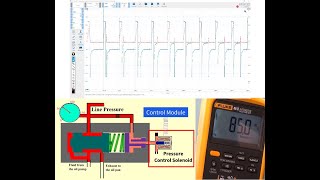
Connect an oscilloscope to the solenoid's control wire. A healthy Pulse Width Modulated (PWM) signal appears as a clean, sharp square wave. Erratic patterns, voltage drops, or a flat line pinpoint the exact electrical failure.
Tools: Oscilloscope, Service manual (Professional)
When This Code Triggers (Freeze-Frame Conditions)
- Engine Coolant Temp: 180-210°F (Vehicle is at full operating temperature.)
- RPM: 1200-2500 (During light acceleration or steady-state cruise, often during a shift event.)
- Engine Load: 20-50% (Moderate engine load, not at idle or full throttle.)
- Vehicle Speed: 25-60 mph (City or highway driving, when the transmission is actively shifting.)
Related Codes
- P0700 — A generic 'request' code from the TCM to the ECM to illuminate the Check Engine Light. It simply confirms a transmission fault exists; advanced scanners are required to pull the specific P2729 code.
- P2730 — 'Pressure Control Solenoid E Control Circuit High'. The direct opposite of P2729, indicating excessive voltage (short to power). The root causes and diagnostic procedures are identical.
- P2728 — 'Pressure Control Solenoid E Control Circuit Range/Performance'. Indicates erratic circuit performance rather than strictly low or high voltage, often pointing to intermittent wiring issues or a failing solenoid.
- P2724 / P2727 — 'Stuck On' (P2724) and 'Control Circuit Open' (P2727). When seen alongside P2729 on GM trucks, these strongly indicate the known TCM failure outlined in TSB #23-NA-018.
Climate & Environmental Factors
- Cold Weather: Temperatures below freezing cause transmission fluid to thicken, increasing viscosity. This makes solenoid actuation difficult, causing delayed shifts and putting extra strain on the system.
- High Humidity / Road Salt: High humidity and winter road salt accelerate corrosion on external wiring harnesses and connectors. This corrosion creates high electrical resistance, directly causing 'Circuit Low' codes like P2729.
How to Talk to a Mechanic About This Code
Say this: "I have a P2729 code with harsh shifting. I'd like to schedule a diagnostic. Please check for relevant TSBs, especially for the TCM, and perform electrical tests on the solenoid 'E' circuit before recommending internal parts replacement."
This signals you know P2729 is often an electrical or computer issue. It directs the shop to follow a logical diagnostic path and prevents them from immediately quoting an expensive internal repair.
Avoid saying:
- 'My transmission is acting weird, can you fix it?'
- 'The check engine light is on, just do whatever it takes.'
- 'A guy on a forum said to replace the solenoid.'
Questions to ask before authorizing the repair:
- What were the voltage and resistance readings at the solenoid connector?
- Did you find any Technical Service Bulletins (TSBs) for my vehicle related to this code?
- If the TCM needs replacement, does the quoted price include programming?
- What is the warranty on this specific repair, covering both parts and labor?
Where to Take It: Dealer vs Independent vs Chain
- Dealer:
Required for specific TSBs like the GM TCM issue or if the vehicle is under warranty. Otherwise, an expensive option.
Best for: Vehicles under warranty., 2019-2020 GM trucks with the known TCM failure (TSB #23-NA-018)., Complex TCM replacement and programming.
Downsides: Highest labor rates, typically 1.5-2x more than independent shops., Often recommend replacing a whole assembly (e.g., valve body) when only one component failed. (Typical cost: +50% vs. baseline) - Independent Shop:
Best overall choice for most out-of-warranty vehicles, provided you choose a reputable shop with transmission specialists.
Best for: Out-of-warranty vehicles where cost is a major factor., Diagnosing common electrical faults (wiring, connectors)., Known component failures on older cars (e.g., Chrysler conductor plates).
Downsides: Quality varies widely; a certified transmission specialist is required., May lack expensive, manufacturer-specific programming tools for newer models. (Typical cost: +0% vs. baseline) - Chain Shop:
AVOID for diagnosing P2729. The risk of misdiagnosis (e.g., recommending a rebuild for a simple wiring issue) is extremely high.
Best for: Basic fluid and filter changes.
Downsides: Technicians lack specialized training for complex internal transmission diagnostics., High pressure to upsell services leads to misdiagnosis. (Typical cost: -10% vs. baseline)
When to Walk Away From the Repair
If the estimated repair cost exceeds 50% of the car's private-party value, seriously consider selling or trading it in instead of repairing it.
- Car worth $5000, fix is $2800: Walk away. The repair cost is over 50% of the car's value, making it a poor investment.
- Car worth $15000, fix is $1800: Fix it. The repair cost is well under the threshold and restores the vehicle's function and value.
- Car worth $3000, fix is $800: Borderline. While under the 50% rule, consider the car's overall condition. If other major repairs are looming, sell it.
What Scan Tool You Need for This Code
Minimum: A scanner that reads manufacturer-specific transmission codes and views live data for transmission solenoids (commanded state, voltage, current).
A basic $30 code reader only shows the P2729 code but cannot provide live data to determine if the fault is wiring, the solenoid, or the TCM. Bidirectional control is required to command the solenoid on/off for diagnosis.
Budget: XTOOL Anyscan A30M (~$90) — A Bluetooth dongle offering full system diagnostics and basic bidirectional controls to activate the solenoid and confirm circuit function.
Mid-range: Launch X431 CRP919E (~$350) — Provides full system diagnostics, robust bidirectional control to command the solenoid, and live data streams for pressure, voltage, and current. Ideal for advanced DIYers.
Professional: Autel MaxiCOM MK808S (~$480) — A professional tablet scanner offering full bidirectional control, 28+ service functions, and fast live data graphing to definitively pinpoint the fault.
Rent vs buy: Renting a basic scanner from a parts store is NOT sufficient. Buying a mid-range bidirectional scanner is a worthwhile investment that saves thousands in diagnostic fees.
How to Clear the Code After You Fix It
- Use an OBD-II scan tool to clear the diagnostic trouble codes.
- Perform a complete transmission drive cycle.
- Reconnect battery (only if required by the repair procedure, not as a code-clearing method).
Drive cycle (~20 minutes): 1. Cold start and idle for 2-3 minutes. 2. Drive the vehicle, shifting through all forward gears up to highway speed (55-60 mph). 3. Perform several light-to-moderate accelerations and decelerations. 4. Come to a complete stop and idle. 5. Repeat stop-and-go sequences to let the TCM relearn shift points.
Readiness monitors affected: Comprehensive Component Monitor (CCM), Transmission Control Module
Before emissions retest: drive at least 50 miles to fully set monitors.
Watch out for:
- Disconnecting the battery clears the code but erases adaptive learning memory, causing new shifting problems and a failed emissions test.
- The code returns immediately if the underlying electrical or mechanical fault is not repaired.
Will This Fail Emissions / State Inspection?
Yes — this code typically fails an OBD-II emissions inspection.
- California: An illuminated Check Engine Light results in an automatic failure of the Smog Check. All required OBD-II readiness monitors must be 'complete' before passing a re-test.
- New York: A vehicle with an active P2729 code and illuminated MIL fails the On-Board Diagnostics (OBDII) portion of the annual safety and emissions inspection.
- Texas: In the 17 counties requiring emissions testing, an illuminated Check Engine Light is an automatic failure. The vehicle must complete a drive cycle to set readiness monitors before re-inspection.
Most Commonly Affected Vehicles
- GMC Sierra 1500 (2019-2020) — A critical known issue on models with the 8-speed (MQE) transmission, covered by GM TSB #23-NA-018. A faulty TCM causes rear wheels to lock up at low speeds. The fix is TCM replacement.
- Chevrolet Silverado 1500 (2019-2020) — Shares the faulty TCM with the GMC Sierra 1500 8-speed (MQE) transmission. Subject to the same rear wheel lock-up condition (TSB #23-NA-018). 10-speed models are unaffected.
- Ford F-150, Expedition, Mustang (2011-2014) — 6R80 transmissions are prone to molded lead frame failure. A cracked lead frame causes intermittent signal loss and abrupt downshifts into first gear (Recall 19S07).
- Honda Pilot, Odyssey (2016-2022) — P2729 is most often caused by an electrical issue in the external solenoid circuit (open or shorted wire) rather than a mechanical failure of the solenoid itself.
- Chrysler / Dodge 300, Charger, Magnum (NAG1/W5A580) (2005-2014) — Limp mode is frequently caused by a cracked conductor plate atop the valve body. The fix requires replacing the conductor plate (OEM P/N 52108308AC).
- BMW 3-Series, 5-Series, X5 (ZF 6HP) (2002-2010) — The Mechatronic unit (combined TCM and valve body) is a known failure point. Hairline cracks in the adapter block or failing solenoids trigger pressure control fault codes.
- Audi / Volkswagen A4, A5, A6, Q5 (0B5/DL501 S-Tronic) (2009-2016) — The Mechatronic unit in these dual-clutch transmissions frequently fails, causing a flashing PRNDS indicator and limp mode. Requires costly replacement or remanufacturing.
- Kia / Hyundai Optima, Sonata, Sorento (6-speed A/T) (2011-2015) — Documented weaknesses in the internal transmission wiring harness and solenoids make them the primary suspect for electrical fault codes.
Manufacturer-Specific Notes
- General Motors (Chevrolet/GMC): On 2019-2020 trucks with the 8-speed transmission, P2729 is a critical safety warning. A faulty TCM causes rear wheels to lock up at low speeds. The only fix is TCM replacement per TSB #23-NA-018.
- Ford: On 6R80 transmissions (2011-2014 F-150), a faulty molded lead frame causes dangerous downshifts. Covered by Recall 19S07, the fix is lead frame replacement, not a software update.
- Chrysler / Dodge (NAG1): Limp mode and erratic shifting are frequently caused by a cracked conductor plate housing the speed sensors. Repair requires dropping the valve body to replace this specific component (Mopar P/N 52108308AC).
- Honda: P2729 almost always points to an external electrical problem, like a broken wire or corroded harness connection, rather than a failed internal solenoid.
- Audi / Volkswagen (0B5/DL501): The S-Tronic Mechatronic unit integrates the TCM, solenoids, and valve body. Electrical faults within this sealed unit require complete replacement or specialized remanufacturing.
Real Owner Stories
2019 Chevy Silverado 1500 at 45K miles
Check Engine Light illuminated, transmission shifted hard, and rear wheels locked up completely while pulling into a parking spot.
What they tried:
- A local shop scanned P2729 and replaced the 'E' solenoid for $700.
- The problem returned within 24 hours.
Outcome: The owner towed the truck to a GM dealer who identified the issue via TSB #23-NA-018. The faulty TCM was the true cause. The TCM was replaced and programmed (Part #24070762), permanently fixing the issue under a customer satisfaction program.
Lesson: For 2019-2020 GM trucks, P2729 is a known TCM failure, not a solenoid issue. Checking TSBs prevents misdiagnosis and dangerous wheel lock-up.
2012 Dodge Charger R/T (NAG1) at 110K miles
Car entered limp mode (stuck in 2nd gear) with a P2729 code after weeks of harsh shifting.
What they tried:
- Checked transmission fluid, which was full but dark.
- Performed a fluid and filter change, which did not solve the problem.
Outcome: A mechanic confirmed a failed conductor plate. The valve body was dropped and the plate replaced with a new Mopar part (P/N 52108308AC). Total cost was $950 ($350 parts, $600 labor), resolving all shifting issues.
Lesson: On Chrysler/Dodge vehicles with the NAG1 transmission, limp mode with solenoid codes frequently points to a failed conductor plate, not individual solenoids.
2017 Honda Pilot at 85K miles
Check Engine Light on with code P2729. No major drivability symptoms other than occasional rough shifts.
What they tried:
- The DIY owner checked fluid level and condition, which were fine.
- Prepared to drop the transmission pan to replace the solenoid.
Outcome: Before dropping the pan, the owner tested the wiring with a multimeter. They found an intermittent open wire in the harness rubbing against a bracket. Repairing the single broken wire cost under $10 and cleared the code permanently.
Lesson: Perform basic electrical checks before replacing internal components. On modern cars, the fault is often in the external wiring.
How to Prevent This Code From Triggering
- Regular Transmission Fluid and Filter Changes (Every 30,000-60,000 miles) — Clean fluid lubricates, cools, and ensures proper hydraulic pressure. Degraded fluid causes overheating and allows debris to clog solenoids.
- Use ONLY the Manufacturer-Specified (OEM) Fluid (Every fluid change) — Modern transmissions require specific friction modifiers. Universal fluids cause slipping, seal damage, and solenoid malfunction.
- Install an Auxiliary Transmission Cooler (Once, especially if you tow) — Heat destroys automatic transmissions. Towing quickly overheats fluid. An auxiliary cooler reduces operating temperatures, preserving internal components.
- Address Fluid Leaks Immediately (As needed) — Low fluid causes solenoid and clutch failure due to lack of hydraulic pressure. Ignoring a small leak leads to thousands of dollars in damage.
Frequently Asked Questions
What does the 'E' pressure control solenoid actually do?
The Pressure Control Solenoid 'E' is a computer-controlled valve inside your transmission that regulates hydraulic fluid pressure. This precise pressure engages specific clutch packs, allowing your car to shift gears smoothly.
Is it safe to drive my car with a P2729 code?
No. On certain GM trucks, it signals an immediate risk of the rear wheels locking up while driving. On all other cars, driving in limp mode quickly causes overheating and catastrophic internal damage, requiring a full transmission rebuild.
What is the most common misdiagnosis for P2729?
Replacing the internal solenoid on a 2019-2020 GM truck when the actual cause is a faulty TCM (TSB #23-NA-018). Another common mistake is performing an expensive transmission rebuild before testing external wiring and connectors.
Can a bad battery or alternator cause code P2729?
Yes. The 'Circuit Low' designation means the solenoid is not receiving enough voltage. A weak battery or failing alternator lowers the entire vehicle's system voltage, triggering this and other low voltage codes.
What is the difference between P2729 (Circuit Low) and P2730 (Circuit High)?
P2729 means voltage is too low (short to ground), while P2730 means voltage is too high (short to power). Both are electrical faults related to the same solenoid, wiring, or TCM. They share an identical diagnostic procedure.
Will a transmission fluid change fix a P2729 code?
Yes, if the problem is caused by low or extremely dirty fluid. Topping off low fluid restores hydraulic pressure, though you must locate the leak. Changing degraded fluid removes debris causing the solenoid to stick.
Why is checking for TSBs so important for this code?
Manufacturers release TSBs for known design flaws. For P2729, GM TSB #23-NA-018 prevents catastrophic wheel lock-up by identifying the TCM, not the solenoid, as the culprit. Checking TSBs prevents thousands of dollars in misdiagnosis.
Key Takeaways
- Code P2729 indicates the transmission control module (TCM) detects under 9 volts in the 'E' pressure control solenoid circuit, preventing proper gear engagement.
- Driving with P2729 triggers 'limp mode' (locking the transmission in 2nd or 3rd gear) and causes harsh, banging shifts that rapidly degrade internal clutches.
- On 2019-2020 GM Sierra and Silverado trucks, P2729 is a critical safety hazard caused by a faulty TCM (TSB #23-NA-018) that causes rear wheels to lock up at low speeds.
- Before replacing a $300 internal solenoid, test the external wiring harness; frayed wires or corroded connectors cause over 50% of P2729 low-voltage codes.
- A standard transmission fluid and filter change costs $200-$400 and resolves P2729 if the root cause is metallic debris clogging the solenoid valve.
Helpful Videos

Shop the Parts Behind P2729
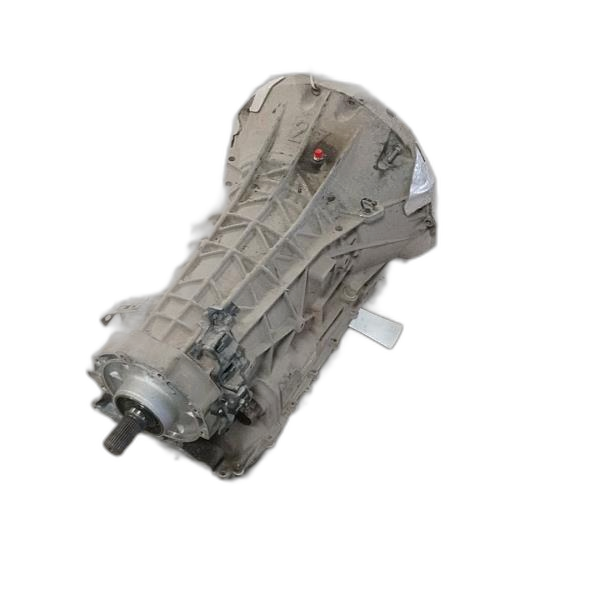
Below are the parts most often responsible for code P2729, ranked by how frequently each one is the actual culprit (per the diagnosis above). Tap any to see what we have for your vehicle.



The information in this article is provided for general reference and educational purposes only. Vehicle specifications, procedures, and part compatibility can vary by production date, trim level, and region. Always consult your vehicle's factory service manual and verify part numbers before purchasing or performing repairs. Safety-critical components such as airbags, seat belts, and braking systems should be installed by a qualified professional.
- 🧭 Diagnostic Flowchart
- 🎬 Helpful Videos
- 🛍️ Shop This Part
- What Does P2729 Mean?
- Can I Drive With P2729?
- Common Causes
- Symptoms
- Common Fixes & Costs
- DIY vs Professional
- Used vs. New Parts: Buying Guide
- What Happens If You Wait — Timeline
- Cost of Not Fixing It
- Diagnosis Steps
- When This Code Triggers (Freeze-Frame Conditions)
- Related Codes
- Climate & Environmental Factors
- How to Talk to a Mechanic About This Code
- Where to Take It: Dealer vs Independent vs Chain
- When to Walk Away From the Repair
- What Scan Tool You Need for This Code
- How to Clear the Code After You Fix It
- Will This Fail Emissions / State Inspection?
- Most Commonly Affected Vehicles
- Manufacturer-Specific Notes
- Real Owner Stories
- 2019 Chevy Silverado 1500 at 45K miles
- 2012 Dodge Charger R/T (NAG1) at 110K miles
- 2017 Honda Pilot at 85K miles
- How to Prevent This Code From Triggering
- Frequently Asked Questions
- What does the 'E' pressure control solenoid actually do?
- Is it safe to drive my car with a P2729 code?
- What is the most common misdiagnosis for P2729?
- Can a bad battery or alternator cause code P2729?
- What is the difference between P2729 (Circuit Low) and P2730 (Circuit High)?
- Will a transmission fluid change fix a P2729 code?
- Why is checking for TSBs so important for this code?
- Key Takeaways
- 🎟️ Get 5% Off