

P2763 on 2020-2023 Subaru Outback: Torque Converter Solenoid Circuit High Guide
P2763 on a 2020-2023 Outback almost always indicates a fault in the transmission's valve body, specifically the torque converter clutch solenoid. This is a known issue addressed by a Subaru TSB and typically requires replacing the entire valve body assembly, a costly repair. For this specific model range, the cause is often moisture intrusion into the valve body connector.
- P2763 on a 2020-2023 Outback is most often a failed torque converter lock-up solenoid within the transmission valve body.
- Subaru TSB 16-149-25 identifies moisture getting into the main harness connector as a specific cause for these model years.
- The official repair is to replace the entire valve body assembly, which is expensive ($1500-$3500).
- Owners should immediately check if their vehicle is covered by Subaru's 10-year/100,000-mile CVT warranty extension, which could make the repair free.
What's Unique About the 2020-2023 Subaru OUTBACK
For the 2020-2023 Outback with the TR580 CVT, this code is specifically addressed by Subaru Technical Service Bulletin (TSB) 16-149-25. The TSB notes that condensation can form inside the transmission's top cover and seep into the harness connector for the CVT control valve, causing this and other related electrical fault codes. This indicates a specific vulnerability to moisture intrusion on this platform, leading to what would otherwise seem like an internal transmission failure. The TSB outlines a fix that includes a new, better-sealed connector cover to prevent recurrence.
Diagnostic Flowchart
Tap your situation to follow the diagnostic path that matches what you're seeing on this vehicle.
Symptoms You May Notice
- Check Engine Light is on
- Flashing 'AT OIL TEMP' light on the dashboard
- Vehicle may enter 'limp mode' with reduced power
- Torque converter fails to lock up at highway speeds, causing higher than normal RPM
- Reduced fuel economy
- Harsh or erratic shifting
- Vehicle may shudder or stall when slowing to a stop
- Multiple dashboard lights activating at once, including EyeSight and parking brake warnings
- Replacing the entire transmission when only the valve body is needed.
- Replacing the torque converter itself, when the issue is with the electronic solenoid that controls it.
Most Likely Causes
- Faulty Transmission Valve Body / Solenoid 🔴 High Probability → Shop Transmission Valve Body This is a very common failure point on Subaru CVTs. TSB 16-149-25 was issued specifically for this problem on 2020-2023 models, noting that moisture can enter the valve body connector, causing a high circuit fault. The solenoid itself can also fail internally with an open circuit, which is a frequent issue across both TR580 and TR690 CVTs.
How to confirm: A technician will test the resistance of the solenoid's circuit. This can be done at the external transmission harness connector. The expected resistance is between 10 and 13.5 Ohms. A reading of 'OL' (Open Loop) or a very low reading like 2.5 ohms indicates an open/shorted circuit and a failed solenoid.
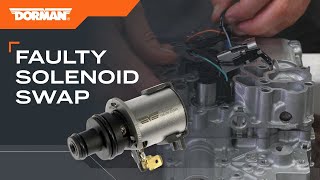
Typical fix: Replace the entire CVT control valve body assembly. While the solenoid is the point of failure, Subaru does not sell it separately for this model and recommends replacing the complete valve body. Aftermarket solenoids are available, but replacement requires disassembling the valve body. After replacement, a transmission relearn procedure is required.
Est. part cost: $800-$1200 for OEM Valve Body Assembly - Wiring Harness Issue 🟡 Medium Probability TSB 16-149-25 specifically mentions moisture seeping into the harness connector for the CVT control valve as a primary cause for this model year range. This can lead to corrosion and an open or shorted circuit, creating a 'Circuit High' fault.
How to confirm: Visually inspect the transmission harness connectors for corrosion, moisture, or damage after removing the top transmission cover. Perform a continuity test on the wiring between the TCM and the valve body connector to check for breaks.
Typical fix: Clean the corroded connectors and apply dielectric grease. If the wire is broken, the harness may need to be repaired or replaced. The TSB also introduces a new, better-sealed connector cover to prevent future moisture intrusion as part of the official repair procedure.
Est. part cost: $50-$500 - Faulty Transmission Control Module (TCM) ⚪ Low Probability → Shop Transmission Assembly
How to confirm: This is diagnosed by exclusion. If the valve body solenoid and all related wiring test good (both when cold and hot), the TCM is the likely culprit.
Typical fix: Replace and reprogram the Transmission Control Module.
Est. part cost: $500-$800
Diagnosis Steps
- Scan the vehicle for all stored trouble codes. Note P2763 and any other related codes like P0700.
- Check the transmission fluid level and condition. While not a direct cause of a 'circuit high' code, low or dirty fluid can indicate other transmission problems.
- Using a multimeter, measure the resistance of the torque converter clutch solenoid circuit. This can be done from the external transmission harness connector to check the entire circuit. The expected resistance is between 10 and 13.5 Ohms. A reading of 'OL' (Open Loop) or a very low number indicates an open/shorted circuit and a failed solenoid.
- If resistance is abnormal, access the valve body on top of the transmission to test the solenoid directly, isolating it from the wiring harness.
- If resistance is normal at the main connector, inspect the wiring harness and connectors between the TCM and the transmission for any signs of damage, corrosion, or moisture, as outlined in TSB 16-149-25.
- If the solenoid and wiring are confirmed to be good, further diagnostics on the Transmission Control Module (TCM) may be necessary.
- If the solenoid is confirmed bad, proceed with replacing the valve body assembly.
- After replacement, perform the compulsory learning/relearn procedure using a capable diagnostic scan tool.
Parts You'll Likely Need
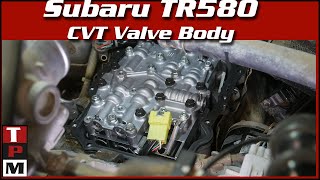
- CVT Control Valve Body Assembly
(OEM #31825AA055)— This assembly contains the torque converter clutch solenoid, which is the most common point of failure for code P2763. Subaru does not sell the individual solenoid, requiring the replacement of the entire unit. This part number supersedes previous versions 31825AA050, 31825AA051, 31825AA052, 31825AA053, and 31825AA054.
Trusted brands: Subaru (OEM)
OEM price range: $800-$1200
Aftermarket price range: N/A (for full assembly), ~$100 for individual solenoid
Related Codes That Often Appear With This One
- P0700 — P0700 is a generic code indicating the Transmission Control Module (TCM) has stored a fault. It almost always appears alongside a more specific transmission code like P2763.
- P2721 — Pressure Control Solenoid “D” Control Circuit High. This code is listed in the same TSB (16-149-25) and can be caused by the same moisture intrusion issue at the valve body connector.
- P0974 — Shift Solenoid “A” Control Circuit High. Also listed in TSB 16-149-25 with the same underlying cause.
- P0977 — Shift Solenoid “B” Control Circuit High. Also listed in TSB 16-149-25 with the same underlying cause.
- P2764 — Torque Converter Clutch Pressure Control Solenoid Control Circuit Low. This is the counterpart to P2763 and indicates a short to ground rather than an open circuit, but it points to the same component.
Technical Service Bulletins (TSBs) & Recalls
- 16-149-25: Announcing a new TR580 control valve and connector cover to address DTCs P2721, P2763, P0974, & P0977 caused by moisture intrusion.
- 16-115-18 & 16-139-22: Details on the CVT warranty extension to 10 years/100,000 miles for various Subaru models, which may cover this repair.
Platform-Specific Known Issues
- Subaru has extended the CVT warranty for many models to 10 years or 100,000 miles. Owners should check with a Subaru dealer to see if their vehicle is covered under this extension, as a valve body replacement would likely be included. This extension was announced for various model years, including some 2020 models.
- TSB 16-149-25 specifically identifies moisture intrusion into the valve body harness connector as a cause for this code on 2020-2023 models and provides a redesigned connector cover as part of the repair.
- A Reddit user with a 2020 Crosstrek (a platform mate) experienced this failure at just 25,000 miles, with a dealer quote of $3,500 for the valve body replacement.
Mechanic-Grade Diagnostic Values
- Torque Converter Clutch (Lock-Up) Solenoid Resistance — expected: 10 to 13.5 Ohms at 68°F (20°C).. Failure: A reading of 'OL' (Open Loop) indicates an open circuit, while a very low reading (e.g., 2.5 Ohms) indicates a short. The resistance may test normal when cold but go open circuit ('OL') when heated with a heat gun to ~200°F, indicating an intermittent thermal failure.
- Resistance test at external transmission connector — expected: 10 to 13.5 Ohms between Pin 11 (White wire or Light Green wire depending on specific harness) of the T4/B11 grey connector and a clean chassis/transmission case ground.. Failure: An 'OL' reading confirms an open circuit in the harness or, more commonly, the solenoid itself.
- Valve Body and Cover Bolt Torque — expected: Valve body-to-case bolts: 6.5 ft-lbs (80 in-lbs). Valve body cover bolts: 6 ft-lbs (72 in-lbs).. Failure: N/A - These are installation specifications.
Scan Tool Commands That Help
- Autel MaxiSys, Launch X431, Subaru Select Monitor (SSM): AT Learning Mode / Compulsory Learning Mode — This procedure is mandatory after replacing the valve body or transmission. It clears old calibration data and forces the TCM to learn the operational characteristics of the new solenoids. Failure to perform this can result in poor shifting, continued fault codes, or a flashing 'AT OIL TEMP' light.
- Autel MaxiSys, Launch X431, Subaru Select Monitor (SSM): Clear Learning Value — Used before initiating the 'AT Learning Mode' to ensure all previous adaptive values from the old valve body are erased from the TCM's memory.
Wiring & Ground Locations
- T4 / B11 Connector (Grey) — On top of the transmission, accessible from the engine bay. It is the grey-colored of the two main harness connectors.. This is the primary external test point for the transmission solenoids. The TCC Lock-Up solenoid signal wire is at Pin 11, allowing a technician to test the solenoid's resistance without removing any transmission components.
- Intake Manifold Grounds — Bolted to the top of the intake manifold.. The ECU/TCM receives its primary ground reference from the intake manifold. A poor connection here due to corrosion or looseness can cause a variety of strange electrical issues and incorrect sensor readings, potentially mimicking a component failure.
- Main Chassis Ground — The point where the negative battery cable bolts directly to the vehicle's chassis/frame.. All electrical circuits, including the TCM and its solenoids, rely on a solid connection back to the battery negative. A corroded or loose main ground can introduce resistance and voltage fluctuations throughout the entire vehicle's electrical system.
Real Owner Repair Stories
- Ultimate Subaru Message Board user (2014 Subaru Legacy 2.5L CVT) — Check Engine Light, blinking AT OIL TEMP light, and multiple other dash lights came on simultaneously. Codes P0700 and P2763 were stored.
❌ Tried (didn't work) Initially, the user cleared the codes to see if they would return, which is a common first step for intermittent issues.
✅ What actually fixed it The issue was a failed lock-up solenoid. The user noted that the worst-case scenario, which turned out to be the actual cause, was replacing the entire control valve assembly because Subaru does not service the individual solenoids. - SubaruImpreza.org Forum user 'Pete-ame' (2012 Impreza 2.0 CVT) — P2763 code appeared two weeks after purchasing the car.
❌ Tried (didn't work) Tested solenoid resistance when cold and hot from the external connector and TCM, and it was within spec (~13 ohms)., Manipulated wiring to check for intermittent connections., Replaced the solenoid with an aftermarket Dorman part, but the code persisted despite the new solenoid testing correctly at 12.8 ohms.
✅ What actually fixed it The resolution is not definitively posted in the thread, but the user was left suspecting a faulty TCM after the new solenoid and wiring checks failed to resolve the issue. Another user cautioned that Dorman parts can sometimes be defective out of the box, suggesting an OEM part or further TCM diagnostics as the next step. - YouTube video by 'Gary Ferraro' (2010 Subaru with TR690 CVT) — Code P2763, Lockup Duty Solenoid Circuit High.
❌ Tried (didn't work) N/A, went straight to diagnosis.
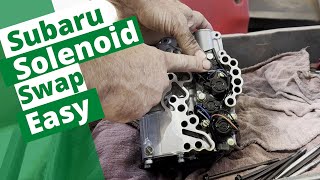
✅ What actually fixed it Diagnosis confirmed an open circuit on the lock-up duty solenoid by testing resistance at the valve body connector (light green wire). The reading was 'OL' (open) while the adjacent solenoid correctly read ~13 Ohms. The fix was to replace only the failed solenoid on the valve body, demonstrating it's possible without replacing the entire assembly.
OEM Part Supersession History
31825AA050, 31825AA051, 31825AA052, 31825AA053, 31825AA054→31825AA055— The part has undergone successive updates and design changes for improved durability and to prevent certain fault codes. TSB 16-119-19 mentions circuit shape changes to prevent air bubbles causing false DTCs, and TSB 16-156-25R mentions an enhanced valve sleeve for durability.
Heads up: While older part numbers might physically fit, using the latest superseded part (31825AA055) is critical to ensure all design improvements are included.
Helpful Videos

We Have This Part in Stock


The information in this article is provided for general reference and educational purposes only. Vehicle specifications, procedures, and part compatibility can vary by production date, trim level, and region. Always consult your vehicle's factory service manual and verify part numbers before purchasing or performing repairs. Safety-critical components such as airbags, seat belts, and braking systems should be installed by a qualified professional.
- Subaru OUTBACK:
- 🧭 Diagnostic Flowchart
- 🎬 Helpful Videos
- 🛍️ Shop This Part
- What's Unique About the 2020-2023 Subaru OUTBACK
- Symptoms You May Notice
- Most Likely Causes
- Diagnosis Steps
- Parts You'll Likely Need
- Related Codes That Often Appear With This One
- Technical Service Bulletins (TSBs) & Recalls
- Platform-Specific Known Issues
- Mechanic-Grade Diagnostic Values
- Scan Tool Commands That Help
- Wiring & Ground Locations
- Real Owner Repair Stories
- OEM Part Supersession History
- 🎟️ Get 5% Off