

P2764 on 2008-2015 Dodge Challenger: TCC Solenoid and Torque Converter Guide
On a 2008-2015 Dodge Challenger, code P2764 most often points to either a failed Torque Converter Clutch (TCC) solenoid or a failing torque converter. For V6 models with the 62TE transmission, a manufacturer TSB confirms that if the solenoid tests okay, the torque converter is the likely cause, making proper diagnosis essential to avoid a costly misdiagnosis. V8 models with the NAG1 transmission can also experience TCC issues, but they are more often related to valve body wear or the TCC solenoi
- P2764 on a Dodge Challenger indicates a low voltage issue in the Torque Converter Clutch (TCC) solenoid circuit.
- The two most likely causes are a failed TCC solenoid (part of the solenoid pack) or a failed torque converter.
- A crucial Dodge TSB (#9004009) for the 62TE transmission advises that if the solenoid tests good, the torque converter is the culprit. Do not replace the solenoid without proper diagnosis.
- Symptoms include transmission slipping, jerking, and potentially stalling the engine when coming to a stop.
- This is a serious issue that requires professional diagnosis and repair due to the complexity of internal transmission work.
What's Unique About the 2008-2015 Dodge CHALLENGER
Many Dodge Challengers in this year range with the V6 engine are equipped with the 62TE automatic transmission. For vehicles with this transmission, Chrysler issued a Technical Service Bulletin (TSB #9004009) that provides a very specific diagnostic path. The TSB states that if code P2764 appears and the TCC solenoid itself is functioning correctly, the root cause is likely a failing torque converter. This is a critical piece of information that can save a technician from incorrectly replacing only the solenoid pack. V8 models use the Mercedes-derived W5A580 (NAG1) transmission, which does not follow this specific TSB but is known to have its own set of TCC shudder and apply issues, often related to valve body wear or brittle O-ring seals on the TCC solenoid.
Diagnostic Flowchart
Tap your situation to follow the diagnostic path that matches what you're seeing on this vehicle.
Symptoms You May Notice
- Check Engine Light is on
- Transmission slipping or jerking. [Bulletin #9004009]
- Vehicle stalling when coming to a stop, particularly when shifting into Drive but not in Reverse.
- Harsh or erratic shifting.
- Failure of the torque converter to lock up at highway speeds, resulting in higher than normal RPMs
- Shuddering or vibration, sometimes described as driving over a rumble strip, during light acceleration or between 35-50 mph.
- Increased fuel consumption.
- Transmission may enter "limp mode," getting stuck in one gear.
- Replacing the TCC solenoid or solenoid pack when the actual failure is the torque converter. The TSB for the 62TE transmission specifically warns against this by advising that a good solenoid points toward a bad torque converter. [Bulletin #9004009, 8]
Most Likely Causes
- Failed Torque Converter 🔴 High Probability → Shop Automatic Transmission Torque Converter A manufacturer TSB for the 62TE transmission explicitly states that if the TCC solenoid tests okay, this code is indicative of a torque converter failure. [Bulletin #9004009, 8] The internal lock-up clutch can fail or stick, causing the drivability issues. Remanufacturers often use upgraded billet covers and new lock-up linings to address this weakness.
How to confirm: After confirming the TCC solenoid and its wiring are functioning correctly using a scan tool and multimeter, the torque converter becomes the primary suspect per the TSB. Excessive metal debris in the transmission pan is a strong confirmation of mechanical failure.
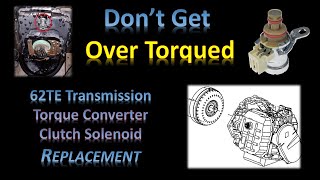
Typical fix: Replace the torque converter. This is a major repair that requires removing the transmission. 🎬 Watch: A walkthrough of the torque converter replacement process.
Est. part cost: $300-$800 - Failed Torque Converter Clutch (TCC) Solenoid / Solenoid Pack 🟡 Medium Probability → Shop Automatic Transmission Torque Converter The solenoid is an electronic component that can fail over time due to heat and wear. On the 62TE, the TCC solenoid (also called EMCC VFS Solenoid) is a separate, serviceable part on the valve body, though it is often replaced with the entire solenoid pack. 🎬 Watch: Step-by-step guide to replacing the 62TE solenoid pack. On the NAG1, the TCC solenoid O-rings can become brittle and leak.
How to confirm: Using a bi-directional scan tool to command the solenoid on/off while monitoring voltage. An electrical test with a multimeter can check the solenoid's internal resistance against specifications. For the 62TE, the TCC solenoid resistance should be between 4.8-5.3 ohms at ~70°F. For the NAG1, resistance values are similar for its various solenoids. 🎬 See how to test NAG1 solenoids using a multimeter.
Typical fix: For the 62TE, replace the individual TCC solenoid (P/N: 5169313AA) or the entire solenoid pack. This requires draining the transmission fluid and removing the transmission pan and valve body. For the NAG1, replace the TCC solenoid and its O-rings.
Est. part cost: $150-$400 - Low or Contaminated Transmission Fluid ⚪ Low Probability → Shop Transmission Assembly Leaks can develop over time, and fluid breaks down, allowing debris and sludge to clog solenoid passages and affect hydraulic pressure. This is a common and often overlooked cause of solenoid performance issues.
How to confirm: Check the transmission fluid level and condition. If the fluid is dark, burnt-smelling, or contains metal shavings, it indicates a more severe internal problem.
Typical fix: Perform a transmission fluid and filter change using the correct ATF+4 fluid. If the fluid is heavily contaminated, a full flush may be needed, but this won't fix underlying mechanical damage.
Est. part cost: $50-$150 - Wiring or Connector Issue ⚪ Low Probability The wiring harness to the transmission is exposed to heat and debris, which can cause wires to become frayed, shorted, or corroded over time, especially at the main connector. Poor ground connections can also cause erratic voltage readings.
How to confirm: Visually inspect the wiring harness leading to the transmission for any signs of damage. Test for voltage at the solenoid connector. Test for continuity and resistance between the TCM connector and the solenoid connector to rule out an open or short in the harness.
Typical fix: Repair or replace the damaged section of the wiring harness or the connector.
Est. part cost: $20-$100
Rare But Worth Checking
- Faulty Transmission Control Module (TCM) or Powertrain Control Module (PCM): → Shop Transmission Assembly This is rare and should only be considered after all other possibilities (solenoid, wiring, torque converter) have been definitively ruled out. A module failure can mimic a circuit fault. If all circuit tests are good but the problem persists, the TCM's internal driver may be at fault.
- Worn Valve Body (Primarily on NAG1): → Shop Transmission Valve Body On the V8 models with the NAG1 transmission, wear in the valve body bores for the TCC control valves is a known cause of shudder and TCC-related issues. This requires specialized valve body repair or replacement.
Diagnosis Steps
- Check the transmission fluid level and condition. Ensure it is clean, full, and of the correct ATF+4 type. Address any leaks first.
- Use an OBD-II scanner to check for any other related trouble codes, paying special attention to P0740 and P0700.
- Perform a visual inspection of the transmission wiring harness and connectors for any signs of damage, corrosion, or loose connections.
- With a bi-directional scan tool (like wiTECH), command the TCC solenoid on and off to check for a response. Monitor the voltage readings from the solenoid circuit.
- If the solenoid does not respond or voltage is low, drop the transmission pan to access the solenoid/valve body.
- Test the resistance of the TCC solenoid with a multimeter. For the 62TE, test between Pin 10 (power) and Pin 3 (control) at the main solenoid connector. The expected resistance is 4.8-5.3 Ohms at room temperature. A reading of infinity indicates an open coil.
- Test the wiring for continuity between the TCM connector and the solenoid connector to rule out an open or short in the harness.
- If the solenoid and wiring test good on a 62TE-equipped vehicle, follow the guidance of TSB #9004009, which indicates a high probability of torque converter failure.
- Inspect the transmission fluid and pan for excessive metal debris, which would confirm a mechanical failure within the torque converter or transmission.
Parts You'll Likely Need
- Torque Converter
(OEM #68039261AC, R8070538AC (Reman))— A manufacturer TSB identifies this as the likely failure point on 62TE models if the TCC solenoid is functioning correctly. [Bulletin #9004009] Mopar has superseded the part number multiple times.
Trusted brands: Mopar, ATP, Transtar, Whatever Man
OEM price range: $500-$800
Aftermarket price range: $300-$500 - Transmission Solenoid Pack
(OEM #68376696AA (supersedes 5169313AA))— The TCC solenoid is a common failure point and is typically part of the main solenoid pack on the 62TE transmission. This is the first part to test and a likely cause if the torque converter is not the issue.
Trusted brands: Mopar, Rostra, Sonnax
OEM price range: $250-$450
Aftermarket price range: $150-$300 - TCC Solenoid (62TE)
(OEM #5169313AA, 5169313AB)— For the 62TE transmission, the TCC (EMCC) solenoid is a separate, serviceable component that bolts to the valve body. If diagnosis isolates the fault to just this solenoid, it can be replaced individually without replacing the entire solenoid pack.
Trusted brands: Mopar
OEM price range: $60-$100
Aftermarket price range: $40-$70
Related Codes That Often Appear With This One
- P0740 — This code also relates to the Torque Converter Clutch Circuit. The manufacturer TSB explicitly groups P2764 and P0740 together as indicators of the same potential failures (TCC solenoid or torque converter). [Bulletin #9004009, 8, 43]
- P0700 — This is a generic transmission fault code indicating that the TCM has stored a specific fault, such as P2764. It acts as a general alert for a transmission issue.
Technical Service Bulletins (TSBs) & Recalls
- 9004009
Platform-Specific Known Issues
- For models equipped with the 62TE transmission, TSB #9004009 is a critical document. It states: 'If vehicle is jerking/slipping with MIL code(s) P0740 or P2764, check TCC Solenoid operation. If TCC Solenoid is ok, the codes are indicative of a torque converter failure. Replace the torque converter.'
- A common real-world symptom of the torque converter failure on 62TE models is the engine stalling when the driver shifts into Drive from a stop, but not when shifting into Reverse. This points to the TCC being stuck in the 'on' or locked position.
- For V8 models with the W5A580 (NAG1) transmission, while P2764 can occur, a more common complaint is a 'TCC shudder' between 35-50 mph. This is often caused by wear in the TCC regulator valve bore within the valve body, rather than the torque converter itself.
Mechanic-Grade Diagnostic Values
- 62TE TCC (EMCC) Solenoid Resistance — expected: 4.8 - 5.3 Ohms at room temperature (~70°F). Failure: A reading significantly outside this range, or OL (Open Loop/infinity), indicates a failed solenoid coil.
- 62TE Shift Solenoid Resistance (e.g., Low/Reverse, Underdrive) — expected: 1.6 - 1.8 Ohms at room temperature (~70°F). Failure: A reading of OL (Open Loop) indicates an internal open in the solenoid. This value is for shift solenoids, not the TCC solenoid.
- 62TE Solenoid Pack Power Supply — expected: Battery voltage (~12V) at Pin 10 of the main solenoid connector. This pin receives power from the transmission control relay.. Failure: Low or no voltage indicates a problem with the relay, fuse, or wiring leading to the transmission, not the solenoid pack itself.
Scan Tool Commands That Help
- Chrysler wiTECH or equivalent bi-directional scanner: TCC Solenoid Actuation Test / Duty Cycle Command — This function is used to manually command the TCC solenoid on and off or to a specific duty cycle. It helps verify if the solenoid is mechanically responding (often heard as a click) and if the control circuit wiring from the TCM is functional. It's a critical step before physically removing parts.
- Chrysler wiTECH: Quick Learn Procedure — This procedure should be performed after replacing the valve body, solenoid pack, or the entire transmission. It allows the TCM to relearn the hydraulic and timing characteristics of the new components to ensure proper shift quality. Failure to perform this can result in harsh engagements or shifting issues.
Wiring & Ground Locations
- 62TE Main Solenoid Connector — On the front side of the 62TE transmission, typically accessible after removing the air filter housing.. This is the primary electrical interface for the entire valve body. Pin 10 is the 12V power feed from the relay, and Pin 3 is the specific control circuit for the TCC (EMCC) solenoid. Testing for resistance and voltage at these pins is a key diagnostic step.
- G300 — A primary body ground point located below the driver's side "B" pillar.. While not directly for the transmission case, this is a major ground point for various interior modules. A poor ground here can cause erratic behavior in control modules that communicate with the TCM, potentially leading to false codes or communication errors.
- TCM C4 Connector (Green) — This is one of the main connectors at the Transmission Control Module (TCM) or Powertrain Control Module (PCM), depending on the vehicle configuration.. This connector contains the control circuit wire for the TCC solenoid. Technicians can back-probe this connector to verify if the control signal is being sent from the module, which helps differentiate between a wiring fault and a faulty TCM.
Real Owner Repair Stories
- ATRA Technical Document (Vehicle with 62TE transmission (e.g., Dodge Challenger V6)) — Vehicle was towed in. After a long trip, the engine would die every time the transmission was put into Drive, but not in Reverse.
❌ Tried (didn't work) Initial diagnosis focused on potential engine stalling issues.
✅ What actually fixed it The issue was a stuck-on TCC solenoid. The solenoid was mechanically failed, keeping the torque converter locked at a stop, which stalled the engine in gear. Replacing the TCC solenoid (Part # 5169313AA) resolved the issue.
OEM Part Supersession History
5169313AA→5169313AB— Revision and update to the part by Mopar.
Heads up: The parts are interchangeable. This is the individual TCC (EMCC) solenoid for the 62TE transmission.5078709AA, 5078709AB, 68376696AA→68371508AB— Part number consolidation and updates by Mopar for the entire solenoid pack assembly.
Heads up: These numbers all refer to the 62TE solenoid pack. The latest number is generally recommended for repairs.
Model Year Variations Within This Range
- 2011-2013: Chrysler released a software update for the PCM (TSB 21-012-12 REV. B) for vehicles with the 3.6L engine and 62TE transmission to address customer complaints of harsh shifts (1-3, 2-3) and improve torque converter lock-up behavior in fifth gear. While not a direct fix for a failed part causing P2764, ensuring the latest software is installed is a key step in diagnosing any drivability issues with this transmission.
- 2015: The 2015 model year marked a major refresh. While V6 models continued with the 62TE, V8 models began using the ZF 8-speed automatic transmission, replacing the older 5-speed NAG1. This completely changes the diagnosis for P2764 on a 2015 V8, as the transmission hardware, solenoids, and control strategy are different.
- 2009-2010: Early V6 models used a 3.5L engine, which was replaced by the 3.6L Pentastar in 2011. Both engines were commonly paired with the 62TE transmission, so the P2764 diagnosis remains largely the same, but part numbers for other components may differ.
Helpful Videos
We Have This Part in Stock

The information in this article is provided for general reference and educational purposes only. Vehicle specifications, procedures, and part compatibility can vary by production date, trim level, and region. Always consult your vehicle's factory service manual and verify part numbers before purchasing or performing repairs. Safety-critical components such as airbags, seat belts, and braking systems should be installed by a qualified professional.
- Dodge CHALLENGER:
- 🧭 Diagnostic Flowchart
- 🎬 Helpful Videos
- 🛍️ Shop This Part
- What's Unique About the 2008-2015 Dodge CHALLENGER
- Symptoms You May Notice
- Most Likely Causes
- Rare But Worth Checking
- Diagnosis Steps
- Parts You'll Likely Need
- Related Codes That Often Appear With This One
- Technical Service Bulletins (TSBs) & Recalls
- Platform-Specific Known Issues
- Mechanic-Grade Diagnostic Values
- Scan Tool Commands That Help
- Wiring & Ground Locations
- Real Owner Repair Stories
- OEM Part Supersession History
- Model Year Variations Within This Range
- 🎟️ Get 5% Off