

P2800 on 2008-2012 Ford Escape Hybrid: Transmission Range Sensor 'B' Circuit Causes and Fixes
On a 2008-2012 Ford Escape Hybrid, code P2800 is most often caused by a faulty Transmission Range Sensor (TRS) or corroded wiring. This can cause a no-start condition or erratic shifting. Expect to pay $250-$500 for a sensor replacement at a shop. Before replacing the sensor, it is critical to inspect wiring and connectors for corrosion, as this is a very common and cheaper fix.
- P2800 on a 2008-2012 Escape Hybrid indicates a serious issue with the Transmission Range Sensor circuit that can prevent your car from starting.
- Before replacing any parts, thoroughly inspect the sensor's wiring connector and other nearby harness connectors for corrosion, as this is a very common cause on Ford hybrids.
- Symptoms are severe and include a no-start condition, incorrect gear display, and the vehicle entering a 'limp mode'.
- Driving with this code is not recommended due to the risk of being stranded or unpredictable transmission behavior.
- The fix may be as simple as cleaning a corroded connector, but can also require replacing the sensor itself.
What's Unique About the 2008-2012 Ford Escape
The Ford Escape Hybrid uses an electronically controlled continuously variable transmission (eCVT), which is different from the conventional automatic in non-hybrid models. While the P2800 code is not exclusive to this platform, Ford hybrids have a known sensitivity to wiring issues. A Technical Service Bulletin (TSB Bulletin #SSM 47790) for later model Fusion and C-MAX hybrids with similar powertrains points to water intrusion in main wiring harness connectors as a primary cause for this code, not just the sensor itself. This suggests that for the Escape Hybrid, diagnosing a P2800 should focus heavily on checking for corrosion in the wiring, not just immediately replacing the sensor. The eCVT is a highly reliable planetary gear set design, often licensed from Toyota, and internal failures are less common than issues with external sensors and wiring.
Symptoms You May Notice
- Engine will not crank or start.
- Vehicle may only start when the shifter is in Neutral.
- Incorrect gear selection displayed on the instrument cluster, or the display is blank.
- Transmission enters a 'limp home' mode with limited functionality.
- "Stop Safely Now" or other wrench/warning lights appear on the dash.
- Reverse lights do not work.
- Check Engine Light is illuminated.
- Replacing the Transmission Range Sensor without first inspecting the wiring and connectors. Corrosion is a very common cause and cleaning a connector is much cheaper than replacing a sensor that may not be faulty.
Most Likely Causes
- Corroded or Damaged Wiring/Connectors 🔴 High Probability The Transmission Range Sensor and its wiring are exposed to the elements under the vehicle, leading to corrosion from moisture and road salt. Furthermore, other Ford hybrids have a documented issue with water intrusion into major harness connectors causing this exact code, a pattern which is highly relevant to the Escape Hybrid.
How to confirm: Visually inspect the Transmission Range Sensor connector for green or white corrosion, bent pins, or physical damage. Trace the harness and inspect other large connectors in the engine bay (like C134 and C146 on similar models) for similar signs of water intrusion.
Typical fix: Clean the corroded terminals using an electrical contact cleaner and a small brush. If the corrosion is severe, the connector pigtail may need to be replaced. Apply dielectric grease to the cleaned connector to prevent future moisture intrusion.
Est. part cost: $10-$50 - Failed Transmission Range Sensor (TRS) 🟡 Medium Probability → Shop Transmission Assembly The sensor itself can fail internally from heat, vibration, and age. On some Ford Escape models, fluid leaks from components higher up in the engine bay can drip onto the sensor and its connector, causing it to short out.
How to confirm: After confirming the wiring is intact and has proper voltage/ground, the sensor is the next logical point of failure. A diagnostic scan tool can be used to monitor the sensor's output voltage while moving the shifter; erratic or non-existent readings point to a bad sensor.
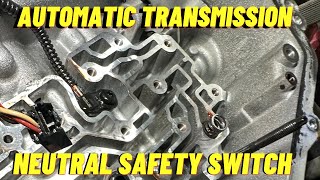
Typical fix: Replace the Transmission Range Sensor. This typically involves 🎬 Watch this step-by-step Ford range sensor replacement guide removing the connector and two mounting bolts, then installing and aligning the new sensor.
Est. part cost: $45-$130 - Misadjusted Shift Linkage ⚪ Low Probability Over time, the cable connecting the gear shifter to the transmission can stretch or its bushings can wear, causing a slight misalignment between the shifter's position and what the sensor reports. This is less common on the eCVT than on conventional automatics but still possible.
How to confirm: Try starting the vehicle in Neutral. You can also try wiggling the gear shifter while holding the key in the 'start' position. If the vehicle starts, it's a strong indication of an adjustment issue.
Typical fix: Adjust the shift cable at the transmission lever or adjust the position of the TRS on its slotted mounting holes to ensure it aligns correctly with the gear detents.
Est. part cost: $0-$20
Rare But Worth Checking
- Faulty Powertrain Control Module (PCM): → Shop Engine Control Module (ECM) This is very rare. The PCM should only be considered as the cause after all wiring, connectors, and the sensor itself have been thoroughly tested and proven to be good.
Diagnosis Steps
- Read all Diagnostic Trouble Codes (DTCs) with a capable OBD-II scanner. Note any other transmission or communication codes.
- Inspect the battery and charging system to ensure proper voltage, as low voltage can cause communication errors.
- Locate the Transmission Range Sensor (TRS) on the outside of the eCVT transmission case, typically below the battery box area.
- Thoroughly inspect the TRS electrical connector and wiring harness for any signs of corrosion, water damage, melted plastic, or loose pins.
- Following the logic from TSB Bulletin #SSM 47790 on similar Ford hybrids, inspect other major wiring harness connectors in the engine bay for signs of water intrusion or corrosion.
- If corrosion is found, disconnect the battery, clean the connector terminals with electrical contact cleaner, apply dielectric grease, and reconnect.
- Check for proper shift linkage adjustment. Ensure the gear selected on the shifter matches the position of the lever on the transmission.
- If wiring and adjustment are confirmed to be good, use a multimeter to test the sensor's voltage output at the connector pins while an assistant moves the shifter. Compare readings to the manufacturer's specifications. If readings are out of range or absent, the TRS has failed.
- If the sensor tests good, the final step is to consider a PCM fault, which is rare.
- Clear all DTCs and perform a test drive, shifting through all gears to confirm the repair.
Parts You'll Likely Need
- Transmission Range Sensor
(OEM #GN1Z-7H557-B (supercedes 9L8Z-7H557-A, 9L8Z-7H557-C))— This sensor is the most common part to fail or require replacement after wiring issues are ruled out. It is responsible for sending the gear position signal to the computer.
Trusted brands: Motorcraft, Standard Motor Products (SMP)
OEM price range: $80-$135
Aftermarket price range: $45-$90 - Transmission Range Sensor Connector — Due to its location, the connector is prone to corrosion which can interrupt the signal. In cases of severe corrosion, the connector pigtail must be replaced.
Trusted brands: Motorcraft, Dorman
OEM price range: $30-$60
Aftermarket price range: $15-$40
Related Codes That Often Appear With This One
- P0705 — This code indicates a general fault in the Transmission Range Sensor circuit. It often appears with P2800 and points to the same root causes.
- P0707 — This code for 'Transmission Range Sensor A Circuit Low' can appear with P2800, strongly suggesting a problem affecting multiple sensor circuits, such as a bad connector, wiring issue, or a complete sensor failure.
- U019F / U0284 — These are communication codes that can be set alongside P2800, particularly when the cause is water intrusion in a major wiring harness connector, as noted in TSBs for similar Ford vehicles.
Technical Service Bulletins (TSBs) & Recalls
- While not directly for this vehicle, TSB Bulletin #SSM 47790 for 2013-2019 Ford Fusion/C-MAX models is highly relevant. It notes that P2800 is often caused by water intrusion into main harness connectors (like C134 and C146), a diagnostic clue that should be considered for the Escape Hybrid as well.
Platform-Specific Known Issues
- A user on the Car Talk Community forum with a 2008 Escape Hybrid experienced a complete transmission failure where the starter motor gears shredded; the eCVT had to be replaced with a new-in-crate unit found on eBay.
Mechanic-Grade Diagnostic Values
- TRS Signal 'B' Voltage — expected: Smoothly transitions from ~0.5V (Park) to ~4.5V (Drive).. Failure: Voltage is stuck, jumps erratically, reads near 0V (short to ground) or near 12V (short to power).
- TRS Reference Voltage at Connector — expected: 5V +/- 0.5V with key on.. Failure: Voltage is significantly lower than 4.5V or absent, indicating a wiring or PCM issue.
- TRS Harness Circuit Resistance to Ground — expected: Greater than 10,000 ohms (>10 kΩ).. Failure: Resistance is less than 10 kΩ, indicating a short to ground in the wiring harness.
- TRS Harness Circuit Continuity — expected: Less than 5 ohms between the TRS connector and the PCM connector on the signal wire.. Failure: High or infinite resistance (OL), indicating an open circuit in the harness.
- Scan Tool PID: TR_FREQ (TRS Frequency) — expected: 100 to 240 Hz.. Failure: Frequency is unstable, outside the expected range, or reads as invalid.
Hidden / Shadow Codes Worth Checking
- P1705: A Ford-specific code indicating the Transmission Range Circuit is not showing Park or Neutral during a self-test. Often appears with P2800. (see via Most capable OBD-II scanners, visible in PCM and/or TCM data.)
- PIDs: TR_DC and TR_FREQ: These are not trouble codes but live data Parameter IDs (PIDs) visible on a professional scan tool. TR_DC shows the sensor's duty cycle and TR_FREQ shows its frequency, which are more precise indicators of sensor health than a simple voltage reading. (see via A professional-level scan tool (like Ford IDS) or advanced DIY software (like FORScan) that can read manufacturer-specific PIDs.)
Scan Tool Commands That Help
- Professional Scan Tool (e.g., Ford IDS): Transmission Range Sensor Test / Read Input Status — To command the PCM/TCM to report the signal it is receiving from the sensor. If the module reports 'No Signal' even when voltage is verified at the harness, it points towards an internal module fault.
- FORScan / Ford IDS: Clear Transmission Adaptive Tables — This service function should be performed after replacing major transmission components like the valve body or the entire transmission to reset the learned shift pressure values. It is not typically required for a simple sensor replacement but is a key related procedure.
- No Tool Required: Manual TCM Relearn Procedure — After a battery disconnect or clearing codes, this procedure can help the TCM relearn shift points. It involves a specific sequence of key cycles and gear shifts (e.g., key on, shift to Neutral, key off, wait 20s, shift to Park, key on, wait 20s, etc.) followed by a specific driving pattern.
Wiring & Ground Locations
- Transmission Range Sensor (TRS) Connector — On the top/front of the eCVT case, generally below and behind the battery tray area.. This is the primary connector to inspect for corrosion or damage, as it's the direct interface for the sensor.
- G109 — A key ground point located on the firewall at the rear of the engine compartment.. A poor ground at this location can cause unstable or incorrect voltage readings from various engine and transmission sensors, including the TRS.
- TRS Connector Pin 11 (Example) — Within the main connector for the Transmission Range Sensor.. Pinpoint testing requires knowing which pin carries which signal. For example, on some Escapes, Pin 11 carries the 'AA Park sense' signal, allowing a technician to test that specific circuit for voltage or continuity.
- Connectors C134 / C146 — Main inline harness connectors in the engine bay.. As identified in TSB Bulletin #SSM 47790 for similar Ford hybrids, these connectors are known points of water intrusion that can disrupt multiple circuits, causing a P2800 code even if the TRS and its own connector are perfectly fine.
OEM Part Supersession History
9L8Z-7H557-A, 9L8Z-7H557-C→GN1Z-7H557-B— Standard part revision and consolidation by the manufacturer.
Heads up: No incompatibility is noted; GN1Z-7H557-B is the correct and current service replacement part for the specified vehicle range.
Model Year Variations Within This Range
- 2008 vs 2009-2012: The 2008 model year used a 2.3L Atkinson-cycle engine, while the 2009-2012 models used an updated 2.5L version. However, the eCVT transmission design and the function/location of the external Transmission Range Sensor remained fundamentally the same, making the diagnosis for P2800 consistent across this year range.
Diagnostic Flowchart
Other Known Issues on This Vehicle
Issues unrelated to this code that are worth knowing about as an owner of this generation:
- Motor Electronics Cooling System (MECS) Pump Failure 🔴 High — Common on 2005-2008 models, but can occur on later models. Failure often happens between 50,000 and 100,000 miles. (Ref: Safety Recall 14S19 / NHTSA 14V-526; TSB 08-24-5.)
- HVAC Blend Door Actuator Failure 🟠 Medium — Very common across many Ford models of this era. Symptoms include clicking/buzzing from the dash and inability to change air temperature.
- Hybrid Battery Cooling Fan / Blend Door Issues 🟠 Medium — The actuator for the hybrid battery cooling air inlet door can fail, causing a B1239 code and potentially impacting battery performance and longevity.
- Power Steering Assist Failure 🔴 High — Widespread complaints, particularly for the 2008 model year, leading to a recall. The failure of the torque sensor in the electric power steering system can cause a sudden loss of steering assist. (Ref: NHTSA Recall for power steering.)
- ABS Tone Ring Failure / Corrosion 🟠 Medium — The front ABS tone rings are prone to cracking or corroding, causing the ABS and Traction Control lights to illuminate and the systems to function erratically.
- Brake System (HCU) Failure 🔴 High — The 2008 model year is noted for expensive failures of the Hydraulic Control Unit (HCU) for the regenerative braking system, leading to very costly repairs.
Used vs. New Parts: Buying Guide for This Vehicle
When a used part is the smart pick: A used Transmission Range Sensor is NOT recommended, as it is an electronic part prone to failure from age, heat, and moisture, and the cost of a new aftermarket part is relatively low. However, sourcing a used connector pigtail from a junkyard is a smart and cost-effective choice if the original connector is damaged or corroded beyond cleaning.
Donor-vehicle mileage cap: roughly under 150000 miles for the part to have meaningful remaining life.
What to inspect on the donor part:
- For a connector pigtail: Inspect for the complete absence of green or white corrosion on pins.
- Ensure the plastic locking tab is intact and functional.
- Check that the attached wires are flexible and the insulation is not cracked or brittle.
- Verify it is from a vehicle that did not suffer an engine fire or major front-end flood damage.
OEM-only on this vehicle (don't cheap out):
- No parts for this specific repair are considered strictly OEM-only. Quality aftermarket sensors are widely available and perform well.
Aftermarket brands forum-validated for this vehicle:
- Standard Motor Products (SMP)
- Dorman (especially for connector pigtails)
Real Owner Stories
Aggregated from forums and TSBs cited above. Mileages and costs reflect what owners reported in those sources.
2008 Ford Escape Hybrid 2.5L HEV
Symptoms: The owner experienced a P2800 code and performed a diagnosis by checking the wiring first.
What fixed it: The issue was resolved by replacing the Transmission Range Sensor itself after confirming the wiring was intact.
Source hint: https://www.ford-trucks.com/forums/1243194-2008-escape-hybrid-transmission-range-sensor-code-p2800.html
2008 Ford Escape Hybrid 2.5L HEV
Symptoms: Classic no-start symptom where the engine will not crank.
What fixed it: The user was advised on the classic symptoms of a Transmission Range Sensor failure.
Source hint: https://www.cargurus.com/Cars/Discussion-t35473_ds551800
2008 Ford Escape Hybrid 2.5L HEV
Symptoms: Complete transmission failure where the starter motor gears shredded.
What fixed it: The eCVT had to be replaced with a new-in-crate unit found on eBay.
Source hint: Car Talk Community forum
NHTSA Reported Incident
Symptoms: An owner reported that both P2803 and P2800 sensors were defective, noting that the cost to repair was far above fair pricing (NHTSA ODI #10845590).
Related OBD-II Codes
Frequently Asked Questions
Does TSB Bulletin #SSM 47790 apply to my 2008-2012 Ford Escape Hybrid?
Why does my Escape Hybrid only start when I move the shifter to Neutral?
Can a bad MECS pump cause a P2800 code on my 2008 Escape?
Where is the Transmission Range Sensor located on the 2.5L HEV eCVT?
Is there a recall for the power steering failure mentioned in my diagnostic reports?
Helpful Videos

We Have This Part in Stock

The information in this article is provided for general reference and educational purposes only. Vehicle specifications, procedures, and part compatibility can vary by production date, trim level, and region. Always consult your vehicle's factory service manual and verify part numbers before purchasing or performing repairs. Safety-critical components such as airbags, seat belts, and braking systems should be installed by a qualified professional.
- Ford Escape:
- 🧭 Diagnostic Flowchart
- 🎬 Helpful Videos
- 🛍️ Shop This Part
- What's Unique About the 2008-2012 Ford Escape
- Symptoms You May Notice
- Most Likely Causes
- Rare But Worth Checking
- Diagnosis Steps
- Parts You'll Likely Need
- Related Codes That Often Appear With This One
- Technical Service Bulletins (TSBs) & Recalls
- Platform-Specific Known Issues
- Mechanic-Grade Diagnostic Values
- Hidden / Shadow Codes Worth Checking
- Scan Tool Commands That Help
- Wiring & Ground Locations
- OEM Part Supersession History
- Model Year Variations Within This Range
- Other Known Issues on This Vehicle
- Used vs. New Parts: Buying Guide for This Vehicle
- Real Owner Stories
- 2008 Ford Escape Hybrid 2.5L HEV
- 2008 Ford Escape Hybrid 2.5L HEV
- 2008 Ford Escape Hybrid 2.5L HEV
- NHTSA Reported Incident
- Related OBD-II Codes
- Frequently Asked Questions
- 🎟️ Get 5% Off