

P2800 on 2010-2015 Toyota Prius: Transmission Range Sensor 'B' Circuit Causes and Fixes
On a 2010-2015 Prius, code P2800 is most often caused by a failed Transmission Range Sensor (also called a Neutral Safety Switch). This can prevent the car from starting or entering 'Ready' mode. The fix is usually replacing the sensor, which costs around $100-$160 for an OEM part, though inspecting the connector for corrosion first can save money.
- P2800 on a Gen 3 Prius means the car's computer has lost a key signal that confirms which gear is selected.
- The most common symptoms are a no-start condition and an incorrect or blank gear indicator on the dash.
- Before replacing parts, always inspect the sensor's wiring connector on the transaxle for corrosion, as this is a frequent and cheaper fix.
- The most likely part to fail is the Transmission Range Sensor itself, OEM part number 84540-47010.
What's Unique About the 2010-2015 Toyota Prius
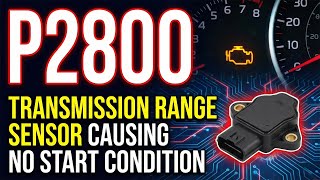
The 2010-2015 (Gen 3) Prius uses a 'shift-by-wire' system. The gear selector in the cabin is just an electronic switch that sends a request to the Hybrid Control ECU. The P2800 code relates to the 🎬 Watch: Understanding the P2800 error code actual position sensor located on the transaxle itself, which confirms the gear position. Because this sensor is mounted externally on top of the transaxle, its electrical connector is a common failure point due to corrosion from moisture and road salt, a frequent issue on Toyotas.
Symptoms You May Notice
- Vehicle will not start or enter 'Ready' mode.
- Engine may start in Neutral but not in Park.
- Gear position indicator on the dashboard is blank, incorrect, or flashes.
- Check Engine Light and other warning lights (like the Master Warning light) are illuminated.
- Vehicle enters 'limp home' mode with reduced power.
- Reverse lights do not work or stay on constantly.
- A clicking noise may be heard, but the engine will not crank.
- Replacing the 12V battery without diagnosing the starting system. A no-start condition is a primary symptom of a bad range sensor, which can be mistaken for a dead battery.
- Condemning the entire hybrid transaxle. This is an electronic control issue, not an internal mechanical failure of the transmission itself.
- Replacing the starter motor. A faulty range sensor prevents the computer from sending the signal to engage the starter, which can mimic a failed starter motor.
Most Likely Causes
- Failed Transmission Range Sensor (Neutral Safety Switch) 🔴 High Probability → Shop Transmission Assembly The sensor is an electro-mechanical part with internal contacts that can wear out over time, leading to an open or shorted circuit. Its external location on the transaxle exposes it to harsh conditions, accelerating wear.
How to confirm: After confirming wiring is intact, test the sensor's resistance between specific pins for each gear position using a multimeter. Compare readings to the vehicle's service manual specifications. A scan tool showing an "Invalid" or "Fault" status for the sensor data also points to a failed sensor.
Typical fix: Replace the transmission range sensor. The OEM part number for the Gen 3 🎬 See this: How to test and replace the switch Prius is confirmed to be 84540-47010.
Est. part cost: $100 - $160 - Corroded or Damaged Wiring Connector 🟡 Medium Probability The sensor and its connector are located on top of the transaxle, where they are exposed to moisture, heat, and road debris, making corrosion a very common issue. Water intrusion into the harness is a leading cause of this code.
How to confirm: Visually inspect the sensor's electrical connector for green or white corrosion, bent pins, or signs of water intrusion. A common failure is for the male pins on the sensor to break off inside the female connector harness. Wiggle the harness while monitoring live data with a scan tool to check for intermittent signal loss.
Typical fix: Clean the connector terminals with an electrical contact cleaner and apply dielectric grease to prevent future moisture intrusion. If corrosion is severe or pins are damaged, the connector pigtail may need to be replaced.
Est. part cost: $20 - $50 - Misadjusted Sensor or Shift Linkage ⚪ Low Probability While the Prius has a shift-by-wire system, the sensor on the transaxle is still mechanically actuated. Vibrations or previous service can cause the sensor's alignment to drift slightly.
How to confirm: Use a scan tool to view the live data from the sensor. If the reported gear (e.g., 'Reverse') does not match the selected gear, an adjustment is likely needed.
Typical fix: Loosen the sensor mounting bolts and rotate it slightly to align it correctly. Toyota procedures often require inserting a 5mm drill bit into an alignment hole on the sensor case before tightening the bolts to ensure perfect alignment.
Est. part cost: $0
Rare But Worth Checking
- Failed Hybrid Control ECU or Powertrain Control Module (PCM): → Shop Engine Control Module (ECM) This is very rare and should only be considered after the sensor, connector, and all wiring have been thoroughly tested and confirmed to be good.
Diagnosis Steps
- Scan the vehicle for all diagnostic trouble codes and record the freeze frame data. Note if the code is current or historic.
- Visually inspect the Transmission Range Sensor and its electrical connector on top of the transaxle. Look for obvious signs of green/white corrosion, physical damage, or loose connections.
- With the key on, have an assistant shift through P, R, N, D, and B while you observe the gear indicator on the dash. Note any discrepancies or blank displays.
- Use a scan tool to monitor the live data parameter for the transmission range sensor 'B' circuit. The value (often a voltage) should change clearly and distinctly for each gear position. An "Invalid" or "Fault" reading points to a sensor or circuit failure.
- If the signal is missing or erratic, disconnect the sensor and inspect the connector pins closely for damage or corrosion.
- Perform a voltage drop test. Check for battery voltage (typically a 5V reference) at the power supply pin and verify a good ground at the connector with a multimeter.
- Check for continuity on the signal wire between the sensor connector and the Hybrid Control ECU. Wiggle the harness during the test to check for intermittent breaks.
- If wiring and power are good, the sensor itself is the likely culprit. It can be tested by measuring resistance across different pins for each gear position, but replacement is often the most practical step.
- After replacing the sensor, ensure it is correctly aligned. For many Toyotas, this involves rotating the sensor until a 5mm drill bit can be inserted into an alignment hole before tightening the mounting bolts.
- If a new, correctly aligned sensor does not resolve the issue, the problem may be a rare failure within the Hybrid Control ECU.
Parts You'll Likely Need
- Transmission Range Sensor / Neutral Safety Switch
(OEM #84540-47010)— This sensor is the most common point of failure for the P2800 code on the Gen 3 Prius due to wear and environmental exposure.
Trusted brands: Toyota (OEM), Aisin, Standard Motor Products (SMP), Beck/Arnley, WVE/NTK
OEM price range: $140-$160
Aftermarket price range: $40-$90
Related Codes That Often Appear With This One
- P0705 — P0705 is a general code for 'Transmission Range Sensor Circuit Malfunction'. P2800 is a more specific fault for the 'B' circuit, and they often appear together if multiple signal problems are detected.
Platform-Specific Known Issues
- A recall was issued for 2010-2014 Prius models for the hybrid system inverter and control software, which could cause warning lights and reduced power, but this is a separate issue from the P2800 code.
- The location of the sensor on top of the transaxle makes it particularly susceptible to water running down from the cowl area, leading to a high rate of connector corrosion.
Mechanic-Grade Diagnostic Values
- Transmission Range Sensor Continuity Test — expected: Near-zero ohms of resistance between specific pairs of pins on the sensor's connector for each gear position (P, R, N, D, B). The exact pinout combinations must be referenced from the vehicle's factory service manual.. Failure: An open circuit (infinite resistance) or high resistance on a pin pair that should have continuity for a given gear indicates internal failure of the sensor.
- Transmission Range Sensor 'B' Circuit Voltage (General) — expected: A distinct voltage level for each gear position, typically changing smoothly between ~0.5V and ~4.5V as the selector moves through its range. For example, Park may be ~0.5V and Drive may be ~4.5V.. Failure: A voltage reading of 0V can indicate a short to ground, while a reading near 5V or 12V could indicate a short to power. An 'Invalid' or 'Fault' status on a scan tool points to a failed sensor or circuit.
Hidden / Shadow Codes Worth Checking
- INF Codes (e.g., P0705/571, P0705/572): Toyota systems often supplement primary DTCs with more specific Information (INF) codes. For a range sensor fault, these can pinpoint the exact nature of the failure (e.g., signal performance, specific circuit malfunction). While P2800 indicates a 'B' circuit fault, an accompanying INF code could provide deeper insight. (see via These are typically visible using dealer-level diagnostic software like Toyota Techstream, under the HV ECU or Transmission data.)
Scan Tool Commands That Help
- Toyota Techstream: Live Data (Data List) Monitoring — This is the primary diagnostic function for P2800. Monitor the parameters for 'Shift Position', 'M Shift Sensor Voltage', and 'S Shift Sensor Voltage' under the HV ECU. As the gear selector is moved, the values should change instantly and logically. An 'Invalid' status or a value that doesn't correspond to the selected gear points directly to a fault in the sensor or its circuit.
Wiring & Ground Locations
- Engine Harness Ground Cluster — A cluster of ground wires bolted to the chassis on the driver's side strut tower, near the under-hood fuse box.. A loose or corroded ground at this primary point can cause floating voltages and erratic signals for multiple sensors connected to the engine harness, including the transmission range sensor, potentially triggering a false P2800 code.
- Engine Block Ground Strap — A ground strap connecting the main wiring harness directly to the 2ZR-FXE engine block.. This ensures the engine and its mounted sensors have a solid ground reference. A poor connection here can lead to incorrect sensor readings and communication errors with the ECU.
OEM Part Supersession History
84540-47010→No known supersession— The part number remains current for the 2010-2015 Prius.
Heads up: Crucially, other Toyota range sensors that appear physically similar, such as 84540-42010 (for RAV4/Highlander) or 84540-51010, are NOT compatible. Using the wrong part will result in continued codes and shifting problems.
Diagnostic Flowchart
Other Known Issues on This Vehicle
Issues unrelated to this code that are worth knowing about as an owner of this generation:
- Head Gasket Failure 🔴 High — Commonly occurs between 120,000 and 200,000 miles, often preceded by a rough engine rattle on cold startup. Failure is often linked to a clogged EGR system.
- Excessive Oil Consumption 🟠 Medium — Caused by low-tension piston rings that get clogged with carbon. Can become noticeable after 100,000 miles and may lead to misfire codes (P030x) if oil levels drop too low. (Ref: T-SB-0168-16 (Inspection) and T-SB-0169-16 (Repair) were issued for 2010-2014 models, outlining a procedure to test for consumption and replace pistons/rings if criteria are met.)
- EGR System Clogging 🔴 High — The EGR valve, cooler, and intake manifold passages become restricted with carbon buildup, typically around 100,000-150,000 miles. This leads to rough idle, engine knocking, and is a primary contributor to head gasket failure. (Ref: Toyota issued Warranty Enhancement Program ZE2 for some 2010-2012 models for a sticking EGR valve causing a P0401 code. T-SB-0116-15 addresses misfires caused by EGR issues.)
- Brake Actuator / Booster Pump Failure 🔴 High — Internal failure of the brake booster or pump assembly can lead to a loss of braking assist, accompanied by warning lights and DTCs like C1391, C1252, or C1256. This is a well-documented issue across multiple Toyota hybrid models from this era. (Ref: Customer Support Program ZJB extended the warranty for the brake booster and pump on 2010-2015 models for 10 years/150,000 miles.)
- Hybrid Inverter Failure 🔴 High — The inverter, which converts DC from the battery to AC for the motors, can fail due to overheating of its intelligent power modules (IPMs). This typically causes the car to shut down with multiple hybrid system warnings. (Ref: Toyota issued recalls (e.g., Safety Recall E0E, F0R) for 2010-2014 models to update the control software and, if necessary, replace the inverter.)
Used vs. New Parts: Buying Guide for This Vehicle
When a used part is the smart pick: A used Transmission Range Sensor is a reasonable budget-friendly option for this repair, as it is an external, easily accessible part. Sourcing from a reputable recycler that provides the donor vehicle's VIN and mileage is recommended.
Donor-vehicle mileage cap: roughly under 100000 miles for the part to have meaningful remaining life.
What to inspect on the donor part:
- Inspect the electrical connector pins on the used sensor. They should be straight, clean, and free of any green or white corrosion.
- Confirm none of the male pins are broken off or bent.
- Check the plastic housing for cracks or signs of heat damage.
- Ensure the mechanical lever arm is intact and moves smoothly.
OEM-only on this vehicle (don't cheap out):
- While not strictly 'OEM-only', using a non-reputable, unbranded aftermarket sensor carries a high risk of premature failure or incorrect signaling. Stick to OEM or a known OEM supplier.
Aftermarket brands forum-validated for this vehicle:
- Aisin: Aisin is a Toyota group company and the original equipment manufacturer for many of their transmission components. An Aisin-branded sensor is considered equivalent to a Toyota OEM part.
- Standard Motor Products (SMP): Often cited as a reliable aftermarket alternative.
Real Owner Stories
Aggregated from forums and TSBs cited above. Mileages and costs reflect what owners reported in those sources.
2010 Toyota Prius 1.8L
Symptoms: The vehicle experienced a no-start/'Ready' mode failure and the gear position indicator on the dashboard was blank.
What fixed it: Replacing the Neutral Safety Switch (Transmission Range Sensor), part number 84540-47010.
Source hint: PriusChat Forum / User Experience with P0706 (related code)
2010-2015 Toyota Prius 1.8L
Symptoms: The vehicle would not start in Park, but the engine would successfully start when the shifter was placed in Neutral.
What fixed it: Replacement of the Transmission Range Sensor due to worn internal electro-mechanical contacts.
Source hint: ARTICLE CONTEXT: common_causes
2010-2015 Toyota Prius 1.8L
Symptoms: Intermittent signal loss and P2800 code; upon inspection, the male pins on the sensor had physically broken off and were stuck inside the female connector harness.
What fixed it: Replacing the sensor and the connector pigtail due to severe corrosion and water intrusion.
Source hint: ARTICLE CONTEXT: common_causes
Related OBD-II Codes
Frequently Asked Questions
My 2010 Prius won't enter 'Ready' mode and the gear indicator is blank. Is there a specific part I need?
I heard there was a recall for the 2010-2014 Prius regarding power loss. Does this cover my P2800 code?
Can I adjust the sensor myself on my 2012 Prius, or does it require a special tool?
Why is the connector on my Prius transaxle corroded when it's tucked away in the engine bay?
Is it true that a weak 12V battery can cause symptoms similar to a P2800 sensor failure?
Does the Lexus CT200h suffer from this same P2800 issue?
Helpful Videos

We Have This Part in Stock


The information in this article is provided for general reference and educational purposes only. Vehicle specifications, procedures, and part compatibility can vary by production date, trim level, and region. Always consult your vehicle's factory service manual and verify part numbers before purchasing or performing repairs. Safety-critical components such as airbags, seat belts, and braking systems should be installed by a qualified professional.
- Toyota Prius:
- 🧭 Diagnostic Flowchart
- 🎬 Helpful Videos
- 🛍️ Shop This Part
- What's Unique About the 2010-2015 Toyota Prius
- Symptoms You May Notice
- Most Likely Causes
- Rare But Worth Checking
- Diagnosis Steps
- Parts You'll Likely Need
- Related Codes That Often Appear With This One
- Platform-Specific Known Issues
- Mechanic-Grade Diagnostic Values
- Hidden / Shadow Codes Worth Checking
- Scan Tool Commands That Help
- Wiring & Ground Locations
- OEM Part Supersession History
- Other Known Issues on This Vehicle
- Used vs. New Parts: Buying Guide for This Vehicle
- Real Owner Stories
- 2010 Toyota Prius 1.8L
- 2010-2015 Toyota Prius 1.8L
- 2010-2015 Toyota Prius 1.8L
- Related OBD-II Codes
- Frequently Asked Questions
- 🎟️ Get 5% Off