

P3004 on 2012-2019 Toyota Prius c: High Voltage Malfunction Causes and Fixes
P3004 on a Prius c means there's a serious fault in the high-voltage system, often preventing the car from becoming 'Ready'. The most likely causes are a failed relay (contactor) in the hybrid battery junction block or an internal inverter fault. This is not a DIY repair; professional diagnosis is required due to lethal voltages up to 201.6V.
- P3004 is a critical fault indicating a failure in the high-voltage power supply. The vehicle is not safe to drive and likely will not start.
- Do not attempt DIY repair. The high-voltage system is extremely dangerous and requires a trained professional.
- Diagnosis requires an advanced scan tool to read the specific 'info code' that accompanies P3004, which is essential for pinpointing the fault.
- Unlike other Prius models, the Prius c is not covered by the special warranty extension for inverter failures, so do not assume the repair will be free at a dealership.
- Common causes include failed relays in the HV battery junction block, a faulty inverter, or loose connections from prior service.
What's Unique About the 2012-2019 Toyota Prius c
Unlike the larger Toyota Prius and Prius V models from the same era, the Prius c is not part of the well-known warranty extension programs (like 23TE03 or T-SB-0003-21) for inverter failures. While an inverter failure can still cause a P3004 on a Prius c, it is not considered the same type of widespread, warrantied defect. Therefore, diagnosis should also strongly consider other causes like the HV battery relays (contactors) or wiring issues, which are common across all Toyota hybrids and often occur after DIY battery service.
Symptoms You May Notice
- Vehicle will not go into 'Ready' mode
- "Check Hybrid System" message on the dash
- Master Warning Light (red triangle) illuminated
- Vehicle is a 'no-start' (powers on but won't drive)
- Clicking sounds from the rear of the vehicle as relays attempt to engage, which may be followed by silence on subsequent attempts.
- Car is stuck in Park and cannot be shifted into Drive or Reverse.
- The vehicle may enter "Fail Safe Mode" and illuminate various warning lamps on the instrument panel, as noted in manufacturer documentation regarding inverter-related P3004 faults.
- Replacing the entire hybrid battery pack. P3004 typically points to a power delivery problem (relays, inverter, wiring) rather than the battery cells themselves. A bad battery pack usually sets a P0A80 code, though both can appear if a P3004 fault occurs after DIY battery work.
- Assuming the Prius c is covered by the inverter warranty extension. Owners may see information for the standard Prius (T-SB-0003-21) and assume it applies, but the Prius c is not explicitly included in the known Customer Confidence Programs for inverter failure.
Most Likely Causes
- Failed HV Battery Relay (Contactor) 🔴 High Probability → Shop Vehicle Battery The high-voltage relays, also called contactors or System Main Relays (SMRs), inside the battery junction block are mechanical switches that handle very high current. They can fail mechanically (stick open) or electrically (burnt contacts), preventing power from leaving the battery pack. There are typically three relays (SMRB, SMRP, SMRG) that must engage in sequence.
How to confirm: A technician can use an advanced scan tool (like Toyota Techstream) to monitor the relay command and voltage at the inverter. An info code P3004-131 (Open Circuit) strongly points to this issue. Using the 'Active Test' function, a technician can command each relay to close individually and listen for an audible 'click'. A silent relay indicates it has failed.
Typical fix: Replace the faulty relay or the entire hybrid battery junction block assembly. A single failed contactor can be replaced by a specialist.
Est. part cost: $150-$400 - Inverter with Converter Assembly Failure 🟡 Medium Probability → Shop Power Converter The inverter contains complex, high-power electronics (like the Intelligent Power Module or IPM) that manage power flow. These components can fail from thermal stress or age, causing an internal short or open circuit. Manufacturer records, such as Customer Confidence Program #23TE03, identify the failure of the IPM inside the inverter assembly as a root cause for DTC P3004.
How to confirm: Diagnosis often requires an advanced scan tool. An info code like P3004-800 (Short Circuit / Excessive overcurrent) strongly points to an internal inverter failure. A technician will follow a specific diagnostic tree, which may involve measuring resistance at the inverter's high-voltage terminals (with the battery disconnected) to check for a short to ground.
Typical fix: Replacement of the inverter with converter assembly. In some cases, only the internal IPM is replaced, but this is a highly specialized repair.
Est. part cost: $800-$2500 - Loose Connections or Improper Service ⚪ Low Probability This is very common if the high-voltage battery or related components have been recently serviced. A forgotten connector, loose bus bar, or improperly installed service plug will interrupt the high-voltage circuit and trigger P3004. The service plug must be fully seated with the lever locked down.
How to confirm: Visually inspect all high-voltage orange cables, the main service plug, and the bus bar connections inside the HV battery pack for tightness and proper installation. This often happens after a DIY battery cell replacement, where a user reports the car worked before the service but now throws P3004.
Typical fix: Retorque all connections to factory specifications and ensure the service plug is fully seated and locked.
Est. part cost: $0 - Weak or Faulty 12V Auxiliary Battery ⚪ Low Probability → Shop Vehicle Battery A weak 12V battery can cause a wide range of unpredictable electronic faults in a Prius. While it doesn't directly cause P3004, it can prevent the various ECUs and relays from initializing correctly, which can sometimes trigger other codes as a side effect.
How to confirm: Test the 12V battery's voltage and health with a multimeter and a load tester. A healthy battery should read ~12.6V at rest and hold voltage under load. A reading below 12.0V is a cause for concern.
Typical fix: Replace the 12V auxiliary battery. This is often a good first step in any electrical diagnosis on a Prius, though some owners have reported it did not fix their P3004 issue.
Est. part cost: $150-$250
Rare But Worth Checking
- Corroded HV Battery ECU Connector: → Shop Vehicle Battery Moisture can sometimes get into the HV battery case and cause corrosion on the pins of the battery ECU connector, leading to a variety of faults. This is worth checking, especially in humid climates or if there are signs of water intrusion.
- Damaged High-Voltage Wiring: The main orange cables connecting the HV battery to the inverter can be damaged by road debris, corrosion, or improper handling, causing an open or short circuit that would trigger P3004.
- Blown High Voltage Fuse: A high voltage fuse located within the service plug grip or junction block can blow, causing an open circuit. This is a specific cause for the P3004-131 info code.
Diagnosis Steps
- SAFETY FIRST: Do not proceed without proper training and equipment. The HV system is dangerous. Wear insulated gloves and remove the service plug, then wait at least 10 minutes before working.
- Check and verify the health of the 12V auxiliary battery. Replace if weak or older than 4-5 years.
- Connect an advanced scan tool (like Toyota Techstream) to read the full DTC, including the crucial 4-digit info code (e.g., -131, -132, -800).
- If P3004-131 (Open Circuit) is present, the focus should be on the HV battery junction block (relays), the service plug and its internal fuse, the pre-charge resistor, and the HV cables.
- If P3004-800 (Short Circuit) is present, the focus should be on diagnosing an internal failure of the inverter/converter assembly or a short in the high-voltage A/C compressor. NHTSA ODI #10816757 describes a case where a vehicle shut off and could not restart with this specific code, requiring a dealer diagnosis of the hybrid system.
- If P3004-132 is present, this points to an inverter voltage sensor malfunction or an increased resistance in the pre-charge resistor.
- If work was recently performed, meticulously double-check that the HV battery service plug is fully installed, all internal bus bars are torqued correctly, and all orange high-voltage connectors are securely seated.
- Use the 'Active Test' feature in Techstream to individually command the three System Main Relays (SMRs). Listen for an audible 'click' from each. Silence points to a failed relay.
- Follow the specific diagnostic flowchart in the Toyota service manual for the corresponding P3004 info code.
Parts You'll Likely Need
- Hybrid Battery Junction Block Assembly
(OEM #G92A0-52030 (Verify with VIN))— This assembly contains the high-voltage relays (contactors) that are a common failure point leading to an open circuit (P3004-131).
Trusted brands: Toyota (OEM)
OEM price range: $300-$500
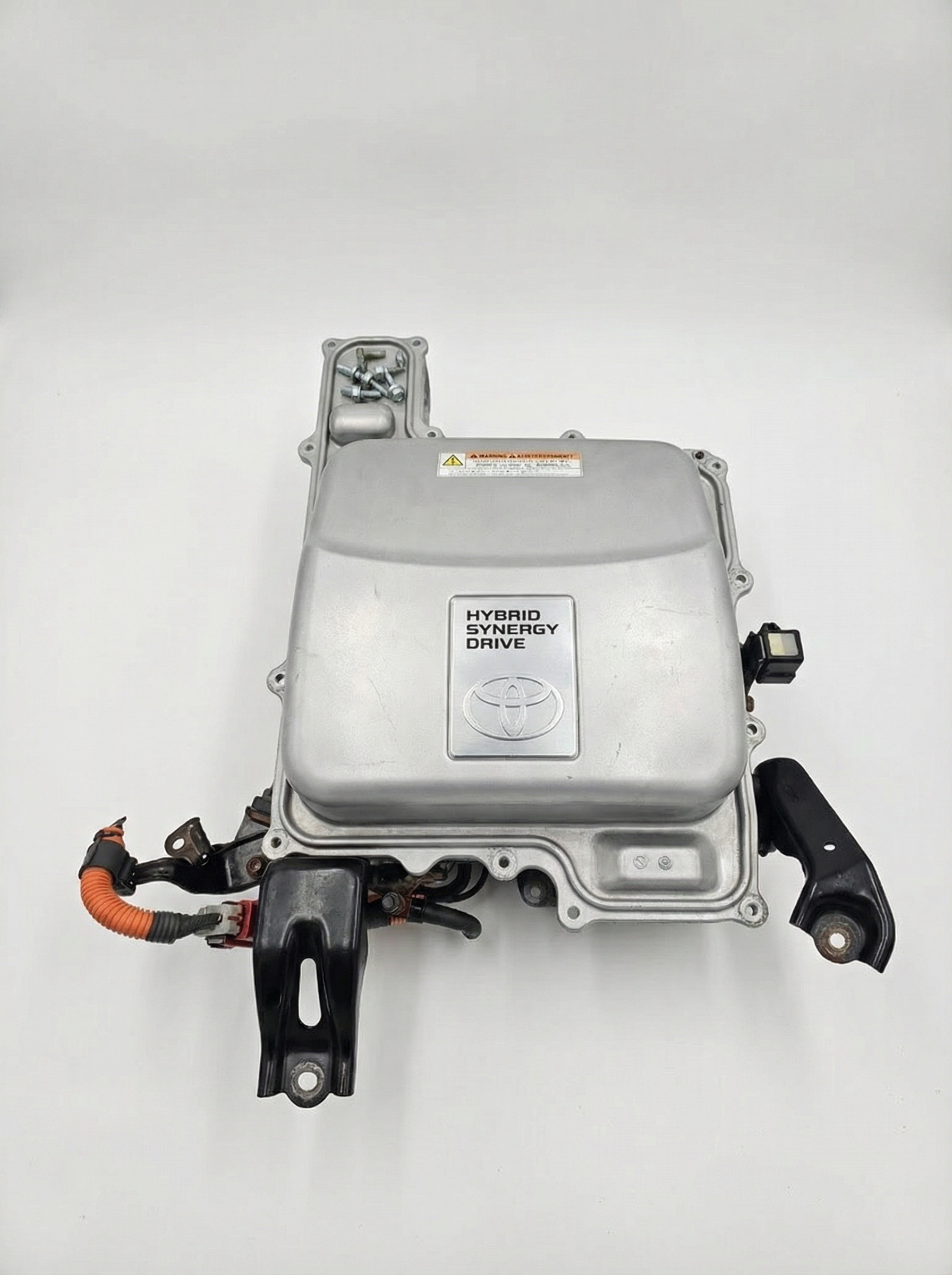
Aftermarket price range: $200-$350 - Inverter with Converter Assembly
(OEM #G9200-52010 (Verify with VIN))— An internal short circuit or other failure within the inverter is a primary cause of P3004, especially if info code -800 is present.
Trusted brands: Toyota (OEM), Used OEM
OEM price range: $2500-$3500
Aftermarket price range: $400-$1200 (Used/Remanufactured)
Related Codes That Often Appear With This One
- P0A80 — If the P3004 code was triggered after working on a failing HV battery, the original P0A80 (Replace Hybrid Battery Pack) code may still be present. This is a common scenario reported by DIYers.
- C1259 — This is a general code for a Hybrid Control System Regenerative Malfunction, often set as a consequence of the primary P3004 fault that prevents the system from becoming ready.
- C1310 — This is a general Hybrid System Malfunction code that is triggered whenever a serious fault like P3004 is detected by the main hybrid ECU.
- P0A94, P324E, and P0A1A — According to TSB Bulletin #TSB000321 and Bulletin #23TE03, these codes frequently appear alongside P3004 when a malfunction has occurred in the inverter assembly with converter.
Technical Service Bulletins (TSBs) & Recalls
- source — This TSB details the repair procedure for inverter failures on the standard Prius and Prius V. It is notable because the Prius c is NOT listed, confirming it is not covered by the associated warranty extensions for this issue.
- TSB Bulletin #TSB000321 — Notes that vehicles may exhibit a MIL ON condition with DTC P3004 indicating a malfunction in the inverter assembly with converter.
- Bulletin #23TE03 — This manufacturer record describes Customer Confidence Program 23TE03, which addresses the failure of the IPM located inside the inverter assembly indicated by DTC P3004.
Mechanic-Grade Diagnostic Values
- Pre-Charge Resistor Resistance — expected: 18 to 22 Ω. Failure: A reading outside this range, especially an open circuit (infinite resistance), indicates a failed resistor.
- Inverter HV Cable Insulation Resistance — expected: 10 kΩ or higher. Failure: A resistance reading below 10 kΩ between the high voltage terminals and body ground indicates a short circuit, a likely cause for P3004-800.
Hidden / Shadow Codes Worth Checking
- P3004-131: Open Circuit / Power Cable Malfunction. The Hybrid Control ECU did not detect voltage at the inverter after commanding the relays to close. This points to a break in the power path, such as a failed relay (contactor), blown HV fuse, open pre-charge resistor, or disconnected cable. (see via Toyota Techstream or equivalent professional scan tool under the 'Hybrid Control' ECU menu.)
- P3004-132: Inverter Pre-charge Malfunction. The ECU detected an issue with the pre-charge sequence, often due to an inverter voltage sensor malfunction or increased resistance in the pre-charge resistor. The voltage isn't rising as expected. (see via Toyota Techstream or equivalent professional scan tool under the 'Hybrid Control' ECU menu.)
- P3004-800: Excessive Overcurrent / Short Circuit. The system detected a massive current draw during the pre-charge sequence, indicating a dead short. This strongly points to an internal failure of the Inverter with Converter Assembly (specifically the IPM) or a shorted A/C compressor. (see via Toyota Techstream or equivalent professional scan tool under the 'Hybrid Control' ECU menu.)
- P3004-801: Minimal Overcurrent during Pre-charge. Similar to -800, this indicates an abnormal current flow was detected during pre-charge, pointing to a short circuit or other malfunction in the high-voltage system. (see via Toyota Techstream or equivalent professional scan tool under the 'Hybrid Control' ECU menu.)
Scan Tool Commands That Help
- Toyota Techstream: Active Test: 'Control the System Main RELAY' — This is the primary diagnostic step for P3004-131. It allows a technician to command each of the three system main relays (SMRP, SMRB, SMRG) to close individually. The technician must listen for an audible 'click' from the HV battery area for each command. A silent relay confirms it has failed and is the cause of the open circuit.
- Toyota Techstream: Data List / Freeze Frame Data Analysis — Crucial for all P3004 info codes. A technician must analyze parameters like 'Power Resource VB' (battery voltage), 'VL-Voltage before Boosting', and 'VH-Voltage after Boosting'. For P3004-131, VH will be unexpectedly low. For P3004-800, the 'Power Resource IB' (battery current) value will be abnormally high in the freeze frame data, confirming an overcurrent event.
Wiring & Ground Locations
- Hybrid Battery Junction Block — Mounted on the high-voltage battery pack, under the rear seat.. This component houses the three System Main Relays (SMRs) and the pre-charge resistor. It is the most common point of failure for P3004-131 (open circuit) and P3004-132 (pre-charge fault). Visual inspection for arcing and testing the relays are key diagnostic steps.
- Inverter with Converter Assembly Connectors — Under the hood, the large silver component with multiple orange high-voltage cables connected.. The main HV cable from the battery connects here. Diagnostic procedures for P3004-800 (short circuit) involve disconnecting the HV cable and measuring resistance at the inverter's terminals to check for an internal short to ground.
- Service Plug Grip — On the HV battery pack, typically accessible from the rear seat or trunk area.. If not fully seated and locked, the high-voltage circuit will be open, directly causing a P3004-131. It also contains a high-voltage fuse that can blow, leading to the same code.
Real Owner Repair Stories
- Professional Mechanic's Diagnostic Blog (Toyota Prius (model year not specified, but same system architecture)) — Vehicle recovered as a non-start, would not go into 'Ready' mode. P3004-131 was the primary code.
❌ Tried (didn't work) 12V battery was tested and confirmed good., Brake pedal switch was confirmed working.
✅ What actually fixed it Using the scan tool's active test, the technician commanded the three HV contactors (relays) to close one by one. Two produced an audible 'click', but the third was silent. The silent, failed contactor was replaced, which cleared the code and allowed the vehicle to start. - Reddit user /r/prius (2010 Toyota Prius) — No start, 'Check Hybrid System' message, clicking sound from the rear, code P3004.
❌ Tried (didn't work) Replacing the 12V auxiliary battery.
✅ What actually fixed it The owner took the vehicle to a Toyota dealership. They diagnosed it as a failed inverter, which was covered and replaced under Toyota's extended warranty for that specific model. While the Prius c is not covered by the same warranty, this story confirms the inverter as a primary cause for these symptoms. - NHTSA ODI #10816757 — An owner reported that their vehicle shut off while in motion and could not restart. A dealership technician identified DTC code P3004-800 as the only code present. The report mentions a previous recall for an IPM reflash and an extended warranty for the IPM.
OEM Part Supersession History
G92A0-52020→G9200-59065— Part number update for the Inverter with Converter Assembly for early model Prius c (approx. 2012-2013).
Heads up: Always verify the correct part number with the vehicle's VIN. While the base part number G9200-52010 is common for the Prius c, several revisions exist.
Diagnostic Flowchart
Used vs. New Parts: Buying Guide for This Vehicle
When a used part is the smart pick: For a failed relay (P3004-131), a complete used Hybrid Battery Junction Block from a low-mileage donor car is an excellent value proposition, often costing significantly less than a new OEM assembly. For a failed inverter (P3004-800), a used unit is a viable, cost-effective option given the high price of a new one, but it carries more risk.
Donor-vehicle mileage cap: roughly under 100000 miles for the part to have meaningful remaining life.
What to inspect on the donor part:
- Verify the donor vehicle's mileage. Lower is always better.
- For an inverter, ensure there is no physical damage, corrosion, or signs of coolant leaks around the housing.
- Purchase from a reputable salvage yard that offers a short-term warranty (e.g., 30-90 days) to protect against receiving a dead-on-arrival part.
- Confirm the part number on the used component exactly matches the one being replaced, or is a known compatible supersession.
OEM-only on this vehicle (don't cheap out):
- Hybrid Battery Junction Block Assembly (Relays)
- Inverter with Converter Assembly
Aftermarket brands forum-validated for this vehicle:
- For these critical high-voltage components, there are no widely trusted new aftermarket brands. The best options are either new OEM Toyota parts or tested, warrantied used OEM parts from a reputable supplier.
Brands owners have reported issues with on this vehicle:
- Unknown, non-vetted sellers on platforms like eBay or Amazon without a clear warranty and return policy.
Real Owner Stories
Aggregated from forums and TSBs cited above. Mileages and costs reflect what owners reported in those sources.
2015 Toyota Prius c 1NZ-FXE 1.5L
Symptoms: After cleaning the HV battery bus bars to fix a P0A80 code, the car would not go into 'Ready' mode and threw a P3004.
What fixed it: The issue was identified as an induced fault from improper reassembly. The fix is to retorque all connections to factory specifications and ensure the service plug is fully seated and locked.
Source hint: Reddit (r/prius): Please Help Diagnose - P0A80 + P3004
Toyota Prius c 1NZ-FXE 1.5L
Symptoms: The vehicle was unable to drive and would not enter 'Ready' Mode, with fault code P3004-131 present.
What fixed it: A technician used the 'Active Test' function on a scan tool to command the three high-voltage relays individually. One relay was silent, indicating it had failed. Replacing the single failed contactor resolved the no-start condition.
Source hint: Gute Fahrt: Toyota Prius Unable to drive, no ‘Ready’ Mode – Fault Code P3004
Toyota Prius c 1NZ-FXE 1.5L
Symptoms: After replacing all hybrid battery modules and bus bars, the car had a no-start condition and a P3004 code.
What fixed it: The issue was caused by improper reassembly after the DIY battery work. The fix involved verifying all high-voltage connections were secure and properly torqued.
Source hint: PriusChat: P3004 after replacing hybrid battery modules
Related OBD-II Codes
Frequently Asked Questions
I just replaced some cells in my Prius c hybrid battery and now I have a P3004 code. What did I do wrong?
My mechanic says the inverter failed on my 2015 Prius c. Is this covered by the special Toyota warranty extension I've heard about?
My scan tool shows a specific info code, P3004-131. What does that mean for my Prius c?
What does the info code P3004-800 point to?
Can a weak 12V battery cause the P3004 code and 'Check Hybrid System' light on my Prius c?
When I try to start my Prius c, I hear clicking from the rear, then nothing. Is this related to P3004?
Used OEM Parts in Stock
New Aftermarket Parts Available



The information in this article is provided for general reference and educational purposes only. Vehicle specifications, procedures, and part compatibility can vary by production date, trim level, and region. Always consult your vehicle's factory service manual and verify part numbers before purchasing or performing repairs. Safety-critical components such as airbags, seat belts, and braking systems should be installed by a qualified professional.
- Toyota Prius c:
- 🧭 Diagnostic Flowchart
- 🛍️ Shop This Part
- What's Unique About the 2012-2019 Toyota Prius c
- Symptoms You May Notice
- Most Likely Causes
- Rare But Worth Checking
- Diagnosis Steps
- Parts You'll Likely Need
- Related Codes That Often Appear With This One
- Technical Service Bulletins (TSBs) & Recalls
- Mechanic-Grade Diagnostic Values
- Hidden / Shadow Codes Worth Checking
- Scan Tool Commands That Help
- Wiring & Ground Locations
- Real Owner Repair Stories
- OEM Part Supersession History
- Used vs. New Parts: Buying Guide for This Vehicle
- Real Owner Stories
- 2015 Toyota Prius c 1NZ-FXE 1.5L
- Toyota Prius c 1NZ-FXE 1.5L
- Toyota Prius c 1NZ-FXE 1.5L
- Related OBD-II Codes
- Frequently Asked Questions
- 🎟️ Get 5% Off