

OBD-II Code P3044: Hybrid Battery State of Charge Low
What P3044 means, why it triggers, and how to fix it
- Code P3044 indicates the high-voltage hybrid battery state of charge has dropped below 40%, requiring immediate diagnosis to prevent being stranded.
- Always test the 12V auxiliary battery and check the hybrid cooling fan for blockages before spending $2,000+ on a high-voltage battery replacement.
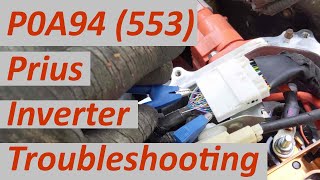
- If paired with code P0A94 on a 2010-2015 Prius, the root cause is a failed inverter assembly, not the battery itself.
- On Volkswagen and Audi vehicles, P3044 is entirely unrelated to hybrids and indicates a short circuit in the low-pressure fuel pump system.
What Does P3044 Mean?
The P3044 code indicates the vehicle's computer detects the high-voltage hybrid battery's state of charge is critically low (typically under 40%). The battery cannot hold enough electrical energy for the hybrid system to operate. This code primarily affects Toyota and Lexus hybrids.
Technical definition: For Toyota and Lexus, P3044 is defined as 'Hybrid Battery State of Charge Low'. For Volkswagen or Audi, it means 'Fuel Pump Short Circuit' or 'Fuel Pump Electronics Defective'. This guide focuses on the hybrid battery definition.
Can I Drive With P3044?
Yes, But With Caution. You can drive temporarily, but doing so risks severe damage. The vehicle experiences reduced power, poor fuel economy, and often fails to restart once turned off. The system can enter 'limp mode' with restricted speed or shut down completely without warning. Continuing to drive stresses the inverter, leading to a potential $3,000+ secondary repair. Stop driving and diagnose the issue immediately.
Common Causes
- Degraded High-Voltage (HV) Hybrid Battery (Very Common) — Over time and past 100,000 miles, individual cells within the battery pack lose their capacity to hold a charge, causing an overall low state of charge and eventual pack failure.
- Prolonged Vehicle Storage (Common) — If a hybrid sits unused for several weeks, the high-voltage battery naturally self-discharges. If it discharges too deeply, the hybrid system cannot recharge it upon startup.
- Blocked or Failed Hybrid Battery Cooling Fan (Common) — The hybrid battery requires active cooling. If the fan's intake vent is blocked by debris or the motor fails, the battery overheats. Heat accelerates degradation and prevents proper charging. 🎬 Watch: How to clean the hybrid battery cooling fan
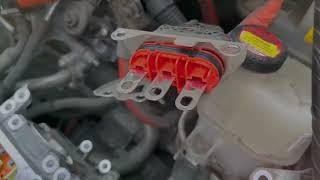
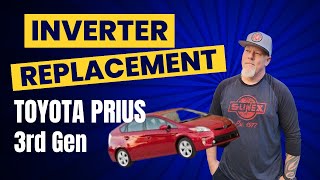
- Failed Inverter/Converter Assembly (Common) — The inverter charges the HV battery. A malfunction within the inverter (like a failed Intelligent Power Module) stops the charging process. This is a known defect on 2010-2015 Toyota Prius models. 🎬 See this step-by-step guide for replacing a failed inverter
- Faulty 12V Auxiliary Battery (Less Common) — A weak 12-volt battery causes communication errors across the hybrid system's ECUs. It prevents the high-voltage system from initializing correctly, triggering false low-charge codes.
- Corroded Battery Bus Bars (Less Common) — Metal bus bars connect the individual battery modules. Corrosion creates high electrical resistance, restricting electricity flow and causing inaccurate voltage readings.
- Failure of System Main Relays (SMRs) (Rare) — High-voltage relays connect the battery to the vehicle. If a relay sticks open, the battery is isolated and cannot provide power or receive a charge.
- Faulty Hybrid Battery Control Module (ECU) (Rare) — The computer monitoring the hybrid battery fails, incorrectly reporting a low state of charge or failing to manage the charging cycles.
Symptoms
- Check Engine Light and Hybrid System Warning — The dashboard displays a master warning, such as 'Check Hybrid System' or 'Propulsion Power Reduced'.
- Vehicle Fails to Start or Enter 'Ready' Mode — The high-voltage battery lacks the charge required to start the gasoline engine, leaving the car completely immobilized.
- Reduced Power and Sluggish Acceleration — The electric motor cannot provide acceleration boost. The vehicle feels noticeably slower and struggles on inclines.
- Decreased Fuel Economy — The gasoline engine runs constantly to compensate for the lack of electrical assistance, dropping fuel efficiency by 10-25%.
- Battery Charge Level Fluctuates Wildly — The dashboard battery gauge jumps from full to empty rapidly, proving the battery cannot hold a stable charge.
- Battery Cooling Fan Runs Constantly — A loud fan noise emits from the rear seat area as the system desperately tries to cool an overheating battery pack.
- Gasoline Engine Won't Shut Off — The internal combustion engine runs continuously at idle to force-charge the failing high-voltage battery.
Diagnostic Flowchart
Tap your situation to follow the diagnostic path that matches what you're seeing on this code.
Common Fixes & Costs
- Full Hybrid Battery Pack Replacement
— Parts: $1,500-$4,500, Labor: $400-$1,200, ~3.5 hr book time
(Professional)
Toyota Prius (2010-2015, Gen 3): OEM
Toyota Camry Hybrid (2007-2011): OEM - Replace Inverter/Converter Assembly
— Parts: $1,000-$3,500, Labor: $400-$800, ~2.5 hr book time
(Professional)
Toyota Prius (2010-2011): OEM - Hybrid Battery Reconditioning — Parts: $600-$2,000, Labor: $300-$600, ~4.0 hr book time (Professional)
- Clean or Replace Hybrid Battery Cooling Fan
— Parts: $150-$250, Labor: $100-$300, ~1.5 hr book time
(Intermediate)
Toyota Prius (2004-2009): OEM - Clean or Replace Corroded Bus Bars
— Parts: $50-$150, Labor: $300-$600, ~3.0 hr book time
(Advanced)
All Toyota/Lexus Hybrids: OEM - Replace Battery Control Module (ECU) — Parts: $400-$1,200, Labor: $200-$400, ~2.0 hr book time (Professional)
DIY vs Professional
- Full Hybrid Battery Pack Replacement 🟢 Beginner
Tools: Class 0 High-voltage safety gloves, insulated socket set, torque wrench, trim removal tools. - Replace Inverter/Converter Assembly 🟢 Beginner
Tools: Class 0 High-voltage safety gloves, insulated socket set, coolant bleeding equipment. - Clean or Replace Hybrid Battery Cooling Fan 🟢 Beginner
Tools: Socket set (10mm, 12mm), trim removal tools, shop vacuum. - Replace 12V Auxiliary Battery 🟢 Beginner
Tools: Socket set (10mm, 12mm).
Used vs. New Parts: Buying Guide
When a used part is worth it: A reconditioned battery is cost-effective for older hybrids where a new battery exceeds 40% of the vehicle's value. It suits budget-conscious owners planning to sell soon.
Donor-vehicle mileage cap: roughly under 80000 miles for the part to have meaningful remaining life.
Donor quality checklist:
- Choose a reputable rebuilder with a physical location and strong warranty terms.
- Verify the rebuilder load-tests and balances all individual cells, not just the single failed module.
Decision logic:
- If Vehicle is newer or you plan to keep it for 5+ years → Buy a new OEM or high-quality aftermarket battery for maximum lifespan.
- If Vehicle is over 10 years old and budget is a primary concern → Buy a reconditioned battery from a reputable supplier with a 1-year warranty.
- If You are a DIYer looking for the absolute cheapest option → Source a used battery from a low-mileage wrecked vehicle, accepting the high risk of premature failure.
Warranty tradeoff: New OEM batteries offer 1-3 year warranties. Reconditioned batteries offer 6-12 months. Used junkyard batteries offer 30 days.
Worst-case if a used part fails: $500-$1,000 in repeat labor costs if a used battery fails prematurely.
What Happens If You Wait — Timeline
- 0-1 month: Code P3044 appears. The gas engine runs more frequently, and EV mode becomes unavailable. The car remains driveable but inefficient. (MPG impact: 10-25%% · Added cost: $50-$150 in wasted fuel.)
- 1-3 months: Acceleration becomes sluggish. The battery charge indicator fluctuates wildly. The car enters 'limp mode' with severely reduced power on inclines. (MPG impact: 25-40%% · Added cost: $150-$400 in wasted fuel, plus strain on the inverter.)
- 3-6 months: The vehicle fails to start intermittently. The constant strain from trying to charge the dead battery overheats and damages the inverter assembly. (MPG impact: 40-60%% · Added cost: $1,500-$3,500 for a destroyed inverter.)
- 6+ months: Complete vehicle shutdown. The high-voltage battery is too deeply discharged to activate the main relays. The battery is unrecoverable. (MPG impact: 100% (vehicle is undriveable)% · Added cost: $2,000-$4,500 for a guaranteed battery replacement, plus towing.)
Cost of Not Fixing It
- 0-1 Month: Significant drop in fuel economy (5-15 MPG) as the gasoline engine runs constantly. Vehicle enters 'limp mode' with reduced power. (Added cost: $50-$150 in extra fuel costs.)
- 1-6 Months: Increased strain on the inverter as it constantly tries to charge a failing battery, leading to overheating and premature inverter failure. (Added cost: $1,500-$3,500 for inverter replacement.)
- 6+ Months: Complete vehicle shutdown. A deeply discharged battery becomes unrecoverable, guaranteeing a full replacement. (Added cost: $400+ for towing and diagnosis.)
Diagnosis Steps
- Read All Diagnostic Trouble Codes (DTCs)
Use an OBD-II scanner to confirm P3044. Look for related codes like P0A80 (Replace Hybrid Battery Pack) or P0A94 (DC/DC Converter), which immediately pinpoint the root cause.
Tools: OBD-II Scanner (Beginner) - Check the 12V Auxiliary Battery
A weak 12-volt battery causes a cascade of false hybrid codes. Test the battery voltage; it must read above 12.4V after sitting for an hour. Replace it if it fails a load test.
Tools: Multimeter or Battery Tester (Beginner) - Inspect the Hybrid Battery Cooling System
Locate the battery cooling fan intake vent near the rear seats. Remove any blockages (floor mats, pet hair). Listen for the fan's operation in 'Ready' mode; silence or grinding indicates failure.
Tools: Flashlight (Beginner) - Analyze Individual Battery Block Voltages
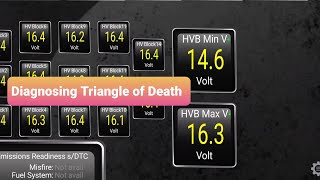
View live data for each battery block. A healthy pack has voltages within 0.2V of each other. A voltage difference (Delta V) greater than 0.3V under load confirms a failing battery pack.
Tools: Advanced OBD-II Scanner (e.g., Veepeak with Dr. Prius app) (Intermediate) - Check Battery Internal Resistance
Check the internal resistance of each battery block. Healthy blocks in a Gen 2/3 Prius sit below 25 milliohms (mΩ). A block reading 5-6 mΩ higher than the rest contains a failing cell.
Tools: Advanced OBD-II Scanner (e.g., Veepeak with Dr. Prius app) (Advanced) - Perform a Forced/Equalization Charge
If the vehicle sat unused for months, use a bi-directional scanner to command a 'forced charge'. This manually runs the engine to charge the HV battery. If it fails to charge, the battery is permanently degraded.
Tools: Advanced Bi-Directional Scanner (e.g., Toyota Techstream) (Advanced) - Visually Inspect the Hybrid Battery Bus Bars
Depower the high-voltage system. Remove the battery cover and inspect the copper bus bars connecting the modules. Green or white crust indicates severe corrosion causing high resistance.
Tools: Class 0 High-Voltage Gloves, Insulated Socket Set (Advanced) - Test System Main Relays (SMRs)
Listen for distinct 'clicks' from the battery area when powering the car on. No click means a relay is stuck open. Command the relays on/off with a scanner while checking for voltage drops.
Tools: Multimeter, Bi-Directional Scanner, Class 0 High-Voltage Gloves (Advanced) - Perform a Battery Load Test / Capacity Test
Use a hybrid battery analyzer to measure the battery's actual capacity (Amp-hours) under a controlled load. This definitively proves whether the battery requires replacement.
Tools: Hybrid Battery Analyzer (Professional) - For VW/Audi: Test Fuel Pump Pressure
Ignore hybrid diagnostics for VW/Audi. Connect a fuel pressure gauge to the low-pressure system. Check for a short circuit to ground on the fuel pump wiring harness.
Tools: Fuel Pressure Gauge, Multimeter (Advanced)
When This Code Triggers (Freeze-Frame Conditions)
- State of Charge (SOC): < 40% (Triggers when the battery's reported charge level drops below the critical operational threshold.)
- Battery Block Voltage Delta: > 0.5V (Shows a significant voltage difference between the highest and lowest battery blocks, indicating a severe cell imbalance.)
- Engine Coolant Temp: 170-200°F (The engine is fully warmed up, indicating the vehicle has been running and failing to charge the battery.)
- Vehicle Speed: 0-55 mph (Occurs at a standstill or steady-state cruising as the system demands power the battery cannot supply.)
Related Codes
- P0A80 — Means 'Replace Hybrid Battery Pack.' P3044 warns of low charge, while P0A80 is the ECU's definitive judgment that the battery pack has failed due to high internal resistance.
- P0A94 — Means 'DC/DC Converter Performance.' Points directly to a failed inverter. If seen with P3044, the inverter stopped charging the battery, causing the low charge state.
- P3011-P3029 — Corresponds to 'Battery Block X Becomes Weak.' These codes pinpoint the exact failing block within the pack, confirming internal battery failure.
- P3000 — Means 'Battery Control System Malfunction.' A general gateway code indicating a fault in the HV system. P3044 specifies the fault is a low state of charge.
Climate & Environmental Factors
- High Heat: Heat is the primary enemy of NiMH batteries. Hot climates (e.g., Arizona) significantly accelerate battery degradation, increasing internal resistance and shortening lifespan.
- Extreme Cold: Cold weather temporarily reduces battery efficiency and power output. It makes a weak, aging battery show symptoms more prominently, triggering P3044.
- High Humidity: Humidity combined with coastal salt accelerates corrosion on the copper bus bars, increasing electrical resistance and causing voltage imbalances.
How to Talk to a Mechanic About This Code
Say this: "I have a P3044 code and a hybrid system warning light. Please test the 12V battery, inspect the hybrid cooling fan, and provide a printout of the live data showing individual battery block voltages and internal resistance before we discuss replacing the main battery."
This prevents a shop from defaulting to a costly battery replacement. Asking for specific data forces the technician to perform a thorough diagnosis and rules out cheaper fixes first.
Avoid saying:
- 'My hybrid is acting weird, can you fix it?'
- 'Just replace the hybrid battery.'
- 'My car won't start, I think it's the battery.'
Questions to ask before authorizing the repair:
- What were the specific voltage readings for each battery block, and what was the maximum voltage difference?
- Did you inspect the battery cooling fan for blockages?
- Were codes like P0A80 or P0A94 present?
- Is the replacement battery new, remanufactured, or reconditioned, and what is the exact warranty?
Where to Take It: Dealer vs Independent vs Chain
- Dealer:
A safe but expensive choice. Best for warranty claims or inverter failures covered by service campaigns.
Best for: Vehicles under warranty, Checking for manufacturer service campaigns (e.g., Prius inverter warranty extension)
Downsides: Highest labor rates and parts costs., Only offers full new battery replacements, the most expensive option. (Typical cost: +50% vs. baseline) - Independent Shop:
Best fit, IF it is a hybrid specialist with ASE L3 certification. Avoid general mechanics.
Best for: Out-of-warranty vehicles where cost is a major factor., Access to cheaper reconditioned or aftermarket batteries.
Downsides: Not all independent shops are equipped or trained for high-voltage work. (Typical cost: +0% vs. baseline) - Chain Shop:
AVOID. They are not equipped to safely or accurately diagnose a P3044 code.
Best for: Simple, non-hybrid related work like tires or oil changes.
Downsides: Technicians lack specialized training and equipment for high-voltage diagnostics., High risk of misdiagnosis. (Typical cost: -10% vs. baseline)
When to Walk Away From the Repair
If the estimated repair cost exceeds 50% of the car's current private-party market value, sell the car as-is or trade it in.
- Car worth $6000, fix is $3500: Walk away. The repair is nearly 60% of the car's value. The risk of other age-related failures is high.
- Car worth $10000, fix is $2500: Fix it. The repair is 25% of the car's value and provides several more years of service.
What Scan Tool You Need for This Code
Minimum: A scanner that reads manufacturer-specific codes and live data for the hybrid system, including individual battery block voltages and internal resistance.
A basic $20 code reader only shows the P3044 code. It cannot access the detailed Battery Control Module data needed to determine if the cause is a bad cell, a cooling fan, or an inverter.
Budget: Veepeak OBDCheck BLE+ with Dr. Prius App (~$50) — The go-to for DIY hybrid owners. The Dr. Prius app performs detailed hybrid battery health checks, showing live graphs of block voltages and resistance.
Mid-range: Foxwell NT510 Elite (~$180) — A handheld scanner offering deeper system access to read and graph live data for the hybrid system without needing a smartphone app.
Professional: Autel MaxiCOM MK808 (~$450) — Provides full bidirectional control to command the battery cooling fan and perform special functions like a 'rescue charge' on a deeply discharged battery.
Rent vs buy: Buy the budget pick. For a one-time, in-depth diagnosis, buy a $50 Veepeak adapter and the Dr. Prius app rather than a $500 pro scanner.
How to Clear the Code After You Fix It
- Reconnect the 12V battery if disconnected.
- Use an OBD-II scan tool to clear all Diagnostic Trouble Codes (DTCs).
- Perform a complete drive cycle to reset readiness monitors.
Drive cycle (~30 minutes): Cold start and idle for 10 minutes. Drive at a steady 55 mph for 15 minutes. Drive in stop-and-go traffic for 10 minutes. Allow the vehicle to cool completely.
Readiness monitors affected: Catalyst Monitor, EVAP System Monitor, Oxygen (O2) Sensor Monitor
Watch out for:
- Disconnecting the 12V battery clears the code but resets all readiness monitors to 'Incomplete', causing an automatic emissions failure.
- The code returns immediately if the degraded battery or failed inverter has not been replaced.
Will This Fail Emissions / State Inspection?
Yes — this code typically fails an OBD-II emissions inspection.
- California: An active Check Engine Light for P3044 is an automatic smog check failure. All readiness monitors must be 'Complete'.
- New York: The NYVIP3 inspection fails any vehicle with an illuminated Malfunction Indicator Lamp (MIL) for emissions-related codes.
- Texas: In emissions-testing counties, an active P3044 code causes an automatic failure of the OBD-II test.
Most Commonly Affected Vehicles
- Toyota Prius (2004-2015) — Extremely common. 2010-2015 models suffer from inverter failures that trigger this code; check for Toyota Customer Support Program ZJB.
- Toyota Camry Hybrid (2007-2014) — Shares the Prius powertrain and is highly susceptible to age-related battery degradation.
- Toyota Highlander Hybrid (2006-2013) — The larger battery pack is prone to failure. Replacement costs exceed $2,500.
- Lexus RX 400h / RX 450h (2006-2013) — A weak 12V battery frequently causes false P3044 codes on these luxury models.
- Ford Escape Hybrid (2005-2013) — Battery lifespan is typically 10 years. Replacements range from $2,400 to $3,600.
Manufacturer-Specific Notes
- Toyota/Lexus: This code almost exclusively indicates a low state of charge in the high-voltage battery. It is a precursor to P0A80.
- Volkswagen/Audi: P3044 means 'Fuel Pump Short Circuit'. It is entirely unrelated to hybrid systems and points to a failed in-tank low-pressure fuel pump.
- Honda: Honda does not use P3044. They use P1570 and P1447 to signal a failing high-voltage battery pack.
Real Owner Stories
2011 Prius at 131k miles with multiple codes
Owner bought a 2011 Prius showing a 'Check Hybrid System' message and multiple codes including P0A94.
Outcome: Another owner with a similar issue got the inverter replaced for free by a dealer under a Customer Service Program after initially being quoted $4,000.
Lesson: Always check for active warranty extensions or customer support programs from the manufacturer, especially for expensive inverter failures on Gen 3 Priuses.
2006 Lexus RX400h that won't start
After a water leak damaged the hybrid relay, the owner replaced the relay and 12V battery. The vehicle still wouldn't start, showing one bar of hybrid charge.
Outcome: The main HV battery was deeply discharged due to inactivity. The new 12V battery powered the computers, but the HV battery lacked the power to start the engine.
Lesson: A non-starting hybrid after a long period of inactivity requires a professional 'rescue charge' using advanced tools like Toyota Techstream to restore the HV battery.
2012 Prius C with P0A94, limp mode
The car entered limp mode, wouldn't accelerate, and failed to start. The scanner showed P0A94 (inverter failure).
Outcome: The owner correctly rejected the battery diagnosis. The actual fix was an inverter replacement, costing $2,500 for parts and $400 for labor at the dealer.
Lesson: Never replace the hybrid battery when code P0A94 is present. P0A94 points directly to the inverter. Always replace a weak 12V battery first to clear false codes.
VW Golf TDI with P3044, non-start
A 2.0L TDI Golf died and would not restart. Codes present were P3044 (Fuel Pump Short Circuit) and P3045.
Outcome: The issue was a failed in-tank lift fuel pump controller. Replacing the pump and controller with used parts resolved the issue.
Lesson: On a VW or Audi, P3044 has nothing to do with a hybrid battery. It points directly to the low-pressure fuel pump system.
How to Prevent This Code From Triggering
- Clean the hybrid battery cooling fan and filter (Inspect every 10,000 miles, clean every 20,000 miles.) — Heat destroys hybrid batteries. A clogged fan restricts airflow, causing the battery to run hot and accelerating chemical degradation.
- Drive the vehicle regularly (At least once every 2 weeks for 30 minutes.) — Sitting unused allows the NiMH battery to self-discharge deeply. Regular driving keeps the battery within its optimal 40-80% state of charge.
- Avoid extreme temperatures (Daily habit) — Extreme heat permanently damages the battery's capacity. Park in the shade or a garage to lower ambient operating temperatures.
- Maintain a partial state of charge for long-term storage (When storing for 1+ month) — Storing a battery fully charged or fully depleted stresses the chemistry. Drive for 20 minutes before storage to achieve a safe 60% charge.
Frequently Asked Questions
Can I just clear the P3044 code and keep driving?
No. Clearing the code does not fix the underlying problem and it will return within a few drive cycles. Ignoring it leads to worsening symptoms, power loss, and risks stranding you when the car won't start.
Is it better to replace or recondition my hybrid battery?
Reconditioning is a cheaper, temporary fix ($1,500-$3,000) that replaces only the weakest cells. A full replacement ($3,000-$8,000+) provides a long-term solution with a better warranty. Choose based on your budget and how long you plan to keep the vehicle.
Can I 'jump start' the high-voltage hybrid battery?
No, you absolutely cannot jump-start the high-voltage battery. It operates at several hundred volts; attempting this causes fatal electrocution or destroys the vehicle's electronics. You can only jump-start the 12V auxiliary battery to power the computers.
What is the most common misdiagnosis for P3044?
The most common mistake is condemning the expensive high-voltage battery without performing basic checks. Technicians must first rule out a faulty 12V auxiliary battery, a blocked cooling fan, and corroded connections. These are much cheaper and simpler fixes.
My mechanic says the P3044 code means I need a new inverter, not a battery. Is that possible?
Yes. The inverter charges the hybrid battery; if it fails, the battery self-discharges and triggers P3044. Codes like P0A94 often accompany this, pointing directly to the inverter, which is a known failure point on 2010-2015 Prius models.
How long does a hybrid battery last?
Most hybrid batteries last between 10 to 15 years or 100,000 to 150,000 miles. Lifespan varies based on climate, driving habits, and the specific vehicle model. Extreme heat significantly shortens this lifespan.
What is the warranty on a replacement hybrid battery?
Federal law in the U.S. mandates hybrid batteries are warrantied for at least 8 years or 100,000 miles from the factory. Aftermarket replacements from specialty shops offer warranties ranging from 1 to 3 years. Always verify the warranty terms before purchasing.
How can I make my hybrid battery last longer?
Avoid extreme temperatures by parking in the shade or a garage. Ensure the battery cooling fan vent remains clear of obstructions like floor mats or pet hair. Drive the car for at least 30 minutes every two weeks to prevent deep self-discharge.
Key Takeaways
- Code P3044 indicates the high-voltage hybrid battery state of charge has dropped below 40%, requiring immediate diagnosis to prevent being stranded.
- Always test the 12V auxiliary battery and check the hybrid cooling fan for blockages before spending $2,000+ on a high-voltage battery replacement.
- If paired with code P0A94 on a 2010-2015 Prius, the root cause is a failed inverter assembly, not the battery itself.
- On Volkswagen and Audi vehicles, P3044 is entirely unrelated to hybrids and indicates a short circuit in the low-pressure fuel pump system.
Helpful Videos




Shop the Parts Behind P3044
Below are the parts most often responsible for code P3044, ranked by how frequently each one is the actual culprit (per the diagnosis above). Tap any to see what we have for your vehicle.



The information in this article is provided for general reference and educational purposes only. Vehicle specifications, procedures, and part compatibility can vary by production date, trim level, and region. Always consult your vehicle's factory service manual and verify part numbers before purchasing or performing repairs. Safety-critical components such as airbags, seat belts, and braking systems should be installed by a qualified professional.
- 🧭 Diagnostic Flowchart
- 🎬 Helpful Videos
- 🛍️ Shop This Part
- What Does P3044 Mean?
- Can I Drive With P3044?
- Common Causes
- Symptoms
- Common Fixes & Costs
- DIY vs Professional
- Used vs. New Parts: Buying Guide
- What Happens If You Wait — Timeline
- Cost of Not Fixing It
- Diagnosis Steps
- When This Code Triggers (Freeze-Frame Conditions)
- Related Codes
- Climate & Environmental Factors
- How to Talk to a Mechanic About This Code
- Where to Take It: Dealer vs Independent vs Chain
- When to Walk Away From the Repair
- What Scan Tool You Need for This Code
- How to Clear the Code After You Fix It
- Will This Fail Emissions / State Inspection?
- Most Commonly Affected Vehicles
- Manufacturer-Specific Notes
- Real Owner Stories
- 2011 Prius at 131k miles with multiple codes
- 2006 Lexus RX400h that won't start
- 2012 Prius C with P0A94, limp mode
- VW Golf TDI with P3044, non-start
- How to Prevent This Code From Triggering
- Frequently Asked Questions
- Can I just clear the P3044 code and keep driving?
- Is it better to replace or recondition my hybrid battery?
- Can I 'jump start' the high-voltage hybrid battery?
- What is the most common misdiagnosis for P3044?
- My mechanic says the P3044 code means I need a new inverter, not a battery. Is that possible?
- How long does a hybrid battery last?
- What is the warranty on a replacement hybrid battery?
- How can I make my hybrid battery last longer?
- Key Takeaways
- 🎟️ Get 5% Off