

P3191 on 2011-2013 Lexus CT Hybrid: 'Engine Does Not Start' Causes and Fixes
On a 2011-2013 Lexus CT Hybrid, code P3191 almost always means the gasoline engine failed to start. The most common causes are running out of fuel or a vacuum leak from a disconnected Purge VSV/PCV hose at the throttle body. Always check the fuel gauge first, then inspect the vacuum lines around the air intake.
- P3191 means your Lexus CT200h's gasoline engine failed to start when it was supposed to.
- Before any complex diagnosis, check the simplest thing: make sure there is fuel in the tank.
- The second most likely cause is a vacuum hose that has popped off the throttle body. This is a known issue covered by a Lexus TSB.
- This code points to a problem with the engine (air, fuel, or spark), not a failure of the expensive high-voltage hybrid battery.
- Ignoring this code will leave you stranded, as the car cannot run on the hybrid battery alone for an extended period.
What's Unique About the 2011-2013 Lexus CT HYBRID
On the CT200h hybrid platform, the gasoline engine starts and stops frequently as part of normal operation. This code is specifically triggered when one of those automated start sequences fails. A well-documented issue for this vehicle is a vacuum line for the Purge VSV (Vacuum Switching Valve) separating from the throttle body, creating a massive vacuum leak that prevents the engine from starting. This is so common that Lexus issued a Technical Service Bulletin (TSB L-SB-0019-15) for it, which may be covered under the Lexus Federal Emissions Warranty for 96 months or 80,000 miles.
Diagnostic Flowchart
Tap your situation to follow the diagnostic path that matches what you're seeing on this vehicle.
Symptoms You May Notice
- Engine cranks but does not start
- "Check Hybrid System" message on the dashboard.
- Vehicle loses power while driving and then will not restart.
- Check Engine Light is on
- Vehicle may only move a very short distance on remaining battery power before stopping
- A significant 'whoosh' of air is heard when opening the gas cap, indicating a potential fuel tank ventilation or EVAP system issue.
- Replacing the 12V auxiliary battery. While a weak 12V battery can cause many electrical issues, it typically won't be the root cause of a P3191 if the engine is cranking normally.
- Assuming the high-voltage hybrid battery has failed. A failed engine will drain the hybrid battery, but P3191 points to a problem with the gasoline engine itself, not the hybrid battery system. The hybrid battery does not cause this code, and a specific code like P0A80 would be present if the hybrid battery were the primary fault.
Most Likely Causes
- Out of Fuel 🔴 High Probability The engine doesn't run constantly, which can sometimes lead drivers to be less aware of the fuel level. The system specifically has a related code, P3193, for a 'Fuel Run Out' condition, but P3191 can also be triggered.
How to confirm: Check the fuel gauge on the dashboard. If it's on empty, this is the most likely cause. Do not rely on the gauge if the car has been sitting on an incline.
Typical fix: Add at least 2-3 gallons of gasoline to the tank. It may take a few 'Ready' cycles to start as the fuel lines need to be reprimed.
Est. part cost: $10-$15 (for fuel) - Purge VSV / PCV Hose Separation 🔴 High Probability → Shop Vapor Canister Lexus issued Technical Service Bulletin L-SB-0019-15 specifically for this issue on 2011-2013 CT200h models. The vacuum line can separate from its connection point on the throttle body housing, causing a large, unmetered air leak.
How to confirm: Visually inspect the vacuum hoses connected to the throttle body and air intake assembly. Look for any disconnected or cracked rubber lines. The TSB specifically points to the Purge VSV and PCV lines as the culprits.
Typical fix: Reconnect the separated hose. Per the TSB, the official repair involves replacing the Purge VSV (Part No. 25860-37020) and reprogramming the ECM, a repair that may be covered under the 8-year/80,000-mile emissions warranty. However, simply reconnecting the hose often resolves the immediate no-start condition.
Est. part cost: $0 (if hose is just disconnected), $90-$130 (for a new OEM Purge VSV). - Faulty Fuel Pump 🟡 Medium Probability → Shop Fuel Pump While generally reliable, fuel pump failures are not unheard of. Some 2013 models may have been included in a wider Denso fuel pump recall that affected many Toyota/Lexus vehicles. Failures can sometimes occur shortly after refueling, possibly due to sediment being disturbed in the tank.
How to confirm: Listen for the pump to prime (a faint hum from the rear seat area) when the car is turned to the 'ON' position. A more definitive test is to check the fuel pressure at the fuel rail using a fuel pressure gauge; it should be between 44-50 psi.
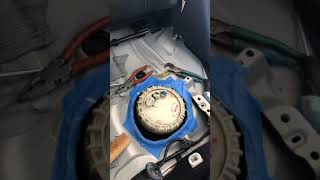
Typical fix: Replace the fuel pump assembly, which is located inside the fuel tank and is accessible from under the rear seat. 🎬 See this walkthrough for removing the fuel pump assembly.
Est. part cost: $500-$720 (for OEM part), $200-$400 (for aftermarket) - Dirty or Faulty Mass Air Flow (MAF) Sensor ⚪ Low Probability → Shop Fuel Injection Air Flow Meter The MAF sensor, located in the intake tube after the air filter, can become contaminated with oil vapors or debris (like cottonwood fibers), causing incorrect air-fuel ratio calculations.
How to confirm: Unplug the MAF sensor electrical connector and try to start the engine. If it starts and runs (though poorly), the MAF sensor is very likely the issue. Cleaning the sensor with dedicated MAF sensor cleaner is a common and effective diagnostic step.
Typical fix: Clean the MAF sensor with a specialized cleaner. If cleaning doesn't work, replace the sensor. Be gentle, as the sensor's internal wires are delicate.
Est. part cost: $10 (for cleaner), $70-$150 (for a new sensor).
Rare But Worth Checking
- Clogged Fuel Injectors: If the car has been sitting for a long time or has been run on poor-quality fuel, injectors can become clogged, preventing fuel from entering the cylinders.
- Failed Crankshaft Position Sensor: The ECM relies on this sensor to know the engine's rotational speed. If it fails, the ECM won't know the engine is cranking and won't initiate fuel or spark.
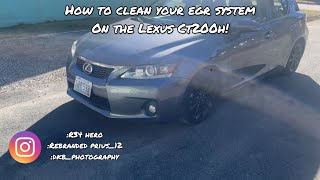
- Internal Engine Failure: In severe cases, such as a blown head gasket causing coolant to enter the cylinders, the engine may not be able to start and will trigger this code. A related known issue on this engine is clogging of the EGR passages in the intake manifold (per TSB L-SB-0019-16), which can cause 🎬 Watch: Step-by-step guide to cleaning the CT200h EGR system. severe misfires and lead to a no-start condition.
- EVAP System Malfunction: A failure in the fuel evaporative system can cause excessive vacuum to build in the fuel tank, preventing the fuel pump from delivering fuel. A loud 'whoosh' when opening the gas cap is a key symptom.
Diagnosis Steps
- Verify the fuel level. Do not trust the gauge if you have any doubts; add a couple of gallons of fuel.
- Scan for all Diagnostic Trouble Codes (DTCs). Note any other codes, especially P0171, P3190, or P0A0F.
- Visually inspect the engine bay for disconnected vacuum hoses, paying close attention to the throttle body and the lines running to the Purge VSV, as detailed in TSB L-SB-0019-15.
- Listen for a 'whoosh' sound when opening the fuel cap. A strong vacuum sound could indicate an EVAP system problem.
- If no vacuum leaks are found, check for fuel pressure. Listen for the fuel pump priming when the car is turned on. Use a fuel pressure gauge for a definitive measurement (target 44-50 psi).
- If fuel pressure is suspect, inspect and clean the Mass Air Flow (MAF) sensor located in the air intake tube after the air filter. This is a low-cost, high-impact diagnostic step.
- Check the condition of the spark plugs for fouling or wear.
- If the engine still won't start, more advanced diagnostics on components like the fuel pump, crankshaft sensor, or for internal engine issues (like compression testing) may be required.
Parts You'll Likely Need
- Purge VSV (Vacuum Switching Valve)
(OEM #25860-37020)— This part is cited in TSB L-SB-0019-15 as a common failure point leading to a vacuum leak that causes P3191. The official repair procedure calls for its replacement and an ECM reprogram.
Trusted brands: Genuine Lexus/Toyota
OEM price range: $95-$130
Aftermarket price range: $75-$100 - Fuel Pump Assembly
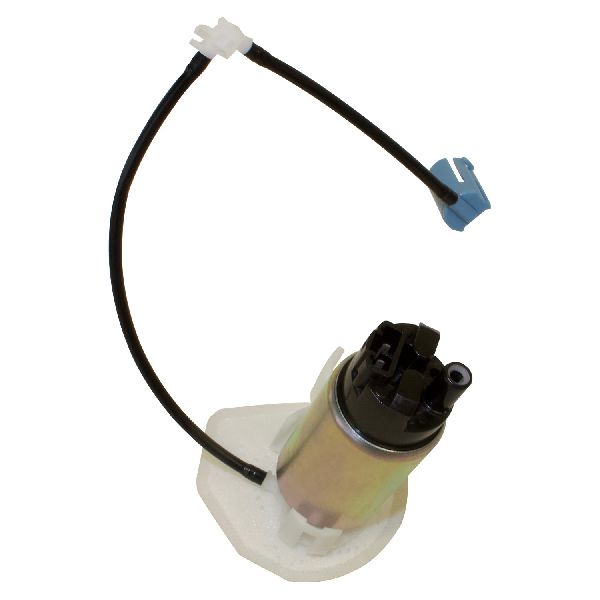
(OEM #77020-76011 (supersedes 77020-76010))— If the vehicle is not out of fuel and has no vacuum leaks, a failed fuel pump is the next most likely component to prevent the engine from starting.
Trusted brands: Denso, Delphi
OEM price range: $517-$720
Aftermarket price range: $150-$400
Related Codes That Often Appear With This One
- P3190 — This code means 'Poor Engine Power'. It often appears with P3191 because the underlying issue (like a vacuum leak or fuel problem) first causes poor performance before leading to a complete failure to start.
- P0171 — This code means 'System Too Lean (Bank 1)'. It is frequently caused by unmetered air entering the engine, such as the vacuum hose separation described in TSB L-SB-0019-15.
- P0A0F — This is a more general hybrid system code for 'Engine Failed to Start'. It is often logged alongside the more specific P3191 and confirms the same fault.
Technical Service Bulletins (TSBs) & Recalls
- L-SB-0019-15: Details the issue of a separated Purge VSV/PCV line causing a no-start condition and logging codes P3191, P3190, and P0171.
- L-SB-0019-16: Addresses engine misfires (P0300-P0304) due to clogged EGR ports in the intake manifold on 2011-2016 models.
- L-SB-0061-12: Pertains to a no-start condition (P0A0F) in freezing temperatures on 2011-2014 models, requiring an updated intake manifold.
Platform-Specific Known Issues
- TSB L-SB-0019-15: For 2011–2013 CT200h, a MIL 'ON' with codes P3191, P3190, P0171, and/or P0A0F is often caused by the Purge VSV/PCV vacuum line separating from the throttle body. The fix involves replacing the Purge VSV and reprogramming the ECM.
- TSB L-SB-0019-16: On 2011-2016 models, a rough running condition with misfire codes (P030x) can be caused by clogged EGR ports in the intake manifold. While this TSB targets misfires, a severe clog can contribute to poor performance and eventual no-start issues.
- TSB L-SB-0061-12 Rev1: Some 2011-2014 models may fail to start and set codes P2111 and P0A0F in
Mechanic-Grade Diagnostic Values
- Crankshaft Position Sensor Resistance — expected: 985 to 1,600 Ω (cold, -10 to 50°C) or 1,265 to 1,890 Ω (hot, 50 to 100°C). Failure: A resistance reading outside of the specified range for the measured temperature.
- Mass Air Flow (MAF) Sensor Reading at Idle (via Scan Tool) — expected: Approximately 1.7 gm/sec. Failure: Significantly lower readings (e.g., 1.2 gm/sec) can indicate a sensor or intake issue preventing the engine from starting.
- Manifold Absolute Pressure (MAP) Sensor Reading at Idle (via Scan Tool) — expected: Approximately 26-28 kPa. Failure: Significantly lower readings (e.g., 22 kPa) can indicate a vacuum leak or sensor issue.
Hidden / Shadow Codes Worth Checking
- Info Code 462 (in ABS module): Indicates a temporary loss of communication with the steering angle sensor. While not directly causing the no-start, it can appear concurrently with P3191 during a major electrical or system fault event. (see via Advanced scan tools like Toyota Techstream, under the ABS/VSC system data.)
Scan Tool Commands That Help
- Toyota Techstream: ECU Flash Reprogramming — Required as the final step when replacing the Purge VSV per TSB L-SB-0019-15. This updates the ECM logic. The procedure requires maintaining battery voltage at a stable 13.5 volts with a dedicated power supply.
- Toyota Techstream: Active Test: Control the Fuel Pump / Speed — To verify fuel pump operation without attempting to start the engine. This allows a technician to confirm the pump runs and to safely check for fuel pressure at the rail, isolating a pump failure from other no-start causes.
- Toyota Techstream: Freeze Frame Data Inspection — This is the first step after reading codes. It provides a snapshot of all sensor values at the exact moment the P3191 code was set, which can point to the root cause (e.g., lean fuel trims, low fuel pressure, etc.).
Wiring & Ground Locations
- ECM (Engine Control Module) — Located in the engine compartment, on the left side.. The ECM is the central computer that receives all sensor inputs (Crankshaft, MAF, etc.) and controls fuel and spark. Checking for corrosion or damage at its connectors is a key step in diagnosing complex no-start issues.
- Power Management Control ECU — Located behind the right side of the dashboard.. This ECU communicates with the main engine ECM to manage the hybrid system and command the engine to start. A communication fault between these two modules can cause a no-start condition.
- Engine Ground Points (e.g., D1, D27) — Various points on the engine block and cylinder head. For example, D1 is on top of the engine.. A poor engine ground can cause erratic sensor readings and weak spark, leading to a no-start condition that can be difficult to diagnose. Ensure main ground straps from the engine to the chassis are clean and tight.
Real Owner Repair Stories
- PriusChat Forum Member (2013 Lexus CT200h, 155,000 miles) — Car does not start, "Check Hybrid System" message, codes P0A0F and P3191.
❌ Tried (didn't work) Considering cleaning MAF/EGR, using head gasket sealant.
✅ What actually fixed it The owner discovered coolant mixed in the engine oil, confirming the root cause was a blown head gasket. The coolant in the cylinders prevented the engine from starting, triggering the P3191 code. The required fix is a head gasket replacement or engine replacement.
OEM Part Supersession History
77020-76010→77020-76011— Standard part revision/update.
Model Year Variations Within This Range
- 2011-2013: The Purge VSV vacuum line separation issue is addressed by TSB L-SB-0019-15 for vehicles produced before VIN JTHKD5BH#D2158591. Vehicles made after this VIN in the 2013 model year likely have an improved component or hose connection from the factory.
- 2011-2013 vs 2014+: The 2014 model year refresh (introduced late 2013) featured an improved EGR system design, which is believed to reduce the prevalence of EGR clogging and subsequent head gasket failures seen more often in earlier models. It also featured a remapped transmission control for a more linear acceleration feel and improved sound insulation.
Helpful Videos
We Have This Part in Stock


The information in this article is provided for general reference and educational purposes only. Vehicle specifications, procedures, and part compatibility can vary by production date, trim level, and region. Always consult your vehicle's factory service manual and verify part numbers before purchasing or performing repairs. Safety-critical components such as airbags, seat belts, and braking systems should be installed by a qualified professional.
- Lexus CT HYBRID:
- 🧭 Diagnostic Flowchart
- 🎬 Helpful Videos
- 🛍️ Shop This Part
- What's Unique About the 2011-2013 Lexus CT HYBRID
- Symptoms You May Notice
- Most Likely Causes
- Rare But Worth Checking
- Diagnosis Steps
- Parts You'll Likely Need
- Related Codes That Often Appear With This One
- Technical Service Bulletins (TSBs) & Recalls
- Platform-Specific Known Issues
- Mechanic-Grade Diagnostic Values
- Hidden / Shadow Codes Worth Checking
- Scan Tool Commands That Help
- Wiring & Ground Locations
- Real Owner Repair Stories
- OEM Part Supersession History
- Model Year Variations Within This Range
- 🎟️ Get 5% Off