

P3402 on 2015-2018 Ram 3500 6.4L HEMI: Cylinder 1 Deactivation Fault Causes and Fixes
This code indicates a fault in the Cylinder 1 deactivation system on the 6.4L HEMI engine. The most common cause is a failed Multi-Displacement System (MDS) solenoid for cylinder 1. Other likely causes include low or incorrect viscosity engine oil, wiring issues near the intake manifold, or the need for a PCM software update as specified in manufacturer TSBs. In some cases, this code can be an early warning for a more serious internal engine problem like a failing MDS lifter.
- P3402 specifically points to a problem with the cylinder deactivation system for cylinder 1 on the 6.4L HEMI engine.
- Before replacing parts, always check the engine oil level and condition, as the MDS system relies on proper oil pressure.
- The most likely part to fail is the cylinder 1 MDS solenoid, located under the intake manifold.
- Check for any available PCM software updates with a dealer, as multiple TSBs indicate a reflash can resolve this code.
What's Unique About the 2015-2018 Ram 3500
For the 2015-2018 Ram 3500, this code is specific to the 6.4L HEMI V8, as the optional Cummins diesel engine does not use a cylinder deactivation system. Ram has issued multiple Technical Service Bulletins (TSBs) that include P3402, often grouping it with deactivation codes for other cylinders (P3426, P3442, P3450). This pattern suggests that the issue can sometimes be resolved with a PCM software update rather than a direct hardware replacement. TSB 18-036-20, for example, not only addresses these DTCs but also contains an optional software path to fix drone or shudder complaints during MDS operation. This makes checking for software updates a critical first step for this specific vehicle range.
Diagnostic Flowchart
Tap your situation to follow the diagnostic path that matches what you're seeing on this vehicle.
Symptoms You May Notice
- Check Engine Light is on
- Rough or unstable idle
- Reduced fuel economy as MDS will be disabled
- Engine hesitation or loss of power during acceleration
- Possible engine misfire sensation or ticking noise, which could indicate a more serious lifter issue.
- Replacing the PCM when only a software update is needed.
- Replacing spark plugs or ignition coils for a misfire sensation, when the root cause is the mechanical valve deactivation system, not the ignition system.
Most Likely Causes
- Failed Cylinder 1 MDS Solenoid 🔴 High Probability → Shop Engine Cylinder Deactivation Solenoid The MDS solenoids are electro-hydraulic parts that operate under the intake manifold. They are subjected to heat and can fail electrically or become clogged with oil sludge or debris, making them a very common failure point for MDS-related codes.
How to confirm: Use a bi-directional scan tool to command the cylinder 1 MDS solenoid on and off while listening for a click. If it doesn't respond, or if swapping it with an adjacent cylinder's solenoid (e.g., cylinder 4) causes the code to move, the solenoid is faulty. The solenoids are located in the engine valley, under the intake manifold.
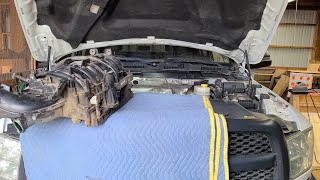
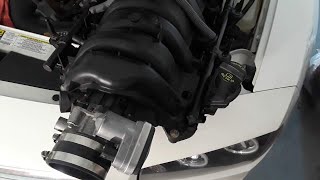
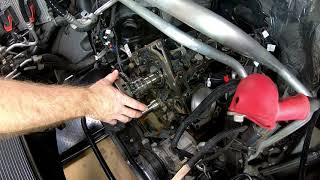
Typical fix: Replace the cylinder 1 MDS solenoid. 🎬 See this walkthrough on how to remove MDS solenoids This requires removing the intake manifold to access the four solenoids. 🎬 Watch: Tips for removing the 6.4L Hemi intake manifold Many owners and shops choose to replace all four at the same time due to the labor involved.
Est. part cost: $70-$130 - Low Engine Oil Level or Incorrect Viscosity 🟡 Medium Probability The MDS system is critically dependent on oil pressure and volume to actuate the lifters. The 6.4L HEMI specifies a full synthetic 0W-40 oil meeting Chrysler specification MS-12633. Using the wrong weight oil (like 5W-20 or 5W-30) or being low on oil can cause pressure drops that prevent the solenoids from functioning correctly.
How to confirm: Check the engine oil level and condition. Verify the oil type used matches the manufacturer's specification (0W-40 full synthetic). Some owners on forums have resolved MDS codes simply by changing the oil to the correct type.
Typical fix: Perform an oil and filter change using a high-quality, full synthetic 0W-40 oil that meets the MS-12633 spec, such as Pennzoil Ultra Platinum. Ensure the oil level is at the full mark.
Est. part cost: $80-$120 for oil and filter - Wiring Harness or Connector Issue 🟡 Medium Probability The wiring harness for the MDS solenoids is located under the intake manifold, an area attractive to rodents. Wires can be chewed, or the plastic connectors can become brittle from heat cycles and break. One owner on a forum discovered a squirrel's nest and chewed wires to the solenoid connector was the cause of their P3401 code.
How to confirm: After removing the intake manifold, visually inspect the wiring harness leading to all four MDS solenoids for any signs of damage, melting, or rodent activity. Check each connector for a secure fit and clean contacts.
Typical fix: Repair the damaged section of the wiring harness or replace the faulty connector pigtail.
Est. part cost: $15-$60 for repair materials or a new pigtail - Outdated Powertrain Control Module (PCM) Software ⚪ Low Probability → Shop Engine Control Module (ECM) Multiple TSBs for this vehicle generation, including #18-036-20, list P3402 as a code that may be resolved by a PCM software update. This indicates the original factory logic may have been overly sensitive to minor fluctuations in the MDS system, triggering a false code.
How to confirm: A Ram dealership or a qualified shop with access to FCA's wiTECH software can check the current PCM calibration ID against the latest available version referenced in the TSBs.
Typical fix: Reflash the PCM with the updated manufacturer software. This is a non-invasive fix that should be considered before replacing hardware.
Est. part cost: $0 (if covered by warranty) or $100-$200 shop labor cost
Rare But Worth Checking
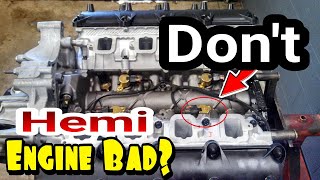
- Failed MDS Lifter / Camshaft Lobe: → Shop Engine Camshaft This is the most severe potential cause. The MDS lifters are a known weak point on HEMI engines. The roller bearings can fail, causing the lifter to seize or collapse. This results in a ticking noise (the 'Hemi tick') and can quickly destroy the corresponding camshaft lobe. 🎬 Watch: How to tell if your Hemi tick is serious A P3402 code can be an early symptom of this failure. Repair requires replacing all lifters (MDS and standard) and the camshaft, a very expensive job.
- Restricted Oil Passages: Engine sludge from poor maintenance or using incorrect oil can block the small oil passages that feed the MDS solenoids and lifters, starving them of the pressure needed to operate. This often points to a larger issue with engine maintenance and may require an engine flush or more significant teardown to clean.
Diagnosis Steps
- Check and document any other DTCs stored in the PCM. Multiple MDS codes (P3426, P3442, P3450) appearing at once may point to a software or oil issue.
- Verify the engine oil level is correct and the oil is clean and of the proper viscosity (full synthetic 0W-40 meeting MS-12633 spec). If in doubt, perform an oil change.
- Check with a dealer for any available PCM software updates related to TSBs #18-036-20, #18-082-16, #18-002-15 REV B, or #18-080-15 REV A before proceeding with mechanical teardown.
- If software and oil are ruled out, prepare to remove the upper intake manifold to access the MDS components.
- Once the intake is removed, visually inspect the wiring harness for the MDS solenoids for any signs of damage, especially from rodents.
- Using a bi-directional scan tool, command the cylinder 1 MDS solenoid on and off to check for an audible click. Cylinder 1 is on the driver's side, front-most cylinder.
- If the solenoid does not respond, test the circuit for proper voltage and ground at the solenoid connector.
- If the circuit is good, the solenoid is likely bad. If the solenoid and wiring test good, the problem may be mechanical, such as a stuck MDS lifter or a blocked oil passage, which requires more significant engine disassembly to inspect.
Parts You'll Likely Need
- Engine Multiple Displacement System (MDS) Solenoid
(OEM #53022298AB)— This solenoid is the most common failure point for P3402. It is an electro-hydraulic component that controls oil flow to the deactivating lifters and is prone to electrical failure or clogging.
Trusted brands: Mopar, Dorman, Standard Motor Products
OEM price range: $90-$130
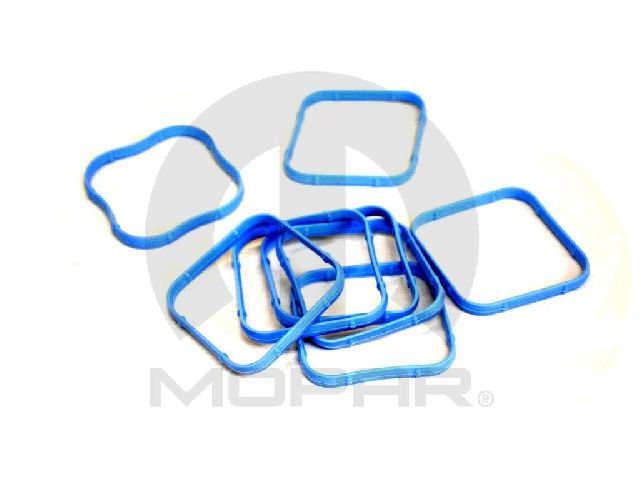
Aftermarket price range: $60-$110 - Intake Manifold Gasket Set — Required when removing the intake manifold to access the MDS solenoids. These are typically not reusable and must be replaced to prevent vacuum leaks.
Trusted brands: Mopar, Fel-Pro, Mahle
Related Codes That Often Appear With This One
- P3426 — This is the deactivation control performance code for cylinder 4. Seeing them together is common and is mentioned in multiple TSBs, often pointing to a shared cause like a software issue or wiring problem.
- P3442 — This is the deactivation control performance code for cylinder 6. Like P3426, it often appears with P3402 and is cited in the same TSBs.
- P3450 — This is the deactivation control performance code for cylinder 7. TSB 18-036-20 and forum posts show that when multiple MDS codes appear at once on a low-mileage truck, it can point towards a software glitch or a systemic issue like oil pressure.
- P0456 — This code for a small EVAP system leak was listed alongside P3402 in TSBs #18-082-16 and #18-080-15 REV A. While functionally unrelated, their appearance together in a TSB suggests a PCM software update may address both DTCs simultaneously.
Technical Service Bulletins (TSBs) & Recalls
- 18-036-20: Addresses MIL illumination with P3402, P3426, and P3442. Also provides an optional software path for MDS drone/shudder complaints.
- 18-082-16: Lists P3402 among several other DTCs that may be stored, solvable by a PCM flash.
- 18-002-15 REV B: Notes P3402 may be found with other cylinder deactivation codes.
- 18-080-15 REV A: Mentions P3402 as a possible DTC upon investigation of MIL illumination.
Platform-Specific Known Issues
- TSB #18-036-20 was released to address MIL illumination for P3402, P3426, and P3442, suggesting a PCM reflash may be the solution, and also includes an optional update to reduce MDS drone/shudder.
- The 6.4L HEMI is known for the 'Hemi Tick,' which is often caused by a failing lifter roller bearing. An MDS code like P3402 can be an early indicator of this much more serious and costly failure.
- Rodents nesting under the intake manifold have been known to chew through the MDS solenoid wiring, causing an open circuit and triggering codes like P3401/P3402.
Mechanic-Grade Diagnostic Values
- MDS Solenoid Resistance — expected: 11.8–14.2 Ω. Failure: A reading outside of this range indicates a faulty solenoid.
- MDS Solenoid Control Circuit Voltage — expected: Voltage should pulse when the solenoid is activated via a scan tool.. Failure: No voltage present when commanded on points to a wiring or PCM issue; constant voltage could indicate a short.
Scan Tool Commands That Help
- wiTECH or equivalent bi-directional scanner: MDS Solenoid #1 Actuation Test — This is a primary diagnostic step to determine if the solenoid is mechanically responding to an electrical command. The PCM can be commanded to activate the solenoid, and the technician should listen for an audible click from the solenoid under the intake manifold. Lack of a click points to a failed solenoid or a circuit issue.
Wiring & Ground Locations
- MDS Solenoid Connector — Under the intake manifold, in the engine valley. There are four solenoids, with Cylinder 1 being the front-most on the driver's side.. This is the primary connection point for testing voltage, ground, and resistance of the solenoid and its circuit. The connector and harness are prone to heat damage and rodent activity.
- PCM Connector C3 / C140 — At the Powertrain Control Module (PCM), which is typically located in the engine bay.. This is the source of the control signal. Diagnostic procedures involve testing the (K451) MDS Solenoid No. 1 Control Circuit and the (Z903) Ground circuit at this connector to isolate a fault between the PCM and the solenoid.
Real Owner Repair Stories
- RamForum.com user (2012 Ram 1500 5.7L Hemi, 112k miles) — P0302 (Cylinder 2 Misfire) under heavy load, Hemi tick from cylinder 8.
❌ Tried (didn't work) Replacing the MDS Solenoid, Replacing spark plugs
✅ What actually fixed it Diagnosis revealed the intake valve on cylinder 2 was only opening about 15%, indicating a failed lifter. The user planned a full repair including replacing the camshaft and all lifters due to the high likelihood of cam lobe damage from the failed lifter. - RamForum.com user (2018 Ram 6.4L Hemi) — Check Engine Light with codes P3402, P3426, P3442, and P3450.
❌ Tried (didn't work) Initial diagnosis pointed to bad gas, which was incorrect.
✅ What actually fixed it The issue was identified as failed MDS solenoids, which were replaced under warranty. The user noted it is a known problem with the MDS system.
OEM Part Supersession History
53022298AA→53022298AB— The newer part (53022298AB) features an improved internal O-ring for easier installation and enhanced quality.
Model Year Variations Within This Range
- 2018: For the 2018 model year, the 6.4L HEMI V8 became the standard engine for Ram Heavy Duty (2500/3500) trucks, whereas it was an option in prior years, replacing the 5.7L HEMI as the base engine. The engine itself, used in trucks since 2015, is tuned for lower-end torque compared to the car-based 6.4L SRT versions, featuring a different intake, lower compression (10.0:1), and camshaft profile.
Helpful Videos
We Have This Part in Stock


The information in this article is provided for general reference and educational purposes only. Vehicle specifications, procedures, and part compatibility can vary by production date, trim level, and region. Always consult your vehicle's factory service manual and verify part numbers before purchasing or performing repairs. Safety-critical components such as airbags, seat belts, and braking systems should be installed by a qualified professional.
- Ram 3500:
- 🧭 Diagnostic Flowchart
- 🎬 Helpful Videos
- 🛍️ Shop This Part
- What's Unique About the 2015-2018 Ram 3500
- Symptoms You May Notice
- Most Likely Causes
- Rare But Worth Checking
- Diagnosis Steps
- Parts You'll Likely Need
- Related Codes That Often Appear With This One
- Technical Service Bulletins (TSBs) & Recalls
- Platform-Specific Known Issues
- Mechanic-Grade Diagnostic Values
- Scan Tool Commands That Help
- Wiring & Ground Locations
- Real Owner Repair Stories
- OEM Part Supersession History
- Model Year Variations Within This Range
- 🎟️ Get 5% Off