

P3426 on 2015-2018 Ram 2500: Cylinder 4 Deactivation Fault Causes and Fixes
This code indicates a problem with the Multi-Displacement System (MDS) for cylinder 4. The most common fixes are replacing the cylinder 4 MDS solenoid or having a dealer update the powertrain control module (PCM) software, as specified in several Technical Service Bulletins (TSBs). Before replacing parts, checking for the software update is the first and most critical step.
- First, check with a dealer to see if your truck needs a PCM software update, as this is a very common and simple fix covered by multiple TSBs.
- Ensure your engine oil is at the correct level and is the proper viscosity (e.g., 0W-40 for the 6.4L HEMI). The MDS system is sensitive to oil condition.
- If a software update doesn't fix it, the most likely failed part is the cylinder 4 MDS solenoid, which is located under the intake manifold.
- Listen for a persistent engine ticking noise. This could signal a more serious lifter failure, which requires immediate professional diagnosis to prevent catastrophic engine damage.
What's Unique About the 2015-2018 Ram 2500
On the 2015-2018 Ram 2500 with a HEMI V8, this code is frequently addressed by a simple PCM software update, as outlined by multiple manufacturer TSBs like 18-036-20. Before replacing any hardware, it's crucial to check if your truck's software is outdated, as this is the most common and least expensive fix. The HEMI engine's MDS is also notoriously sensitive to oil level, quality, and viscosity. In some cases, this code can be an early warning of a failing MDS lifter—a more serious and well-documented issue with these engines often preceded by a distinct 'Hemi Tick'.
Diagnostic Flowchart
Tap your situation to follow the diagnostic path that matches what you're seeing on this vehicle.
Symptoms You May Notice
- Check Engine Light is on
- Decreased fuel economy as MDS is disabled
- Vehicle may feel slightly rough or hesitate when the MDS is supposed to activate
- Audible engine 'tick' or tapping noise, especially at idle, if the cause is a failing lifter.
- In some cases, a misfire can be felt if the lifter fails to reactivate properly.
- Replacing the PCM when only a software update is needed.
- Replacing spark plugs or ignition coils, which are unlikely to cause this specific deactivation performance code.
- Replacing MDS solenoids when the actual fault is a collapsed lifter. A mechanic on YouTube cautions, 'you do not always need a particular part based off the particular fault code name... the stuff got to be diagnosed.'
Most Likely Causes
- Outdated Powertrain Control Module (PCM) Software 🔴 High Probability → Shop Engine Control Module (ECM) Manufacturer issued multiple Technical Service Bulletins (TSBs), specifically 18-036-20 for 2018 models, to resolve this exact code with a software update. The update addresses overly sensitive fault logic.
How to confirm: A Ram dealership or a well-equipped independent shop with a wiTECH scan tool can check for and apply available PCM updates. This should be the first step in diagnosis.
Typical fix: Reprogramming the PCM with the latest software version. The process takes about 0.3-0.5 hours of labor.
Est. part cost: $0 - Faulty Cylinder 4 MDS Solenoid 🔴 High Probability → Shop Engine Cylinder Deactivation Solenoid The solenoids operate in hot engine oil and can fail electrically or become clogged with debris over time, preventing proper oil flow. They are a known failure point across the HEMI engine family.
How to confirm: Use a bidirectional scan tool to command the solenoid on and off; listen for a click. A definitive test requires removing the intake manifold to access the solenoids, then testing resistance with a multimeter. A visual inspection for clogged screens on the solenoid is also recommended.
Typical fix: Replace the cylinder 4 MDS solenoid. Since the intake manifold must be removed, many owners and shops replace all four MDS solenoids at the same time 🎬 Watch: This walkthrough shows how to replace the MDS solenoids. as a preventative measure.
Est. part cost: $50-$100 - Low or Incorrect Engine Oil 🟡 Medium Probability The MDS system is hydraulic and relies on specific oil pressure and viscosity. Using the wrong oil weight (e.g., 5W-30 instead of the specified 5W-20 or 0W-40) or running the engine low on oil can prevent the deactivation lifters from working correctly.
How to confirm: Check the oil level on the dipstick and verify the correct oil type was used during the last oil change. Forum users have reported that an oil change with high-quality, spec-correct oil can sometimes resolve MDS-related ticking.
Typical fix: Perform an oil and filter change with the manufacturer-specified oil (typically 5W-20 for the 5.7L and 0W-40 for the 6.4L, but always check your owner's manual).
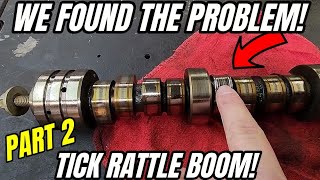
Est. part cost: $50-$120 - Failed MDS Lifter ⚪ Low Probability HEMI engines of this era are known for potential lifter failures, particularly the complex MDS lifters. The roller bearing can fail, causing the lifter to stop rotating and grind against the camshaft, leading to catastrophic engine damage. This is often referred to as the 'Hemi tick'.
How to confirm: This is a mechanical failure often identified by a persistent ticking or tapping noise that increases with engine RPM. A definitive diagnosis requires removing the cylinder head to inspect the lifters and camshaft lobes for scoring or damage.
Typical fix: Requires replacing all lifters (both MDS and standard) and the camshaft, as a damaged lifter will almost always damage the cam lobe. This is a significant and expensive repair.
Est. part cost: $800-$2000+ - Wiring Harness or Connector Issue ⚪ Low Probability
How to confirm: Visually inspect the wiring harness leading to the MDS solenoids (located in the valley under the intake manifold) for damage from rodents or chafing. Test for continuity and proper voltage at the solenoid connector. A wiring diagram is essential for this step. Sometimes the 🎬 See why you should check the wiring before replacing parts. harness clip on the back of the intake manifold is forgotten during reassembly, which can cause issues.
Typical fix: Repair the damaged section of the wiring harness or replace the connector.
Est. part cost: $10-$50
Diagnosis Steps
- Verify the engine oil level is correct and the oil is clean. Confirm the viscosity matches the manufacturer's specification (e.g., 0W-40 for 6.4L). If in doubt, perform an oil change.
- Connect a scan tool. Record all DTCs and freeze frame data. Check for MDS-related codes for other cylinders (P3402, P3442, P3450).
- Crucial First Step: Contact a Ram dealer or a shop with a wiTECH subscription to check if your vehicle's VIN has an open campaign or is eligible for the software update outlined in TSBs #18-036-20, #18-082-16, or #18-002-15. This is the most common fix.
- If no software update is needed, the next step is to test the MDS solenoid. This requires removing the intake manifold to gain access. Be aware of hidden clips and connectors, especially the wiring harness clip at the rear of the manifold.
- Once the manifold is off, inspect the wiring harness in the engine valley for any signs of rodent damage, chafing, or corrosion.
- Use a bidirectional scan tool to command the cylinder 4 solenoid. Listen for an audible click. If there is no click, test the solenoid's resistance with a multimeter (spec is typically 6-30 ohms, but consult a service manual). An out-of-spec reading indicates a failed solenoid.
- While the solenoids are accessible, inspect their filter screens for metal debris. Significant metal is a sign of a larger internal engine problem.
- If the solenoid and wiring test good, the issue may be mechanical. Listen carefully for any engine ticking that could indicate a lifter problem.
- If a lifter failure is suspected, a more in-depth mechanical inspection of the valve train (lifters and camshaft) is required, which is best left to a professional.
Parts You'll Likely Need
- Engine Cylinder Deactivation Solenoid (MDS Solenoid)
(OEM #53022298AB (supersedes 53022298AA))— This solenoid is the most common hardware failure for this code. It controls the oil flow that deactivates the cylinder. It's recommended to replace all four if the intake is removed.
Trusted brands: Mopar, Dorman (e.g., 916-871), Standard Motor Products (SMP)
OEM price range: $70-$100
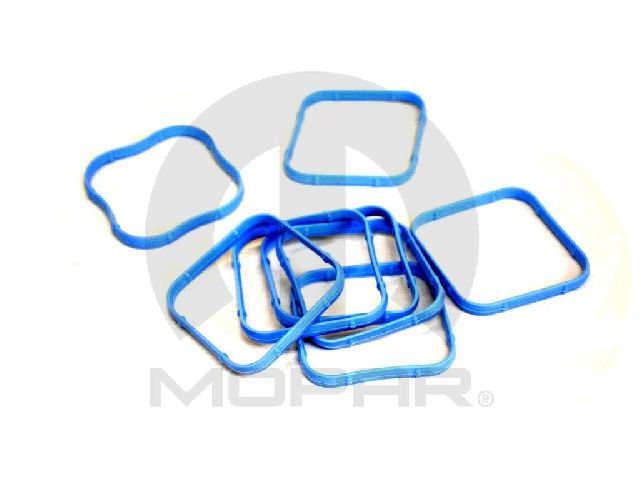
Aftermarket price range: $40-$80 - Intake Manifold Gasket Set
(OEM #Consult Dealer)— The intake manifold must be removed to access the MDS solenoids. The gaskets are one-time use and must be replaced to prevent vacuum leaks.
Trusted brands: Mopar, Fel-Pro, Mahle
OEM price range: $40-$60
Aftermarket price range: $20-$40
Related Codes That Often Appear With This One
- P3402 — This is the code for Cylinder 1 Deactivation Control Performance. It often appears with P3426 because TSB #18-036-20 addresses a software issue affecting multiple MDS cylinders (1, 4, 6, 7) simultaneously.
- P3442 — This is the code for Cylinder 6 Deactivation Control Performance. It is also commonly listed in the same TSBs as P3426 for the same software-related reasons.
- P3450 — This is the code for Cylinder 7 Deactivation Control Performance, another cylinder included in the MDS software updates. Seeing all four codes together strongly points towards a software or systemic issue rather than four simultaneous hardware failures.
- P0128 — This code for Thermostat Rationality is also mentioned in TSB #18-036-20. A PCM flash for the MDS issue will often resolve this code as well, as it's part of the same software package update.
Technical Service Bulletins (TSBs) & Recalls
- 18-036-20: For 2018 6.4L models (Sales Code ESA or ESB), this TSB involves a PCM flash to fix P3426 and other MDS codes. It also addresses P0128 (Thermostat Rationality).
- 18-082-16: Also lists P3426 as a code that may be resolved with a PCM software update for 2016 models.
- 18-002-15 REV B: Notes that P3426 may be present and fixed with updated software on 2015 models.
- 18-002-15 REV A: An earlier revision of a TSB also pointing to a software fix for P3426.
- 18-080-15 REV A: Another bulletin that includes P3426 in a list of codes addressed by software updates for 2016 models.
Platform-Specific Known Issues
- Multiple TSBs (#18-036-20, #18-082-16, #18-002-15) were issued by the manufacturer to fix this code by reprogramming the PCM. This should always be the first check and is often the only repair needed.
- These HEMI engines are known for lifter failures, especially on the MDS cylinders (1, 4, 6, 7). While P3426 is often electrical or software-related, it can be an early symptom of a mechanical lifter issue, often identified by the 'Hemi Tick'.
Mechanic-Grade Diagnostic Values
- MDS Solenoid Coil Resistance — expected: 6-30 ohms (consult vehicle-specific service manual). Failure: Resistance is outside the specified range (open or shorted).
- MDS Solenoid Power Supply Voltage (Key On) — expected: ~12.0 V (Battery Voltage). Failure: Significantly lower or no voltage indicates a wiring or PCM supply issue.
- MDS Solenoid Ground Circuit Resistance — expected: Below 0.1 Ω. Failure: Higher resistance indicates a poor ground connection, which can cause performance issues.
- 6.4L HEMI Engine Oil Pressure (Hot Idle) — expected: 29-35 psi. Failure: Pressure significantly below this range could indicate oil pump wear, incorrect oil viscosity, or other internal engine issues affecting MDS operation.
- 6.4L HEMI Engine Oil Pressure (Cruising) — expected: 50-55 psi. Failure: Pressure that fails to rise with RPM could indicate a faulty oil pump or blockages.
Scan Tool Commands That Help
- wiTECH (or equivalent professional scan tool): MDS Solenoid Actuator Test — This bidirectional command allows a technician to manually activate and deactivate a specific MDS solenoid while the engine is off or running. It is used to listen for an audible click from the solenoid and to observe its effect on the engine, helping to confirm if the solenoid is mechanically and electrically responding to commands from the PCM.
- wiTECH: ECU Flash / Reprogram — This service function is used to apply software updates to the Powertrain Control Module (PCM). For the P3426 code, this is a critical first step, as multiple TSBs indicate the fault can be resolved with a software update alone.
Wiring & Ground Locations
- MDS Solenoid Connector — In the engine valley, underneath the intake manifold. Each of the four solenoids has its own connector.. This is the primary connection point for testing the solenoid's resistance and voltage supply. The harness in this area is susceptible to rodent damage or oil contamination after leaking.
- Intake Manifold Rear Harness Clip — A clip on the back of the intake manifold (firewall side) that secures a wiring harness running between the cylinder heads.. This clip is often forgotten during intake manifold removal or reinstallation. If not properly secured, the harness can chafe or get damaged, potentially causing issues with the MDS solenoid circuits.
- C101 Inline Connector — A service manual for a similar model year indicates a C101 harness connector is located behind the left side (driver's side) cylinder head.. This connector can be used as a test point to check the MDS solenoid control circuit from the PCM side, helping to isolate a wiring fault between the PCM and the solenoid itself.
Real Owner Repair Stories
- RamForum.com user (5.7L HEMI (similar MDS system)) — Code P1414 (Cylinder 4 Reactivation Failure). The truck drove fine in 8th gear but would set the code after MDS activation.
❌ Tried (didn't work) Replaced PCM, Replaced MDS solenoid for that cylinder, Replaced wiring harness
✅ What actually fixed it The user's issue was not resolved in the thread, but they noted the previous owner had the camshaft replaced 30,000 miles prior. The user was speculating that metal debris from the previous failure may have blocked an oil passage to the lifter, preventing proper reactivation. This highlights how a history of lifter/cam failure can lead to recurring MDS issues even after parts are replaced.
OEM Part Supersession History
53022298AA→53022298AB— Mopar part listings indicate the new part features an improved internal O-ring for easier assembly and reduced insertion force.
Heads up: The parts are interchangeable, with 53022298AB being the current, improved replacement.
Model Year Variations Within This Range
- 2017-2018 (approx.): Around 2017-2018, the 6.4L HEMI engine block was updated to a thicker casting known as the 'Big Gas Engine' or BGE. These blocks have higher nickel content and increased rigidity. While not directly related to the P3426 code, it's a notable production change within the vehicle range.
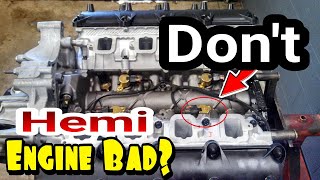
Helpful Videos


We Have This Part in Stock


The information in this article is provided for general reference and educational purposes only. Vehicle specifications, procedures, and part compatibility can vary by production date, trim level, and region. Always consult your vehicle's factory service manual and verify part numbers before purchasing or performing repairs. Safety-critical components such as airbags, seat belts, and braking systems should be installed by a qualified professional.
- Ram 2500:
- 🧭 Diagnostic Flowchart
- 🎬 Helpful Videos
- 🛍️ Shop This Part
- What's Unique About the 2015-2018 Ram 2500
- Symptoms You May Notice
- Most Likely Causes
- Diagnosis Steps
- Parts You'll Likely Need
- Related Codes That Often Appear With This One
- Technical Service Bulletins (TSBs) & Recalls
- Platform-Specific Known Issues
- Mechanic-Grade Diagnostic Values
- Scan Tool Commands That Help
- Wiring & Ground Locations
- Real Owner Repair Stories
- OEM Part Supersession History
- Model Year Variations Within This Range
- 🎟️ Get 5% Off