

OBD-II Code P3792: Exhaust Temperature Too High After DPF
The Ultimate 2026 Guide: What It Means, Why It Triggers, and How to Fix It
- P3792 indicates exhaust temperatures downstream of the DPF have exceeded safe limits, requiring immediate shutdown to prevent a $7,000+ DPF meltdown.
- Do not blindly replace the EGT sensor; verify live data first, as a physically clogged DPF or leaking 7th injector causes identical high-temperature readings.
- On PACCAR MX engines (Peterbilt/Kenworth), a metallic exhaust rattle accompanying P3792 guarantees a broken DOC baffle covered under Service Bulletin E254.
- Driving more than 100 miles with an active P3792 triggers a severe engine derate and permanently destroys the ceramic DPF substrate.
What Does P3792 Mean?
The trouble code P3792 means the Engine Control Unit (ECU) detects exhaust gas temperatures exceeding safe limits immediately after the Diesel Particulate Filter (DPF). This signals a critical aftertreatment system failure caused by a faulty sensor, severe soot blockage, or uncontrolled raw fuel combustion.
Technical definition: The official SAE/OBD-II definition for P3792 is "Exhaust Gas Temperature After DPF – Data Valid But Too High, Least Severe". This indicates the ECU is receiving a plausible but excessively high temperature reading from the downstream DPF sensor.
Can I Drive With P3792?
Yes, But With Caution. Yes, but driving more than 100 miles guarantees severe component damage. This code is your final warning before the DPF melts internally, turning a $200 sensor fix into a $7,000+ replacement. In severe cases, extreme heat cracks the Diesel Oxidation Catalyst (DOC), adding another $2,500 to the repair bill.
Common Causes
- Faulty Exhaust Gas Temperature (EGT) Sensor (Very Common) — Constant exposure to extreme heat degrades the sensor, causing internal shorts or inaccurate readings. It frequently reports a high temperature even when exhaust conditions are normal.
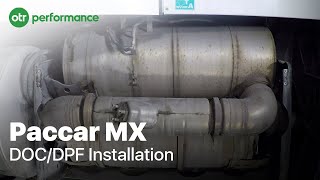
- Damaged Diesel Oxidation Catalyst (DOC) Baffle (Common) — On PACCAR engines, the internal baffle of the DOC frequently breaks apart. This debris blocks the DPF inlet, causing a dangerous, uncontrolled burn inside the aftertreatment system that spikes downstream temperatures.
- Clogged Diesel Particulate Filter (DPF) (Common) — When the DPF saturates with soot due to failed regeneration cycles or excessive idling, it creates massive backpressure. The engine works harder, causing extreme heat buildup during forced regeneration attempts.
- Leaking Fuel Injectors (Cylinder or HC Doser) (Less Common) — A leaking cylinder injector or a stuck-open 7th injector (HC doser) dumps raw, unburnt fuel directly into the exhaust. This fuel ignites inside the DPF, causing a thermal runaway event and catastrophic temperature spikes.
- Wiring or Connector Shorts (Less Common) — The EGT sensor wiring harness runs along the hot exhaust. Melted insulation, corroded connectors, or rubbed-through wires create electrical shorts, sending an erroneous high-temperature signal to the ECU.
- Faulty Turbocharger (Rare) — A failing turbocharger leaks engine oil into the exhaust stream. This oil burns inside the aftertreatment system, artificially raising temperatures and permanently face-plugging the DPF.
Symptoms
- Check Engine and DPF Warning Lights Illuminated — The ECU immediately triggers the CEL and the specific aftertreatment warning lamp on the dash.
- Engine Derate or 'Limp Mode' — To prevent catastrophic fire or melting, the ECU severely limits engine power, torque, and vehicle speed. 🎬 See this guide on managing Paccar engine limp mode derates.
- Audible Exhaust Rattling — A metallic clanking sound from the DPF/SCR assembly indicates a broken internal DOC baffle, a primary cause of this code on PACCAR engines.
- Decreased Fuel Economy — Constant, inefficient regeneration attempts consume massive amounts of diesel fuel.
- Frequent or Failed Regenerations (also visible on scanner) — The truck constantly attempts to perform regenerations that fail to complete, keeping the HEST (High Exhaust System Temperature) lamp illuminated.
Diagnostic Flowchart
Tap your situation to follow the diagnostic path that matches what you're seeing on this code.
Common Fixes & Costs
- Replace Exhaust Gas Temperature (EGT) Sensor — Parts: $80 - $250, Labor: $100 - $200, ~1.1 hr book time (Intermediate)
- Professionally Clean DPF and DOC — Parts: $0, Labor: $800 - $1,500, ~4.5 hr book time (Professional)
- Replace Diesel Oxidation Catalyst (DOC) — Parts: $1,500 - $3,000, Labor: $200 - $400, ~2.0 hr book time (Professional)
- Replace Diesel Particulate Filter (DPF) — Parts: $3,000 - $8,000, Labor: $300 - $700, ~3.0 hr book time (Professional)
DIY vs Professional
- Replace Exhaust Gas Temperature (EGT) Sensor — Beginner:
- Professionally Clean DPF and DOC — Beginner:
- Replace Diesel Oxidation Catalyst (DOC) — Beginner:
- Replace Diesel Particulate Filter (DPF) — Beginner:
Used vs. New Parts: Buying Guide
When a used part is worth it: A used DPF or DOC from a low-mileage wrecked vehicle is a gamble. It only makes sense for older trucks on extremely tight budgets where the owner accepts the risk of a drastically shorter lifespan.
Donor-vehicle mileage cap: roughly under 150000 miles for the part to have meaningful remaining life.
Donor quality checklist:
- Avoid parts from trucks scrapped for engine or emissions failures.
- Visually inspect the filter face for heavy soot, oil residue, or cracks.
- Ensure the part number is an exact match to your ECU requirements.
Decision logic:
- If The original filter is physically cracked or melted → You must buy a new or professionally remanufactured unit; a used part is too risky.
- If Vehicle is under warranty or less than 5 years old → Buy a new OEM part to ensure compatibility and preserve warranty coverage.
Warranty tradeoff: Used parts carry a 30-90 day warranty covering only the part. New aftermarket parts offer 1-2 years. New OEM parts installed by a dealer provide the most comprehensive factory coverage.
Worst-case if a used part fails: $2,000 if a used part fails prematurely, doubling your labor and replacement costs.
What Happens If You Wait — Timeline
- 0-2 weeks: Code P3792 appears. The system attempts frequent active regenerations to combat perceived soot loads. No drivability symptoms yet. (MPG impact: 1-5%% · Added cost: $0-100 in wasted fuel.)
- 2 weeks - 2 months: The DPF partially clogs with hardened ash. The ECU triggers a power derate ('limp mode') to protect the system. (MPG impact: 5-10%% · Added cost: $800 - $1,500 (Professional DPF cleaning required).)
- 2-4 months: Severe clogging creates extreme backpressure. Sustained temperatures exceeding 1200°F cause micro-cracks in the ceramic substrate. (MPG impact: 10-15%% · Added cost: $3,000 - $8,000 (DPF replacement required).)
- 4+ months: Catastrophic failure. The DPF melts down completely. Extreme heat cracks the upstream DOC and destroys multiple sensors. (MPG impact: 15-25%+% · Added cost: $5,000 - $12,000+ (Full aftertreatment system replacement).)
Cost of Not Fixing It
- 0-1 Month: Forced frequent regenerations, reduced fuel economy, and engine power derates limiting the truck to low speeds. (Added cost: $200 - $500 in wasted fuel and lost productivity.)
- 1-3 Months: The DPF becomes irreversibly clogged with hardened soot. It can no longer regenerate and requires removal for professional baking. (Added cost: $800 - $1,500 for professional DPF cleaning.)
- 3+ Months: Catastrophic failure. Extreme heat melts the DPF ceramic substrate and cracks the upstream DOC, requiring full replacement of both units. (Added cost: $5,000 - $10,000+ for DPF and DOC replacement.)
Diagnosis Steps
- Read All Fault Codes
Use a heavy-duty OBD-II scanner to confirm P3792. Crucially, check for P3794 (DPF Pressure) or P3796 (Soot Level). If present, the DPF is physically clogged—do not waste time testing the sensor.
Tools: Heavy-Duty OBD-II Scanner (Beginner) - Check Live Sensor Data (Key On, Engine Off)
With the engine cold and ignition on, view live data from all EGT sensors. They must read close to ambient air temperature. If the post-DPF sensor reads 500°F+ on a cold engine, the sensor or wiring is dead.
Tools: Advanced OBD-II Scanner (Intermediate) - Visual Inspection & Rattle Check
Inspect the DOC, DPF, and SCR for heat discoloration or cracks. Strike the DOC housing firmly with a rubber mallet; a metallic rattle confirms a broken internal baffle requiring immediate DOC replacement.
Tools: Rubber Mallet, Flashlight (Beginner) - Advanced EGT Sensor Electrical Test
Disconnect the suspect EGT sensor. Verify a 5V reference at the harness. Measure the sensor's internal resistance with a multimeter. At 70°F, an NTC sensor shows high resistance. Heat it carefully with a heat gun; resistance must drop smoothly. Infinite or zero resistance confirms a failed sensor.
Tools: Multimeter, Heat Gun (Advanced) - Forced Regeneration & Live Temp Analysis
If the sensor passes electrical tests, initiate a forced regeneration. Monitor DOC inlet, DOC outlet, and DPF outlet temps. If the DPF outlet spikes significantly higher than the DOC outlet (exceeding 1200°F), raw fuel or oil is burning inside the filter.
Tools: Professional Diagnostic Tool (Advanced) - Inspect DPF and DOC Internals
Stop DIY diagnosis and take the truck to a diesel specialist if forced regeneration fails due to high backpressure. The shop must remove the DPF/DOC to check for face plugging, melted ceramic substrates, or broken baffles.
Tools: Mechanic's Tool Set, Borescope (Professional) - Test Fuel System & HC Doser
If the DPF is melting but not clogged, fuel contamination is the culprit. Perform an injector cutout test and physically inspect the 7th injector (HC doser) for leaks.
Tools: Professional Diagnostic Equipment (Professional)
When This Code Triggers (Freeze-Frame Conditions)
- Engine Coolant Temp: 185-205°F (85-96°C) (Fully warmed up, often during an active regeneration cycle.)
- Engine Load: 40-80% (Sustained load, such as pulling a grade or maintaining highway speed.)
- Vehicle Speed: 40-65 mph (Steady highway driving, which triggers active or passive regeneration.)
Related Codes
- P3793 — The 'moderately severe' version of P3792. Temperatures exceeded a higher threshold or remained elevated longer, triggering an aggressive engine derate.
- P3794 — Indicates 'DPF Differential Pressure Too High'. If active alongside P3792, a physically clogged DPF is the guaranteed root cause.
- P3796 — Indicates 'DPF Soot Level, Most Severe'. The DPF is critically full, causing the high temperatures of P3792. Immediate professional cleaning or replacement is mandatory.
- P3807 — Indicates 'Stationary Regeneration Aborted'. Proves the system repeatedly failed to clean itself, leading directly to the clog and heat spike.
Climate & Environmental Factors
- High Altitude: Lower air density reduces combustion efficiency, increasing soot production by up to 30%. This loads the DPF faster and makes it difficult to maintain the 550°C temperatures required for effective regeneration.
- Cold Weather: Prolonged engine warm-up times prevent the DOC from reaching the 315°C minimum required to initiate regeneration. Vehicles doing short trips in winter rapidly accumulate soot.
How to Talk to a Mechanic About This Code
Say this: "I have a P3792 code indicating high exhaust temps after the DPF. Before replacing parts, please check live EGT sensor data with the key on/engine off to rule out a bad sensor. If the sensor is fine, please inspect the DOC for a broken baffle, as I know this is common on PACCAR engines."
This proves you are an informed owner. It directs the mechanic to perform logical diagnostic steps instead of blindly replacing the sensor, preventing unnecessary exploratory labor.
Avoid saying:
- My check engine light is on, can you fix it?
- Just replace the sensor, I'm sure that's it.
- Do whatever you think is best.
Questions to ask before authorizing the repair:
- What were the temperature readings from all EGT sensors during your live data test?
- If recommending a DPF/DOC replacement, can you show me borescope images of the melted substrate or broken baffle?
- If the DPF is clogged, what is the root cause? I want to fix the source, not just the symptom.
- What is the warranty on the parts and labor for this specific repair?
Where to Take It: Dealer vs Independent vs Chain
- Dealer:
Best for: Vehicles under emissions or extended warranty, Complex, manufacturer-specific issues like the PACCAR broken DOC baffle (TSB E254), Repairs requiring proprietary software for ECU reflashing
Downsides: Significantly higher labor rates ($175+/hour)., Tendency to replace entire aftertreatment assemblies rather than diagnosing specific component failures. (Typical cost: +40% vs. baseline) - Independent Shop:
Excellent fit for out-of-warranty trucks. A reputable independent diesel shop easily diagnoses P3792 causes at significant cost savings.
Best for: Out-of-warranty trucks where cost is a major factor., Common repairs like sensor replacement, DPF cleaning, or injector swaps., Specialized diesel emissions shops with strong reputations.
Downsides: Quality varies widely; vet shops carefully., May lack OEM-specific software for complex ECU programming. (Typical cost: +0% vs. baseline) - Chain Shop:
AVOID. This is a complex, specialized heavy-duty repair beyond the scope of automotive chain shops.
Best for: Not recommended for this type of repair.
Downsides: Technicians lack specialized training and heavy-duty equipment for complex diesel aftertreatment diagnostics., Unlikely to possess correct diagnostic tools for PACCAR or Cummins. (Typical cost: +0% vs. baseline)
When to Walk Away From the Repair
If the total estimated repair cost for the aftertreatment system exceeds 35% of the truck's current market value, seriously evaluate selling as-is.
- Car worth $24000, fix is $8500: Walk away. A repair cost exceeding 35% of the truck's value is a major red flag. The risk of other high-mileage failures is too high.
- Car worth $45000, fix is $2800: Fix it. This repair is well under the threshold and necessary to maintain resale value.
What Scan Tool You Need for This Code
Minimum: A heavy-duty scanner capable of reading J1939/J1708 protocols, viewing live EGT sensor data, and commanding forced DPF regenerations.
Generic car OBD-II readers cannot communicate with heavy-duty trucks. Diagnosing P3792 requires viewing all EGT sensors simultaneously and commanding forced regenerations, which basic readers cannot do.
Budget: N/A (~$0) — Scanners in this price range cannot perform heavy-duty diagnostics or forced regenerations.
Mid-range: FOXWELL HD500 (~$350) — Reads heavy-duty codes, displays live sensor data, and performs forced DPF regenerations on Cummins and PACCAR engines. Excellent for owner-operators.
Professional: ANCEL X7HD / V6 Pro+ (~$700-1100) — Offers full bidirectional control for injector cutout tests, aftertreatment system resets, and forced regenerations. Essential for pinpointing root causes.
Rent vs buy: For a one-time issue, pay a shop a $150-$300 diagnostic fee. For owner-operators, buying a mid-range scanner is a mandatory investment that pays for itself by avoiding a single unnecessary repair.
How to Clear the Code After You Fix It
- Use a professional OBD-II scan tool to clear all active and pending fault codes.
- If the DPF was replaced or cleaned, perform a 'DPF Ash Accumulator Reset' using a bidirectional diagnostic tool.
- Perform a complete drive cycle to allow all readiness monitors to set to 'Ready'.
Drive cycle (~45 minutes): Start with a cold engine. Idle for 10 minutes until coolant reaches 185°F. Drive at steady highway speeds (>50 mph) for 30 minutes to allow the aftertreatment system to heat up and run internal self-tests. Cool down completely and repeat.
Readiness monitors affected: Exhaust Gas Sensor Monitor, Diesel Particulate Filter (DPF) Monitor
Before emissions retest: drive at least 100 miles to fully set monitors.
Watch out for:
- Clearing the code without fixing the root cause guarantees it will return during the next regen cycle.
- Failing to perform the DPF reset function after replacement causes improper regens and repeat failures.
- Testing immediately after clearing codes results in an automatic failure due to 'Not Ready' monitors.
Will This Fail Emissions / State Inspection?
Yes — this code typically fails an OBD-II emissions inspection.
- California: An active CEL is an automatic failure. After repair, all OBD readiness monitors must be 'Ready', requiring 100-200 miles of varied driving before a retest.
- New York: Automatic failure for an illuminated CEL. Vehicles must complete a full drive cycle after clearing codes; testing with 'Not Ready' monitors results in rejection.
- Texas: In emissions counties, an active CEL is an automatic fail. Texas allows one 'Not Ready' monitor on 2001+ models, but P3792 must be fully resolved.
Most Commonly Affected Vehicles
- Peterbilt 579 (2013-2025) — Extremely common on PACCAR MX-13 engines. 2017+ EPA models are highly susceptible to the broken DOC baffle issue detailed in PACCAR service bulletin E254.
- Kenworth T680 (2013-2025) — Shares the PACCAR MX-11/MX-13 powertrains with Peterbilt. The E254 DOC baffle failure frequently triggers this code on models with right-hand under-cab exhaust.
- Peterbilt 389 / 567 (2013-2025) — Any Peterbilt utilizing the PACCAR MX engine platform logs this code during aftertreatment thermal events.
- Kenworth T880 / W990 (2013-2025) — Susceptible to the same sensor degradation and DOC baffle failures as the T680.
- Freightliner Cascadia (2010-2024) — Occurs on Cummins ISX/X15 engines. The direct Cummins equivalent fault is SPN 3246 FMI 0.
Manufacturer-Specific Notes
- PACCAR (Peterbilt, Kenworth): A broken internal DOC baffle is a massive known issue on EPA17 MX engines (NHTSA campaign E254). It presents with an exhaust rattle and triggers P3792. Always strike the DOC with a mallet to check for rattling before replacing sensors.
- Cummins: On Cummins ISX/X15 engines, the equivalent fault is SPN 3246 FMI 0. Diagnostics heavily focus on testing the HC Doser Injector (7th injector), as a leaking doser is the primary cause of uncontrolled DPF burning on this platform.
- All Makes: Replacing the EGT sensor without checking live data is the most common industry misdiagnosis. If P3792 returns immediately after a new sensor is installed, the sensor was correctly reporting a real thermal event caused by a clog or fuel leak.
Real Owner Stories
2018 Peterbilt 579 with MX-13 at ~450K miles
P3792 code appeared. The truck had no drivability symptoms, but the driver heard a faint metallic rattling from the exhaust.
What they tried:
- Initial thought was a bad EGT sensor.
- Shop struck the DOC housing with a mallet, confirming the rattle.
- Removed the aftertreatment system and found the internal DOC baffle broken and blocking the DPF.
Outcome: Replaced the DOC per PACCAR service bulletin E254. Cost was $2,500. Code cleared permanently.
Lesson: An audible exhaust rattle on a PACCAR engine guarantees a broken DOC baffle. Do not replace the sensor; inspect the DOC internals immediately.
2020 Kenworth T680 with MX-13 at ~300K miles
P3792 active alongside P3794 (DPF Pressure) and P3796 (Soot Level). Engine was in severe derate.
What they tried:
- Replaced the post-DPF EGT sensor; codes immediately returned.
- Attempted a forced regeneration, which failed due to excessive backpressure.
- Removed the DPF and found it completely plugged with hardened ash.
Outcome: The DPF was too clogged for cleaning and required replacement. Total cost exceeded $7,000. The failure stemmed from excessive idling.
Lesson: When P3792 pairs with pressure codes (P3794/P3796), the DPF is physically clogged. Replacing the sensor is a waste of money.
How to Prevent This Code From Triggering
- Use high-quality, low-ash (API CK-4/FA-4) engine oil (Every oil change) — Standard oils contain metallic additives that turn into non-combustible ash, permanently clogging the DPF. Low-ash oil extends DPF service life.
- Minimize engine idling time (Daily habit) — Idling produces insufficient exhaust heat for passive regeneration, causing rapid soot accumulation. Shut off the engine when parked for more than 15 minutes.
- Ensure sufficient highway driving (At least once per week) — Sustained driving over 40 mph for 45 minutes achieves the exhaust temperatures required for passive regeneration, naturally cleaning the DPF.
- Perform periodic professional DPF cleaning (Every 200,000-250,000 miles) — Proactive 'bake and blow' cleaning removes non-combustible ash before it hardens into a permanent clog, avoiding a $5,000 replacement.
Frequently Asked Questions
I replaced the EGT sensor but the P3792 code came back. What's next?
This is a classic misdiagnosis. The code returning means the sensor correctly reported a real temperature problem. Stop replacing sensors and physically inspect the DPF for clogs, the DOC for a broken baffle, or the fuel system for leaks.
What should the DPF outlet temperature be during a normal regen?
During a healthy parked regeneration, the DOC outlet temperature (EGT #2) reaches 1050-1200°F. The DPF outlet temperature (EGT #3) stays in a similar range. Readings significantly above 1200°F indicate an uncontrolled raw fuel burn inside the DPF.
Can I just delete the DPF system to get rid of this code?
No. Deleting emissions equipment violates the Clean Air Act for on-road vehicles. It causes automatic emissions inspection failures and triggers massive fines for both the owner and the shop.
What is the difference between an NTC and PTC EGT sensor?
They measure temperature differently. An NTC sensor's resistance decreases as temperature increases, while a PTC sensor's resistance increases. You must know your vehicle's specific sensor type before testing with a multimeter.
Why is my truck trying to 'regenerate' so often?
Frequent regeneration means the DPF fills with soot too quickly or previous cycles failed to clean it. This points to underlying engine issues like leaking injectors or a physical DPF clog.
Can my driving habits cause code P3792?
Yes. Consistent short trips, prolonged idling, or low-speed city driving prevent the DPF from reaching passive regeneration temperatures. This rapidly builds soot, causing severe clogs and triggering high-temperature codes.
Do I need to clear the code with a scanner after the repair?
Yes. After repairs, use an OBD-II scanner to clear fault codes and reset the engine light. Major aftertreatment repairs also require a system reset or relearn procedure using a professional diagnostic tool.
What is a broken DOC baffle?
The Diesel Oxidation Catalyst (DOC) uses an internal baffle to direct exhaust flow. On PACCAR engines, this baffle frequently cracks, breaks loose, and blocks the exhaust path. This causes dangerous heat buildup, triggers P3792, and creates an audible rattling sound.
Key Takeaways
- P3792 indicates exhaust temperatures downstream of the DPF have exceeded safe limits, requiring immediate shutdown to prevent a $7,000+ DPF meltdown.
- Do not blindly replace the EGT sensor; verify live data first, as a physically clogged DPF or leaking 7th injector causes identical high-temperature readings.
- On PACCAR MX engines (Peterbilt/Kenworth), a metallic exhaust rattle accompanying P3792 guarantees a broken DOC baffle covered under Service Bulletin E254.
- Driving more than 100 miles with an active P3792 triggers a severe engine derate and permanently destroys the ceramic DPF substrate.
Helpful Videos

Shop the Parts Behind P3792
Below are the parts most often responsible for code P3792, ranked by how frequently each one is the actual culprit (per the diagnosis above). Tap any to see what we have for your vehicle.



The information in this article is provided for general reference and educational purposes only. Vehicle specifications, procedures, and part compatibility can vary by production date, trim level, and region. Always consult your vehicle's factory service manual and verify part numbers before purchasing or performing repairs. Safety-critical components such as airbags, seat belts, and braking systems should be installed by a qualified professional.
- 🧭 Diagnostic Flowchart
- 🎬 Helpful Videos
- 🛍️ Shop This Part
- What Does P3792 Mean?
- Can I Drive With P3792?
- Common Causes
- Symptoms
- Common Fixes & Costs
- DIY vs Professional
- Used vs. New Parts: Buying Guide
- What Happens If You Wait — Timeline
- Cost of Not Fixing It
- Diagnosis Steps
- When This Code Triggers (Freeze-Frame Conditions)
- Related Codes
- Climate & Environmental Factors
- How to Talk to a Mechanic About This Code
- Where to Take It: Dealer vs Independent vs Chain
- When to Walk Away From the Repair
- What Scan Tool You Need for This Code
- How to Clear the Code After You Fix It
- Will This Fail Emissions / State Inspection?
- Most Commonly Affected Vehicles
- Manufacturer-Specific Notes
- Real Owner Stories
- 2018 Peterbilt 579 with MX-13 at ~450K miles
- 2020 Kenworth T680 with MX-13 at ~300K miles
- How to Prevent This Code From Triggering
- Frequently Asked Questions
- I replaced the EGT sensor but the P3792 code came back. What's next?
- What should the DPF outlet temperature be during a normal regen?
- Can I just delete the DPF system to get rid of this code?
- What is the difference between an NTC and PTC EGT sensor?
- Why is my truck trying to 'regenerate' so often?
- Can my driving habits cause code P3792?
- Do I need to clear the code with a scanner after the repair?
- What is a broken DOC baffle?
- Key Takeaways
- 🎟️ Get 5% Off