

U0001 on 2014-2016 Ram 3500: CAN C Bus Communication Failure Causes and Fixes
This code indicates a communication failure on the high-speed CAN C bus. On the 2014-2016 Ram 3500, this is often caused by a wiring harness issue (specifically the connector on the driver's frame rail), a faulty module (the ABS module is a common culprit), a failing NOx sensor, or simply a loose battery connection. The fix involves inspecting and repairing wiring, replacing the failed component, or sometimes a PCM software update per a TSB.
- U0001 on a 2014-2016 Ram 3500 means a failure on the critical CAN C communication network.
- Diagnosis is complex and not recommended for beginners. It requires specialized tools and a systematic approach.
- Check the easy things first: battery health, charging system output, and all major ground connections.
- On these trucks, the fault is often related to the emissions system (like a NOx sensor) or the ABS module, as indicated by TSBs and owner reports.
- Before replacing any expensive modules, thoroughly inspect the wiring harnesses for damage, as this is a very common cause.
What's Unique About the 2014-2016 Ram 3500

On the 2014-2016 Ram 3500, particularly those with the 6.7L Cummins engine, the U0001 code is frequently logged alongside a variety of diesel emissions system codes. Multiple Technical Service Bulletins (TSBs) show U0001 appearing with codes for NOx sensors, the SCR (Selective Catalytic Reduction) system, and the EGR system. This suggests that the root cause is often not a random bus failure, but rather a fault in an emissions component or its wiring that disrupts the entire network. The official fix in these TSBs is often to reprogram the PCM with updated software, which may change the fault sensitivity from a single-trip to a two-trip fault, preventing a MIL for intermittent issues.
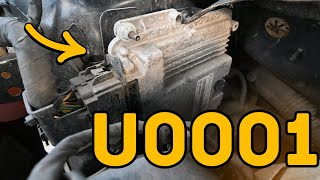
🎬 Watch: A quick guide to understanding the U0001 communication code.Diagnostic Flowchart

Tap your situation to follow the diagnostic path that matches what you're seeing on this vehicle.
Symptoms You May Notice

- Check Engine Light is on
- Multiple warning lights on the dashboard (ABS, Airbag, Traction Control).
- Engine may stall or refuse to start.
- Transmission may get stuck in one gear or shift erratically.
- Loss of instrument cluster gauges like the speedometer.
- Backup camera or infotainment system failure.
- Service messages like 'Service Shifter' may appear.
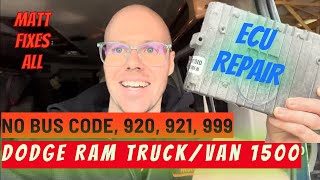
- 'NO BUS' message displayed on the instrument cluster. 🎬 See this video for a walkthrough of the No Bus message.
- Replacing the Powertrain Control Module (PCM) first without proper diagnosis. While the PCM can be the cause, wiring issues (especially the frame rail connector), the ABS module, and poor battery connections are more common failure points and should be ruled out first.
Most Likely Causes

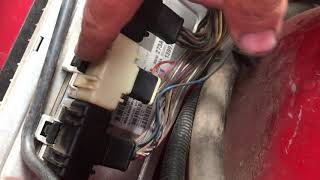
- Damaged or Corroded Wiring Harness 🔴 High Probability Ram trucks are prone to wiring issues from exposure and wear. A common failure point is the large bulkhead connector on the driver-side frame rail, which can get contaminated with water and corrode. Another reported issue is chafing of wires near the PCM connector.
How to confirm: Visually inspect all major wiring harnesses. Pay special attention to the connector on the driver's frame rail; disconnect it and check for green or white corrosion on the pins. Also inspect the harness where it routes near the engine and firewall.
Typical fix: Repair the damaged section of the wire by splicing in a new piece and protecting it with heat-shrink tubing and loom. For corroded connectors, clean the pins carefully and apply dielectric grease before reconnecting. In severe cases, a partial harness or connector replacement is needed.
Est. part cost: $10-$500 - Faulty Control Module 🟡 Medium Probability Any module on the CAN C bus can fail and disrupt the network. Forum discussions frequently point to the ABS module as a primary culprit on these trucks. Additionally, TSBs repeatedly link U0001 to failing emissions components like NOx sensors, which can short internally and take down the bus.
How to confirm: Use a high-end scan tool to see which modules are not communicating. A more advanced method is to disconnect modules one by one from the CAN bus 'star connector' (located under the dash near the steering column) to see if communication is restored to the rest of the network.
Typical fix: Replace the faulty module. The ABS module can be replaced separately from its hydraulic unit. Many modules, like the PCM or BCM, require programming to the vehicle's VIN after installation.
Est. part cost: $200-$1500 - Poor Battery Voltage or Bad Grounds 🟡 Medium Probability → Shop Vehicle Battery Unstable voltage is a major cause of communication codes. Multiple owner forums confirm that a loose or corroded main battery terminal was the sole cause of U0001 and 'no bus' faults. The truck's numerous body and frame ground straps can also corrode over time.
How to confirm: Test the battery voltage with the engine off (>12.4V) and while running (13.5V-14.5V). Physically grab the battery terminals and ensure they cannot be moved by hand. Locate, remove, and clean major ground connections from the battery to the body, frame, and engine block.
Typical fix: Tighten or replace faulty battery terminals. Replace a weak battery or failing alternator. Clean or replace corroded ground straps.
Est. part cost: $20-$600 - Faulty CAN Bus Terminating Resistor ⚪ Low Probability The CAN bus requires two 120-ohm terminating resistors for a total network resistance of 60 ohms. On these Ram trucks, the resistors are integrated into the CAN bus star connectors/junction blocks. While the resistor itself rarely fails, a problem with the connector block can cause an open circuit.
How to confirm: With the battery disconnected, measure the resistance between Pin 6 (CAN High) and Pin 14 (CAN Low) at the OBD-II port. A healthy network should read approximately 60 ohms. A reading of 120 ohms indicates an open circuit, often pointing to an issue with one of the star connectors or the wiring between them.
Typical fix: If a star connector is faulty, it must be replaced. A Mopar CAN bus connector part number is 68230537AA.
Est. part cost: $50-$200
Rare But Worth Checking
- Aftermarket Electronics: Poorly installed aftermarket devices like remote starters, alarms, or tuners that tap into the CAN bus wiring can interfere with network communication and trigger a U0001 code. Even devices plugged into the OBD-II port, like some power steps, have been known to cause issues.
- Software Glitches: Sometimes, communication issues can be caused by software bugs within the modules. The provided TSBs often involve a software update (reflash) to the PCM to resolve a cluster of codes that includes U0001, often by changing the fault-reporting logic.
Diagnosis Steps
- Scan for All Codes: Use a professional scan tool to read codes from ALL available modules, not just the engine computer. Note which modules are not responding.
- Check Battery and Grounds: Physically confirm battery terminals are tight and free of corrosion. Ensure battery voltage is above 12.4V (engine off) and the charging system is working correctly (13.5V-14.5V running). Inspect the main ground straps for security and cleanliness.
- Inspect Specific Wiring Locations: Perform a thorough visual inspection of the main wiring harnesses. Prioritize the large bulkhead connector on the driver-side frame rail for moisture or corrosion. Also check the harness near the PCM for any signs of chafing, melting, or damage.
- Check Terminating Resistance: Disconnect the battery. Use a multimeter to measure the resistance between Pin 6 (CAN-C High) and Pin 14 (CAN-C Low) on the OBD-II diagnostic port. The reading should be approximately 60 Ohms. A reading of 120 Ohms points to an open in the circuit or a bad terminating resistor within one of the star connectors.
- Isolate the Fault: If resistance is incorrect or modules are offline, locate the CAN bus star connectors under the dash near the steering column. Disconnect modules or branches one by one and re-check resistance or communication status. When the faulty module or wiring branch is disconnected, the network should return to normal.
- Test Individual Module: Once a suspect module is identified (e.g., the ABS module), verify it has proper power and ground at its connector using a multimeter before condemning the module itself.
- Use an Oscilloscope (Advanced): For intermittent issues, use an oscilloscope to monitor the CAN High and CAN Low waveforms at the OBD-II port. Look for a clean, mirror-image signal. Noise, a flat line, or distorted signals can point to the source of the interference or short. 🎬 Watch: Professional tips for diagnosing CAN bus network faults.
Parts You'll Likely Need
- Wiring Harness Repair Supplies — If the cause is chafed or corroded wiring, repairing the specific wires is the most common fix.
Trusted brands: 3M, Standard Motor Products
OEM price range: $N/A
Aftermarket price range: $10-$50 - ABS Control Module — The ABS module is a common point of failure on the CAN C bus and can take the whole network down when it fails.
Trusted brands: Mopar, Bosch
OEM price range: $400-$800
Aftermarket price range: $250-$500 - NOx Sensor — As cited in multiple TSBs, a faulty NOx sensor can disrupt CAN communication on these diesel trucks. [Bulletin #18-042-20]
Trusted brands: Mopar, Bosch, Walker Products
OEM price range: $450-$700
Aftermarket price range: $200-$400 - Totally Integrated Power Module (TIPM) — The TIPM acts as a central gateway and fuse box. Internal failures can cause widespread communication issues, including U0001.
Trusted brands: Mopar
OEM price range: $600-$1200
Aftermarket price range: $400-$800
Related Codes That Often Appear With This One
- P218F — Reductant No Flow Detected. This code is cited alongside U0001 in multiple TSBs, indicating the fault may lie within the emissions control system.
- P229E — NOx Sensor Circuit. A failing NOx sensor or its wiring can disrupt the CAN bus, causing both codes to appear. This is a very common pairing according to Ram TSBs.
- P24A5 — EGR Cooler Bypass Control Stuck. This is another emissions-related component on the CAN bus that is mentioned in TSBs with U0001.
- U0101 — Lost Communication with TCM. This code specifically points to a communication loss with the transmission module, often appearing with the general U0001 code when shifting is affected.
- U0121 — Lost Communication With Anti-Lock Brake System (ABS) Control Module. This code is a strong indicator that the ABS module itself or its wiring is the source of the network failure.
Technical Service Bulletins (TSBs) & Recalls
- 1813022REVA
- 1811322
- 18-042-20
- 1813022
- 1807622
- 1800322
- 1802321
- 18-092-17
- 18-015-18
Platform-Specific Known Issues
- Driver-Side Frame Rail Connector Corrosion: A large wiring harness bulkhead connector located on the outside of the driver-side frame rail is a known weak point. It is susceptible to moisture intrusion, leading to corrosion on the CAN bus pins and causing intermittent U0001 codes and 'Service Shifter' warnings. Owners have fixed this by disconnecting, cleaning the pins, and applying dielectric grease.
- ABS Module Failure: → Shop ABS Control Module The ABS module is a frequently cited point of failure on these trucks that can bring down the entire CAN C network. Symptoms often include a flurry of warning lights (ABS, Brake, Traction Control) along with the U0001 code. In some cases, the internal motor of the ABS hydraulic unit can get stuck, which can be repaired without replacing the entire expensive unit.
- Loose Battery Terminals: → Shop Vehicle Battery Multiple owners have traced a 'no bus' condition and U0001 code to a loose or damaged main battery terminal. Before diving into complex wiring diagnostics, ensuring both positive and negative terminals are clean and securely fastened is a critical first step, as unstable voltage can cause modules to drop off the network.
Mechanic-Grade Diagnostic Values
- CAN Bus Network Resistance — expected: ~60 Ω. Failure: A reading of ~120 Ω indicates an open circuit or a problem with one of the two terminating resistors. A reading significantly less than 60 Ω indicates a short between the CAN High and CAN Low wires.
- CAN-C Bus Voltage (Recessive / Idle State) — expected: CAN-H: ~2.4-2.5 V; CAN-L: ~2.4-2.5 V. Failure: Significant deviation from these voltages, or voltage that doesn't change when the bus becomes active, indicates a fault.
- CAN-C Bus Voltage (Dominant / Active State) — expected: CAN-H: ~2.6-3.5 V; CAN-L: ~1.3-2.3 V. Failure: A flat line or lack of mirror-image switching between high and low signals on an oscilloscope points to a short or open.
- System Voltage — expected: 13.5V - 14.5V (engine running). Failure: Voltage below 13.2V or above 16.0V during operation can cause communication modules to drop out.
Hidden / Shadow Codes Worth Checking
- U0001-00: This is a more specific version of the U0001 code used by FCA. While a public definition is not available, its appearance in multiple TSBs alongside emissions system faults (P229E, P218F, P24A5) strongly suggests it is set when an emissions component fault disrupts the CAN C bus. (see via A professional scan tool like wiTECH or AlfaOBD that can read manufacturer-specific codes.)
- C2200-49: Internal Electronic Failure. This code is specific to the ABS module and is a strong indicator that the module itself has failed internally and needs to be repaired or replaced. It often accompanies U0121 (Lost Communication with ABS) and the general U0001. (see via A scan tool capable of reading ABS module fault codes.)
Scan Tool Commands That Help
- wiTECH (Dealer Tool): Loss of Comm Test — This function is invaluable for intermittent U0001 faults. It continuously 'pings' every module on the network and logs any 'no response' events, allowing a technician to identify which module is dropping out by wiggling harnesses or connectors.
- wiTECH (Dealer Tool): ECU Flash / Reprogramming — Used to update the software on modules like the PCM or TCM. Many TSBs for this vehicle list a PCM reflash as the final step to resolve a cluster of codes that includes U0001, often to change fault sensitivity.
- AlfaOBD (Aftermarket): Program VIN — When replacing a control module like the ABS module with a used or remanufactured unit, the vehicle's VIN must be programmed into it. AlfaOBD provides a non-dealer software option to perform this programming.
Wiring & Ground Locations
- ABS Control Module — Behind the driver's side front wheel well liner. The wheel must be removed for access.. This is one of the most common modules to fail and cause a U0001 code on these trucks. Its location exposes its wiring to the elements.
- CAN Bus Star Connectors — Under the dashboard, located near the steering wheel shaft. There are separate connectors for the CAN-C and CAN-IHS bus.. These connectors are the central hub for the network. They contain terminating resistors and provide a single point to disconnect different branches of the network for diagnosis.
- Frame Ground — On the frame in the driver's side wheel well, located forward of the Upper Control Arm (UCA).. A poor ground at this location can cause a voltage differential and disrupt communication for modules grounded here.
- Engine Ground Strap — Should run from the back of the cylinder head to the body/firewall.. This is a primary ground for the engine and its associated electronics, including the PCM. A loose or corroded strap can cause a host of electrical issues, including communication codes.
Real Owner Repair Stories
- Reddit user in /r/Cummins (2016 Ram 2500 6.7L) — U0001 code present that would not clear with normal driving or multiple cold starts.
❌ Tried (didn't work) Driving for 250 miles, 25+ cold starts
✅ What actually fixed it The code finally cleared and the emissions monitors set to 'Ready' after towing a heavy fifth-wheel trailer for approximately 50 miles. This suggests the fault was related to an emissions system that required the engine to be under significant load to run its self-test and clear the associated bus communication fault. - YouTube channel 'Matt Fixes All' (Dodge Ram (1500, but diagnostic process is relevant)) — 'NO BUS' error on the instrument cluster, OBD-II scanner would not connect, codes 920, 921, 999 present via cluster self-test.
❌ Tried (didn't work) Checking for power and ground at the PCM connector pins (they tested good).
✅ What actually fixed it The Powertrain Control Module (PCM) was sent to a repair service. The service found that solder joints on the internal circuit board had failed over time due to heat cycles. After resoldering the connections and reprogramming the module, it was reinstalled and all communication was restored. - RamForum.com user (2015 Ram) — ABS light on, multiple communication codes.
❌ Tried (didn't work) Waiting for a new module from the dealer (long backorder).
✅ What actually fixed it The owner purchased a remanufactured ABS module from eBay and replaced it themselves. The critical step was using the AlfaOBD software on an Android device with an OBDLink MX+ adapter to program the vehicle's VIN into the replacement module, which restored full functionality without a dealer visit.
"I Checked Everything" — The Actual Cause
- A common scenario is when the CAN bus resistance test shows a perfect 60 ohms and all visible wiring appears intact, yet a 'NO BUS' or U0001 code persists. In these cases, the fault can be an internal hardware failure within a module, most commonly the PCM or ABS module. Heat and vibration can cause microscopic cracks in solder joints on the internal circuit board, leading to an open circuit that isn't detectable from external wiring tests. The only fix is to repair the internal board or replace the module.
OEM Part Supersession History
68230537AA→N/A— This is the current part number for the CAN bus star/junction connector.
Heads up: This is a 13-way connector, often described as green/white or tan, containing an integrated 60-ohm terminating resistor. It is used across many 2014+ FCA vehicles, including the Ram 3500 with the 6.7L Cummins.
Helpful Videos

We Have This Part in Stock


The information in this article is provided for general reference and educational purposes only. Vehicle specifications, procedures, and part compatibility can vary by production date, trim level, and region. Always consult your vehicle's factory service manual and verify part numbers before purchasing or performing repairs. Safety-critical components such as airbags, seat belts, and braking systems should be installed by a qualified professional.
- Ram 3500:
- 🧭 Diagnostic Flowchart
- 🎬 Helpful Videos
- 🛍️ Shop This Part
- What's Unique About the 2014-2016 Ram 3500
- Symptoms You May Notice
- Most Likely Causes
- Rare But Worth Checking
- Diagnosis Steps
- Parts You'll Likely Need
- Related Codes That Often Appear With This One
- Technical Service Bulletins (TSBs) & Recalls
- Platform-Specific Known Issues
- Mechanic-Grade Diagnostic Values
- Hidden / Shadow Codes Worth Checking
- Scan Tool Commands That Help
- Wiring & Ground Locations
- Real Owner Repair Stories
- "I Checked Everything" — The Actual Cause
- OEM Part Supersession History
- 🎟️ Get 5% Off