

OBD-II Code U0029: Vehicle Communication Bus 'A' Performance
What U0029 means, why it triggers, and how to fix it
- Code U0029 indicates a performance failure on the high-speed CAN bus, meaning data packets between computers are corrupted or timing out.
- Damaged wiring, corroded connectors, and loose ground straps cause over 70% of U0029 communication failures.
- For 2014-2020 GM trucks and SUVs, a pinched dashboard wiring harness (documented in TSB #PIT5288H) is the leading cause of this code.
- A blank infotainment screen, erratic speedometer, and overnight parasitic battery drain are the three most common symptoms of a U0029 fault.
- Never replace an expensive control module without first verifying the 60-ohm CAN bus resistance and testing the battery under load.
What Does U0029 Mean?

The U0029 code means a performance problem exists on one of your car's main communication networks, typically the high-speed CAN bus. This network acts as the car's nervous system, allowing different computers (modules) to share data. This code signals that communication between these modules is failing, timing out, or corrupted. It indicates data signals are distorted rather than a completely severed network wire, which sets a U0028 code.
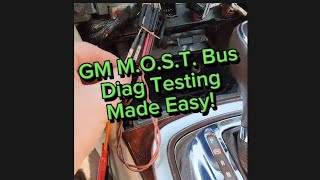
Technical definition: The SAE/OBD-II definition is Vehicle Communication Bus A Performance. This indicates the primary CAN-Bus fails to meet required timing, voltage, or data rate specifications (e.g., 500 kbps). On many GM vehicles, this code specifically targets the MOST (Media Oriented Systems Transport) bus 🎬 Watch: A simple guide to testing the GM MOST bus, a high-speed ring network for infotainment components.
Can I Drive With U0029?

Yes, But With Caution. You can drive, but it poses a significant risk. You will likely lose critical dashboard information (like speed), experience a blank infotainment screen, hear no safety chimes, or face unpredictable stalling. Driving with this fault becomes a severe safety hazard if power steering assist fails or the transmission shifts erratically. Continued driving also drains the battery, requiring a tow and replacement, adding $200-$400 to your repair bill.
Common Causes

- Damaged or Pinched Wiring Harness (Very Common) — Wires forming the communication bus run throughout the vehicle. They are frequently pinched by brackets during assembly (a known GM issue), corroded by moisture, or chewed by rodents, which distorts data signals.
- Faulty Control Module or Gateway (Common) — Any computer on the network (radio, HMI, instrument cluster, or gateway router) can fail internally. This failure disrupts the entire communication ring. On GM MOST networks, a failed CD player is the most frequent culprit.
- Poor Ground Connection (Common) — The network requires a solid connection to the vehicle's chassis. A loose or corroded ground strap introduces electrical noise and causes immediate communication errors.
- Weak or Failing Battery (Common) — Control modules require stable voltage (12.0V-14.8V) to communicate. A weak battery or failing alternator provides inconsistent voltage, confusing modules and triggering network codes.
- Aftermarket Accessory Interference (Less Common) — Improperly installed stereos, alarms, or remote starters interfere with the CAN bus. These devices introduce electrical noise or are improperly spliced directly into data lines.
- Blown Module Fuse (Less Common) — A blown fuse cuts power to a critical module. If a module loses power, it stops communicating, triggering U0029 as other modules report it missing.
- Outdated Module Software (Less Common) — Corrupted software within a control module causes it to send improper signals. A software update (reflash) from the manufacturer fixes these known bugs.
Symptoms

- Loss of Infotainment and Convenience Features — The radio screen goes blank, audio cuts out, and features like power windows or climate controls stop working.
- Erratic or Blank Instrument Cluster — Gauges drop to zero, warning lights flash randomly, or the entire cluster goes dark while driving.
- Parasitic Battery Drain — Modules fail to receive the 'go to sleep' command due to the communication fault, staying active when the car is off and draining the battery overnight.
- Vehicle Stalls or Will Not Start — If the communication loss involves the engine (ECM) or transmission (TCM) modules, the engine stalls while driving or fails to crank.
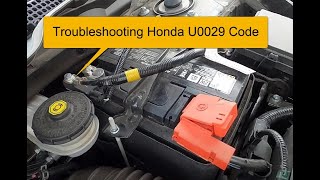
- Blinking 'D' (Drive) Indicator Light — On Hondas and Acuras, a blinking gear selector light is the primary sign 🎬 Watch: Troubleshooting Honda U0029 communication bus performance codes of a CAN communication fault involving the transmission.
- Check Engine Light is On (also visible on scanner) — The primary indicator that a trouble code is stored in the vehicle's computer memory.
Common Fixes & Costs
- Repairing Damaged Wiring Harness — Parts: $10-$50, Labor: $300-$1500, ~2.0-8.0 hr book time (Intermediate)
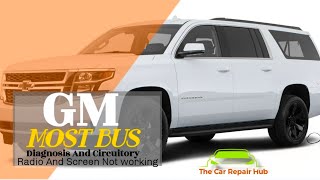
- Replacing Failed CD Player/Media Module (GM) 🎬 See this walkthrough on GM MOST bus circuitry and testing — Parts: $65-$300, Labor: $150-$300, ~1.0-2.0 hr book time (Intermediate)
- Replacing Failed Control Module (HMI, BCM, PCM) — Parts: $250-$800, Labor: $200-$400, ~1.5-3.0 hr book time (Professional)
- Cleaning or Repairing Ground Connections — Parts: $5-$20, Labor: $100-$250, ~0.8-1.5 hr book time (DIY)
- Updating Control Module Software — Parts: $0, Labor: $125-$250, ~0.5-1.5 hr book time (Professional)
Used vs. New Parts: Buying Guide
When a used part is worth it: For non-critical, plug-and-play modules like a GM CD player, a used part is cost-effective. For critical, VIN-locked modules (HMI, BCM, PCM), a used part only makes sense if you have access to professional programming tools.
Donor-vehicle mileage cap: roughly under 100000 miles for the part to have meaningful remaining life.
Donor quality checklist:
- Verify the part number matches exactly; mid-year production changes are common.
- Source from a vehicle scrapped due to an accident, not electrical failure.
- Check the seller's return policy and warranty period.
Decision logic:
- If The part is a critical, VIN-locked module and you cannot get it pre-programmed to your VIN → Buy new or remanufactured from a specialist who provides programming.
- If The part is a simple, non-programmed module and the cost savings are over 50% → A used part is a reasonable choice, but accept the risk of a shorter lifespan.
- If The vehicle is newer and still under warranty → Always use new OEM parts installed by a dealer to maintain warranty coverage.
Warranty tradeoff: Used parts offer a 30-90 day warranty. Remanufactured parts offer a limited lifetime warranty. New OEM parts carry a 1-2 year warranty when installed by a dealer.
Worst-case if a used part fails: $300-$600 if a used, programmed module fails prematurely, requiring you to pay for the part, programming, and labor a second time.
What Happens If You Wait — Timeline
- 0-2 weeks: Code is set, MIL is on. Intermittent symptoms appear, such as the radio screen flickering or going blank briefly. No major drivability issues. (MPG impact: 0%% · Added cost: $0)
- 2 weeks - 3 months: Symptoms become persistent. The infotainment system dies. A parasitic battery drain begins, causing slow cranking. Intermittent stalling occurs. (MPG impact: 0-1%% · Added cost: $75-$250 (Potential cost for a tow and diagnostic if stranded).)
- 3-6 months: The persistent parasitic drain permanently damages the vehicle's battery through repeated deep discharge cycles. The battery requires replacement. (MPG impact: 0-1%% · Added cost: $200-$400 (Cost of a new AGM battery + installation).)
- 6+ months: The vehicle is highly unreliable. Continued voltage stress damages other sensitive electronic modules on the network, turning a wiring repair into a multi-module replacement. (MPG impact: 0-1%% · Added cost: $1000-$2500+ (Cost to replace a battery and major control modules).)
Cost of Not Fixing It
- Immediate: Unpredictable loss of critical systems like the instrument cluster, power steering, or backup camera, creating a safety hazard. (Added cost: Potential for traffic tickets or accidents.)
- 0-1 month: Intermittent no-start conditions or stalling. A persistent parasitic drain kills the battery, requiring a jump start or tow. (Added cost: $75-$250 for a tow and diagnostic.)
- 1-6 months: Repeatedly draining the battery destroys it. Continued communication errors cause voltage instability that damages other sensitive electronic modules. (Added cost: $200-$400 for a new battery, plus $500-$1500+ for a damaged control module.)
Diagnosis Steps

- Read and Record All Codes
Use a bi-directional scanner to read codes from all modules. A flood of 'U' codes points to a network-wide issue. Clear the codes to see which return immediately.
Tools: Professional Bi-Directional Scan Tool (Beginner) - Check for Technical Service Bulletins (TSBs)
Search for TSBs related to U0029 for your specific VIN. Manufacturers document known issues, like GM's TSB #PIT5288H for a pinched dash harness.
Tools: Internet Access (Beginner) - Test the Battery and Charging System
Measure battery voltage (12.6V off) and alternator output (13.5-14.5V running). Unstable power causes communication errors.
Tools: Multimeter (Beginner) - Perform a Visual Inspection
Inspect visible wiring harnesses, especially under the dashboard. Look for pinched wires, corrosion, or rodent damage.
Tools: Flashlight, Trim Removal Tools (Intermediate) - Scan Tool Live Data Analysis
Monitor network PIDs. On GM vehicles, check 'Number of MOST Communication Breaks'. A '0' means the wiring is intact but a module is internally failing.
Tools: Professional Bi-Directional Scan Tool (Advanced) - Isolate the Faulty Module
Disconnect modules one by one. On GM MOST networks, use a fiber optic bypass loop to jump modules until communication is restored.
Tools: Fiber Optic Bypass Loop, Wiring Diagram (Advanced) - Check CAN Bus Resistance
With battery disconnected, measure resistance between OBD-II Pins 6 and 14. A healthy network reads 60 ohms. 120 ohms indicates a broken wire.
Tools: Multimeter (Advanced) - Check CAN Bus Voltage
With key on, measure voltage on CAN lines. CAN High (Pin 6) should be ~2.5-3.5V; CAN Low (Pin 14) should be ~1.5-2.5V.
Tools: Multimeter (Advanced) - Oscilloscope Data Analysis
Connect an oscilloscope to CAN lines to view data packets. Look for distorted or noisy signals to definitively identify integrity issues.
Tools: Oscilloscope, Probes (Professional)
When This Code Triggers (Freeze-Frame Conditions)
- Vehicle Speed: 0 mph (During key-on, initial module handshake)
- Battery Voltage: 11.5-12.5V (Key-On, Engine-Off (KOEO) during initial network check)
- Time Since Start: 0-10 seconds (The fault occurs immediately as modules attempt to establish communication at startup)
Related Codes
- U0028 — Indicates a severe communication break or a complete loss of signal. In contrast, U0029 suggests a 'performance' issue where the network has integrity but a module is failing to communicate correctly.
- U0100 — Indicates 'Lost Communication With ECM/PCM'. Frequently appears with U0029 on Honda vehicles, pointing to a communication breakdown specifically with the engine computer.
- U0140 — Means 'Lost Communication With Body Control Module (BCM)'. Suggests the network problem is affecting the BCM or the BCM itself is the cause, common in Hyundai vehicles.
- Multiple U-codes (U0121, U0155, etc.) — A flood of 'U' codes confirms a widespread network issue rather than a single faulty part. Diagnosis must focus on the network wiring, gateway module, or shared power/ground.
Climate & Environmental Factors
- High Humidity / Moisture: Direct water intrusion accelerates corrosion on wiring connectors and ground points. This corrosion increases resistance and disrupts sensitive voltage signals on the CAN bus.
- Road Salt (Winter Climates): Salt spray creates a highly corrosive environment for wiring on the vehicle's undercarriage, significantly increasing the likelihood of communication codes.
- Extreme Cold/Heat Cycles: Temperature fluctuations cause plastic connectors to become brittle and solder joints inside control modules to fail, leading to intermittent open circuits.
How to Talk to a Mechanic About This Code
Say this: "I have a U0029 communication bus code, and my radio screen is blank. Please perform a full network scan to see all communicating modules and check for any relevant TSBs. I want to start by checking the bus wiring and grounds before assuming a major module has failed."
This signals that you understand U0029 is a complex network problem. It directs the technician toward a logical diagnostic process and away from shotgunning an expensive module.
Avoid saying:
- 'Just fix whatever's wrong'
- 'My check engine light is on, can you look at it?'
- 'Whatever you recommend'
Questions to ask before authorizing the repair:
- Did you find any Technical Service Bulletins (TSBs) for my vehicle?
- What was the CAN bus resistance reading between pins 6 and 14?
- Were you able to isolate the fault to a specific wiring section or module?
- If a module needs to be replaced, does it require programming and is that cost included in the quote?
Where to Take It: Dealer vs Independent vs Chain
- Dealer:
Best for: Vehicles still under warranty, Known manufacturer-specific quirks like the GM TSB #PIT5288H, Repairs requiring module programming that independent shops cannot perform
Downsides: Higher labor rates, Defaults to replacing a whole assembly rather than performing a granular wiring repair (Typical cost: +50% vs. baseline) - Independent Shop:
A strong choice, but only if it is a top-tier independent shop with proven expertise in electrical diagnostics. Ask if they are comfortable diagnosing CAN bus issues before booking.
Best for: Out-of-warranty vehicles where cost is a major factor, Shops that specialize in your vehicle's brand, Shops with a strong reputation for electrical and diagnostic work
Downsides: Quality and diagnostic capabilities vary widely, Lacks access to the very latest software updates or programming tools (Typical cost: +0% vs. baseline) - Chain Shop:
AVOID. This code requires advanced diagnostic expertise not found at chain repair shops.
Best for: Simple, routine maintenance like oil changes or brake jobs
Downsides: Technicians lack specialized training and tools for complex network diagnostics, High risk of misdiagnosis (Typical cost: -10% vs. baseline)
When to Walk Away From the Repair
If the estimated repair cost for the U0029 fault exceeds 40-50% of your car's private-party value, seriously consider not fixing it.
- Car worth $4000, fix is $2000: Borderline. The repair cost is 50% of the car's value. Get a second opinion before authorizing.
- Car worth $12000, fix is $1800: Fix it. The repair is only 15% of the vehicle's value.
- Car worth $2500, fix is $1500: Walk away. The repair cost is 60% of the car's value. It is not economically sensible to proceed.
What Scan Tool You Need for This Code
Minimum: A scan tool that performs a 'full system scan'. It must read codes from the BCM, Radio, ABS, and other modules, not just the engine computer.
A basic $20 code reader only communicates with the Engine Control Module (ECM). It will not see U-codes stored in other modules, making it impossible to understand the scope of the network failure.
Budget: Autel MaxiAP AP200 / TOPDON TopScan Lite (~$60) — These Bluetooth dongles use a smartphone app to perform full system diagnostics. They read codes from all modules, providing the minimum necessary information to see which systems are affected.
Mid-range: FOXWELL NT809 / Autel MaxiCOM MK808BT (~$350) — These tablet scanners offer full system scans, live data graphing, and bi-directional controls. This allows you to command a specific module to perform an action, confirming if it is responsive on the network.
Professional: Autel MaxiSys MS906 Pro / XTOOL D8S (~$500-1200) — Provides full bi-directional control, ECU coding, and topology mapping, which visually shows the network layout and offline modules.
Rent vs buy: Rentals from auto parts stores are basic engine-only code readers and are NOT sufficient for this code. You must buy a capable scanner or take the vehicle to a professional shop.
How to Clear the Code After You Fix It
- Reconnect battery if disconnected for repair
- Use an OBD-II scan tool to clear all Diagnostic Trouble Codes (DTCs)
- Perform a complete drive cycle to allow readiness monitors to run
Drive cycle (~30 minutes): Start with a cold engine. Idle for 2-3 minutes with electrical loads on. Drive for 15-20 minutes with a mix of steady highway speed (55-60 mph) and stop-and-go city driving. Allow the vehicle to cool down completely.
Readiness monitors affected: Comprehensive Component Monitor, Misfire Monitor
Before emissions retest: drive at least 50 miles to fully set monitors.
Watch out for:
- Disconnecting the battery clears the code but resets all readiness monitors, guaranteeing an emissions test failure until a drive cycle is completed.
- If the root cause is not fixed, the code returns almost immediately after being cleared.
Will This Fail Emissions / State Inspection?
Yes — this code typically fails an OBD-II emissions inspection.
- California: An active U0029 code causes an automatic failure of the OBD-II smog check. All readiness monitors must be 'Ready' before the test passes.
- New York: An illuminated Check Engine Light results in an automatic failure. After repair, the vehicle must complete a drive cycle to set readiness monitors.
- Texas: An active DTC like U0029 causes the vehicle to fail the OBD-II test. The Malfunction Indicator Lamp (MIL) must be functional and commanded off by the PCM.
Most Commonly Affected Vehicles
- GMC Yukon / Yukon XL (2015-2020) — Extremely prone to a pinched main dash wire harness behind the instrument panel (TSB #PIT5288H). A failed CD player or HMI module is the second most likely cause.
- Chevrolet Silverado, Tahoe, Suburban (2014-2020) — Frequently caused by a pinched wiring harness near the parking brake pedal or a failed CD player/HMI module on the MOST bus network.
- Ford F-150 (2015-2018) — Often triggered by grounding issues or electrical interference after the installation of aftermarket stereo equipment.
- Honda Accord (2008-2017) — Often related to a bus-off failure in the F-CAN network. Causes include a faulty ECM/PCM, outdated software, or poor connections at the gauge control module.
- Honda Civic (2011-2021) — Caused by F-CAN bus failures involving the ECM, TCM, or outdated module software. A blinking shift indicator is a key symptom.
- Honda CR-V, Odyssey (2011-2022) — Associated with F-CAN communication errors pointing to a faulty CAN gateway, TCM, or BCM.
- Hyundai Elantra, Sonata (2011-2017) — Linked to internal failures of the Body Control Module (BCM), causing widespread communication faults, parasitic battery drain, and no-start conditions.
- Nissan Altima, Rogue (2013-2018) — Caused by failures in the ABS actuator, which acts as a central hub for CAN communication.
Manufacturer-Specific Notes
- General Motors (Chevrolet, GMC): On 2014-2020 trucks and SUVs, U0029 is most frequently caused by a pinched wiring harness behind the driver's side dash (TSB #PIT5288H). The second most common cause is a failed CD player module on the MOST bus.
- Honda / Acura: Honda refers to the network as the 'F-CAN'. A blinking 'D' (Drive) light on the instrument cluster is a classic symptom, pointing to a fault with ECM/PCM or TCM communication.
- Ford: U0029 is frequently traced to aftermarket modifications. Improperly installed stereos or lighting that tap into CAN bus wires create electrical noise that disrupts the network.
- Hyundai / Kia: A failing Body Control Module (BCM) is a known weak point that causes a cascade of 'U' codes, parasitic battery drain, and a no-start condition.
Real Owner Stories
2015 Chevy Suburban with blank radio and U0029
The owner experienced a blank infotainment screen and no audio. Navigation and phone functions worked, but radio controls were unresponsive. A scan revealed code U0029 and a rapidly increasing 'Number of MOST Communication Breaks' counter.
Outcome: With the CD player bypassed, the communication break counter stopped, and the radio screen functioned correctly. The internal failure of the CD player module was the root cause.
Lesson: Never assume the most expensive part is the cause. On a MOST ring network, any single module failure takes down the entire system. Using a fiber optic bypass loop isolates modules cost-effectively.
2016 GMC Yukon Denali with multiple random electrical failures
The vehicle experienced a blank radio screen, dead battery overnight, and service messages for Stabilitrak. Codes U0029 and U0028 were present.
Outcome: The main dash harness was crushed between a metal mounting bracket and the body. After repairing the damaged wires and rerouting the harness, all electrical symptoms disappeared.
Lesson: Always check Technical Service Bulletins (TSBs). For 2014-2020 GM trucks and SUVs, this pinched harness is a well-documented manufacturing flaw and the leading root cause of U0029.
2017 Honda Accord with intermittent codes
The check engine light illuminated, showing code U0029. The vehicle occasionally hesitated during shifts.
Outcome: The U0029 code did not return. The weak battery caused voltage drops during startup, disrupting the F-CAN network communication.
Lesson: Checking the battery and alternator is the mandatory first step before diving into complex wiring diagnostics.
How to Prevent This Code From Triggering
- Apply Dielectric Grease to Connectors (During any repair that exposes a major connector.) — Blocks moisture and oxygen from reaching metal pins, preventing corrosion that disrupts sensitive CAN bus voltage signals.
- Perform Regular Battery Health Checks (Annually, especially before winter.) — Ensures stable voltage (12.0-14.8V). Weak batteries cause voltage drops that confuse modules and trigger communication errors.
- Ensure Professional Installation of Aftermarket Electronics (Whenever adding stereos, alarms, or remote starters.) — Prevents improper splicing into CAN bus wires, which introduces electrical noise and ground loops.
- Address Water Leaks Promptly (As needed.) — Prevents moisture from reaching critical modules under the dashboard, avoiding corrosion and short circuits.
Frequently Asked Questions
Can I fix a U0029 code myself?
Simple checks like testing the battery and cleaning ground connections are DIY-friendly. However, accurately diagnosing the specific faulty wire or module requires professional scan tools and wiring diagrams. Stop DIY efforts and visit a shop if basic multimeter tests do not reveal the issue.
How much does it cost to fix code U0029?
Costs vary dramatically based on the root cause. A simple wiring repair costs $300-$1500, mostly in labor to access the dashboard. Replacing a major control module like the PCM or HMI exceeds $1,000 including the part and mandatory programming.
Will clearing the code make it go away?
Clearing the code with a scanner turns off the warning light temporarily, but it will return if the underlying electrical problem remains. If it is an intermittent fault, the light stays off briefly, but the root issue is not resolved.
What's the difference between CAN Bus 'A', 'B', and 'F-CAN'?
Modern cars utilize multiple CAN networks for different systems. Bus 'A' is the high-speed network connecting critical modules like the engine, transmission, and ABS. 'F-CAN' is Honda's specific terminology for their high-speed (Fast) CAN bus.
My radio screen is black. Is that related to the U0029 code?
Yes, a blank radio screen is a classic symptom of this code. On many vehicles, the infotainment screen operates on a communication network called the MOST bus. A performance failure on this bus triggers code U0029 and disables the screen.
What is a common misdiagnosis for U0029?
A frequent mistake is immediately replacing an expensive module just because it stops communicating. The actual fault is usually in the wiring or a cheaper module on the same network. Always diagnose the entire network's integrity before replacing the most expensive component.
Can a weak battery cause a U0029 code?
Yes, control modules are highly sensitive to voltage fluctuations. A weak battery provides unstable power, causing modules to malfunction and fail to communicate properly. Always test the battery and charging system early in your diagnostic process.
What is a fiber optic bypass loop?
It is a diagnostic tool used on fiber optic networks like the GM MOST bus. It plugs into a module's connector, effectively bypassing that specific module on the network ring. If bypassing a module restores the rest of the network, you have identified the faulty component.
Key Takeaways
- Code U0029 indicates a performance failure on the high-speed CAN bus, meaning data packets between computers are corrupted or timing out.
- Damaged wiring, corroded connectors, and loose ground straps cause over 70% of U0029 communication failures.
- For 2014-2020 GM trucks and SUVs, a pinched dashboard wiring harness (documented in TSB #PIT5288H) is the leading cause of this code.
- A blank infotainment screen, erratic speedometer, and overnight parasitic battery drain are the three most common symptoms of a U0029 fault.
- Never replace an expensive control module without first verifying the 60-ohm CAN bus resistance and testing the battery under load.
Helpful Videos
Shop the Parts Behind U0029
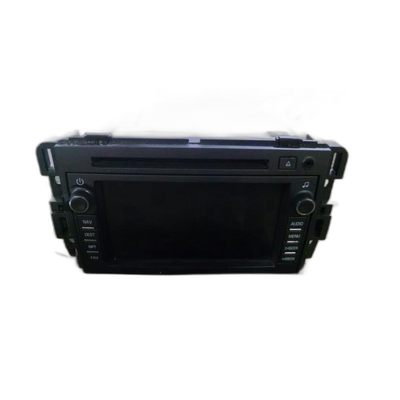
Below are the parts most often responsible for code U0029, ranked by how frequently each one is the actual culprit (per the diagnosis above). Tap any to see what we have for your vehicle.




The information in this article is provided for general reference and educational purposes only. Vehicle specifications, procedures, and part compatibility can vary by production date, trim level, and region. Always consult your vehicle's factory service manual and verify part numbers before purchasing or performing repairs. Safety-critical components such as airbags, seat belts, and braking systems should be installed by a qualified professional.
- 🎬 Helpful Videos
- 🛍️ Shop This Part
- What Does U0029 Mean?
- Can I Drive With U0029?
- Common Causes
- Symptoms
- Common Fixes & Costs
- Used vs. New Parts: Buying Guide
- What Happens If You Wait — Timeline
- Cost of Not Fixing It
- Diagnosis Steps
- When This Code Triggers (Freeze-Frame Conditions)
- Related Codes
- Climate & Environmental Factors
- How to Talk to a Mechanic About This Code
- Where to Take It: Dealer vs Independent vs Chain
- When to Walk Away From the Repair
- What Scan Tool You Need for This Code
- How to Clear the Code After You Fix It
- Will This Fail Emissions / State Inspection?
- Most Commonly Affected Vehicles
- Manufacturer-Specific Notes
- Real Owner Stories
- 2015 Chevy Suburban with blank radio and U0029
- 2016 GMC Yukon Denali with multiple random electrical failures
- 2017 Honda Accord with intermittent codes
- How to Prevent This Code From Triggering
- Frequently Asked Questions
- Can I fix a U0029 code myself?
- How much does it cost to fix code U0029?
- Will clearing the code make it go away?
- What's the difference between CAN Bus 'A', 'B', and 'F-CAN'?
- My radio screen is black. Is that related to the U0029 code?
- What is a common misdiagnosis for U0029?
- Can a weak battery cause a U0029 code?
- What is a fiber optic bypass loop?
- Key Takeaways
- 🎟️ Get 5% Off