

U0038 on 2016-2017 Honda Civic: Causes for No-Start and Communication Failure
On a 2016-2017 Honda Civic, code U0038 almost always points to an internal failure of the Transmission Control Module (TCM), a defect acknowledged by Honda in TSB 17-012. This failure causes a no-start condition, prevents shifting out of Park, and illuminates multiple dashboard warnings. The fix requires replacing and programming the TCM, a job for a professional with Honda-specific tools.
- U0038 on a 2016-2017 Civic is a critical code that will prevent the car from starting and shifting out of park.
- The cause is almost certainly a failed Transmission Control Module (TCM), a known issue acknowledged by Honda in service bulletin 17-012.
- Do not waste money on a new starter or battery before properly diagnosing the communication network, although checking battery voltage is a valid first step.
- This is not a DIY-friendly repair. The replacement TCM must be programmed to the vehicle by a professional with the correct Honda-specific tools.
- Ensure the correct part number is ordered for your engine (2.0L vs 1.5L Turbo) and use the latest superseded OEM part for reliability.
What's Unique About the 2016-2017 Honda CIVIC

For the 10th generation Civic, particularly the 2016-2017 models, this code is strongly linked to a known hardware defect. Honda issued Technical Service Bulletin 17-012 (also known as A17060C) acknowledging that the Transmission Control Module (TCM) itself is prone to an internal malfunction, causing this specific communication breakdown. Unlike many communication codes that stem from wiring issues, the problem on these Civics is most often the module itself, making diagnosis more direct if you are aware of the TSB.
Diagnostic Flowchart

Tap your situation to follow the diagnostic path that matches what you're seeing on this vehicle.
Symptoms You May Notice

- Vehicle will not crank or start.
- Cannot shift the transmission out of Park.
- Multiple warning lights illuminated on the instrument panel, often described as a 'Christmas tree' effect by owners. Common messages include 'Electric Parking Brake Problem,' 'Brake System Problem,' and 'Charging System Problem.'
- Malfunction Indicator Lamp (Check Engine Light) is on.
- The 'D' (Drive) shift position indicator may blink continuously.
- Accessory mode works, but the engine does not turn over when the start button is pressed.
- Replacing the starter
- Replacing the battery without diagnosing the underlying communication fault
- Replacing the Powertrain Control Module (PCM) without confirming the TCM is the source of the communication loss
- Replacing the push-button start switch or key fob battery
Most Likely Causes

- Internal Failure of the Transmission Control Module (TCM) 🔴 High Probability → Shop Transmission Assembly Honda issued TSB 17-012 (A17060C) and ATS161101 specifically identifying an internal TCM malfunction as the primary cause for this code on 2016-2017 Civics with a CVT.
How to confirm: After verifying the battery is fully charged and checking for power and ground at the TCM, the diagnosis is confirmed by the inability to communicate with the TCM via a professional scan tool (like Honda HDS). The presence of both U0038 and U0101 together strongly points to this failure, as noted in the TSB.
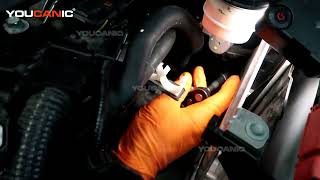
Typical fix: Replace the TCM and program the new module. 🎬 Watch: Step-by-step guide to replacing the Transmission Control Module For 2016 models, the PCM must also be updated to match the new TCM's software. For 2017 models, only the TCM needs replacement and programming.
Est. part cost: $275-$815
Rare But Worth Checking
- Wiring Harness or Connector Issue: While the TSB points to the TCM, it's always possible for the TM-CAN communication wires between the TCM and PCM to be damaged, corroded, or have a loose connection. A continuity check should be performed on these wires before replacing the expensive module. A visual inspection of the TCM connector for bent or corroded pins is also a wise step.
- Low Battery Voltage: → Shop Vehicle Battery Extremely low battery voltage (below 10V) can cause various communication modules to set error codes. While unlikely to be the root cause if symptoms persist after charging, ensuring the battery is healthy and fully charged is a simple first step. Some owners have reported a cascade of warning lights due to a failing battery, though this typically doesn't result in a persistent U0038 code once the battery is replaced.
Diagnosis Steps
- Connect an OBD-II scanner and confirm the presence of U0038. Note any other codes, especially U0101.
- Check for relevant Technical Service Bulletins. For this vehicle, TSB 17-012 (A17060C) is the primary document.
- Verify the battery voltage is above 12.4V and the charging system is functioning correctly. A weak battery can cause spurious communication codes.
- Visually inspect the wiring harness and the 50-pin connectors at both the Transmission Control Module (TCM) and the Powertrain Control Module (PCM). Look for any signs of damage, corrosion, or loose pins.
- If wiring appears intact, perform a continuity check on the TM-CAN lines. Disconnect the TCM and PCM connectors. Check for continuity between TCM connector pin 4 (TM-CAN H) and PCM connector A pin 21. Then check for continuity between TCM connector pin 12 (TM-CAN L) and PCM connector A pin 20.
- If continuity is good on the CAN lines and power/ground to the TCM are verified, the diagnosis definitively points to an internal failure of the TCM, as specified in the manufacturer TSBs.
- Proceed with replacing the TCM. The new module must be programmed using the Honda Diagnostic System (HDS). 🎬 See how to program a new module using specialized tools For 2016 models, the PCM software must also be updated.
Parts You'll Likely Need
- Transmission Control Unit (TCU/TCM) for 2.0L Engine
(OEM #28100-5DJ-A06)— This is the part identified by Honda in TSB 17-012 for the 2.0L engine. It has a known internal malfunction causing code U0038. This part number supersedes previous versions 28100-5DJ-A01 through A05.
Trusted brands: Honda (Genuine OEM)
OEM price range: $275-$815
Aftermarket price range: Not Recommended due to programming requirements. - Transmission Control Unit (TCU/TCM) for 1.5L Turbo Engine
(OEM #28100-5CG-A08)— This is the equivalent part for Civics with the 1.5L Turbo engine, as listed in TSB 17-012. This part number supersedes previous versions 28100-5CG-A01 through A07.
Trusted brands: Honda (Genuine OEM)
OEM price range: $275-$450
Aftermarket price range: Not Recommended due to programming requirements.
Related Codes That Often Appear With This One
- U0101 — This code means "Lost Communication with TCM." The official Honda TSBs state that U0038 and U0101 are often stored together for this specific internal TCM fault.
- U0100 — This code means "Lost Communication with ECM/PCM." In some cases, if the TCM failure disrupts the entire CAN bus, other modules may report a loss of communication with the main engine computer. One owner reported this code alongside U0038 before the issue was traced to a bad battery.
Technical Service Bulletins (TSBs) & Recalls
- A17060C / 17-012: '2016-17 Civic Will Not Come Out of Park or Will Not Start and Sets DTC U0038 and/or U0101.' This is the definitive bulletin. It states the cause is an internal malfunction with the TCM and provides the specific part numbers for both the 2.0L (28100-5DJ-A06) and 1.5L Turbo (28100-5CG-A07, now superseded by A08) engines. It also specifies that 2016 models require a PCM software update after TCM replacement.
- ATS161101: An earlier technical service summary describing the same symptoms: starter won't crank, won't shift out of park, multiple indicators lit, and DTCs U0038 and U0101 are set due to a communication issue with the transmission.
Platform-Specific Known Issues
- A known issue documented in Honda TSB 17-012 (A17060C) describes an internal malfunction of the TCM in 2016-2017 Civics, leading to a no-start/no-shift condition and storing codes U0038 and U0101.
Mechanic-Grade Diagnostic Values
- CAN Bus Resistance — expected: Approximately 60 Ω between CAN-H and CAN-L pins (e.g., at the DLC) with the battery disconnected.. Failure: A reading of ~120 Ω indicates an open circuit or a missing terminating resistor/module. A reading near 0 Ω indicates a short between the CAN lines.
- CAN Bus Voltage (Average) — expected: With ignition ON, CAN-H should be ~2.6V and CAN-L should be ~2.4V, measured to a known good ground.. Failure: Voltages stuck at 2.5V on both lines can indicate a short between them. Voltages at 0V can indicate a short to ground (check with ignition off). Any major deviation suggests a fault on that line.
- Minimum Battery Voltage — expected: Above 12.4V at rest. During cranking, voltage should not drop below 10V.. Failure: A resting voltage below 12.4V indicates a discharged battery. A cranking voltage below 10V indicates a weak battery that can cause spurious communication codes.
Scan Tool Commands That Help
- Honda Diagnostic System (HDS): REPLACE TCM/PCM MENU — This function is used to first READ and save configuration data (like ATF life) from the old module and then WRITE it to the new module after installation.
- Honda Diagnostic System (HDS): IMMOBI System -> Replace ECM/PCM — This is a critical step after installing a new TCM/PCM to register the immobilizer codes with the new unit, allowing the engine to start.
- Honda Diagnostic System (HDS): PCM Software Update (J2534 Rewrite Application) — This is mandatory for 2016 models after replacing the TCM. The PCM's software must be updated to be compatible with the new TCM.
Wiring & Ground Locations
- Transmission Control Module (TCM) — Located in the engine bay, mounted on top of the transmission, underneath the main air intake ducting.. This is the module that fails internally according to Honda's TSB. Its connector and ground must be inspected before replacement.
- Powertrain Control Module (PCM/ECM) — Located in the engine bay, typically near the battery and firewall, mounted in a bracket.. This is the other end of the TM-CAN communication line. Its connector pins (specifically Connector A) must be inspected for damage.
- Main Transmission Ground — A primary ground strap typically connects from the negative battery terminal to a bolt on the transmission case.. A poor ground connection for the transmission can cause a floating ground for the TCM, leading to communication errors. This connection should be clean and tight.
Real Owner Repair Stories
- YouTube channel 'Flexin My Rex' (2016 Honda Civic) — Multiple system failures, no communication with various modules.
❌ Tried (didn't work) Initial diagnosis pointed towards a bad PCM.
✅ What actually fixed it A thorough inspection of the PCM connectors revealed a bent pin (A26) that was shorting against an adjacent pin (A25). Straightening the pin and reconnecting the module resolved the communication failures. This highlights the critical need to physically inspect connectors before replacing expensive modules.
"I Checked Everything" — The Actual Cause
- This fault pattern is not applicable as U0038 is an electrical/communication code. The equivalent scenario is when all wiring and continuity checks pass inspection. In this case for the 2016-2017 Civic, the cause is almost certainly the internal TCM failure as documented in Honda's TSB A17060C.
When the Usual Fixes Don't Work
- While the official TSB points directly to an internal TCM failure as the overwhelming cause, this diagnosis assumes the wiring and connectors are intact. There is documented evidence of similar no-communication symptoms on this platform being caused by bent pins within the larger PCM connector. Therefore, a physical inspection of module connectors should be considered a mandatory step before ordering a replacement TCM, even when the symptoms perfectly match the TSB.
OEM Part Supersession History
28100-5DJ-A01 through 28100-5DJ-A05 (for 2.0L)→28100-5DJ-A06— The original part numbers were prone to the internal malfunction described in TSB A17060C. The superseding part is the revised, corrected version.28100-5CG-A01 through 28100-5CG-A07 (for 1.5L Turbo)→28100-5CG-A08— The original part numbers were prone to the internal malfunction described in TSB A17060C. The superseding part is the revised, corrected version.
Heads up: TSB 17-012 originally listed A07 as the replacement, which has since been superseded by A08.
Model Year Variations Within This Range
- 2016 vs 2017: When replacing the TCM for this issue, 2016 models require a mandatory PCM software update using the HDS to ensure compatibility with the new TCM. 2017 models only require the TCM to be replaced and programmed, with no PCM update needed.
Helpful Videos


We Have This Part in Stock




The information in this article is provided for general reference and educational purposes only. Vehicle specifications, procedures, and part compatibility can vary by production date, trim level, and region. Always consult your vehicle's factory service manual and verify part numbers before purchasing or performing repairs. Safety-critical components such as airbags, seat belts, and braking systems should be installed by a qualified professional.
- Honda CIVIC:
- 🧭 Diagnostic Flowchart
- 🎬 Helpful Videos
- 🛍️ Shop This Part
- What's Unique About the 2016-2017 Honda CIVIC
- Symptoms You May Notice
- Most Likely Causes
- Rare But Worth Checking
- Diagnosis Steps
- Parts You'll Likely Need
- Related Codes That Often Appear With This One
- Technical Service Bulletins (TSBs) & Recalls
- Platform-Specific Known Issues
- Mechanic-Grade Diagnostic Values
- Scan Tool Commands That Help
- Wiring & Ground Locations
- Real Owner Repair Stories
- "I Checked Everything" — The Actual Cause
- When the Usual Fixes Don't Work
- OEM Part Supersession History
- Model Year Variations Within This Range
- 🎟️ Get 5% Off