

OBD-II Code U0047: Vehicle Communication Bus 'C' Performance
What U0047 means, why it triggers, and how to fix it
- U0047 indicates a communication failure on Vehicle Bus C, which controls interior convenience features like the radio, climate control, and power windows.
- Diagnose this code by measuring the CAN bus resistance at the OBD-II port; a healthy network reads exactly 60 ohms, while 120 ohms indicates an open circuit.
- Do not immediately replace the first non-communicating module; systematically unplug modules one by one to isolate the single component crashing the network.
- Water intrusion from clogged sunroof drains or damaged windshield seals is the leading cause of the corroded wiring that triggers this $200-$500 repair.
- Always test the battery first, as voltage drops below 12.0V during startup cause modules to drop offline and trigger false U0047 codes.
What Does U0047 Mean?
Code U0047 indicates your car's computer detected a performance problem with 'Bus C,' the communication network linking electronic modules. Bus C controls cabin comfort and convenience features like the radio, climate controls, and interior lighting. When this network fails, these devices cannot communicate, leading to intermittent or total failure.
Technical definition: Vehicle Communication Bus C Performance. Data communication on the 'C' network is missing, corrupted, or signal timing falls outside expected parameters. The system logs this fault when message error frames exceed a predefined threshold or the bus state sticks in a 'dominant' or 'recessive' state.
Can I Drive With U0047?
Yes, But With Caution. You can drive with a U0047 code, but you will lose non-essential features like climate control, power windows, or interior lights. If the bus issue affects safety systems like stability control, the vehicle enters a limited power 'limp mode'. Driving for an extended period masks deeper electrical issues and leads to more costly repairs. Diagnose the vehicle within one week.
Common Causes
- Damaged or Corroded Wiring (Very Common) — Wires for Bus C running under carpets and door jambs are vulnerable to moisture from clogged sunroof drains or damaged seals. This water intrusion causes shorts, opens, or high resistance in the circuit.
- Poor Power or Ground to a Module (Common) — A loose or corroded chassis ground wire or faulty power supply causes a module to malfunction and disrupt communication across the entire network.
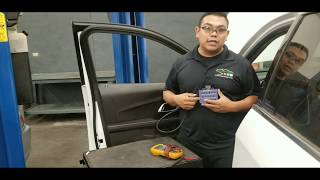
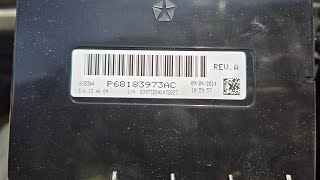
- Faulty Control Module (Common) — An internal failure in a module (like the BCM or HVAC) 🎬 See how to locate and remove a faulty HVAC control module. prevents it from sending or receiving messages, crashing the network.
- Weak or Failing Battery (Less Common) — Low battery voltage causes unpredictable module behavior and disrupts bus communication, especially during engine startup.
- Aftermarket Device Interference (Less Common) — Poorly installed remote starters or alarms introduce electrical noise or draw excessive power, corrupting bus signals.
- Software or Programming Glitches (Less Common) — Corrupted module software, often after a failed update or sudden power loss, stops communication and requires a dealer reflash.
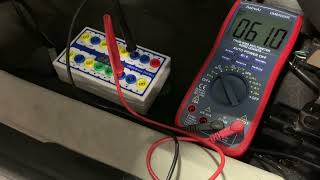
- Missing or Faulty Termination Resistor (Rare) — A failed 120-ohm termination resistor corrupts network data. Total bus resistance must measure approximately 60 ohms for the network to function. 🎬 Watch: How to perform a CAN bus resistance check with a multimeter.
Symptoms
- Malfunctioning Interior Electronics (also visible on scanner) — Climate controls fail, power windows stall or reverse, interior lights flicker, or the radio acts erratically.
- Warning Lights on Dashboard (also visible on scanner) — A general communication error message or multiple system warning lights (ABS, SRS, stability control) illuminate simultaneously.
- Inaccurate Gauge Readings (also visible on scanner) — The instrument cluster shows incorrect speed or fuel levels, or the gauges drop to zero while driving.
- Vehicle Entering 'Limp Mode' (also visible on scanner) — If the communication bus fault affects critical systems, the vehicle enters a reduced power mode to prevent damage, limiting speed to 30-40 mph.
Diagnostic Flowchart
Tap your situation to follow the diagnostic path that matches what you're seeing on this code.
Common Fixes & Costs
- Repair Damaged Wiring or Connectors — Parts: $10-$50, Labor: $200-$500, ~2.5 hr book time (Intermediate)
- Clean or Repair a Chassis Ground Connection — Parts: $5-$15, Labor: $50-$150, ~0.8 hr book time (Beginner)
- Replace a Faulty HVAC Control Module — Parts: $400-$700, Labor: $100-$200, ~1.5 hr book time (Intermediate)
- Replace a Faulty Body Control Module (BCM) — Parts: $600-$900, Labor: $200-$300, ~2.0 hr book time (Professional)
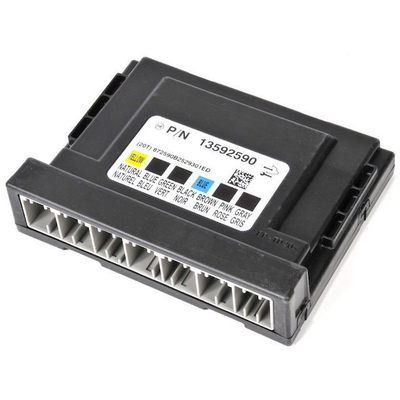
- Replace a Faulty Gateway Module — Parts: $100-$300, Labor: $100-$250, ~1.5 hr book time (Professional)
- Update or Reprogram Module Software — Parts: $0, Labor: $100-$250, ~1.0 hr book time (Professional)
DIY vs Professional
- Repair Damaged Wiring or Connectors 🟢 Beginner
Tools: Multimeter, wire strippers, soldering iron, heat shrink tubing, wiring diagrams. - Clean or Repair a Chassis Ground Connection 🟢 Beginner
Tools: Socket set, wire brush, sandpaper, dielectric grease. - Replace a Faulty HVAC Control Module 🟢 Beginner
Tools: Socket set, trim removal tools, screwdrivers. - Replace a Faulty Body Control Module (BCM) 🟢 Beginner
Tools: Socket set, trim removal tools, advanced OBD-II scanner capable of programming. - Replace a Faulty Gateway Module 🟢 Beginner
Tools: Socket set, trim removal tools, advanced OBD-II scanner capable of programming.
Used vs. New Parts: Buying Guide
When a used part is worth it: For simple, non-programmed modules like an HVAC control head on an older vehicle, a used part from a low-mileage donor is a cost-effective solution.
Donor-vehicle mileage cap: roughly under 100000 miles for the part to have meaningful remaining life.
Donor quality checklist:
- Match the part number exactly. A single digit difference means incompatibility.
- Inspect connectors for corrosion or bent pins.
- Verify the donor vehicle had identical trim options.
Decision logic:
- If The part is a BCM, Gateway Module, or tied to vehicle security. → Buy a new or professionally remanufactured unit. A used module will not start the car without expensive dealer programming.
- If The part is a simple convenience module with no programming required. → A used part is a reasonable, budget-friendly choice.
- If The vehicle is less than 10 years old and the part is a critical module. → Favor a new OEM part with a warranty to ensure longevity and access to software updates.
Warranty tradeoff: Used salvage parts offer a 30-90 day warranty covering only the part. New aftermarket or remanufactured modules come with a 1-year to lifetime warranty.
Worst-case if a used part fails: $300-800 if a used module is dead on arrival, requiring repeat diagnostic and labor costs.
What Happens If You Wait — Timeline
- 0-2 weeks: Intermittent failure of one or two convenience features. U0047 stores as a history code. (MPG impact: 0%% · Added cost: $0)
- 2 weeks - 3 months: Failures become frequent and affect more systems. The Check Engine Light stays on. (MPG impact: 0%% · Added cost: $100-$250)
- 3-6 months: A hard fault develops. Multiple features are inoperative. Safety system warnings appear and limp mode engages. (MPG impact: 0-5%% · Added cost: $500 - $1500)
- 6+ months: Cascading failure. Electrical stress damages other modules on the network. The vehicle fails to start. (MPG impact: 0-5%% · Added cost: $1500+)
Cost of Not Fixing It
- 0-1 month: Intermittent loss of non-essential features like radio or climate control. Diagnostic difficulty remains stable. (Added cost: $0)
- 1-6 months: Wiring issues worsen due to vibration or moisture. Intermittent problems become hard failures, affecting safety systems like ABS and triggering limp mode. (Added cost: $500 - $1500)
- 6+ months: Continued electrical stress from a bus short damages multiple modules on the network. The vehicle becomes unreliable and fails to start. (Added cost: $1500+)
Diagnosis Steps
- Perform a Full Network Scan
Use an advanced OBD-II scanner to perform a full network scan. Note all 'U' codes and identify exactly which modules are offline to map out the fault area.
Tools: Advanced OBD-II Scanner (bi-directional capable) (Beginner) - Perform a Thorough Visual Inspection
Inspect the wiring harnesses and connectors associated with the offline modules. Look for water intrusion, corrosion, or pinched wires under the dashboard, along floor sills, and near the main fuse box.
Tools: Flashlight, Trim Removal Tools (Beginner) - [PRO TIP] Isolate Modules Systematically
Disconnect suspected modules from the bus one by one. Clear the codes and re-scan the network after each unplug. When communication with the rest of the network restores, the last disconnected module is the faulty unit.
Tools: Basic Hand Tools, OBD-II Scanner (Advanced) - Measure Bus Resistance
With the battery disconnected, measure the resistance between the CAN High and CAN Low pins at the OBD-II port. A reading of 60 ohms is healthy. 120 ohms indicates an open circuit or missing resistor. 0 ohms indicates a short.
Tools: Digital Multimeter (Intermediate) - Check Bus Voltages (Key On, Engine Off)
With the key on, check voltages on the CAN High and CAN Low lines. In a 'recessive' state, both lines read 2.5V. In a 'dominant' state, CAN High reads 3.5V and CAN Low reads 1.5V. Deviations point to a short or a faulty module dragging the bus down.
Tools: Digital Multimeter (Intermediate) - Check for Power and Ground at the Suspect Module
Verify the main non-communicating module has battery voltage (12.0-12.8V) and a solid ground connection. High resistance on the ground side causes a module to drop off the network.
Tools: Digital Multimeter, Vehicle-Specific Wiring Diagram (Intermediate) - [PRO TIP] Perform a 'Wiggle Test'
Have a helper monitor the scan tool's live network status. Gently wiggle wiring harnesses and connectors related to Bus C. If the fault appears or disappears as you move a section of wiring, you found the physical break.
Tools: Advanced OBD-II Scanner, Helper (Intermediate) - Advanced Ground Resistance Test
Measure the resistance between the module's ground pin and a known-good chassis ground point. A reading under 1.0 ohm is ideal. Anything over 5.0 ohms confirms a bad ground requiring repair.
Tools: Digital Multimeter (Advanced) - Advanced Voltage Drop Test
With the module connected and key on, place the positive multimeter lead on the battery's negative post and the negative lead on the module's ground wire. A reading greater than 0.1 volts indicates excessive voltage drop.
Tools: Digital Multimeter (with back-probe pins) (Advanced) - Use an Oscilloscope for Advanced Analysis
Connect an oscilloscope to the CAN High and CAN Low lines. A healthy network shows a clean, square waveform switching between 2.5V and 3.5V/1.5V. Distorted signals pinpoint a shorted transceiver.
Tools: Oscilloscope, Back-probe pins (Professional)
When This Code Triggers (Freeze-Frame Conditions)
- Vehicle State: Key On or Engine Running (The fault detects during the initial network 'roll call' at key-on or when a module stops communicating while driving.)
- System Voltage: 11.5-14.5V (The code sets if system voltage drops during startup or a faulty module pulls bus voltage down.)
- Time Since Start: 0-10 seconds (The communication failure logs immediately after ignition as modules check in.)
- Module Status: Not Communicating (Freeze frame data points to specific offline modules or excessive error frames.)
Related Codes
- U0140 — Lost Communication With Body Control Module. If only the BCM is offline, U0140 is the primary fault. If multiple modules are offline, U0047 points to a wider bus problem.
- U0155 — Lost Communication With Instrument Panel Cluster (IPC). If the gauges are dead but HVAC works, the problem is isolated to the IPC (U0155). If both fail, diagnose the shared bus (U0047).
- U0164 — Lost Communication With HVAC Control Module. Check if other modules on the bus respond. If only the HVAC is unresponsive, diagnose U0164 by checking its specific power and ground.
- U0048 - U0054 — Specific circuit faults (Open, Low, High, Shorted) for Bus C. U0047 is a general performance code; these codes pinpoint the exact electrical failure (e.g., U0048 means Bus C is shorted to Bus C+).
Climate & Environmental Factors
- High Humidity / Water Intrusion: Moisture entering via leaking sunroof drains or windshield seals wicks into wiring harnesses. This corrodes CAN bus pins, causing high resistance or short circuits.
- Extreme Cold: Wiring and plastic connectors become brittle and break. Weak batteries degrade significantly in the cold, causing voltage drops that knock modules offline.
- Vibration and Rough Roads: Constant vibration chafes wires through their insulation, causing shorts. It loosens connector pins, resulting in intermittent open circuits.
How to Talk to a Mechanic About This Code
Say this: "I have a U0047 communication bus code. Please authorize one hour of diagnostic time to trace the network fault. Call me with a full diagnostic plan and estimate before replacing any parts."
This directs the shop to perform methodical electrical diagnosis (checking wiring, grounds, and network signals) rather than guessing and replacing the first module that doesn't respond.
Avoid saying:
- 'My radio and windows are acting weird, can you fix it?'
- 'My check engine light is on, can you look at it?'
- 'Just replace the Body Control Module.'
Questions to ask before authorizing the repair:
- What was the result of the network scan? Which modules were offline?
- Did you test the bus resistance and voltages? What were the readings?
- How did you isolate the fault to this specific wire or module?
- If a module needs replacement, does it require programming? Is that included in the quote?
- Will you provide a written estimate with a breakdown of parts and labor?
- What is the warranty on the parts and the labor for this repair?
Where to Take It: Dealer vs Independent vs Chain
- Dealer:
Recommended. Dealers have specific wiring diagrams, TSBs, and proprietary diagnostic procedures needed for network faults.
Best for: Vehicles under warranty., Complex, brand-specific electrical issues., When a module replacement requires proprietary software for programming.
Downsides: Highest labor rates., May be quicker to replace a major module than to trace a difficult wiring fault. (Typical cost: +50% vs. baseline) - Independent Shop:
Good fit, IF you vet the shop. Ensure they have CAN bus diagnostic experience and a bi-directional scan tool.
Best for: Out-of-warranty vehicles where cost is a major factor., Shops that specialize in electrical diagnostics.
Downsides: A general mechanic lacks the advanced tools or experience for network diagnosis., May not have access to proprietary programming software. (Typical cost: +0% vs. baseline) - Chain Shop:
AVOID. Technicians lack the training and equipment for complex network diagnostics. High pressure to sell unnecessary parts.
Best for: Simple maintenance like oil changes or tires.
Downsides: Technicians lack the training and equipment for complex network diagnostics., High pressure to sell unnecessary parts. (Typical cost: -10% vs. baseline)
When to Walk Away From the Repair
If the total estimated repair cost exceeds 40% of your car's private-party value, consider selling or trading it in.
- Car worth $5000, fix is $2200: Borderline. The repair is nearly half the car's value. Get a second opinion before authorizing.
- Car worth $15000, fix is $1200: Fix it. The repair cost is well below the threshold and restores significant functionality.
- Car worth $3000, fix is $1800: Walk away. The repair cost is over 50% of the vehicle's value. It is not a sound financial decision.
What Scan Tool You Need for This Code
Minimum: A scanner that performs an 'All Module Scan' to see which modules are online. A basic engine-only code reader is useless for this code.
A $20 reader tells you a 'U' code exists but cannot poll individual modules (BCM, HVAC, IPC) to see which are offline.
Budget: BlueDriver Pro Scan Tool (~$120) — Connects to your smartphone and reads codes from all vehicle systems, providing the essential 'All Module Scan'.
Mid-range: Foxwell NT510 Elite (~$180) — Offers bi-directional control to actively command modules and isolate faulty components.
Professional: Autel MaxiCOM MK808BT (~$550) — Provides full bi-directional control, network topology mapping, and ECU programming required after replacing a module.
Rent vs buy: Buy. Proper diagnosis takes time and multiple scans. A bi-directional tool is a must-have for network faults.
How to Clear the Code After You Fix It
- Reconnect the battery if it was disconnected for the repair.
- Use an OBD-II scan tool to perform a 'Clear DTCs' or 'Erase Codes' function.
- Turn the ignition off, then back on, and wait 10 seconds to allow modules to re-establish communication.
- Perform a drive cycle to ensure the fault does not return.
Drive cycle (~20 minutes): Cold start -> 3 minutes idle -> 15 minutes mixed city/highway driving. Operate accessories (HVAC, windows, radio) using the repaired bus -> Park and shut down.
Readiness monitors affected: Clearing a U-code resets all readiness monitors, including Catalyst, EVAP, and O2 Sensor.
Before emissions retest: drive at least 50 miles to fully set monitors.
Watch out for:
- Disconnecting the battery does not clear the code from all modules.
- The code returns immediately if the root cause (bad wire, faulty module) is not fixed.
- Not allowing enough time for modules to 'wake up' after clearing codes leads to a false 'fixed' conclusion.
Will This Fail Emissions / State Inspection?
Yes — this code typically fails an OBD-II emissions inspection.
- California: An illuminated Check Engine Light causes an automatic failure. Complete a full drive cycle to set readiness monitors before re-testing.
- New York: The NYS inspection includes an OBD-II scan. An active U0047 code automatically fails the emissions portion.
- Texas: In emissions-testing counties, an active U0047 code triggering the Check Engine Light fails the OBD inspection.
Most Commonly Affected Vehicles
- Honda Accord (2023-2025) — Prone to communication failures between the gauge control module and the infotainment unit. Diagnosis requires checking the F-CAN bus lines for opens or shorts.
- Honda CR-V (2017-2022) — Issues relate to the CAN gateway affecting communication with the PCM, VSA, and SRS modules. Troubleshooting involves systematically disconnecting modules like the electric brake booster to isolate the fault.
- Dodge/Ram 1500 (2014-2018) — Frequently experiences lost communication with the HVAC module located behind the glove box. Module replacement is the standard fix.
- Ford F-150 (2011-2018) — On 2011-2013 models, a faulty transmission molded leadframe causes communication faults (TSB 13-6-8). For 2015+ models, the gateway module itself fails.
- Jeep Grand Cherokee, Cherokee (2014-2019) — Logs this code due to a faulty HVAC module or interior module losing communication on the bus.
- Chevrolet/GMC Silverado, Sierra (2014-2019) — Communication issues arise from faulty power steering or electronic brake control modules, traced directly to wiring or ground faults.
- Hyundai Elantra, Sonata (2017-2021) — Wiring harnesses routing to specific modules chafe and short, leading to communication codes.
- BMW 3 Series, 5 Series, X5 (2010-2018) — Diagnosis is complex and requires checking seemingly unrelated components that share data bus lines.
Manufacturer-Specific Notes
- Honda: On the Accord and CR-V, U0047 points to a communication breakdown on the F-CAN bus. The official troubleshooting procedure requires methodically disconnecting modules (VSA modulator, multipurpose camera, PCM) to restore communication.
- Chrysler/Dodge/Jeep/Ram: A failed HVAC control module is the primary culprit. Technicians check power, ground, and communication signals directly at the HVAC module first.
- Ford: On 2011-2013 F-150s, a faulty transmission molded leadframe causes widespread communication issues (TSB 13-6-8). On 2015+ models, the Gateway Module (Smart Data Link Connector) frequently fails.
- General Motors (Chevrolet/GMC): A poor ground connection causes network codes. Check the main chassis ground points under the hood and near the A-pillar for corrosion before replacing modules (Service Bulletin #PIP5104).
Real Owner Stories
2016 Ford F-150 Platinum with multiple system faults
HVAC, audio, BLIS, lane assist, windows, and folding mirrors stopped working shortly after startup. Multiple 'U' codes were present.
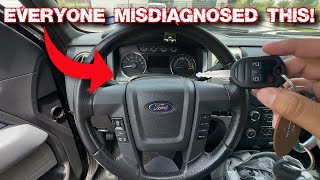
Outcome: The dealership diagnosed a corroded 16-pin connector located near the spare tire, part of the MS-CAN network loop. Repairing the corroded wiring resolved all communication issues.
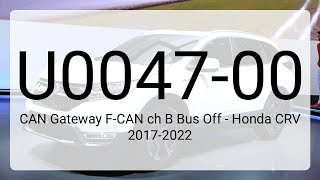
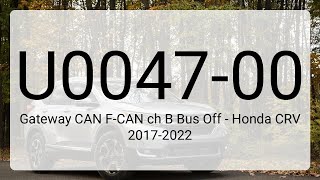
2017-2022 Honda CR-V with U0047-00 F-CAN Bus Off Error
Check Engine Light on with loss of stability control. The code pointed to a failure on the F-CAN 'B' channel.
Outcome: Disconnecting the VSA modulator stopped the U0047 code from reappearing, identifying it as the faulty component.
Lesson: A single bad module brings down the whole network. Following a systematic isolation procedure is the correct way to find the true source.
How to Prevent This Code From Triggering
- Regularly clean vehicle drainage systems (Once per year) — Clearing leaves from sunroof drains and the cowl prevents water from leaking into the cabin and corroding CAN bus connectors.
- Maintain battery health and connections (Every 6 months) — Cleaning terminals and ensuring the battery passes a load test prevents voltage drops that disrupt module communication.
- Inspect and protect chassis grounds (During under-hood service) — Tightening ground straps and removing corrosion prevents voltage shifts that corrupt CAN bus data.
- Be cautious with aftermarket electronics (During installation) — Installing alarms or stereos correctly prevents electrical noise and power draws that disrupt the CAN bus.
Frequently Asked Questions
Can a bad battery cause a U0047 code?
Yes, a weak battery causes low voltage across the electrical system, disrupting module communication and triggering U0047. Always ensure the battery is fully charged and passes a load test before diagnosing network faults.
What is a common misdiagnosis for U0047?
A common mistake is replacing the first non-communicating module without verifying network integrity. The actual cause is often a wiring issue or a different malfunctioning module crashing the entire bus. Disconnect modules one by one to isolate the true culprit.
Will the U0047 code clear itself?
If the fault was a temporary voltage drop, the code stores as history and clears after 3-5 successful drive cycles. However, persistent hardware or wiring issues keep the code active. You must properly diagnose and repair the root cause.
Is it expensive to fix code U0047?
Repair costs range from $50 for a simple ground cleaning to over $1,500 if a major control module requires replacement and dealer programming. Wiring repairs typically cost $200-$500 in labor. Accurate diagnosis prevents wasting money on unnecessary parts.
What does 'isolating a module' mean?
Isolating a module means physically unplugging it from the communication network. A failed module often broadcasts gibberish, preventing other modules from communicating. Unplugging them one at a time reveals which component is causing the disruption.
What is a 'bus' in a car?
A bus is a Controller Area Network (CAN) that allows different electronic control modules to share information. This system drastically reduces the amount of physical wiring needed in the vehicle. Bus C specifically handles interior comfort and convenience features.
Can I diagnose this code myself?
You can perform basic steps like checking fuses, testing the battery, and visually inspecting wiring for water damage. However, accurately diagnosing a network issue requires a vehicle-specific wiring diagram, a multimeter, and a bi-directional scan tool. If you lack these tools, take the vehicle to a professional.
What is a 'termination resistor' and why does it matter?
A 120-ohm termination resistor sits at each end of a CAN bus network to prevent data signals from reflecting and corrupting messages. Measured together in parallel, they give a healthy bus a total resistance of 60 ohms. Measuring this resistance is a critical first diagnostic step.
Key Takeaways
- U0047 indicates a communication failure on Vehicle Bus C, which controls interior convenience features like the radio, climate control, and power windows.
- Diagnose this code by measuring the CAN bus resistance at the OBD-II port; a healthy network reads exactly 60 ohms, while 120 ohms indicates an open circuit.
- Do not immediately replace the first non-communicating module; systematically unplug modules one by one to isolate the single component crashing the network.
- Water intrusion from clogged sunroof drains or damaged windshield seals is the leading cause of the corroded wiring that triggers this $200-$500 repair.
- Always test the battery first, as voltage drops below 12.0V during startup cause modules to drop offline and trigger false U0047 codes.
Helpful Videos
![How To Test CAN BUS With A Multimeter [CAN Bus Resistance Check] Mechanic Mindset](https://img.youtube.com/vi/JPE42HSJxAk/mqdefault.jpg)
Shop the Parts Behind U0047
Below are the parts most often responsible for code U0047, ranked by how frequently each one is the actual culprit (per the diagnosis above). Tap any to see what we have for your vehicle.


The information in this article is provided for general reference and educational purposes only. Vehicle specifications, procedures, and part compatibility can vary by production date, trim level, and region. Always consult your vehicle's factory service manual and verify part numbers before purchasing or performing repairs. Safety-critical components such as airbags, seat belts, and braking systems should be installed by a qualified professional.
- 🧭 Diagnostic Flowchart
- 🎬 Helpful Videos
- 🛍️ Shop This Part
- What Does U0047 Mean?
- Can I Drive With U0047?
- Common Causes
- Symptoms
- Common Fixes & Costs
- DIY vs Professional
- Used vs. New Parts: Buying Guide
- What Happens If You Wait — Timeline
- Cost of Not Fixing It
- Diagnosis Steps
- When This Code Triggers (Freeze-Frame Conditions)
- Related Codes
- Climate & Environmental Factors
- How to Talk to a Mechanic About This Code
- Where to Take It: Dealer vs Independent vs Chain
- When to Walk Away From the Repair
- What Scan Tool You Need for This Code
- How to Clear the Code After You Fix It
- Will This Fail Emissions / State Inspection?
- Most Commonly Affected Vehicles
- Manufacturer-Specific Notes
- Real Owner Stories
- 2016 Ford F-150 Platinum with multiple system faults
- 2017-2022 Honda CR-V with U0047-00 F-CAN Bus Off Error
- How to Prevent This Code From Triggering
- Frequently Asked Questions
- Can a bad battery cause a U0047 code?
- What is a common misdiagnosis for U0047?
- Will the U0047 code clear itself?
- Is it expensive to fix code U0047?
- What does 'isolating a module' mean?
- What is a 'bus' in a car?
- Can I diagnose this code myself?
- What is a 'termination resistor' and why does it matter?
- Key Takeaways
- 🎟️ Get 5% Off