

U0100 on 2004 Audi A6 3.0L: Lost Communication with ECM Causes and Fixes
On a 2004 Audi A6, code U0100 is most often caused by water damage to either the Engine Control Module (ECM) or the Transmission Control Module (TCM). This is due to the C5 platform's notorious issue with clogged plenum and battery tray drains. Check for water under the passenger-side carpet and in the sealed electronics box in the plenum area below the windshield.
- For a 2004 Audi A6, U0100 is almost always a symptom of water damage.
- Your first step should be to check for water in the plenum (under the windshield) and under the passenger carpet.
- The most likely failed part is either the Engine Control Module (ECM) or the Transmission Control Module (TCM).
- Simply replacing a module is not enough; you MUST clean the clogged drains that caused the water leak in the first place, or the new part will be destroyed.
- Due to the complexity of CAN bus diagnostics and module programming, this repair is best left to a professional familiar with Audis.
What's Unique About the 2004-2004 Audi A6
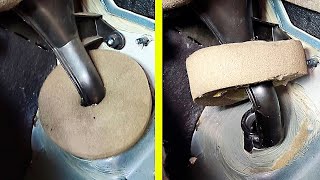
The 2004 Audi A6 (C5 platform) has a well-documented design vulnerability that is the leading cause of this code. The drains in the plenum area under the windshield (one under the battery, another near the brake booster) are prone to clogging with leaves and debris. When this happens, rainwater backs up and floods two critical electronic modules: the ECM, located in a supposedly sealed box in the plenum, and the Transmission Control Module (TCM), located under the passenger-side carpet. A U0100 code on this specific car is less likely to be a random wiring fault and more likely a direct result of this water intrusion, a fact frequently discussed in owner forums.
🎬 Watch: How water leaks cause major transmission problemsSymptoms You May Notice
- Check Engine Light is on
- Vehicle will not start, or cranks but does not fire
- Engine stalls intermittently while driving
- Transmission is stuck in 'limp mode' (usually one gear)
- PRNDS (gear indicator) on the dashboard is fully illuminated or flashing
- EPC (Electronic Power Control) and/or ABS lights are on
- No communication with the engine control module using a scan tool
- Replacing the ECM without first checking for water damage in the TCM, or vice-versa. The U0100 code can be logged in a good module when a different failed module brings down the network.
- Replacing the battery without checking for parasitic drain caused by a water-damaged module.
- Replacing modules without first thoroughly cleaning all plenum, sunroof, and A/C drains, leading to a repeat failure.
Most Likely Causes
- Water Damage to Engine Control Module (ECM) 🔴 High Probability → Shop Engine Control Module (ECM) The ECM is located in the plenum/cowl area, and clogged drains cause water to flood the 'waterproof' electronics box, shorting out the module. This is the #1 cause of ECM failure on this platform.
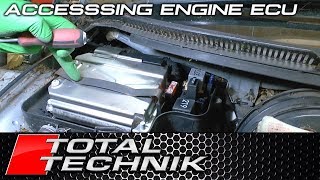
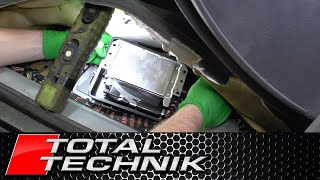
How to confirm: Remove the plastic cowl cover at the base of the windshield. Open the black electronics box (usually on the driver's side, secured by 8mm hex screws) 🎬 See this walkthrough on how to access your engine ECU and inspect for any signs of moisture, corrosion, or a high water mark. The gasket for the box lid is a known failure point.
Typical fix: The ECM must be replaced. The immobilizer data from the old ECM must be transferred to the replacement unit via a 'cloning' service, or the new module must be programmed by a dealer or specialist. The plenum drains must be thoroughly cleaned to prevent a repeat failure. This involves removing the battery and battery tray to access the primary drain hole.
Est. part cost: $50-$200 (Used/Cloned), $800-$1200 (New) - Water Damage to Transmission Control Module (TCM) 🔴 High Probability → Shop Transmission Assembly The TCM is located in a plastic box under the carpet in the passenger footwell. Clogged plenum, sunroof, or A/C evaporator drains cause water to pool in this area, submerging and destroying the module.
How to confirm: Pull back the passenger-side front carpet and padding. If it is wet or damp, remove the black plastic cover for the TCM and inspect the module and its wiring harness for corrosion. A musty smell in the cabin is a strong indicator.
Typical fix: Replace the TCM. The wiring connector often needs to be replaced as well due to corrosion. The replacement module may need to be coded to the vehicle. The source of the water leak (plenum, sunroof, or A/C drain) must be found and fixed.
Est. part cost: $200-$500 (Used), $700-$1200 (Remanufactured) - Low Battery Voltage or Faulty Battery 🟡 Medium Probability → Shop Vehicle Battery All modern cars are sensitive to low voltage. A weak battery can cause unpredictable communication errors between modules before it gets weak enough to prevent starting.
How to confirm: Test the battery with a multimeter. A healthy, resting battery should be at or above 12.6 volts. Test its ability to hold a load. Check battery terminals for corrosion.
Typical fix: Clean battery terminals and charge the battery. If it fails a load test or is more than 4-5 years old, replace it.
Est. part cost: $150-$250 - CAN Bus Wiring or Connector Fault ⚪ Low Probability While less common than water damage, corrosion can still affect CAN bus junction blocks or wiring, especially in regions where road salt is used.
How to confirm: This requires advanced diagnostics. A technician would check for 60 Ohms of resistance across pins 6 (CAN-H) and 14 (CAN-L) at the OBD-II port. They would also use an oscilloscope to check the network signal. A visual inspection of wiring harnesses for chafing or corrosion is also necessary.
Typical fix: Repair the specific section of damaged wiring or replace the corroded connector.
Est. part cost: $10-$100 (for wiring repair)
Diagnosis Steps
- Scan all vehicle modules for fault codes using a VAG-specific tool like VCDS. Note which modules are not communicating.
- Check battery voltage and terminal connections. Ensure the battery is healthy and fully charged (at least 12.6V).
- CRITICAL: Inspect for water intrusion. Pull up the passenger-side front carpet and check for dampness around the TCM. Check for clogged A/C evaporator drains as a potential source.
- CRITICAL: Inspect the plenum chamber. Remove the cowl cover and check the ECM box for signs of water. Pour water into the plenum area (with electronics protected) to verify the drains under the battery and near the brake booster are clear.
- If water is found, address the source of the leak (clean drains, check sunroof drains) and inspect the affected module (ECM or TCM) and its connector for corrosion. This is the most likely cause.
- If no water is found, the issue is likely electrical. Visually inspect the main engine and transmission wiring harnesses for obvious damage, chafing, or corrosion.
- Perform a CAN bus integrity test. This involves measuring resistance between CAN-High (Pin 6) and CAN-Low (Pin 14) at the DLC (should be ~60 Ohms). This is an advanced step and may require a professional.
- If all wiring and other modules check out, the ECM itself may have failed internally.
Parts You'll Likely Need
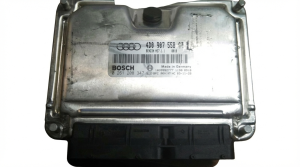
- Engine Control Module (ECM)
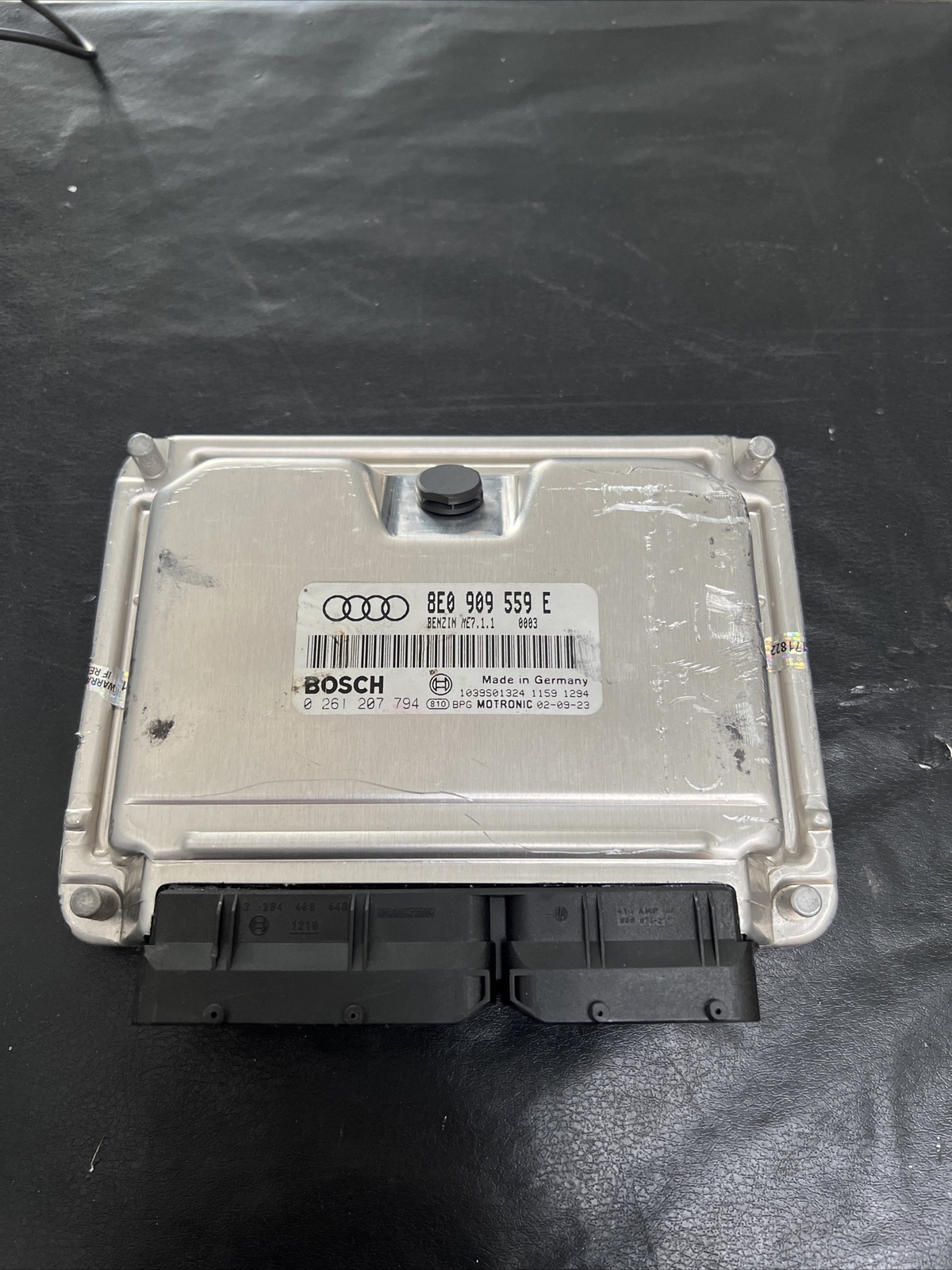
(OEM #8E0909559R)— Frequently fails due to water damage from clogged plenum drains. A failed ECM will not communicate, setting this code. Part number 8E0909559RX is a factory-remanufactured unit and is also compatible.
Trusted brands: Bosch (OEM), Remanufactured/Cloned Service
OEM price range: $1000-$1500
Aftermarket price range: $50-$200 (Used, requires cloning) - Transmission Control Module (TCM)
(OEM #01J927156JG)— Commonly fails due to water damage from clogged drains flooding the passenger footwell. A failed TCM can bring down the entire powertrain CAN bus. This part number is for the CVT transmission; verify based on your vehicle's specific transmission.
Trusted brands: Bosch (OEM), Remanufactured Service
OEM price range: $1000+
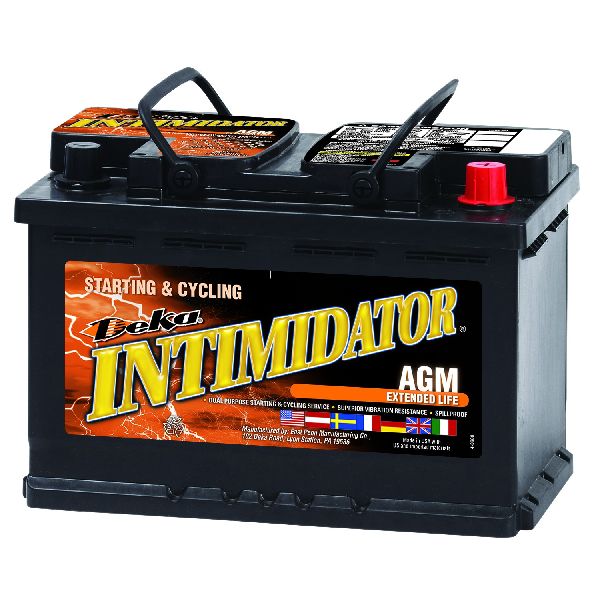
Aftermarket price range: $200-$700 (Remanufactured) - Battery — Low system voltage from a weak battery can cause communication faults between modules.
Trusted brands: Varta, Bosch, Interstate
OEM price range: $200-$300
Aftermarket price range: $150-$250
Related Codes That Often Appear With This One
- U0100 — Loss of communication with ECM. As noted in a cross-manufacturer report (NHTSA ODI #11218134), this can manifest as a vehicle that takes multiple cranks to start, regardless of whether the engine is warm or cold.
- U0101 — Indicates 'Lost Communication with TCM'. If both U0100 and U0101 are present, it strongly suggests a network-wide issue, often pointing back to a faulty TCM or a major wiring problem.
- P0606 — Indicates 'ECM/PCM Processor Fault'. This code points directly to an internal failure of the engine computer and is often seen when the ECM itself is the source of the U0100 code.
- P0700-P0799 — These are transmission-related codes. Their presence alongside U0100 strongly suggests the root cause is related to the TCM or transmission wiring.
Technical Service Bulletins (TSBs) & Recalls
- While no TSB explicitly links U0100 to water leaks on the C5 A6, TSBs for other Audi platforms (like TSB 2060335/4 for the C8 platform) document the manufacturer's awareness of body seam issues causing water ingress, a conceptually similar problem.
Platform-Specific Known Issues
- Clogged Plenum Drains: The rubber drains under the battery tray and in the cowl area are poorly designed with small outlets that are easily blocked by leaves and debris, leading to water overflowing into the cabin and electronics boxes.
- Clogged Sunroof Drains: The four sunroof drains (one at each corner) can become clogged, with the front drains typically exiting near the door hinges and the rears in the wheel wells. Clogs can cause water to back up and stain the headliner or run down the A-pillars into the footwells.
- Clogged A/C Evaporator Drain: A clog in the A/C drain can also cause water to back up and spill into the passenger footwell, directly onto the TCM.
Mechanic-Grade Diagnostic Values
- CAN Bus Resistance (Power Off) — expected: ~60 Ohms. Failure: A reading of ~120 Ohms indicates one of the two terminating resistors (in the ECM or Instrument Cluster) is offline or the wiring to it is broken. A reading of 0 Ohms indicates a short between CAN-H and CAN-L. An open-loop/infinite reading indicates a break in both CAN lines.
- CAN-High Voltage (Key On, Engine Off) — expected: ~2.5V to 3.5V. Failure: Voltage significantly outside this range, or a steady 0V or 5V, indicates a short or open on the CAN-High wire.
- CAN-Low Voltage (Key On, Engine Off) — expected: ~1.5V to 2.5V. Failure: Voltage significantly outside this range, or a steady 0V or 5V, indicates a short or open on the CAN-Low wire.
Scan Tool Commands That Help
- VCDS (VAG-COM): Gateway Installation List (Address 19) — This is a primary diagnostic step. The Installation List shows all modules the CAN Gateway is configured to communicate with and their current status (e.g., 'OK', 'No Communication'). If the Engine module (Address 01) shows 'No Communication', it confirms the U0100 fault from the Gateway's perspective.
- VCDS (VAG-COM): TCM Coding (Address 02) — After replacing the Transmission Control Module (TCM), it must be coded to match the vehicle's specifications (engine, drivetrain, etc.). Failure to code a new or used TCM can prevent it from communicating correctly on the CAN bus, potentially causing a U0100 fault.
- Specialized EEPROM Programmer (e.g., K-Tag, Galletto): ECM Cloning — When replacing the ECM (Bosch ME7.1.1), the immobilizer data from the original ECU's EEPROM must be read and written to the donor ECU. This 'cloning' process makes the replacement plug-and-play. Without it, the car will not start due to an immobilizer mismatch.
Wiring & Ground Locations
- Powertrain CAN Terminating Resistor 1 — Inside the Engine Control Module (ECM), located in the electronics box in the plenum chamber.. The ECM contains one of the two 120-Ohm terminating resistors for the powertrain CAN bus. If the ECM fails or its connector is corroded, this resistor is lost, disrupting the entire network and causing a U0100 code.
- Powertrain CAN Terminating Resistor 2 — Inside the Instrument Cluster (Kombi) module.. The Instrument Cluster contains the second 120-Ohm terminating resistor. A failure of the cluster itself or its connector can take down the network and set a U0100, even if the ECM is perfectly fine. This is a common misdiagnosis point.
- Ground Point 12 — In the engine compartment, on the left side frame rail.. This is a primary ground point for engine bay components. A corroded or loose connection here can cause floating grounds and intermittent communication issues for various modules, including the ECM.
- Ground Point 44 — At the base of the driver's side (left) A-pillar, behind the kick panel.. This is a major grounding point for interior electronics, including the Instrument Cluster and CAN bus connections. Water ingress from a clogged sunroof or plenum drain can corrode this ground, leading to network faults.
- A76 Connection — Described in wiring diagrams as an 'in-harness connection' where the K-Line diagnostic wires from various modules splice together, typically near the instrument cluster.. While U0100 is a CAN bus code, a short to ground on the K-Line (often from a faulty radio, ABS, or airbag module) can prevent a scan tool from communicating with any module, making diagnosis impossible. Finding and disconnecting the faulty module from this splice point can restore diagnostic capability.
Real Owner Repair Stories
- AudiWorld Forums (1998 Audi A6 (C5 Platform)) — VCDS scan tool would not communicate, reporting 'K1 short to ground'.
❌ Tried (didn't work) Disconnecting the ECU, TCM, ABS module, radio, climate control, and instrument panel one by one.
✅ What actually fixed it The final module to be disconnected was the Airbag (SRS) module. Disconnecting it resolved the K-line short and allowed the scan tool to communicate again, indicating an internal failure of the SRS module was blocking all diagnostics. - quattroworld.com Forums (2001 Audi Allroad (C5 Platform)) — VAG-COM reported 'K-Line shorted to ground' with key on, preventing communication.
❌ Tried (didn't work) General troubleshooting of wiring.
✅ What actually fixed it After consulting wiring diagrams, the owner disconnected the Steering Wheel Multifunction Control Module. This immediately cleared the K-Line short, allowing VAG-COM to communicate with the car again. The module itself had failed internally.
OEM Part Supersession History
01J927156JG→This part number has multiple compatible hardware versions from Temic/Continental (e.g., 00402516A1) and can be cross-referenced with other Audi part numbers like 4F1910155D.— Software updates and minor hardware revisions.
Heads up: The suffix (e.g., 'JG', 'HH', 'HT') is critical as it denotes the software calibration for a specific engine and vehicle configuration. While some may be physically interchangeable, using the wrong suffix can lead to shifting problems or communication errors. Always match the part number and suffix or use a specialist who can re-flash the module.
Diagnostic Flowchart
Other Known Issues on This Vehicle
Issues unrelated to this code that are worth knowing about as an owner of this generation:
- Front Control Arm Bushing Failure 🔴 High — Extremely common. Bushings often fail after 40,000-60,000 miles, causing clunking noises over bumps, steering vibrations, and uneven tire wear. It is often recommended to replace the entire 8-piece front control arm kit rather than individual arms.
- Excessive Oil Consumption 🟠 Medium — Common on higher mileage AVK engines. Often attributed to failing PCV systems, hardened valve stem seals, or piston rings clogged with carbon. Some owners have reported success with piston soak procedures. (Ref: Class action lawsuits have been filed for oil consumption on later Audi engines, but not specifically for the 3.0L AVK.)
- Timing Belt Maintenance 🔴 High — The 3.0L AVK is an interference engine with a timing belt. The recommended replacement interval is critical (typically 75,000 miles). Failure to replace the belt, tensioners, and water pump can lead to catastrophic engine failure.
- Oil Leaks from Gaskets and Seals 🟠 Medium — Very common as the vehicle ages. Leaks frequently develop from the valve cover gaskets, camshaft adjuster seals, and rear coolant flange.
- Variable Intake Manifold Linkage Failure 🟡 Low — The plastic arms and bushings for the variable length intake manifold runners can break or wear out, leading to a rattling noise from the engine and a loss of power, often setting fault codes for the intake runner.
- Ignition Coil Failure 🟡 Low → Shop Ignition Coil — Ignition coils can fail, leading to misfires (P0300-P0306). This was common enough on some VAG models of this era that service campaigns were issued. (Ref: Check with dealer for potential service campaigns based on VIN.)
Used vs. New Parts: Buying Guide for This Vehicle
When a used part is the smart pick: A used ECM is a very common and cost-effective repair, but ONLY if you use a cloning service to transfer the immobilizer data from your original module to the used one. A used TCM can also be an option, but its high failure rate makes it a gamble; a remanufactured unit is often a safer bet.
Donor-vehicle mileage cap: roughly under 80000 miles for the part to have meaningful remaining life.
What to inspect on the donor part:
- For ECM/TCM: Ask for a photo of the module's connector pins to check for any corrosion or damage.
- Verify the donor car was not involved in a flood.
- Ensure the part number, including the suffix letters (e.g., 'JG' for the TCM), is an exact match to the original part.
- Prefer sellers who guarantee the part is tested and working.
Aftermarket brands forum-validated for this vehicle:
- For TCM: Remanufacturing services from specialists like XeMODeX or Module Repair Pro are well-regarded in forums as they address the original design flaws.
- For ECM: Bosch (OEM). Cloning services are widely available and reliable for transferring data to a used Bosch unit.
Brands owners have reported issues with on this vehicle:
- Generic, unbranded TCMs from non-specialist sellers on platforms like AliExpress or eBay can be risky, as they may have incorrect software or be untested.
Real Owner Stories
Aggregated from forums and TSBs cited above. Mileages and costs reflect what owners reported in those sources.
2004 Audi A6 3.0L V6
Symptoms: The user found a fried TCM due to water intrusion in the passenger compartment.
What fixed it: Cleaning the plenum drains under the battery to prevent further leaks and replacing the damaged TCM.
Source hint: AudiForums.com thread titled 'Plenum Drains - AudiForums.com'
2004 Audi A6 4.2L (C5 Platform)
Symptoms: Water leakage into the passenger compartment from cowl and sunroof drains.
What fixed it: Clearing the cowl and sunroof drains which are known failure points on the C5 platform.
Source hint: AudiWorld Forums thread titled 'Water leakage into passenger compartment. (A6 4.2)'
2004 Audi A6 (C5 Platform)
Symptoms: Water leak on the driver side of the vehicle.
What fixed it: Checking and clearing the two main plenum drains, specifically the one under the battery and the one near the heater hoses.
Source hint: AudiWorld Forums thread titled 'Water leak, driver side'
Audi Owner Report
Symptoms: An owner reported that the vehicle sometimes requires multiple cranks to start, regardless of whether the engine is warm or cold. A scan revealed code U0100 indicating a loss of communication with the ECM.
Source hint: NHTSA ODI #11218134
Related OBD-II Codes
Frequently Asked Questions
Where is the Transmission Control Module (TCM) located on my 2004 Audi A6?
My 2004 A6 has a flashing PRNDS indicator and won't start. Is this related to U0100?
Does TSB 2060335/4 apply to my 2004 Audi A6?
How can I prevent water from destroying my Engine Control Module (ECM)?
Can I just swap in a used ECM to fix the U0100 code?
Why is my passenger floor wet, and could it cause a U0100 code?
Helpful Videos

Used OEM Parts in Stock
New Aftermarket Parts Available

The information in this article is provided for general reference and educational purposes only. Vehicle specifications, procedures, and part compatibility can vary by production date, trim level, and region. Always consult your vehicle's factory service manual and verify part numbers before purchasing or performing repairs. Safety-critical components such as airbags, seat belts, and braking systems should be installed by a qualified professional.
- Audi A6:
- 🧭 Diagnostic Flowchart
- 🎬 Helpful Videos
- 🛍️ Shop This Part
- What's Unique About the 2004-2004 Audi A6
- Symptoms You May Notice
- Most Likely Causes
- Diagnosis Steps
- Parts You'll Likely Need
- Related Codes That Often Appear With This One
- Technical Service Bulletins (TSBs) & Recalls
- Platform-Specific Known Issues
- Mechanic-Grade Diagnostic Values
- Scan Tool Commands That Help
- Wiring & Ground Locations
- Real Owner Repair Stories
- OEM Part Supersession History
- Other Known Issues on This Vehicle
- Used vs. New Parts: Buying Guide for This Vehicle
- Real Owner Stories
- 2004 Audi A6 3.0L V6
- 2004 Audi A6 4.2L (C5 Platform)
- 2004 Audi A6 (C5 Platform)
- Audi Owner Report
- Related OBD-II Codes
- Frequently Asked Questions
- 🎟️ Get 5% Off