

U0100 on 2007-2014 Chevrolet Suburban: Lost Communication with ECM/PCM Fixes
U0100 on a 2007-2014 Suburban means the Engine Control Module (ECM) has lost communication with other vehicle modules. This is often caused by a wiring issue at the 16-way transmission connector, a poor engine ground, or a weak battery. Check battery voltage, ground straps on the engine block, and the transmission harness before suspecting a bad ECM.
- U0100 on your Suburban is a serious communication error, not a simple sensor failure.
- Before suspecting an expensive ECM failure, thoroughly check the battery, all ground connections, and fuses.
- Pay special attention to the large electrical connector on the transmission; it is a known weak point on this vehicle for causing this exact code.
- Due to the complexity of network diagnostics, professional help is strongly recommended if the initial checks don't reveal an obvious problem.
- This code is often accompanied by other communication codes (U0101, U0073), which can help a technician narrow down the fault.
What's Unique About the 2007-2014 Chevrolet SUBURBAN

The GMT900 platform, which includes the 2007-2014 Suburban, is known for specific wiring vulnerabilities that can trigger a U0100 code. A key issue, identified in GM's own service bulletin #08-07-30-021H, involves poor connections or corrosion in the 16-way electrical connector at the transmission (also known as the T43 connector). Water intrusion or simple vibration can disrupt the high-speed GMLAN communication lines (TAN and TAN/BLK wires) that run through this harness, leading to intermittent communication loss between the ECM and TCM. Additionally, engine ground straps, particularly G103 and G104 on the cylinder heads, are known to corrode or break, causing unstable voltage that disrupts module communication.
Diagnostic Flowchart

Tap your situation to follow the diagnostic path that matches what you're seeing on this vehicle.
Symptoms You May Notice
- Check Engine Light is on
- Engine may not crank or is hard to start, sometimes with a long crank time.
- Transmission may not shift or defaults to a single gear (limp mode).
- Intermittent stalling while driving, sometimes when shifting into reverse as the engine torques.
- "Service Stabilitrak" or "Traction Control Off" message on the Driver Information Center (DIC).
- Instrument panel gauges fluctuate wildly or go completely dead.
- Gear position indicator (PRNDL) may disappear from the dash display.
- Warning lights for ABS, Stabilitrak, or Airbags may illuminate.
- Door locks may cycle on their own.
- Reduced engine power or "limp mode".
- Replacing the ECM without first thoroughly checking all wiring, power, and ground connections. A wiring fault is a much more common and less expensive cause for this code.
- Replacing the transmission or Transmission Control Module (TCM) when the issue is only a bad connection at the transmission harness.
Most Likely Causes

- Wiring/Connector Issues at Transmission Harness 🔴 High Probability → Shop Transmission Assembly A widely-referenced GM Technical Service Bulletin (#08-07-30-021H) specifically points to problems with the 16-way transmission connector on this platform. Terminals for the GMLAN bus (often TAN and TAN/BLK wires) can back out, corrode, or the terminal position assurance (TPA) lock may not be fully seated, disrupting communication.
How to confirm: Visually inspect the large connector on the driver's side of the transmission for any signs of corrosion, moisture, or backed-out pins. Wiggle the connector while the vehicle is running to see if symptoms appear. A technician would check for 60 ohms of resistance across pins 6 and 14 of the OBD-II port with the battery disconnected to verify the main bus integrity.
Typical fix: Disconnect, clean the connector terminals with electrical contact cleaner, apply a liberal amount of dielectric grease to seal out moisture, and ensure the connector is fully seated and locked. In cases of heavy corrosion or damaged terminals, a new connector pigtail may need to be spliced in.
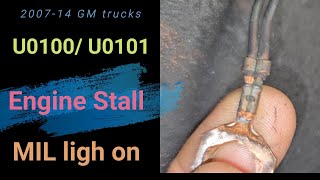
Est. part cost: $20-$75 - Poor Ground Connections 🟡 Medium Probability Vibrations and exposure to elements cause critical ground straps to loosen or corrode. On the GMT900 platform, the grounds on the front and rear of the cylinder heads (G103, G104) are frequent culprits. In one documented case, the small ground wire broke inside the ring terminal lug where it attached to the engine block, causing intermittent stalls only when the engine torqued.
How to confirm: Inspect all major ground points, especially the main engine-to-chassis ground strap and the smaller ground wires bolted to the cylinder heads. Look for green/white corrosion or looseness. A voltage drop test from the ground point to the negative battery terminal should show less than 0.1 volts.
Typical fix: Remove the ground bolt/nut, thoroughly clean the ring terminal and the mounting surface with a wire brush or sandpaper until shiny, then securely re-tighten. Applying dielectric grease before reattaching can prevent future corrosion.
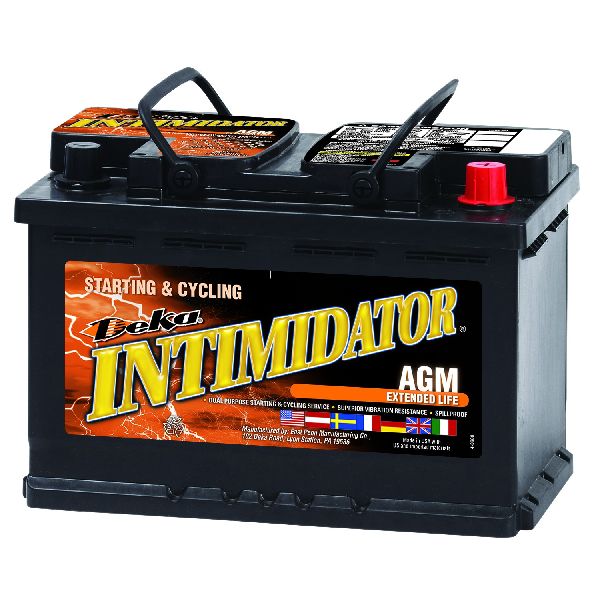
Est. part cost: $5-$50 - Weak or Failing Battery 🟡 Medium Probability → Shop Vehicle Battery Modern vehicles are highly sensitive to voltage. A battery that provides low voltage during startup can cause communication modules to glitch and fail to initialize properly, triggering a flood of network codes like U0100. This is one of the most common first-step checks suggested in owner forums.
How to confirm: Test the battery with a multimeter. A healthy, fully charged battery should read at least 12.6 volts with the engine off. Test it under load during cranking; a significant voltage drop below 9.6V indicates a weak battery. Many auto parts stores will load test your battery for free.
Typical fix: Recharge or replace the battery. Ensure battery terminals are clean and tight.
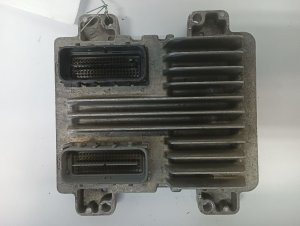
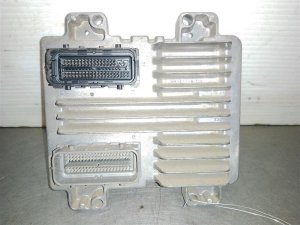
Est. part cost: $150-$300 - Faulty Engine Control Module (ECM) ⚪ Low Probability → Shop Engine Control Module (ECM) The E38 ECM used in these trucks can fail internally, though it's less common than wiring issues. Failure can be caused by heat, vibration, or internal shorts.
How to confirm: This is a last resort after all wiring, power, and ground issues have been ruled out. A key symptom is a no-start condition where the check engine light does not illuminate at all when the key is turned to 'ON'. A professional scan tool will fail to establish communication with the ECM, while still being able to talk to other modules like the TCM or BCM.
Typical fix: Replace the ECM. The new module must be programmed with the vehicle's VIN and specific software. Example service numbers include 12633238 or 12633055. 🎬 Watch: Diagnosing a no-start condition caused by a bad ECM This programming is typically done by a dealer or a specialized shop with the correct tools.
Est. part cost: $300-$800
Rare But Worth Checking
- Faulty CAN Bus Termination Resistor: The CAN bus network has a 120-ohm resistor at each end. If one of these fails, it can take down the entire network. On many GM vehicles, one resistor is in the ECM and the other is in a separate module (sometimes the Instrument Panel Cluster). Diagnosis involves measuring the resistance across the CAN bus pins (Pin 6 and Pin 14) at the OBD-II port with the battery disconnected. A healthy reading is approximately 60 ohms. A reading of 120 ohms suggests one resistor or the wiring to it has failed.
- Faulty Ignition Switch: → Shop Ignition Switch A worn or faulty ignition switch can cause momentary power drops to various modules as the key is turned or jiggled. This power interruption can cause modules to drop off the communication network, triggering U-codes. If symptoms seem related to key position, this is a possible cause.
Diagnosis Steps
- Check the battery voltage and inspect terminals for corrosion. Ensure the battery is fully charged and passes a load test.
- Scan for all codes in all modules. Note any other 'U' codes, as they can help pinpoint the location of the network failure.
- Inspect all relevant fuses in the underhood fuse block. Pay close attention to fuses labeled ECM, TCM, BCM, and any large 'STUD' fuses, like STUD #2, which can be related to module power.
- Perform a thorough visual inspection of the main engine wiring harness. Focus on the 16-way connector at the transmission for damage or corrosion, as noted in TSB #08-07-30-021H. Also check for harnesses rubbing on chassis or engine components.
- Inspect major ground connections. Check the main battery-to-chassis ground and specifically the grounds on the engine cylinder heads (G103, G104). Ensure they are clean, tight, and free of corrosion.
- With the battery disconnected, measure the resistance between Pin 6 (CAN High) and Pin 14 (CAN Low) at the OBD-II diagnostic port. The reading should be approximately 60 Ohms. A reading of 120 Ohms or an open circuit points to a problem with a termination resistor or the bus wiring itself.
- If a no-start condition exists, turn the key to the 'ON' position and observe the Check Engine Light. If it does not illuminate for a bulb check, it strongly suggests the ECM is not powering up or communicating.
- If the problem persists, professional diagnosis with a scan tool that can monitor CAN bus traffic is required to isolate the faulty module or wiring section.
Parts You'll Likely Need
- Engine Control Module (ECM)
(OEM #Varies by year/engine, e.g., ACDelco Service #12612384, 12633238, 12597121)— This is the part to replace only after all other diagnostic steps (wiring, power, grounds) have been exhausted. A failed ECM cannot communicate with the rest of the vehicle.
Trusted brands: ACDelco (OEM)
OEM price range: $400-$800
Aftermarket price range: $250-$500 - Battery — A weak or failing battery is a common cause of network communication codes due to low voltage during startup.
Trusted brands: ACDelco, DieHard, Optima
OEM price range: $200-$300
Aftermarket price range: $150-$250 - Wiring Harness Connector/Pigtail
(OEM #GM 15131300 / 19303772 (16-way transmission connector))— If the 16-way transmission connector is damaged by corrosion or heat, replacing the connector pigtail is the proper repair.
Trusted brands: ACDelco, Kostal, ICT Billet
OEM price range: $45-$90
Aftermarket price range: $25-$50 - Engine Ground Strap
(OEM #e.g., GM 19434466)— If the main engine-to-chassis or cylinder head ground straps are corroded or broken, they must be replaced to ensure stable module operation.
Trusted brands: ACDelco (OEM), Dorman
OEM price range: $20-$40
Aftermarket price range: $10-$25
Related Codes That Often Appear With This One
- U0101 — Lost Communication with TCM. Since the transmission harness is a common failure point, it's frequent to see a specific TCM communication loss code alongside the general ECM code.
- U0073 — Control Module Communications Bus OFF. This is a more general code indicating the entire high-speed communication bus has shut down, which can happen as a result of the fault that triggers U0100.
- P0700 — Transmission Control Module (TCM) Requested MIL Illumination. This code means the TCM has detected a fault (like losing communication) and has asked the ECM to turn on the Check Engine Light. It often accompanies communication codes when shifting is affected.
Technical Service Bulletins (TSBs) & Recalls
- 08-07-30-021H
Platform-Specific Known Issues
- A known issue documented in TSB #08-07-30-021H points to the 16-way transmission harness connector as a primary source of GMLAN communication loss, causing codes U0100, U0101, and others. Symptoms include no-shift conditions, gauge fluctuation, and no-crank situations. The fix involves inspecting and repairing the terminals in that specific connector.
Mechanic-Grade Diagnostic Values
- GMLAN Bus Resistance — expected: Approximately 60 Ohms. Failure: A reading of ~120 Ohms indicates an open in the bus or a faulty termination resistor. A reading significantly less than 60 Ohms indicates a short between the CAN high and low wires.
- GMLAN Bus Voltage (Key On, Engine Off) — expected: CAN High (Pin 6) and CAN Low (Pin 14) should both rest at approximately 2.5V. When communicating, CAN High should pulse to ~3.5V and CAN Low should pulse to ~1.5V.. Failure: Voltages shorted to ground will read 0V. Voltages shorted to power will read 12V. If the two wires are shorted together, the voltage will equalize and no communication will occur.
- Ground Point Voltage Drop — expected: Less than 0.1 Volts (100 millivolts). Failure: A reading higher than 0.1V indicates high resistance in the ground circuit, which can cause intermittent module behavior.
Scan Tool Commands That Help
- GDS2 (GM Global Diagnostic System 2): Data Bus Diagnostic Tool — This function, available in GDS2 for 2015 and later models but conceptually applicable to earlier diagnostics, helps identify which modules are and are not communicating on the network. It can perform a 'Detected State' test to list all responsive modules, helping to isolate the location of a break or shorted module.
- GDS2 / Tech2: Module Isolation — A common manual technique is to disconnect modules one by one from the CAN bus to see if communication is restored. For GMT900s, a key point to do this is by disconnecting the C3 (X3) connector from the instrument panel junction block, which splits the bus into two halves. If communication returns to the ECM/TCM/BCM side, the fault is in the disconnected half.
Wiring & Ground Locations

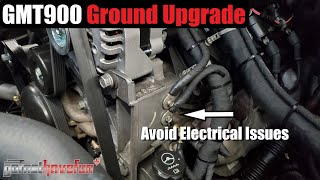
- G103 — On the front of the passenger side (right) cylinder head.. This is a primary engine ground. Corrosion or looseness here can cause unstable voltage to the ECM and other modules, leading to communication codes like U0100.
- G104 — On the rear of the driver side (left) cylinder head, near the brake booster. A ground strap often runs from here to the firewall (G108).. This is another critical engine ground. A documented failure involves the wire breaking inside the lug at this point, causing intermittent stalling and communication loss when the engine torques.
- SP205 — A splice pack for the data bus, typically located in the driver's side kick panel area, under the sill plate.. This is a junction point where multiple data lines come together. Water intrusion or corrosion in this splice pack can take down the entire communication network, causing widespread U-codes.
- Underhood Fuse Block (UBEC) — Driver's side of the engine bay.. The fuse block itself can be a point of failure. Corrosion can form on the internal bus bars or on the underside where harnesses connect, leading to intermittent power loss to the ECM or other modules and triggering U0100.
- E38 ECM Connectors (X1 & X2) — The ECM is located on the driver's side of the engine bay, near the fender.. The High-Speed GMLAN wires are on pins 27 (CAN-) and 28 (CAN+) of the X1 connector. Poor connection or corrosion at these specific pins can cause a U0100 code.
Real Owner Repair Stories
- YouTube channel 'WillPowered Garage' (2007-2014 Tahoe/Suburban platform) — Intermittent stalling, especially when shifting into reverse. Codes U0100 and U0101 (Lost communication with ECM and TCM).
❌ Tried (didn't work) Initial diagnosis pointed towards oil pressure issues, which was a red herring.
✅ What actually fixed it The root cause was a broken ground wire at the G104 location (rear of driver's side cylinder head). One of the smaller wires had broken all its strands inside the ring terminal lug. The connection was intermittent, failing only when the engine torqued, which explained the stalling in reverse. The fix was to cut back the wire and crimp on a new ring terminal. - DuramaxDiesels.com forum user (Duramax-powered truck (similar GMT900 electrical architecture)) — U0100, P0700, P0181, P0116 codes.
❌ Tried (didn't work) N/A
✅ What actually fixed it A loose negative battery cable on the driver's side battery was found. Tightening the battery terminal and clearing the codes resolved the issue completely. - Chevy HHR Network forum user (similar GM CAN bus logic) (Chevrolet HHR) — No crank/no start, hard shifting, loss of power steering, DIC dropping out. Code U0100 set. Symptoms appeared when the car's interior was very hot.
❌ Tried (didn't work) Jump starting provided a temporary start.
✅ What actually fixed it The issue was temporarily resolved by performing a hard reset (disconnecting the negative battery cable for 20 minutes). This suggests the root cause was a module 'locking up' due to heat or a voltage glitch, a condition sometimes referred to as 'brain fart'. While not a permanent fix, it points to a sensitive module rather than a hard wiring fault.
OEM Part Supersession History
12612384→12633238— Standard part evolution, integrating updated hardware or firmware revisions for improved reliability.
Heads up: While 12633238 is a common service replacement for many 2010-2014 models, always verify the correct service number by VIN. Used modules from other vehicles cannot be programmed with factory GM equipment; a new or remanufactured unit is required for dealer programming.
Model Year Variations Within This Range
- 2010-2014: The E38 ECM with service number 12633238 became common starting in the 2010 model year, superseding earlier part numbers. While the fundamental diagnostic approach is the same, using the correct part number for the specific year and VIN is critical if replacement is necessary.
Helpful Videos
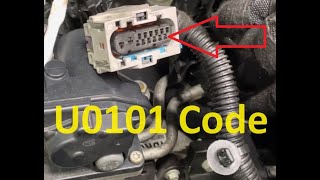
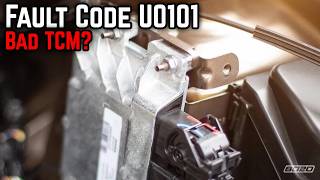
Used OEM Parts in Stock
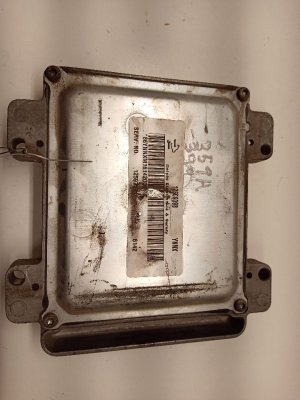
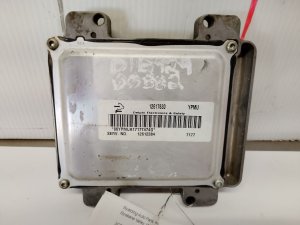
New Aftermarket Parts Available


The information in this article is provided for general reference and educational purposes only. Vehicle specifications, procedures, and part compatibility can vary by production date, trim level, and region. Always consult your vehicle's factory service manual and verify part numbers before purchasing or performing repairs. Safety-critical components such as airbags, seat belts, and braking systems should be installed by a qualified professional.
- Chevrolet SUBURBAN:
- 🧭 Diagnostic Flowchart
- 🎬 Helpful Videos
- 🛍️ Shop This Part
- What's Unique About the 2007-2014 Chevrolet SUBURBAN
- Symptoms You May Notice
- Most Likely Causes
- Rare But Worth Checking
- Diagnosis Steps
- Parts You'll Likely Need
- Related Codes That Often Appear With This One
- Technical Service Bulletins (TSBs) & Recalls
- Platform-Specific Known Issues
- Mechanic-Grade Diagnostic Values
- Scan Tool Commands That Help
- Wiring & Ground Locations
- Real Owner Repair Stories
- OEM Part Supersession History
- Model Year Variations Within This Range
- 🎟️ Get 5% Off