

U0100 on 2019 Fiat 500X: Lost Communication with ECM/PCM Causes and Fixes
On a 2019 Fiat 500X with the 1.3L Turbo engine, U0100 is most often caused by a software glitch that requires a dealer-installed update per TSB #18-039-21. This commonly presents as a no-start or no-crank condition when the ECM gets hotter than 50°C (122°F). [TSB #18-039-21, TSB #18-029-20 REV. A] If the software is up-to-date, the ECM itself is the next likely culprit.
- For a 2019 Fiat 500X, U0100 is very likely a software issue that a Fiat dealer can fix with an update, as specified in two different TSBs.
- Before replacing any parts, check if the software updates from TSB #18-039-21 or #18-029-20 REV. A have been performed.
- A primary symptom specific to this vehicle is a no-start or no-crank condition that appears when the engine bay is hot.
- Do not drive the vehicle. The risk of stalling or being unable to restart is high.
- If the ECM/PCM needs replacement, it requires a special programming procedure called a 'Proxy Alignment' to work with the car.
What's Unique About the 2019-2019 Fiat 500X
The Fiat 500X and its platform-mate, the Jeep Renegade, are known for setting the U0100 code due to specific software and hardware vulnerabilities in vehicles with the 1.3L Turbo engine. Two separate Technical Service Bulletins (TSBs) were issued to address this code with software updates. A particularly common and well-documented symptom on this platform is a no-start condition that occurs specifically when the engine bay gets hot. TSB 18-029-20 REV. A specifies this failure point is when the ECM's temperature exceeds a certain threshold, pointing to either a software logic failure or an ECM that is overly sensitive to temperature changes. [TSB #18-029-20 REV. A]
Diagnostic Flowchart
Tap your situation to follow the diagnostic path that matches what you're seeing on this vehicle.
Symptoms You May Notice
- Check Engine Light is on.
- Vehicle will not crank or start, especially when the engine is hot (above 50°C / 122°F). [TSB #18-039-21, TSB #18-029-20 REV. A]
- Engine stalling intermittently while driving.
- Reduced engine power or 'limp mode'.
- Flashing odometer, indicating a 'Proxy Alignment' issue.
- Hard or delayed starting.
- Multiple warning lights for other systems (like ABS, VSA, EPS) may illuminate simultaneously.
- Replacing the starter motor when a no-crank condition is present. The issue is often the ECM not commanding the starter to engage due to the communication loss or internal fault.
- Replacing other modules (like the TCM or BCM) before confirming the ECM has proper power, ground, and up-to-date software.
Most Likely Causes
- Outdated ECM/PCM Software 🔴 High Probability Fiat issued two separate TSBs (#18-039-21 which supersedes #18-029-20 REV. A) to fix this code with a software update, indicating it's a widespread, known issue specifically for the 1.3L Turbo engine. [TSB #18-039-21, TSB #18-029-20 REV. A, 7]
How to confirm: A Fiat dealer or a properly equipped independent shop can check the vehicle's VIN against the TSBs to see if the software update has been performed. This should always be the first step.
Typical fix: The dealer performs a software reflash of the ECM/PCM using the wiTECH diagnostic tool. The TSB indicates this is a warrantable repair. [TSB #18-039-21, 31]
Est. part cost: $0-$200 - Faulty Engine Control Module (ECM/PCM) 🟡 Medium Probability → Shop Engine Control Module (ECM) TSB #18-029-20 REV. A specifically links the U0100 code to a no-crank condition when the ECM gets hotter than a certain temperature, suggesting internal component failure within the module that is sensitive to heat. [TSB #18-029-20 REV. A] If the software flash doesn't work, the module itself is the likely cause.
How to confirm: This is typically a process of elimination. If the software is up to date and all wiring, grounds, and power feeds to the ECM test good, the module itself is the likely culprit, especially if symptoms are heat-related.
Typical fix: Replace the ECM/PCM. The new module must be programmed to the vehicle with a procedure called Proxy Alignment.
Est. part cost: $250-$1200 - Weak or Failing Battery ⚪ Low Probability → Shop Vehicle Battery Modern vehicles like the 500X are highly sensitive to voltage. A weak battery can cause modules to drop off the communication network during startup, triggering communication codes. A fully charged battery should read at least 12.6 volts when the vehicle is off.
How to confirm: Test the battery with a multimeter or a professional battery tester. A resting voltage below 12.4 volts indicates it needs charging or replacement. A load test is more reliable than a simple voltage check.
Typical fix: Recharge or replace the battery.
Est. part cost: $150-$350 - Wiring Harness or Connector Issue ⚪ Low Probability Vibrations and heat can cause wires to chafe or connectors to become loose over time, interrupting signals on the CAN bus. Bad grounds are a common point of failure for communication issues.
How to confirm: Visually inspect the wiring harness going to the ECM for any signs of damage, corrosion, or loose pins. Pay special attention to the main ground straps. Test for power, ground, and CAN bus signal integrity at the ECM connector.
Typical fix: Repair the damaged section of the wiring harness or clean/replace the faulty connector or ground strap.
Est. part cost: $10-$500
Diagnosis Steps
- Check the battery voltage and the condition of the battery terminals. Ensure voltage is above 12.4V and terminals are clean and tight.
- Scan for all Diagnostic Trouble Codes (DTCs) in all modules. Note any other communication codes (U-codes) or performance codes.
- Contact a Fiat dealer with your VIN to check if TSB #18-039-21 has been performed. This is the most likely and crucial first step.
- If the TSB has been done or is not applicable, inspect the wiring harness and connectors at the ECM/PCM for any visible damage, corrosion, or loose pins. Check main power and ground connections for the module.
- If symptoms are heat-related (no-start when hot), try to replicate the condition. Once it fails, carefully attempt to cool only the ECM (e.g., with an electronics-safe canned air duster held upside down) to see if communication is restored. If it starts after cooling, the ECM is faulty. [TSB #18-029-20 REV. A]
- Using a multimeter, verify proper power and ground signals at the ECM connector according to the vehicle's wiring diagram.
- Test the CAN bus network integrity. Measure the resistance between pins 6 (CAN-H) and 14 (CAN-L) of the OBD-II port; it should be approximately 60 ohms with the battery disconnected. A reading of 120 ohms indicates a break in the circuit or a missing terminating resistor.
- If all wiring, power, grounds, and software are confirmed good, the ECM/PCM is the most likely point of failure.
Parts You'll Likely Need
- Engine Control Module (ECM/PCM)
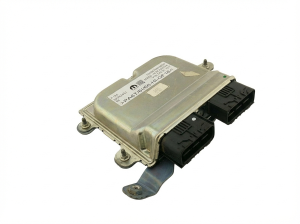
(OEM #68350434AC, 68350434AD)— This is the primary hardware failure associated with U0100 on this vehicle, especially when symptoms are heat-related and a software update has been ruled out. Part number 68350434AD is a common superseding number.
Trusted brands: Mopar
OEM price range: $800-$1200
Aftermarket price range: $250-$600 (Remanufactured/Used) - Battery — A weak battery can cause low voltage issues, leading to communication dropouts between modules. It's a common and relatively simple cause to rule out first.
Trusted brands: Mopar, Interstate, DieHard
OEM price range: $250-$400
Aftermarket price range: $150-$300
Related Codes That Often Appear With This One
- P2110 — TSB #18-039-21 explicitly mentions this code for 'Electronic Throttle Control System - Forced Limited RPM' can be set along with U0100, and is resolved by the same software update. [TSB #18-039-21]
- P2173 — TSB #18-039-21 also lists this code for 'High Airflow/Vacuum Leak Detected' as being potentially set with U0100 and addressed by a software update. [TSB #18-039-21]
- P0607 — This code for 'ECU Internal Performance' is mentioned in TSB #18-039-21. Its fault-setting logic was changed from a one-trip to a two-trip fault in the same software update that addresses U0100. [TSB #18-039-21]
Technical Service Bulletins (TSBs) & Recalls
- 18-039-21: Supersedes the earlier TSB. Involves a PCM software reflash to fix U0100, a hot no-crank condition (above 50°C/122°F), and codes P2110, P2173, and P0607. [TSB #18-039-21]
- 18-029-20 REV. A: An earlier version of the TSB, now superseded, that first identified the U0100 code linked to a no-crank condition when the ECM gets hot. [TSB #18-029-20 REV. A]
Platform-Specific Known Issues
- A known issue, addressed by TSB #18-039-21, is a no-crank condition when the ECM gets hotter than 50°C (122°F). [TSB #18-039-21]
- TSB #18-039-21 also addresses U0100 in conjunction with throttle body and airflow codes (P2110, P2173), which can be resolved with the same software update. [TSB #18-039-21]
- The issue is not unique to the 500X; it is also documented on the Jeep Renegade with the same 1.3L engine, confirming a platform-wide vulnerability.
Mechanic-Grade Diagnostic Values
- CAN Bus Network Resistance — expected: ~60 Ohms. Failure: A reading of ~120 Ohms indicates a missing terminating resistor or a break in the wiring. A reading near 0 Ohms indicates a short between the CAN High and CAN Low wires.
- CAN Bus Voltage (Key On, Engine Off) — expected: CAN High (Pin 6 to ground) should be ~2.5V to ~3.5V. CAN Low (Pin 14 to ground) should be ~1.5V to ~2.5V.. Failure: Significant deviation from these voltages, or voltage that is stuck high or low, indicates a faulty module transceiver or a short to power/ground on the bus.
Hidden / Shadow Codes Worth Checking
- P0000-00: According to FCA TSB 18-119-16 for a similar platform, the scan tool may display this code when the actual fault is P0326-00 (Knock Sensor 1 Circuit Performance). (see via This may appear on a wiTECH scan tool or other professional scanners when a knock sensor fault is present.)
Scan Tool Commands That Help
- wiTECH or equivalent professional scanner: Proxy Alignment Procedure — This procedure is mandatory after replacing the ECM, BCM, or certain other modules. It copies the vehicle's configuration from the Body Control Module (BCM) to the new module, allowing it to function. A flashing odometer is the primary symptom indicating a proxy alignment is needed.
- wiTECH: Reprogram ECU / Flash Module — This function is used to install the updated software as specified in TSBs #18-039-21 and #18-029-20 REV. A to resolve the U0100 hot no-start condition. A stable battery charger providing 13.2-13.5 volts is required during the process.
- wiTECH: Clear All DTCs — This function should be run after any module reprogramming (flash) to clear any faults that were set during the update process.
Wiring & Ground Locations
- Main Engine/Transmission Ground Strap — A thick, often braided copper cable running from the transmission case or engine block to the vehicle's chassis/frame, typically located underneath the battery tray area.. This strap provides the main ground path for the powertrain. If it becomes corroded or broken, it can cause unstable voltages and electrical noise, leading to intermittent no-crank conditions and communication codes like U0100. It can be corroded internally and appear fine on visual inspection.
- ECM Main Connectors — The large, multi-pin connectors that plug directly into the Engine Control Module (ECM) in the engine bay.. If these connectors are not fully seated and locked, they can cause intermittent loss of power, ground, or CAN signals to the ECM, directly triggering a U0100 code. Vibration or thermal expansion can be enough to break the connection.
- Body Control Module (BCM) — Located under the dashboard on either the driver's or passenger's side.. The BCM acts as a central hub or gateway for network communications and stores the vehicle's configuration data. A Proxy Alignment procedure copies data from the BCM to other modules.
Real Owner Repair Stories
- Reddit user r/fiat500 (2012 Fiat 500 Sport) — Intermittent no-start, A/C not cooling, electronic throttle light on, codes U0077 and U0100.
❌ Tried (didn't work) Trickle charging the battery, which was tested as 'healthy'., Visual inspection of fuses and the BCM.
✅ What actually fixed it The main ECM connectors in the engine bay were not fully plugged in. Unplugging the large connector cables and replugging them until they were fully seated and locked made a good connection and resolved the communication and electronic throttle issues. - Reddit user r/fiat500 (Fiat 500 (year not specified)) — Intermittent no-crank, no-start. No starter solenoid click.
❌ Tried (didn't work) Replacing the starter motor, which only seemed to fix the issue temporarily.
✅ What actually fixed it The final resolution was a failed clutch switch relay. Bypassing the relay with a wire allowed the vehicle to start consistently. The owner also noted the main ground strap from the body to the transmission was on the verge of failure and replaced it as a preventative measure.
"I Checked Everything" — The Actual Cause
- In one documented case, a vehicle presented with U0100 and other electronic faults where all standard electrical tests and fuse checks were inconclusive. The root cause was discovered to be the main ECM connectors not being fully seated. A simple physical act of unplugging and firmly replugging the connectors until they clicked and locked resolved the communication loss, a fix that standard diagnostic procedures would easily miss.
OEM Part Supersession History
68350434AC→68350434AD— Standard part revision by the manufacturer, likely to improve reliability or address known failure modes like the heat-soak issue.
Heads up: The new part is a direct replacement for the old one, but requires Proxy Alignment to function in the vehicle.
Model Year Variations Within This Range
- 2019+: The 2019 and newer Fiat 500X models with the 1.3L Turbo engine are specifically affected by the software issue causing U0100 with a hot no-start symptom, as addressed in TSBs 18-039-21 and 18-029-20 REV. A. This specific cause and software fix may not apply to earlier model years with different engines.
Helpful Videos

Used OEM Parts in Stock
New Aftermarket Parts Available


The information in this article is provided for general reference and educational purposes only. Vehicle specifications, procedures, and part compatibility can vary by production date, trim level, and region. Always consult your vehicle's factory service manual and verify part numbers before purchasing or performing repairs. Safety-critical components such as airbags, seat belts, and braking systems should be installed by a qualified professional.
- Fiat 500X:
- 🧭 Diagnostic Flowchart
- 🎬 Helpful Videos
- 🛍️ Shop This Part
- What's Unique About the 2019-2019 Fiat 500X
- Symptoms You May Notice
- Most Likely Causes
- Diagnosis Steps
- Parts You'll Likely Need
- Related Codes That Often Appear With This One
- Technical Service Bulletins (TSBs) & Recalls
- Platform-Specific Known Issues
- Mechanic-Grade Diagnostic Values
- Hidden / Shadow Codes Worth Checking
- Scan Tool Commands That Help
- Wiring & Ground Locations
- Real Owner Repair Stories
- "I Checked Everything" — The Actual Cause
- OEM Part Supersession History
- Model Year Variations Within This Range
- 🎟️ Get 5% Off