

U0100 on 2005-2014 Ford Mustang: Lost Communication With PCM Causes & Fixes
On a 2005-2014 Mustang, code U0100 is most often caused by a water leak onto the Smart Junction Box (SJB) in the passenger footwell, leading to corrosion and electrical faults. This leak is a well-documented design flaw. Other common causes include a weak battery or bad ground connections. Fixing the water leak and inspecting or replacing the SJB is the most likely solution.
- Before any other diagnosis, check for water in the passenger footwell; a wet Smart Junction Box (SJB) is the #1 cause of U0100 on a 2005-2014 Mustang.
- Do not immediately assume the PCM has failed. The issue is much more likely to be the SJB, a weak battery, or a bad ground connection.
- Fixing the water leak source is mandatory. Replacing the SJB without sealing the cowl area will only lead to a repeat failure.
- This code is critical and makes the vehicle unsafe to drive due to the risk of stalling or complete shutdown.
- A professional diagnosis may be necessary to test the CAN bus wiring if the battery and SJB inspection do not reveal the problem.
What's Unique About the 2005-2014 Ford Mustang
The S197 generation Mustang (2005-2014) is notoriously prone to a specific issue that directly causes network codes like U0100: water intrusion. Poorly sealed cowl grommets or clogged drains under the windshield allow rainwater to leak directly onto the Smart Junction Box (SJB), which is the central hub for many of the car's electronics and is located in the passenger-side kick panel. This water damage corrodes the SJB and its connectors, leading to a cascade of electrical failures and communication breakdowns between modules. Ford has issued Technical Service Bulletins (TSBs) like 08-26-7 regarding this water leak issue.
Generation note: This guide covers the entire S197 platform, which includes the first generation from 2005-2009 and the updated second generation from 2010-2014. The primary cause of this code, the water leak affecting the Smart Junction Box (SJB), is a well-documented issue across both generations of the S197 platform, with Ford issuing TSB 08-26-7 for 2005-2009 models.
Symptoms You May Notice
- Check Engine Light is on
- Multiple other warning lights (ABS, Traction Control, Airbag, Anti-Theft) may illuminate
- Engine will not crank or start
- Engine stalls unexpectedly while driving
- Transmission may be stuck in one gear (limp mode)
- Erratic or non-functional gauges on the instrument cluster
- Loss of power windows, radio, or interior lights
- Trunk release inoperative
- Shift interlock may not release, preventing shifting from Park
- Replacing the PCM first. PCM failure is uncommon; the problem is far more likely to be in the power supply, grounding, or wiring to the PCM, especially the water-damaged SJB.
Most Likely Causes
- Water Intrusion into Smart Junction Box (SJB) 🔴 High Probability A known design flaw, acknowledged in Ford TSB 08-26-7, involves clogged cowl drains and/or poorly sealed body grommets under the cowl panel. This allows rainwater to overflow the drain area and pour into the cabin through the cabin air filter opening, directly onto the SJB, causing corrosion and short circuits.
How to confirm: Pull back the carpet in the passenger-side footwell and feel for moisture. Check for dampness on the cabin air filter. Access the SJB behind the passenger kick panel and visually inspect its connectors for green or white corrosion, or water stains.
Typical fix: First, the source of the water leak must be found and sealed. This involves removing the cowl panel, cleaning out all leaves and debris from the drains, and potentially removing the rubber drain grommets entirely to prevent future clogs. The grommet holes can be resealed with urethane seam sealer as described in TSB 08-26-7. Then, disconnect the battery, remove the SJB, and clean the module and its connectors with electrical contact cleaner. If cleaning does not restore function, the SJB must be replaced and programmed to the vehicle.
Est. part cost: $250-$500 for a new SJB - Weak or Failing Battery 🟡 Medium Probability → Shop Vehicle Battery Low system voltage can cause unpredictable communication errors between modules on any modern vehicle. Mustangs stored for long periods can experience battery discharge. A parasitic drain from a faulty factory radio is also a known issue on 2005-2010 models.
How to confirm: Test the battery voltage with a multimeter. A healthy, fully charged battery should read approximately 12.6 volts with the engine off. Check the battery terminals for corrosion and ensure they are tight. Perform a load test to confirm battery health.
Typical fix: Recharge or replace the battery. Clean the battery terminals and cable ends.
Est. part cost: $150-$250 for a new battery - Corroded or Loose Ground Wires 🟡 Medium Probability
How to confirm: Visually inspect the main ground connections. Key locations on the S197 include the ground points next to the battery, a strap from the driver's side cylinder head to the firewall, and a ground on the passenger side motor mount area. Test ground circuit resistance with a multimeter; it should be close to 0 ohms.
Typical fix: Remove the ground connection, clean the contact surfaces on the terminal and the chassis until they are bare metal, and re-secure the connection tightly. Apply dielectric grease to prevent future corrosion.
Est. part cost: $0-$10 for cleaning supplies - Damaged CAN Bus Wiring ⚪ Low Probability
How to confirm: Visually inspect the wiring harnesses connected to the PCM and SJB for any signs of physical damage, chafing, or corrosion. A professional would use a multimeter to check for ~60 ohms of resistance across Pin 6 (CAN-H) and Pin 14 (CAN-L) at the OBD-II port with the battery disconnected. Readings of 120 ohms suggest an open circuit or a missing terminating resistor, while 0 ohms indicates a short between the two lines.
Typical fix: Repair or replace the damaged section of the wiring harness. This can be a complex repair best left to a professional.
Est. part cost: $50-$1000+ depending on the extent of damage and labor
Rare But Worth Checking
- Failed Powertrain Control Module (PCM): → Shop Engine Control Module (ECM) PCM failure is rare and should only be considered after all other possibilities (wiring, power, grounds, and other modules) have been exhaustively ruled out.
- Corrupted PCM Software: In some cases, intermittent communication faults can be caused by corrupted module firmware. A PCM reflash using dealer-level software (like FDRS) can resolve the issue. This should be performed by a qualified shop after hardware faults are ruled out.
- Aftermarket Device Interference: Improperly installed aftermarket electronics like remote starters, alarms, or tuners can interfere with the CAN bus network and cause communication codes.
Diagnosis Steps
- Scan for all codes: Use a high-quality OBD-II scanner that can read manufacturer-specific codes (B, C, and U-codes) from all modules, not just the PCM. Note all present codes.
- Check Battery Health: Test the battery voltage and ensure terminals are clean and tight. A voltage below 12.4V can cause communication issues. Load test the battery to ensure it's healthy under load, not just showing surface charge.
- Inspect the Smart Junction Box (SJB): This is the most critical step for a Mustang. Access the SJB behind the passenger-side kick panel. Pull the carpet back and check for any signs of moisture, water stains, or corrosion on the module, its connectors, or the surrounding carpet.
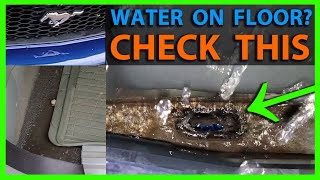
- Address Water Leaks: If water is found, the leak must be repaired before replacing any parts. Remove the plastic cowl panel on the passenger side. Clean out all leaves and debris from the drain area under the cabin air filter housing. Consider removing the rubber drain flap entirely. 🎬 Watch: How to clear plugged cowl drains on your Mustang. Per TSB 08-26-7, inspect and reseal body grommets with urethane sealer if necessary.
- Inspect Grounds: Check the main engine and chassis ground points. Key locations include the body grounds near the battery (G102, G104), the passenger side ground near the hood prop (G103), the engine-to-firewall strap, and the ground on the passenger side motor mount. Ensure they are clean, tight, and free of corrosion.
- Check Fuses: Inspect all fuses related to the PCM and SJB in both the under-hood fuse box (Battery Junction Box) and the SJB itself. Pay special attention to fuses for control modules and the OBD-II port.
- Test CAN Bus Network: This is an advanced step. With the battery disconnected and the car 'asleep', measure the resistance between Pin 6 (CAN-H) and Pin 14 (CAN-L) on the OBD-II port. A healthy network should read approximately 60 ohms. Readings of 120 ohms indicate an open in the circuit or one of the two terminating resistors is offline. A reading of 0 ohms indicates a short between the CAN lines.
- Isolate the Fault: If the above steps don't reveal the issue, the problem is likely a failed module (most likely the SJB), a wiring fault, or a software corruption issue that requires professional diagnosis and potential module programming.
Parts You'll Likely Need
- Smart Junction Box (SJB)
(OEM #BR3T-15604-DA (example for 2010-2014), BR3T-15604-BA (example for 2011). Part numbers are year and option specific.)— This module is highly susceptible to water damage on this platform, which is a primary cause of code U0100. It acts as a central communication hub and body control module. Replacement requires programming.
Trusted brands: Motorcraft
OEM price range: $350-$500
Aftermarket price range: $250-$400 - Battery — Low system voltage from a weak or failing battery is a common cause of network communication faults.
Trusted brands: Motorcraft, Interstate, DieHard
OEM price range: $180-$250
Aftermarket price range: $150-$220 - Urethane Seam Sealer
(OEM #Motorcraft TA-2)— Required to properly seal the cowl grommets and body seams to fix the water leak per Ford's TSB. Silicone is not recommended.
Trusted brands: Motorcraft, 3M
OEM price range: $40-$60
Aftermarket price range: $15-$25
Related Codes That Often Appear With This One
- U0101 — Lost Communication with TCM. If the main CAN bus network is compromised, communication with multiple modules, including the transmission controller, will be lost.
- U0121 — Lost Communication with ABS Control Module. This often appears with U0100 when a network-wide issue like a bad SJB or ground fault is present.
- U0140 — Lost Communication with Body Control Module. On Fords, the SJB acts as the Body Control Module. If the SJB is faulty due to water damage, it will set this code along with U0100.
- U1900 — CAN Communication Bus Fault - Receive Error. This is a general network code that often accompanies more specific 'U' codes when there is a bus problem.
Technical Service Bulletins (TSBs) & Recalls
- WATER LEAK—FRONT FLOOR AREA: Supersedes TSB 07-14-6. Addresses water leaks into the front floor area of 2005-2009 Mustangs, caused by loose cowl grommets, sealer skips, and misaligned weatherstripping. This leak is a direct cause of SJB corrosion.
- Manufacturer Service Bulletin #SSM 54574: While specifically noting the Mustang Mach E, this bulletin describes a "Service Immediately" message and U0100 stored in the ABS module, requiring specific technical instructions to correct.
- Manufacturer Service Bulletin #SSM 54333: Notes that some Ford vehicles may exhibit a no crank/no start condition with multiple warning indicators and DTC U0100 stored in the ABS, ACM, and PSCM.
Platform-Specific Known Issues
- TSB 08-26-7 addresses difficult-to-diagnose water leaks in the front floor area of 2005-2009 Mustangs, caused by loose grommets and sealer skips in the cowl area, which directly leads to SJB failure and codes like U0100.
- Owner forums are filled with accounts of strange electrical behavior (radio staying on, random warning lights, no-start) that were ultimately traced back to a water-damaged SJB.
Mechanic-Grade Diagnostic Values
- HS-CAN Bus Voltage (Key On, Engine Off) — expected: CAN High (Pin 6 at DLC): 2.5V to 3.5V. CAN Low (Pin 14 at DLC): 2.5V to 1.5V.. Failure: Voltages outside these ranges, or a line stuck at 0V or 5V, indicate a wiring fault or a bad module pulling the bus down.
- Ground Circuit Voltage Drop (Under Load) — expected: < 100-200 mV. Failure: A voltage reading higher than 200 millivolts between a ground point and the negative battery terminal indicates high resistance in the ground path, which needs to be cleaned and tightened.
- PCM Power Pin Voltage — expected: ~12.6V (Battery Voltage). Failure: Low or no voltage at the PCM's main power pins indicates a problem with the fuse, relay, or the power supply circuit itself, not necessarily the PCM.
Scan Tool Commands That Help
- Ford IDS (Integrated Diagnostic System): Network Test — This is the primary function to use when a U-code is present. It performs a 'roll call' of all modules on the network and shows which are communicating and which are not, helping to pinpoint the source of the communication breakdown.
- Ford IDS (Integrated Diagnostic System): Programmable Module Installation (PMI) — This function is required when replacing the Smart Junction Box (SJB) or PCM. It downloads the configuration data (As-Built Data) from the old module and uploads it to the new one, ensuring all vehicle options work correctly.
- Ford IDS (Integrated Diagnostic System): Parameter Reset — After replacing a module like the SJB or PCM, a parameter reset may be needed to re-synchronize the security information between the modules (like the keys and instrument cluster) to allow the vehicle to start.
Wiring & Ground Locations
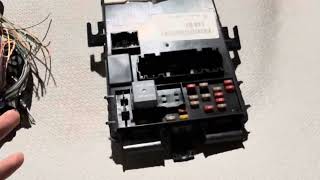
- SJB (Smart Junction Box) — Behind the passenger side kick panel in the footwell.. This is the most common failure point. It is a central communication hub and is highly susceptible to water damage from a known cowl leak, causing widespread network codes like U0100.
- C175B & C175E — These are the main electrical connectors for the Powertrain Control Module (PCM), located in the engine bay.. A fault here directly affects the PCM. The HS-CAN bus wires are on pins 58 (CAN_L, GY-OG) and 59 (CAN_H, WH-BU) of connector C175B. Corrosion or a backed-out pin here will take the PCM offline.
- C2280B — This is one of the large, multi-pin connectors on the Smart Junction Box (SJB).. This specific connector is frequently cited in forums as a location for heavy corrosion due to water intrusion. Cleaning or repairing pins in this connector often resolves multiple electrical issues stemming from a bad SJB.
- G103 / G104 — Main body ground points located in the engine bay, near the battery tray and on the passenger side inner fender.. A poor ground at these primary locations can cause low voltage and electrical noise, disrupting communication between modules and triggering U-codes.
Real Owner Repair Stories
- MustangForums.com user (2011 Ford Mustang V6) — Car would not start, multiple warning lights on the dash, code U0100 present. The anti-theft light was blinking rapidly.
❌ Tried (didn't work) Checking battery and fuses., Inspecting the Smart Junction Box (SJB) for water damage (none was found)., Testing CAN bus resistance (read a perfect 60 ohms).
✅ What actually fixed it The Instrument Panel Cluster (IPC) had failed internally. The IPC acts as a gateway module for the CAN network. Replacing the instrument cluster and having it programmed by the dealer resolved all communication issues and the U0100 code. - TheMustangSource.com user (2007 Ford Mustang) — No dash lights, key fob not working, various electrical problems, and communication codes including U0100.
❌ Tried (didn't work) Initially, the dealer replaced the SJB and fixed the water leak, but the key fob and alarm functions were still incorrect.
✅ What actually fixed it The dealer had failed to properly program the new Smart Junction Box. The owner disconnected an aftermarket sequential turn signal harness, brought the car back, and insisted they reprogram the module correctly. A proper Programmable Module Installation (PMI) procedure restored full functionality.
Documented NHTSA Reports
- NHTSA ODI #11669147: An owner reported experiencing loss of power, mechanical noise, and diagnostic codes including U0100 (lost communication with ECM/PCM) and P0303.
- NHTSA ODI #11704877: A report describes multiple communication fault codes appearing when the ignition is on with the engine off, including U0100, U0131, U0140, and U0151, which disappeared after the engine started.
- NHTSA ODI #11644872: A complaint mentions an illuminated MIL with DTCs U0100 and U0401, referencing service bulletin SSM 49157.
OEM Part Supersession History
e.g., 5R3T-14B476-xx (2005-2006)→e.g., 7R3T-14B476-xx (2007-2009)— Internal revisions and updates by Ford over the model years.
Heads up: It is critical to match the part number exactly when replacing the SJB. While some part numbers from different years may physically plug in, they are not interchangeable due to different programming for vehicle options (coupe vs. convertible, different lighting, etc.). Using the wrong part number can result in features not working.
Model Year Variations Within This Range
- 2005-2009 vs 2010-2014: The Smart Junction Box (SJB) part numbers and internal electronics are different between the pre-refresh (05-09) and post-refresh (10-14) models. While the water leak issue is common to both, the specific SJB part needed for replacement will be different. The 2010+ models have more complex electronics integrated into the SJB.
- 2005-2009: For early S197 models, many owners have found that replacing a faulty SJB with a used unit that has the exact same part number can be plug-and-play without requiring dealer programming. However, this is not guaranteed.
- 2010-2014: For later S197 models, replacing the SJB, even with a used part, is more likely to require programming using Ford's IDS software to configure it to the car's specific options and security system (PATS).
Diagnostic Flowchart
Other Known Issues on This Vehicle
Issues unrelated to this code that are worth knowing about as an owner of this generation:
- Hood Edge Corrosion 🟡 Low — Extremely common across the S197 generation. Bubbling paint appears on the underside of the front hood lip due to contamination during manufacturing. (Ref: TSB 19-2026 addresses aluminum panel corrosion.)
- Automatic Transmission Problems 🟠 Medium → Shop Transmission Assembly — Owners report issues like hard shifting, slipping, and flashing overdrive lights.
- Spark Plug Breakage (4.6L 3V V8) 🔴 High → Shop Spark Plug — The original two-piece spark plugs on the 2005-2008 4.6L 3V engine are famous for breaking off in the cylinder head during removal, requiring a special extraction tool.
- Faulty Throttle Body 🟠 Medium → Shop Fuel Injection Throttle Body — Can cause the vehicle to enter limp mode with reduced power, often setting codes like P2103. (Ref: TSB SSM 46085 revises the diagnostic procedure for electronic throttle bodies.)
- Parasitic Battery Drain from Radio 🟡 Low → Shop Vehicle Battery — On earlier models (approx. 2005-2010), the factory Shaker radio can fail to shut down properly, causing the battery to drain over a few days.
- Erratic Fuel Gauge 🟡 Low — The fuel level sender can fail, causing the gauge to read incorrectly. This may set code P0463.
Used vs. New Parts: Buying Guide for This Vehicle
When a used part is the smart pick: A used Smart Junction Box (SJB) is a very common and cost-effective repair for this vehicle, as Ford no longer produces many of these parts new. Given that the failure is often due to an external water leak, a used part from a dry, undamaged donor car can be a perfectly reliable replacement.
Donor-vehicle mileage cap: roughly under 150000 miles for the part to have meaningful remaining life.
What to inspect on the donor part:
- CRITICAL: Ask the seller for clear, high-resolution photos of all connector ports on the SJB. Look for any hint of white or green powder (corrosion) or water staining.
- Prefer sellers from dry states (e.g., Arizona, California, Texas) to reduce the chance of a water-damaged part.
- Ensure the part number on the used SJB EXACTLY matches the part number on your original unit. Do not rely on year/model alone.
- Buy from a reputable salvage yard or eBay seller that offers a warranty or return policy.
OEM-only on this vehicle (don't cheap out):
- Smart Junction Box (SJB) - While used OEM is common, there are no reliable aftermarket manufacturers for the complete SJB unit. Repair services exist, but quality varies.
Brands owners have reported issues with on this vehicle:
- Avoid generic or no-name electrical connectors or pigtails if repairing the harness. Use OEM-quality terminals when possible to ensure proper pin tension and weather sealing.
Real Owner Stories
Aggregated from forums and TSBs cited above. Mileages and costs reflect what owners reported in those sources.
2005-2009 Ford Mustang
Symptoms: Owner found 4 inches of water on the passenger floorboard after a leak through the cowl area.
What fixed it: The owner cleaned the cowl drains and used urethane seam sealer to repair the leak source as described in the S197 Mustang Forum.
Source hint: How to fix the Water Leak on the Passenger floor | S197 Mustang Forum
2005-2014 Ford Mustang
Symptoms: Water entering through the cabin air filter box, causing electrical havoc and damaging the SJB.
What fixed it: Cleaning clogged cowl drains and potentially wrapping the SJB in plastic as a preventative measure.
Source hint: Leaking on passenger side floorboard | S197 Mustang Forum
2005-2014 Ford Mustang
Symptoms: Multiple electrical failures traced to minor corrosion on the SJB pins, even without a major visible flood.
What fixed it: Cleaning the SJB pins and connectors to restore electrical contact.
Source hint: possible BCM/SJB issue? | Mustang Forums at StangNet
Related OBD-II Codes
Frequently Asked Questions
Does TSB 08-26-7 apply to my 2005-2014 Ford Mustang?
Why is my Mustang's trunk release and radio acting up along with the Check Engine Light?
Can a bad battery really cause a U0100 communication code on a Mustang?
Where should I check for water if I suspect my SJB is failing?
How do I prevent the cowl drains from flooding my interior again?
What are the specific ground points I should check on my S197 Mustang?
Helpful Videos
We Have This Part in Stock

The information in this article is provided for general reference and educational purposes only. Vehicle specifications, procedures, and part compatibility can vary by production date, trim level, and region. Always consult your vehicle's factory service manual and verify part numbers before purchasing or performing repairs. Safety-critical components such as airbags, seat belts, and braking systems should be installed by a qualified professional.
- Ford Mustang:
- 🧭 Diagnostic Flowchart
- 🎬 Helpful Videos
- 🛍️ Shop This Part
- What's Unique About the 2005-2014 Ford Mustang
- Symptoms You May Notice
- Most Likely Causes
- Rare But Worth Checking
- Diagnosis Steps
- Parts You'll Likely Need
- Related Codes That Often Appear With This One
- Technical Service Bulletins (TSBs) & Recalls
- Platform-Specific Known Issues
- Mechanic-Grade Diagnostic Values
- Scan Tool Commands That Help
- Wiring & Ground Locations
- Real Owner Repair Stories
- Documented NHTSA Reports
- OEM Part Supersession History
- Model Year Variations Within This Range
- Other Known Issues on This Vehicle
- Used vs. New Parts: Buying Guide for This Vehicle
- Real Owner Stories
- 2005-2009 Ford Mustang
- 2005-2014 Ford Mustang
- 2005-2014 Ford Mustang
- Related OBD-II Codes
- Frequently Asked Questions
- 🎟️ Get 5% Off