

U0100 on 2020-2026 Hyundai Palisade: Lost Communication with ECM/PCM Causes and Fixes
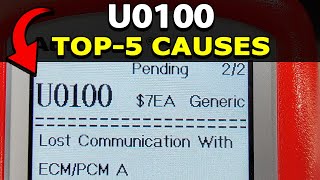
This code means the main engine computer (ECM) is offline. The most common causes are a weak battery, corroded battery terminals, or a bad ground connection. Start by testing the battery and cleaning all main power and ground connections before suspecting more complex issues like a failed ECM.
- U0100 on a Palisade means the main engine computer has lost communication.
- Do not drive the vehicle, as it may stall unexpectedly.
- The most likely cause is a simple electrical issue: a weak battery or a bad ground connection. Always check these first.
- There are no known common defects on the Palisade that specifically cause this code, so diagnosis should follow general best practices.
- Due to the complexity of network diagnostics, professional service is highly recommended if the issue isn't a simple battery or ground fault.
What's Unique About the 2020-2026 Hyundai Palisade
For the 2020-2026 Hyundai Palisade, there are no widely reported pattern failures or Technical Service Bulletins (TSBs) that specifically cause the U0100 code. This suggests that an occurrence of U0100 is likely due to general electrical issues rather than a flaw unique to the Palisade platform. However, it's critical to check for the status of NHTSA recall 22V633 (Hyundai Recall 235) 🎬 Watch: Learn about the Palisade tow hitch fire risk recall concerning the tow hitch wiring harness. A short circuit in this harness, caused by water ingress, could potentially disrupt the entire electrical system and CAN bus, leading to communication codes like U0100. Additionally, Palisades from this era feature a Security Gateway (SGW) which can restrict diagnostic functions for non-authorized scan tools, complicating diagnosis.
Symptoms You May Notice
- Check Engine Light is on (may be flashing)
- Vehicle will not start (no crank or cranks but won't fire)
- Engine stalls intermittently while driving
- Multiple other warning lights on the dashboard (ABS, Traction Control, etc.)
- Transmission may not shift properly or may be stuck in one gear (limp mode)
- Loss of throttle response
- Drastic drop in fuel economy.
- Replacing the ECM when the actual problem is a bad battery or a poor ground connection.
- Replacing other modules (like the TCM) when the root cause is a power or ground issue affecting the entire CAN network.
Most Likely Causes
- Weak or Dead Battery 🔴 High Probability → Shop Vehicle Battery Modern vehicles like the Palisade have a high electrical demand with numerous control modules. A battery that is failing or has low voltage (below 12.4V) can cause communication modules to drop offline randomly.
How to confirm: Use a multimeter to test the battery voltage with the vehicle off. It should be at least 12.4V-12.6V. Then, perform a load test or have the battery tested at an auto parts store. Voltage should not drop below 10V during cranking.
Typical fix: Recharge or replace the battery. After replacement, it's a good practice to clear all codes and drive the vehicle for at least 10 miles to allow the ECU to relearn.
Est. part cost: $150-$350 - Corroded or Loose Battery Terminals/Ground Straps 🟡 Medium Probability → Shop Engine Ground Strap
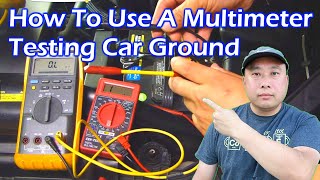
How to confirm: Visually inspect the battery terminals for white or blue-green corrosion. Follow the main negative battery cable to the chassis and engine block; check that these ground connections are clean, tight, and free of rust or corrosion. A key ground point on the Palisade is a bolt just below the under-hood fuse box positive terminal. The transmission ground strap (Part No. 91862-S1010) is another critical point 🎬 Watch: How to test your car's ground with a multimeter to inspect.
Typical fix: Disconnect the battery (negative first), clean the terminals and posts with a wire brush, and re-secure them. Clean and tighten any corroded or loose ground straps.
Est. part cost: $5-$20 - Damaged Wiring Harness or Connectors 🟡 Medium Probability While no specific issue is known for the Palisade, wiring damage can occur from rodents, previous repairs, or chafing. The tow hitch harness recall (NHTSA 22V633) is a prime example of a harness issue that can cause widespread electrical problems due to water intrusion.
How to confirm: Visually inspect the wiring harness leading to the ECM for any signs of damage, such as chewed wires, melted insulation, or corrosion. Pay close attention to the main ECM connector and the CAN bus wiring (typically a twisted pair of wires). Check if the vehicle has the recalled tow hitch harness installed.
Typical fix: Repair or replace the damaged section of the wiring harness. Clean or replace corroded connectors. If the recalled tow hitch harness is present, have the recall service performed by a Hyundai dealer.
Est. part cost: $20-$500+ - Blown Fuse for ECM or Other Modules ⚪ Low Probability
How to confirm: Locate the fuse boxes in the engine bay and inside the cabin. Check all fuses labeled 'ECU 1', 'ECU 2', 'ECU 3', or 'B+' to ensure they are not blown. Also check the fuse for the OBD-II port itself, as a blown fuse there can prevent a scanner from communicating.
Typical fix: Replace the blown fuse with a new one of the same amperage.
Est. part cost: $1-$10
Rare But Worth Checking
- Faulty Engine Control Module (ECM/PCM): → Shop Engine Control Module (ECM) This is a last resort. All other possibilities, especially power, ground, and wiring issues, must be ruled out first. A replacement ECM is expensive and requires dealer programming. Sometimes a failure can be identified by a burnt smell or visible damage on the circuit board when opened.
- Aftermarket Device Interference: Poorly installed remote starters, alarms, or telematics devices spliced into the CAN bus can disrupt communication and trigger a U0100 code. This includes aftermarket trailer wiring harnesses that are not properly installed or protected.
- Faulty Alternator: → Shop Alternator A failing alternator can cause voltage fluctuations or electrical noise that disrupts module communication. With the engine running, check the voltage at the battery terminals; it should be between 13.2V and 14.8V.
Diagnosis Steps
- Check Battery Health: → Shop Vehicle Battery Start with the simplest cause. Test the battery voltage at rest (should be >12.4V) and while cranking (should stay >10V). A weak battery is a very common cause.
- Inspect Power and Grounds: Clean and tighten battery terminals. Inspect the main engine and chassis ground straps for corrosion and tightness. A key ground point on the Palisade is a bolt near the under-hood fuse box. Also inspect the transmission ground strap (P/N 91862-S1010).
- Check for Recalls: Specifically verify if NHTSA Campaign 22V633 (Hyundai Recall 235) for the tow hitch wiring harness applies to your vehicle and if the remedy has been performed. A short in this harness can cause major electrical issues.
- Scan for Other Codes: Use an OBD-II scanner to check for other 'U' codes. If many modules have lost communication, it points to a network-wide issue. If only U0100 is present, the problem is more likely specific to the ECM's power, ground, or wiring.
- Check Fuses: Inspect all fuses related to the ECM/PCM and other control units in both the engine bay and interior fuse panels.
- Visual Wiring Inspection: Carefully inspect the wiring harness connected to the ECM. Look for any signs of physical damage, chafing, melting, or corrosion.
- Check CAN Bus Resistance (Advanced): With the battery disconnected, use a multimeter to measure the resistance between Pin 6 (CAN High) and Pin 14 (CAN Low) at the OBD-II port. A healthy network should read approximately 60 ohms. A reading of 120 ohms suggests an open circuit or a missing terminating resistor, while 0 ohms indicates a short circuit. This step is best left to a professional.
- Verify Power and Ground at the ECM (Advanced): Using a wiring diagram for the Palisade, check for proper battery voltage and ground continuity at the ECM's connector pins. Ground resistance should be less than 0.1 ohms.
- Suspect the ECM: If all wiring, power, and ground checks are good, the ECM itself may have failed. This should be the final step in diagnosis. Replacement requires professional programming.
Parts You'll Likely Need
- Battery — Low system voltage is the most frequent cause of module communication failures.
Trusted brands: Hyundai OE, Interstate, DieHard
OEM price range: $200-$350
Aftermarket price range: $150-$250 - Engine Control Module (ECM/PCM)
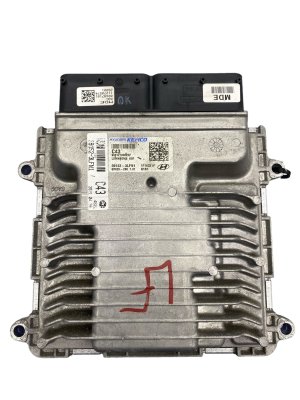
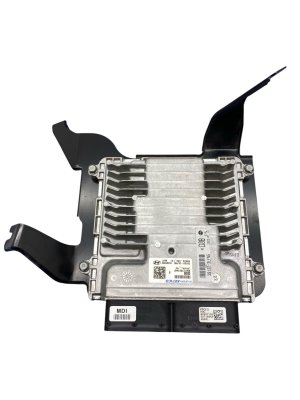
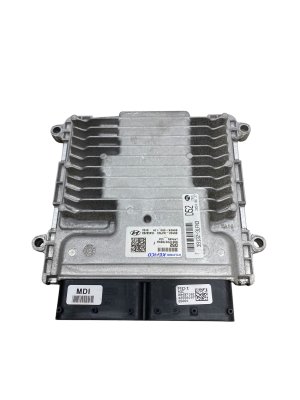
(OEM #39122-3LFN0, 39122-3LFN1, 39122-3LFN2, 39102-3LFN5)— This is the part to replace only after all other diagnostic steps have failed to find a wiring, power, or ground issue. It is the least likely, but most expensive, cause. Must be programmed by a dealer or qualified shop.
Trusted brands: Hyundai OE
OEM price range: $1000-$1300.
Aftermarket price range: $250-$500 (Remanufactured)
Related Codes That Often Appear With This One
- U0101 — Lost Communication with TCM (Transmission Control Module). The TCM and ECM are on the same high-speed network, so a network-wide failure often sets both codes.
- P0562 — System Voltage Low. This code strongly points to a failing battery or charging system as the root cause of the communication failure.
- Multiple U-codes — If codes like U0101, U0121 (ABS), U0140 (Body Control Module), etc., appear together, it strongly suggests a network-wide problem like a bad battery, main ground issue, or a fault on the central CAN bus wiring, rather than a single failed module.
Technical Service Bulletins (TSBs) & Recalls
- 23-01-044H - A TSB related to the permanent fix for a tow hitch wiring harness recall. While not a direct cause, it involves vehicle wiring integrity.
- 22-01-002H - A TSB for an ECM software update to address hesitation, which indicates that ECM software can be a source of issues, though not directly linked to U0100.
Platform-Specific Known Issues
- A critical recall (NHTSA Campaign 22V633, Hyundai Recall 235) was issued for a faulty tow hitch wiring harness on 2020-2022 Palisades that could allow water ingress, leading to an electrical short and potential fire. Owners are advised to park outside until the repair is completed. A short circuit in this harness could disrupt the CAN bus and is a plausible, though not directly documented, cause for code U0100. It is essential to verify this recall has been addressed.
Mechanic-Grade Diagnostic Values
- CAN Bus Network Resistance — expected: ~60 Ω. Failure: A reading of 120 Ω indicates an open circuit or a fault in one of the two terminating resistors. A reading of 0 Ω indicates a short between the CAN High and CAN Low wires.
- CAN Bus Voltage (Key On, Engine Off) — expected: CAN High (Pin 6) and CAN Low (Pin 14) should both read approximately 2.5V relative to chassis ground.. Failure: Voltages significantly different from 2.5V, or a flat line on one or both wires, indicates a network fault.
- ECM Power Ground Pin Resistance — expected: < 0.1 Ω. Failure: Resistance higher than 0.1 Ω indicates a poor ground connection, which is a common cause of module communication failure.
- ECM Switched Power (Key On, Engine Off) — expected: Battery Voltage (~12.4V - 12.6V). Failure: Low or no voltage at the ECM's main power input pins points to a blown fuse, faulty main relay, or a break in the power supply wire.
Scan Tool Commands That Help
- Hyundai GDS (Global Diagnostic System): Resetting Adaptive Values — After replacing an ECM or as a troubleshooting step for suspected software glitches. This function, found in 'Vehicle S/W Management', clears learned engine data and can sometimes resolve communication issues by forcing a 'fresh start'.
- Authorized Bi-Directional Scan Tool: Actuator Tests / Special Functions — To command other modules on the network to perform actions. If the ECM is offline, it will not respond to requests from the scan tool. Note that on 2019+ Hyundai models, a Security Gateway (SGW) will block these functions unless the scan tool is authorized, which can be mistaken for a module failure.
Wiring & Ground Locations
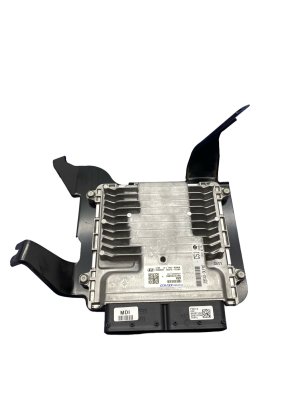
- Engine Control Module (ECM) — Located in the engine bay, on the driver's side (LH side), appearing as a silver metal box with large multi-pin connectors.. This is the module that has lost communication. All power, ground, and network wiring must be tested directly at its connectors.
- Central Gateway / ICU — The central gateway functions are integrated into the Interior Control Unit (ICU) Junction Block, which is the interior fuse box located under the driver's side dashboard.. This module routes CAN bus traffic between different vehicle networks. A fault here can isolate the ECM. The CAN bus wires can be accessed at the rear of this block for testing.
- Engine Bay Fuse & Relay Box — Located in the engine compartment on the left side, near the battery.. This box contains the main power fuses for the ECM (labeled 'ECU 1', 'ECU 2', etc.) and the main power relay. A failure of a fuse or relay here will cut power to the ECM.
- Main Engine/Chassis Ground — The primary ground cable runs from the negative battery terminal to the vehicle's chassis. Another critical ground strap connects the engine block to the chassis.. A loose or corroded main ground is a high-probability cause for multiple module communication errors, including U0100.
OEM Part Supersession History
39122-3LFN0→39122-3LFN1, 39122-3LFN2— Likely internal hardware or software revisions by the manufacturer.
Heads up: These part numbers are specifically for 2020-2022 models. Always match the part number exactly when sourcing a replacement. Installing an incompatible ECM will result in a no-start condition.
Model Year Variations Within This Range
- 2023-2025: The engine wiring harness part number may be different for facelift models. One verified part number for some 2023-2025 models is 91455-S8011. Using the wrong harness can lead to communication issues.
- 2020-2026: All Palisade models in this range are equipped with a Security Gateway (SGW) integrated into the Central Gateway module. This requires an authorized scan tool for advanced diagnostics like actuator tests, regardless of model year.
Diagnostic Flowchart
Other Known Issues on This Vehicle
Issues unrelated to this code that are worth knowing about as an owner of this generation:
- Foul Interior Odor 🟡 Low — Common on early 2020-2021 models with Nappa leather interiors (Limited/Calligraphy trims). The smell, often described as garlic or old socks, typically appears after a few thousand miles. (Ref: Hyundai addressed this via dealer service actions, not a formal TSB, involving neutralizing sprays and, in some cases, headrest replacement.)
- Wind Noise from Front Doors/Mirrors 🟡 Low — Prevalent on 2020-2021 models, causing a whistling or buffeting sound at highway speeds. (Ref: TSB 21-BD-003H (superseding earlier versions) provides a procedure to install foam pads and replace moldings to fix the noise.)
- Tow Hitch Wiring Harness Fire Risk 🔴 High — Affects 2020-2022 models equipped with an accessory tow hitch harness. Water can enter the module, causing a short circuit and fire risk, even when parked. (Ref: NHTSA Campaign 22V633 / Hyundai Recall 235. The remedy involves installing a new fuse and wire extension kit.)
- Windshield Wiper Motor Failure 🟠 Medium — On 2021-2023 models, the wiper motor may fail intermittently or completely, especially in icy conditions. (Ref: NHTSA Campaign 23V180 / Hyundai Recall 243. Dealers will replace the driver-side windshield wiper arm.)
- Excessive Oil Consumption 🟠 Medium — Some owners have reported higher than normal oil consumption across various model years. (Ref: TSB 24-EM-001H provides guidelines for dealers to inspect, perform combustion chamber cleaning, and potentially authorize engine replacement if consumption is excessive.)
- Leaking Radiator 🟠 Medium — Affects some 2020-2022 models which may develop a slight coolant leak from the radiator. (Ref: TSB 23-EM-003H outlines the inspection and replacement procedure for the radiator.)
Used vs. New Parts: Buying Guide for This Vehicle
When a used part is the smart pick: A used part is a reasonable choice for simple, non-electronic components like a battery ground cable or a specific wiring harness connector pigtail. A complete used engine wiring harness can be considered if from a low-mileage donor and thoroughly inspected.
Donor-vehicle mileage cap: roughly under 50000 miles for the part to have meaningful remaining life.
What to inspect on the donor part:
- For wiring harnesses, ensure the protective plastic loom is not brittle, cracked, or missing.
- Check for any signs of previous repairs, such as electrical tape splices or non-factory connectors.
- Verify all connector housings and locking tabs are intact and not broken.
- Confirm the part number on the tag matches the original part exactly.
OEM-only on this vehicle (don't cheap out):
- Engine Control Module (ECM/PCM): A used ECM from a junkyard is strongly discouraged. It is not plug-and-play and requires VIN and immobilizer programming with dealer-level tools. A new OEM part or a professionally remanufactured unit that offers pre-programming services is the only reliable option.
Real Owner Stories
Aggregated from forums and TSBs cited above. Mileages and costs reflect what owners reported in those sources.
2020-2022 Hyundai Palisade
Symptoms: Potential for electrical short circuit and fire risk even when the vehicle is parked; widespread electrical disruption due to water ingress in the rear of the vehicle.
What fixed it: Remedy performed under NHTSA Campaign 22V633 / Hyundai Recall 235 to address the faulty accessory tow hitch wiring harness.
Source hint: NHTSA Campaign 22V633
2020-2024 Hyundai Palisade
Symptoms: Difficulty jump-starting the vehicle and inconsistent electrical connections.
What fixed it: Identified and cleaned a key chassis ground point located just below the positive terminal in the engine bay fuse box.
Source hint: r/HyundaiPalisade thread titled 'hybrid battery jump location help'
Related OBD-II Codes
Frequently Asked Questions
Could the tow hitch recall on my 2020-2022 Palisade be causing the U0100 communication error?
I'm seeing U0100 and my Palisade won't start; where is the main ground point I should check?
Does the ECM software update mentioned in TSB 22-01-002H fix U0100?
How much voltage does my Palisade battery need to prevent control modules from dropping offline?
Is there a specific fuse I should check for the ECM on the Palisade?
Helpful Videos

We Have This Part in Stock

The information in this article is provided for general reference and educational purposes only. Vehicle specifications, procedures, and part compatibility can vary by production date, trim level, and region. Always consult your vehicle's factory service manual and verify part numbers before purchasing or performing repairs. Safety-critical components such as airbags, seat belts, and braking systems should be installed by a qualified professional.
- Hyundai Palisade:
- 🧭 Diagnostic Flowchart
- 🎬 Helpful Videos
- 🛍️ Shop This Part
- What's Unique About the 2020-2026 Hyundai Palisade
- Symptoms You May Notice
- Most Likely Causes
- Rare But Worth Checking
- Diagnosis Steps
- Parts You'll Likely Need
- Related Codes That Often Appear With This One
- Technical Service Bulletins (TSBs) & Recalls
- Platform-Specific Known Issues
- Mechanic-Grade Diagnostic Values
- Scan Tool Commands That Help
- Wiring & Ground Locations
- OEM Part Supersession History
- Model Year Variations Within This Range
- Other Known Issues on This Vehicle
- Used vs. New Parts: Buying Guide for This Vehicle
- Real Owner Stories
- 2020-2022 Hyundai Palisade
- 2020-2024 Hyundai Palisade
- Related OBD-II Codes
- Frequently Asked Questions
- 🎟️ Get 5% Off