

U0100 on 2006-2011 Mercedes-Benz ML-Class: Lost ECM Communication Causes and Fixes
On a 2006-2011 (W164) ML-Class, U0100 almost always means the Engine Control Module (ECM) is offline. The most common causes are water damage to the ECM or, more frequently, the Rear SAM module due to leaky taillight seals. A weak battery is another prime suspect. This is a serious code that often results in a no-start or stalling condition, frequently accompanied by cooling fans running at maximum speed.
- U0100 on a W164 ML-Class is a critical code, often causing a no-start or stall, and should be addressed immediately.
- The most likely cause is not a simple wiring fault, but water damage to a key electronic module.
- Your first diagnostic steps should be to check the battery and then visually inspect the Rear SAM (in the trunk) and the ECM (behind the driver's front wheel) for corrosion.
- Repair is not a simple DIY job, as replacing the ECM or SAM requires expensive, vehicle-specific programming.
- If you replace a water-damaged Rear SAM, you must also replace the leaking taillight seals to prevent the problem from recurring.
What's Unique About the 2006-2011 Mercedes-Benz ML-Class
The W164 ML-Class is particularly susceptible to water intrusion in several key areas that can directly cause a U0100 code. Unlike many vehicles where this code points to a simple wiring issue, on the ML-Class it is frequently caused by water damaging the Rear SAM module from failing taillight housing seals. This issue was so common it prompted a recall campaign (T-RC-2009030003) to replace the seals. Additionally, the ECM itself is located in a vulnerable position behind the driver's side front wheel well liner, and the Central Gateway (CGW) can be damaged by water under the driver's seat. These known water-related failures are the most common story behind a U0100 on this specific platform.
Symptoms You May Notice
- Engine will not start (no-crank or cranks but won't fire)
- Engine stalls intermittently while driving
- Check Engine Light is on
- Multiple other warning lights on the dashboard (ABS, ESP, SRS, etc.)
- Cooling fans run at maximum speed as soon as the ignition is on 🎬 See how a bad ECM causes high-speed fan issues
- Transmission may be stuck in one gear (limp mode)
- No communication with a standard OBD-II scanner
- Multiple electrical systems fail simultaneously (e.g., indicators, wipers, central locking)
- Replacing the starter motor when a no-crank symptom is present. The no-crank is usually because the ECM is offline and cannot authorize the start command.
- Replacing the fuel pump. While a bad fuel pump can cause a crank-no-start, it typically doesn't set a U0100 communication code.
- Replacing the Crankshaft Position Sensor (CPS). A bad CPS causes a no-start but will set its own specific fault code, not a general communication failure code.
Most Likely Causes
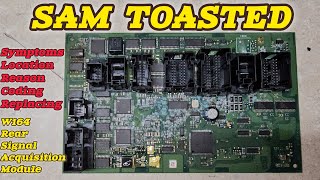
- Water Damage to Rear SAM Module 🔴 High Probability The Rear Signal Acquisition Module (SAM) is located in the right-side cargo area, directly below the taillight assembly. Failing taillight housing seals allow water to drip directly onto the module, causing corrosion and short circuits. This is a notorious design flaw on the W164 platform.
How to confirm: Remove the right-side cargo area trim panel. Inspect the SAM module (a black box with multiple connectors) and its wiring for a white or green powdery residue, rust stains, or any signs of moisture. You may find standing water in the bottom of the compartment.
Typical fix: The SAM module must be replaced and programmed to the vehicle using a tool like STAR/Xentry. It is critical to also replace the faulty taillight seals (Part numbers A1648261591 and A1648261691) to prevent a repeat failure. 🎬 Watch: Rear SAM failure signs, prevention, and coding guide Some owners attempt to clean the corroded board, with mixed success.
Est. part cost: $300-$600 - Water Damage to Engine Control Module (ECM) 🟡 Medium Probability → Shop Engine Control Module (ECM) The ECM is located behind the front driver's side wheel arch liner, making it vulnerable to water splashed up from the road or from water running down the inner fender. This can corrode the ECM's connector pins or cause internal failure.
How to confirm: Remove the front driver's side wheel and wheel arch liner. Unplug the ECM connectors and inspect the module and the harness for any signs of water intrusion or corrosion.
Typical fix: If corrosion is minor, cleaning the contacts may work temporarily. Most often, the ECM will need to be repaired by a specialist or replaced. A replacement ECM must be programmed or 'cloned' from the original unit.
Est. part cost: $500-$1200 - Weak or Failing Battery 🟡 Medium Probability → Shop Vehicle Battery Mercedes' complex electronic systems are highly sensitive to voltage. A weak battery can cause voltage to drop below the required threshold during engine cranking, causing various modules, including the ECM, to temporarily drop off the network and set a U0100 code.
How to confirm: Test the battery with a digital multimeter. A healthy AGM battery should read at least 12.6 volts with the engine off. Perform a load test to check its ability to hold a charge. Voltage dropping below 10V during cranking is a clear sign of a weak battery.
Typical fix: Replace the vehicle's main battery. Ensure the new battery meets the OEM specifications for cold cranking amps (CCA) and capacity. Always check this first before replacing expensive modules.
Est. part cost: $180-$350 - Water Damage to Front SAM / Central Gateway (CGW) ⚪ Low Probability The Central Gateway Module (CGW), the main router for all CAN bus networks, is located under the driver's seat in some configurations, where it is susceptible to flooding from clogged sunroof drains or spills. Its failure will sever communication between networks, causing widespread issues.
How to confirm: Check for dampness or water under the driver's seat carpet. A Mercedes-specific scanner can help determine if the CGW is offline. Visual inspection may reveal heavy corrosion on the module itself.
Typical fix: The CGW must be replaced and programmed, or the data from the old one must be cloned to a new/used unit. The source of the water leak must be identified and repaired.
Est. part cost: $400-$800
Rare But Worth Checking
- CAN Bus Wiring Failure: While less common than module failure from water, a break or short in the CAN bus wiring harness can cause this code. This is often due to physical damage or rodent activity. Diagnosis requires checking for continuity and resistance on the CAN high and low lines with a multimeter.
- Failing ECU Power Relay: The relay that supplies power to the Engine Control Module (ECM/Motronic) can fail intermittently. This relay is often located in the front fuse and relay box (Front SAM) in the engine bay. A faulty relay can cut power to the ECM, causing it to drop off the network and trigger a U0100 code.
Diagnosis Steps
- Check Battery Health: Before any other steps, fully charge and load test the battery. Ensure voltage is above 12.4V and does not drop excessively during cranking. Low voltage is a very common and simple cause to fix.
- Scan with a Mercedes-Specific Tool: Use a scanner like Xentry/STAR to perform a full network scan. This will show which specific modules are not communicating (e.g., 'N10/2 - Rear SAM control unit'), which is crucial for diagnosis. A generic scanner may simply show U0100 without this critical detail.
- Inspect the Rear SAM: Remove the right-side cargo area panel and visually inspect the Rear SAM module for any signs of water damage or corrosion on the board and connectors. Check for moisture in the spare tire well below it.
- Inspect the ECM: Remove the driver's side front wheel and wheel well liner. Disconnect the ECM and inspect the harness connectors and module pins for corrosion or moisture.
- Inspect Fuses and Relays: Check all fuses related to the engine controls and SAM modules in the front and rear fuse boxes. Specifically check the ECM power relay in the front SAM (engine bay fuse box).
- Inspect the Central Gateway (CGW): Pull back the driver's side carpet and check for any signs of moisture or corrosion on the CGW module located on the floor.
- Professional Diagnosis: If the cause is not obvious from the above steps, professional diagnosis is required to test the CAN bus network integrity (checking for ~60 ohms of resistance across CAN High and CAN Low) and confirm internal module failure.
Parts You'll Likely Need
- Rear SAM (Signal Acquisition Module)
(OEM #A1649005401 (supersedes A1649005101, 1644404601, and others))— Extremely common failure point on the W164 due to water leaks from the taillight seals. Its failure disrupts network communication.
Trusted brands: Mercedes-Benz (OEM), Bosch, Delphi
OEM price range: $450-$600
Aftermarket price range: $300-$450 - Engine Control Module (ECM/ECU) — Can fail due to water intrusion or internal component failure. Its loss of communication is the direct definition of U0100.
Related Codes That Often Appear With This One
- Multiple U-codes (U0101, U0121, U0140, etc.) — When a primary module like the ECM or a gateway module (CGW) fails, it often results in a cascade of communication codes from all other modules that are trying, and failing, to talk to it.
Technical Service Bulletins (TSBs) & Recalls
- T-RC-2009030003: A recall campaign acknowledging that water leaking past the tail light seals could short out control modules in the trunk, leading to potential fire risk. The fix involved replacing the seals.
Platform-Specific Known Issues
- Leaking rear taillight seals are a well-documented design flaw that directly leads to the destruction of the Rear SAM module, a primary cause of network faults on the W164.
- The placement of the Engine Control Module behind the front wheel liner exposes it to potential water damage that can be difficult to spot without removing the liner.
Mechanic-Grade Diagnostic Values
- CAN Bus Resistance — expected: ~60 Ω. Failure: A reading of 120 Ω indicates a missing terminating resistor or an open circuit. A reading near 0 Ω indicates a short between CAN High and CAN Low.
- CAN Bus Voltage (Key On, Engine Off) — expected: CAN High: ~2.6V - 2.7V. CAN Low: ~2.3V - 2.4V.. Failure: If one line is stuck at 0V, 5V, or battery voltage, it indicates a short to ground or power. If both lines read the same voltage (e.g., 2.5V), it can indicate a bus failure.
Scan Tool Commands That Help
- Xentry/STAR Diagnosis: Initial Quick Test & Network Topology — This is the first step. It provides a visual map of all control units on the CAN networks and shows which ones are not responding (typically highlighted in red). This immediately tells the technician which module to investigate first (e.g., ME-SFI, Rear SAM, CGW).
- Xentry/STAR Diagnosis: SCN (Software Calibration Number) Coding — This is mandatory after replacing a major control unit like the ECM, Rear SAM, or CGW. The function connects to Mercedes-Benz servers to download and install the correct software and vehicle-specific configuration for the new module. Without SCN coding, the new part will not function correctly.
- Xentry/STAR Diagnosis: Guided Tests for Offline Module — Once an offline module is identified, Xentry provides a guided test plan. It will prompt the technician to check specific fuses, power supplies, and ground connections for that exact module, using wiring diagrams from the integrated WIS (Workshop Information System).
Wiring & Ground Locations
- X30/4 — Right front passenger footwell/kick panel area. It is a CAN Bus potential distributor (a small block where multiple CAN wires connect).. This is a central hub for the interior CAN bus (CAN-B). Corrosion here from water ingress (clogged drains, etc.) can disrupt communication for multiple modules, potentially isolating the CGW or other critical units, leading to a U0100.
- X30/19 — Located at the driver's side A-pillar, this is a distribution connector for the Chassis CAN.. The Chassis CAN is a critical high-speed bus that connects the ECM, transmission (TCM), and electronic ignition switch (EZS). A fault at this connector can directly cause the U0100 code by taking the ECM offline.
- W29/2 — Engine bay, specific location varies by engine, but it is the primary ground point for the Motor Electronics (ME) control unit.. A loose or corroded main ground for the ECM itself will cause it to lose power and drop off the network, directly causing a U0100 code. This should be one of the first physical checks after verifying fuses and relays.
- W15/4 — Right rear longitudinal member/cargo area.. This is a primary chassis ground point for components in the rear of the vehicle, including the Rear SAM. A corroded ground here can cause the Rear SAM to malfunction and disrupt the network, even if the SAM itself is not water damaged.
Real Owner Repair Stories
- MBWorld.org forum user (2007 ML350 (W164)) — No crank, no start, cooling fans running at full speed, multiple warning lights.
❌ Tried (didn't work) Replaced battery, Checked Rear SAM for water (it was dry), Checked all related fuses
✅ What actually fixed it The Engine Control Module (ECM) itself had failed due to internal corrosion. The owner removed the ECM from behind the driver's side wheel well liner, sent it to a specialized repair service, and reinstalling the repaired unit solved all issues. - Benzworld.org forum user (W164 ML-Class) — Intermittent no-start, multiple communication fault codes including U0100.
❌ Tried (didn't work) Inspecting Rear SAM, Checking battery and alternator
✅ What actually fixed it The cause was a faulty ECU power relay (also known as the Motronic relay) located in the front SAM/fuse box in the engine bay. Replacing this inexpensive relay restored power to the ECM and cleared the communication faults. - MHH Auto forum user (W164 ML-Class) — Multiple CAN communication faults, no communication with ISM (Intelligent Servo Module), TCM (Transmission), or SRS (Airbag).
❌ Tried (didn't work) Replacing ISM, Checking Rear SAM for water damage (it was clean)
✅ What actually fixed it The problem was traced to a corroded CAN bus distribution connector (X30/19) at the driver's side A-pillar. Cleaning the corrosion from this connector restored network stability and allowed all modules to communicate again.
OEM Part Supersession History
A1644404601→A1649005101, then A1649005401, then A1649007200— Revisions to improve reliability and potentially address water resistance or component issues in the Rear SAM.
Heads up: While newer parts are generally backward compatible, they absolutely require SCN coding with Xentry to function. You cannot simply swap a unit from another car, even if the part number is identical, without programming it to the new vehicle's VIN and equipment list.
Diagnostic Flowchart
Other Known Issues on This Vehicle
Issues unrelated to this code that are worth knowing about as an owner of this generation:
- M272/M273 Engine Balance Shaft/Idler Gear Wear 🔴 High — Common on early models (approx. 2006-2008). The issue stems from soft metal used for the balance shaft sprocket (V6 M272) or idler gear (V8 M273), leading to premature wear. Failure can occur from 60,000 miles onwards and results in incorrect timing, check engine light (P0016, P0017), and engine rattle. Repair is extremely labor-intensive, requiring engine removal. (Ref: A class-action lawsuit was filed, and Mercedes issued technical service bulletins to address the issue for a specific range of engine serial numbers.)
- Airmatic Suspension Failure 🔴 High — Very common across all W164 models equipped with Airmatic air suspension. Failures include leaking air springs/struts (causing one corner or the entire vehicle to sag, especially overnight), failing air compressors (often from overworking due to leaks), and valve block issues. Symptoms include a harsh ride and a visible drop in ride height.
- Transfer Case Chain Stretching 🟠 Medium — Affects 4MATIC models. The internal chain in the transfer case can stretch over time, causing a skipping or grinding noise, particularly during acceleration from a stop. This is considered a design flaw. Some owners report issues as early as 100,000 miles, while others may not experience it. Using the correct fluid (MB Spec 236.12) is critical.
Used vs. New Parts: Buying Guide for This Vehicle
When a used part is the smart pick: A used ECM, Rear SAM, or Central Gateway can be a cost-effective option, but ONLY if you have a clear plan for programming. It makes sense if you have access to a specialist who can 'clone' the data from your old module to the used one, or if you have access to a Xentry system for online SCN coding.
Donor-vehicle mileage cap: roughly under 150000 miles for the part to have meaningful remaining life.
What to inspect on the donor part:
- Ask the seller for a photo of the connectors. Any green or white powder (corrosion) is an absolute deal-breaker.
- Verify the part number matches or is a valid superseded number for your vehicle.
- For a Rear SAM, specifically ask if it came from a vehicle with leaky taillights or any signs of water in the trunk. Avoid parts from flood-damaged vehicles entirely.
- If possible, get the VIN of the donor car to check its options list against yours, though programming will still be required.
OEM-only on this vehicle (don't cheap out):
- Engine Control Module (ECM)
- Rear SAM
- Central Gateway (CGW)
Aftermarket brands forum-validated for this vehicle:
- For this class of component (control modules), sticking with genuine Mercedes-Benz (new or used) or a professional rebuild of your original unit is highly recommended. There are no widely trusted 'aftermarket' brands that produce new, pre-programmed modules for this application.
Brands owners have reported issues with on this vehicle:
- Avoid any no-name, unbranded modules from online marketplaces that claim to be 'plug and play' without requiring cloning or SCN coding. These claims are almost always false for these specific Mercedes modules.
Real Owner Stories
Aggregated from forums and TSBs cited above. Mileages and costs reflect what owners reported in those sources.
2006-2011 Mercedes-Benz ML-Class (W164)
Symptoms: Electronics gone crazy; multiple electrical systems failed simultaneously including indicators, wipers, and central locking.
What fixed it: Removed the Rear SAM unit, found it full of water, cleaned the board with contact cleaner, and dried it thoroughly.
Source hint: Mercedes-Benz Owners' Forums: 'Electronics gone crazy,possible rear SAM unit'
2006-2011 Mercedes-Benz ML-Class (W164)
Symptoms: No-start condition; owner found moisture in the rear compartment a year after previously replacing seals and cleaning the SAM.
What fixed it: The Rear SAM module required replacement and programming to the vehicle using STAR/Xentry, along with new taillight seals.
Source hint: MBWorld.org Forum Thread: 'Water in rear SAM'
Related OBD-II Codes
Frequently Asked Questions
Is there a recall for the water leaks causing electrical issues in my W164 ML-Class?
Why are my cooling fans running at maximum speed when I turn the key?
Can a bad battery really cause a U0100 communication code on a Mercedes ML?
Where is the Rear SAM located, and how do I check it for damage?
I found water under my driver's seat; could this be related to my U0100 code?
Can I just clean the corrosion off my Rear SAM to fix the U0100 code?
Helpful Videos

The information in this article is provided for general reference and educational purposes only. Vehicle specifications, procedures, and part compatibility can vary by production date, trim level, and region. Always consult your vehicle's factory service manual and verify part numbers before purchasing or performing repairs. Safety-critical components such as airbags, seat belts, and braking systems should be installed by a qualified professional.
- Mercedes-Benz ML-Class:
- 🧭 Diagnostic Flowchart
- 🎬 Helpful Videos
- What's Unique About the 2006-2011 Mercedes-Benz ML-Class
- Symptoms You May Notice
- Most Likely Causes
- Rare But Worth Checking
- Diagnosis Steps
- Parts You'll Likely Need
- Related Codes That Often Appear With This One
- Technical Service Bulletins (TSBs) & Recalls
- Platform-Specific Known Issues
- Mechanic-Grade Diagnostic Values
- Scan Tool Commands That Help
- Wiring & Ground Locations
- Real Owner Repair Stories
- OEM Part Supersession History
- Other Known Issues on This Vehicle
- Used vs. New Parts: Buying Guide for This Vehicle
- Real Owner Stories
- 2006-2011 Mercedes-Benz ML-Class (W164)
- 2006-2011 Mercedes-Benz ML-Class (W164)
- Related OBD-II Codes
- Frequently Asked Questions
- 🎟️ Get 5% Off