

U0101 on 2011-2017 Buick Regal: Lost Communication with TCM Causes and Fixes
On a 2011-2017 Buick Regal, code U0101 almost always points to a wiring or connector problem, not a bad Transmission Control Module (TCM). Before replacing the expensive TCM, inspect the transmission connector pins, underhood fuse block, and TCM grounds (G106/G107) for a poor fit or corrosion, as highlighted in GM Technical Service Bulletin 17-NA-211. A wiring repair or cleaning a connection is often all that's needed.
- U0101 on a 2011-2017 Regal is a network code meaning 'Lost Communication with Transmission Control Module'.
- Do not immediately replace the TCM. The most common cause is a bad electrical connection at the transmission, the fuse block, or a damaged wire.
- Symptoms are serious and include the vehicle going into 'limp mode' or stalling. Do not drive the vehicle until it is repaired.
- Diagnosis requires a methodical check of fuses, wiring, and connectors before condemning the expensive TCM.
- If the TCM does need replacement, it must be programmed to your vehicle's VIN to function.
What's Unique About the 2011-2017 Buick REGAL
For this generation of Buick Regal and similar GM vehicles, the U0101 code is very frequently caused by electrical connection issues rather than an actual failed Transmission Control Module (TCM). General Motors has issued multiple Technical Service Bulletins (TSBs), such as PIP4990D and its successor 17-NA-211, advising technicians to specifically check for poor terminal pin fit at the main transmission connector, the underhood fuse block, and TCM grounds (G106/G107) before considering TCM replacement. This indicates a known weakness in the platform's wiring and connections that can mimic a module failure.
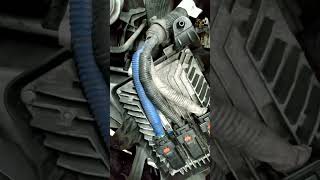
🎬 Watch: A GM tech diagnoses a Regal with U0101 issues.Diagnostic Flowchart
Tap your situation to follow the diagnostic path that matches what you're seeing on this vehicle.
Symptoms You May Notice
- Check Engine Light is on
- Transmission warning light is illuminated
- Vehicle enters "limp mode," staying in a single gear (often 2nd or 3rd).
- Harsh, erratic, or delayed shifting.
- Inability to shift out of Park or Neutral.
- Gear position indicator on the dashboard may be blank or incorrect.
- Vehicle may stall, especially when attempting to shift.
- Scan tool is unable to communicate with the TCM.
- Replacing the Transmission Control Module (TCM) without first thoroughly inspecting all related wiring, connectors, and grounds. The TSBs for this vehicle strongly suggest the problem is usually external to the TCM.
Most Likely Causes
- Poor Connection or Corrosion at Transmission Connector 🔴 High Probability → Shop Transmission Assembly GM TSBs PIP4990D and 17-NA-211 specifically call out checking for poor terminal pin fit at the transmission connector, indicating this is a primary known issue. The connector's flip-style latch can cause pins to spread if not removed carefully.
How to confirm: Visually inspect the main electrical connector at the transmission for bent, loose, or corroded pins. Check for moisture or transmission fluid intrusion, which can be conductive and cause shorts. Wiggle the connector while monitoring communication status.
Typical fix: Clean the connector terminals with an electrical contact cleaner and use a terminal pick to ensure female pins have good tension. Apply dielectric grease before reconnecting. If pins are damaged, the connector pigtail may need to be replaced.
Est. part cost: $0-$50 - Damaged Wiring Harness 🟡 Medium Probability TSB 17-NA-211 mentions checking for the harness rubbing through on sharp objects, particularly on top of the transmission where it can contact the engine block. Another TSB identifies chafe points at the ECM/TCM bracket, driver side upper control arm, and shock tower.
How to confirm: Carefully inspect the wiring harness leading to the TCM for any signs of chafing, breaks, or heat damage. Test for continuity and shorts on the power, ground, and CAN bus wires (typically Tan and Tan/Black) using a multimeter.
Typical fix: Repair the damaged section of wire with solder and heat shrink. Reroute the harness if necessary to prevent future rubbing and secure it with sleeves and zip ties as per GM service procedures.
Est. part cost: $10-$800 - Poor Connection at Underhood Fuse Block 🟡 Medium Probability → Shop Fuse Box This is another specific checkpoint mentioned in GM TSBs for this code. Internal faults or poor pin tension within the fuse block itself can cause intermittent power loss to the TCM.
How to confirm: Inspect the fuses and relays related to the TCM. Check for poor terminal fit or corrosion on the fuse block terminals. In one documented case, a technician found that pressing on the fuse block would restore power to the TCM, indicating an internal failure of the block.
Typical fix: Clean terminals and ensure fuses are properly seated. If the fuse block is faulty internally, it must be replaced.
Est. part cost: $0-$400 - Poor TCM Ground Connection 🟡 Medium Probability TSB 17-NA-211 points to checking the TCM grounds (G106, G107) as a key diagnostic step. These grounds are often on the frame rail or engine block and are exposed to the elements, making them prone to corrosion.
How to confirm: Locate the TCM ground points on the vehicle's chassis or engine block. TSBs identify G106 and G107 as primary suspects. G106 is often on the front center frame cross rail, under the crank pulley. Ensure they are clean, tight, and free of corrosion. Perform a voltage drop test on the ground circuit while the system is under load; it should be less than 0.1 volts.
Typical fix: Disassemble, clean the ground connection point to bare metal, and re-secure the ground wire. Apply a corrosion inhibitor.
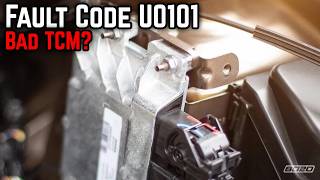
Est. part cost: $0-$5 - Faulty Transmission Control Module (TCM) ⚪ Low Probability → Shop Transmission Assembly While the TCM (also called a TEHCM as it's inside the transmission) can fail, it is far less common than wiring or connection issues on this platform. TSBs explicitly advise checking all other possibilities first.
How to confirm: This is a process of elimination. If all wiring, connectors, power (stable 12V), and grounds to the TCM test good under load, the module itself is the likely culprit. A diagnostic test involves jumping the CAN bus wires at the TCM connector to see if communication is restored to other modules on the network.
Typical fix: Replace the Transmission Control Module. The new module is located inside the transmission side cover and will require programming to the vehicle's VIN.
Est. part cost: $250-$700
Rare But Worth Checking
- Low Battery Voltage or Failing Alternator: → Shop Alternator Control modules can behave erratically when system voltage is low. Before complex diagnostics, always ensure the battery is fully charged (12.6V engine off) and the charging system is working correctly (13.7-14.7V engine on).
Diagnosis Steps
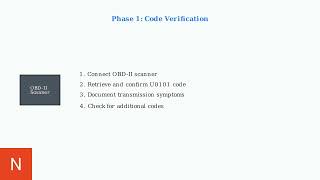
- Scan all vehicle modules for other DTCs. The presence of multiple 'U' codes points to a network-wide issue.
- Check the battery voltage and the charging system output. Ensure voltage is stable and within specification (typically 12.6V engine off, 13.7-14.7V engine on).
- Inspect all fuses related to the TCM (often labeled TCM, ECM, ECU) in the underhood fuse block. Check for blown fuses and ensure they are seated correctly.
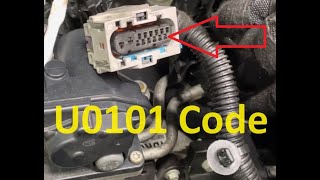
- Following TSB 17-NA-211, carefully inspect the main transmission electrical connector for loose, bent, or corroded pins. Check for fluid intrusion.
- Inspect the TCM wiring harness for any signs of physical damage, especially where it might rub against the engine or transmission case.
- Locate and inspect the main TCM ground connections (G106/G107) for tightness and corrosion. Clean and tighten them regardless of appearance.
- Using a multimeter, perform a voltage drop test on the TCM's power and ground wires. With the key on, back-probe the connector and check for a drop of less than 0.1V on the ground side and minimal drop on the power side compared to battery voltage.
- If all wiring, power, and grounds are confirmed to be good, the Transmission Control Module (TCM) is the most likely failed component.
Parts You'll Likely Need
- Transmission Control Module (TCM)
(OEM #24268164, 24287425, 24265789)— This is the part to replace if all wiring and connection checks pass. It is the least likely cause but is the ultimate fix if it has failed internally. It is located inside the transmission and requires programming.
Trusted brands: ACDelco (OEM), Dorman
OEM price range: $400-$700
Aftermarket price range: $250-$500 - Transmission Connector Pigtail — If the pins inside the main transmission connector are corroded or damaged beyond cleaning, replacing the connector end is necessary to ensure a solid connection.
Trusted brands: ACDelco, Dorman, Pico
OEM price range: $40-$80
Aftermarket price range: $20-$50 - Underhood Fuse Block — In rare cases, an internal failure in the fuse block can cause intermittent power loss to the TCM circuit, requiring replacement of the entire block.
Trusted brands: ACDelco (OEM)
OEM price range: $250-$400
Aftermarket price range: $150-$300
Related Codes That Often Appear With This One
- U0073 — This code means 'Control Module Communication Bus A Off'. Seeing it with U0101, as noted in owner complaint #10918054, suggests a wider network problem affecting more than just the TCM.
- U0128 — 'Lost Communication With Parking Brake Control Module'. Also seen in complaint #10918054, this further points to a general CAN bus failure rather than an isolated TCM issue.
- U0100 — 'Lost Communication with ECM/PCM'. This code may appear in other modules (like the BCM or ABS module), indicating they can't hear from the ECM, which can be a clue to where the network break is occurring.
Technical Service Bulletins (TSBs) & Recalls
- 17-NA-211: Supersedes all previous versions. Provides a comprehensive diagnostic tip list for U0101, focusing on checking the underhood fuse block, TCM grounds (G106, G107), harness chafing, and the main transmission connector pins before replacing any parts.
- PIP4990D: Advised technicians to review diagnostics for U0101 and gather all other DTCs before proceeding. Superseded by 17-NA-211.
- PIP4990C: Pointed to checking terminal pin fit at the transmission connector and underhood fuse block as a primary diagnostic step for DTC U0101. Superseded by PIP4990D.
Platform-Specific Known Issues
- NHTSA Technical Service Bulletin #17-NA-211 (superseding PIP4990D) is the primary diagnostic guide for this code, emphasizing checking connections and grounds before part replacement.
Mechanic-Grade Diagnostic Values
- CAN Bus Network Resistance — expected: ~60 Ohms (Ω) between CAN High (Pin 6) and CAN Low (Pin 14) at the DLC with the battery disconnected.. Failure: A reading of ~120 Ω indicates an open circuit or a missing terminating resistor. A reading significantly below 60 Ω suggests a short between the CAN lines or an extra terminating resistor.
- CAN Bus Voltage (Key On, Engine Off) — expected: CAN High (Pin 6 at DLC): ~2.5V to 3.5V. CAN Low (Pin 14 at DLC): ~1.5V to 2.5V.. Failure: Voltages outside these ranges, or a line stuck at 0V or battery voltage, indicates a short to ground or power on that specific CAN line.
- TCM Ground Circuit Resistance — expected: Less than 0.5 Ω between the TCM ground pin(s) at the connector and a clean chassis ground.. Failure: Higher resistance indicates a corroded or loose ground connection (G106/G107), which can cause the module to malfunction under electrical load.
- TCM Power Supply Voltage — expected: 12.0V - 12.6V at the TCM power supply pin(s) at the connector with key on, engine off.. Failure: Low or no voltage points to a blown fuse, faulty relay, or a break in the power feed wire from the underhood fuse block.
- TCM Module Internal CAN Resistance — expected: 28kΩ - 50kΩ between the CAN High and CAN Low pins on the disconnected TCM itself.. Failure: A reading outside this range, especially a short (low ohms) or open (infinite ohms), suggests the TCM's internal communication circuitry is damaged.
Scan Tool Commands That Help
- GDS2 (Global Diagnostic System 2): Module Setup / Programming — This function is required after replacing the TCM (TEHCM). The new module must be programmed with the correct software and vehicle VIN before it will communicate with other modules on the network.
- GDS2 (Global Diagnostic System 2): Clear All DTCs — After a new TCM is installed and programmed, all DTCs in all modules must be cleared. Old communication codes stored in other modules can prevent proper operation even after the fix.
- Professional Scan Tool (e.g., GDS2): View Data > Module Status — To see a list of all control modules on the network and their communication status. This helps confirm if only the TCM is offline or if there is a wider bus issue affecting multiple modules.
Wiring & Ground Locations
- G106 — On the front center of the frame cross rail, under the crank pulley.. This is a primary ground point for the TCM, as referenced in GM TSBs. Corrosion or a loose connection here will interrupt power to the TCM and cause communication loss.
- G107 — Located in the engine compartment, often on the transmission case itself or the engine block nearby.. This is the other key ground for the TCM mentioned in service bulletins. Like G106, a poor connection here is a very common cause for U0101.
- Engine Harness Chafe Point 1 — The engine wire harness can rub against the sharp edge of the black metal ECM/TCM mounting bracket.. Vibrations can cause the harness to chafe through, shorting the CAN bus or power/ground wires for the TCM. A GM TSB details how to inspect and secure the harness here.
- Engine Harness Chafe Point 2 — The harness may contact the driver's side upper control arm or the shock tower bolt, especially if a retaining clip is missing.. Suspension movement and engine roll can cause the harness to rub through at these points, leading to intermittent shorts and communication failures.
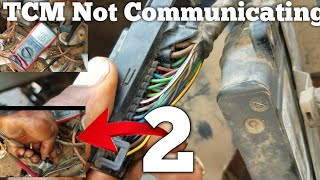
- Transmission Main Connector — The large, round, lever-lock connector on the side of the transmission case.. This is the single point of connection for all TCM power, ground, and communication wires. It is a known weak point for spread or corroded terminals.
Real Owner Repair Stories
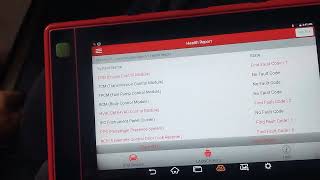
- YouTube video by a GM technician (2014 Buick Regal 2.0 Turbo) — Transmission snaps into gear, multiple communication codes set, scan tool cannot communicate with TCM.
❌ Tried (didn't work) Initial scan showed many modules lost communication with the TCM., Checked communication wires (CAN bus) and found them to be good., Confirmed power was present at the TCM connector.
✅ What actually fixed it The technician discovered that wiggling the harness caused the power to the TCM to cut out. After load testing the wire and removing the underhood fuse block, he found an internal failure within the fuse block was causing the intermittent power loss to the TCM circuit. Replacing the fuse block resolved the issue.
Helpful Videos
We Have This Part in Stock




The information in this article is provided for general reference and educational purposes only. Vehicle specifications, procedures, and part compatibility can vary by production date, trim level, and region. Always consult your vehicle's factory service manual and verify part numbers before purchasing or performing repairs. Safety-critical components such as airbags, seat belts, and braking systems should be installed by a qualified professional.
- Buick REGAL:
- 🧭 Diagnostic Flowchart
- 🎬 Helpful Videos
- 🛍️ Shop This Part
- What's Unique About the 2011-2017 Buick REGAL
- Symptoms You May Notice
- Most Likely Causes
- Rare But Worth Checking
- Diagnosis Steps
- Parts You'll Likely Need
- Related Codes That Often Appear With This One
- Technical Service Bulletins (TSBs) & Recalls
- Platform-Specific Known Issues
- Mechanic-Grade Diagnostic Values
- Scan Tool Commands That Help
- Wiring & Ground Locations
- Real Owner Repair Stories
- 🎟️ Get 5% Off