

U0101 on 2009-2017 Chevrolet Traverse: Lost Communication with TCM Causes and Fixes
Code U0101 on a 2009-2017 Traverse means the Transmission Control Module (TCM) has stopped communicating with other vehicle computers. This is most often caused by a corroded or broken wire in the harness right at the TCM connector. Expect to pay for 1-2 hours of diagnostic time, with the fix being a simple wire repair in most cases.
- Before buying any parts for a U0101 code, thoroughly inspect the wiring harness at the TCM connector for a broken or corroded wire, as this is the most common cause by a wide margin.
- The issue is not isolated to the Traverse; it affects the entire GM Lambda family (Acadia, Enclave, Outlook) in the same way.
- Do not immediately condemn the TCM. A simple wire repair costing a few dollars is the fix in a majority of cases for this specific platform.
What's Unique About the 2009-2017 Chevrolet Traverse
On the first-generation Chevrolet Traverse and its GM Lambda platform siblings (GMC Acadia, Buick Enclave, Saturn Outlook), a very common cause for U0101 is a wiring failure right at the main connector for the TCM. The wires, particularly the Red/White power wire, are known to chafe against the sharp plastic edge of the connector housing itself. This abrasion eventually wears through the insulation, allowing moisture to create corrosion (the 'green crust of death') and break the wire, cutting power to the module. This specific wear point is a well-documented issue in owner forums and mechanic videos for this vehicle generation.
Symptoms You May Notice
- Check Engine Light is on
- Transmission warning light is on
- Vehicle enters 'limp mode,' with speed limited to around 30-45 mph
- Harsh or erratic shifting
- Transmission may not shift out of Park or may get stuck in one gear
- The gear indicator (PRNDL) on the dashboard may disappear or be incorrect
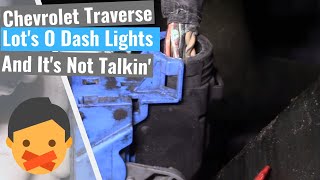
- Scan tool fails to communicate with the TCM 🎬 See how a pro diagnoses a TCM communication failure
- Additional warning messages such as "Service Power Steering" or "Stabilitrak" may appear on the Driver Information Center (NHTSA ODI #11673769).
- Loss of stability control and traction control systems (NHTSA ODI #11515051).
- Replacing the entire transmission when only a wire is broken.
- Replacing the TCM without first thoroughly checking the wiring harness for breaks or corrosion near the connector.
Most Likely Causes
- Chafed/Broken Wire at TCM Connector 🔴 High Probability → Shop Transmission Wiring Harness The wiring harness design allows wires to rub against the sharp edge of the TCM connector housing, leading to abrasion, broken wires, and corrosion. This is most common on the power wire (often a Red wire).
How to confirm: Visually inspect the wiring harness where it enters the large connector at the Transmission Control Module, located on the front of the transmission. Peel back any tape or loom and look for green corrosion ('green crust of death') or a physically broken wire, paying close attention to the wires resting on the edge of the plastic connector shell.
Typical fix: Repair the broken wire using a weatherproof butt connector and heat shrink tubing. Secure the repaired section away from the sharp edge to prevent future chafing. Some may opt to replace the connector pigtail if multiple wires are damaged.
Est. part cost: $5-$25 - Poor Power or Ground to TCM 🟡 Medium Probability Corrosion on ground straps or a blown fuse can cut power to the module, causing it to go offline. A weak or failing battery can also cause intermittent communication faults across various modules.
How to confirm: Check the TCM-related fuses (often labeled TCM, ECM, or Trans) in the vehicle's fuse boxes. Use a multimeter to verify 12V+ power and a good ground (less than 0.5 ohms resistance to chassis ground) at the appropriate pins on the TCM connector with the key on.
Typical fix: Replace the blown fuse after inspecting the circuit for shorts. Clean or replace corroded ground connections. Replace a weak battery.
Est. part cost: $1-$200 - Failed Transmission Control Module (TCM) ⚪ Low Probability → Shop Transmission Assembly While less common than wiring issues, the TCM can fail internally due to heat and vibration over time. NHTSA ODI #11616544 notes a case where troubleshooting confirmed a bad TCM, requiring removal of necessary components for replacement.
How to confirm: This is a process of elimination. If power, ground, and the CAN bus wiring have all been tested and are confirmed to be good, the TCM itself is the likely culprit. A professional scan tool will also fail to establish communication with the module.
Typical fix: Replace the Transmission Control Module. The new module must be programmed to the vehicle's VIN using specialized equipment.
Est. part cost: $300-$700
Rare But Worth Checking
- CAN Bus Network Fault: A break or short in the CAN bus wiring somewhere else in the vehicle can sometimes manifest as a U0101 code. This is rare and usually accompanied by other communication codes (U0100, U0073). Manufacturer Bulletin #PIT5713A notes that U0101 can appear in combination with many other network codes like U0073, U0100, and U0121, sometimes accompanied by IPC gauges sweeping while driving.
Diagnosis Steps
- Scan for all stored trouble codes in all modules. Note any other 'U' codes, which indicate a wider network issue.
- Check the battery voltage. A weak battery (below 12.0V) can cause communication errors.
- Check the fuses related to the TCM and ignition in the under-hood and interior fuse panels.
- Locate the TCM on the front of the transmission. Disconnect the main electrical connector.
- Carefully inspect the wires leading into the back of the connector for signs of chafing, breakage, or green/white corrosion (the 'green crust of death'), paying close attention to the power (Red/White) and CAN bus wires.
- If wiring appears intact, use a multimeter and a wiring diagram to check for 12V+ power and a solid ground connection at the TCM connector pins.
- Check the CAN bus network resistance. With the battery disconnected, measure the resistance between Pin 6 and Pin 14 on the OBD-II port. A healthy network should read approximately 60 ohms.
- If all wiring, power, and grounds are good, the TCM is the most likely failed component.
Parts You'll Likely Need
- Weatherproof Butt Connectors — For repairing the commonly found broken wire at the TCM harness connector.
Trusted brands: 3M, Dorman
Aftermarket price range: $5-$15 - Transmission Control Module (TCM)
(OEM #ACDelco 24256861 (Varies by year/model, verify with VIN))— Needed if the module itself has failed internally, after all wiring issues have been ruled out. Requires programming.
Trusted brands: ACDelco, Dorman
OEM price range: $500-$700
Aftermarket price range: $300-$500 - TCM Connector Pigtail
(OEM #e.g. Dorman 645-939 (Verify application, may not be exact match))— May be needed if the connector housing or multiple wires are damaged beyond a simple single-wire repair.
Trusted brands: Dorman, ACDelco
Aftermarket price range: $25-$60
Related Codes That Often Appear With This One
- P0700 — This is a generic code requested by the ECM to turn on the Check Engine Light when the TCM has detected a fault. It's an informational code that points toward the transmission system.
- U0100 — Lost Communication with ECM/PCM. If this code is present with U0101, it may indicate a more widespread network problem rather than an issue isolated to the TCM circuit.
- P0880 — TCM Power Input Signal. This code has been reported alongside U0101 during "limp mode" events where speed and power were lost (NHTSA ODI #11515051).
Platform-Specific Known Issues
- Common Wire Chafing at TCM Connector: → Shop Transmission Wiring Harness A well-documented issue on 2009-2017 Traverse models is wire chafing at the TCM connector, leading to a broken power or communication wire and triggering the U0101 code. The failure point is where the harness rests against the sharp edge of the connector itself.
- Owner Repair Story: 2011 Traverse U0101: A user on traverseforum.com with a 2011 Traverse reported the classic U0101 symptoms: Check Engine Light and the car going into limp mode. Upon inspection, they found the red power wire to the TCM was broken right at the connector, with visible green corrosion. They were able to repair the wire with a butt connector, which resolved the code and restored normal transmission function. This is a textbook example of the common failure. 🎬 Watch: Step-by-step wire repair for the U0101 code
Mechanic-Grade Diagnostic Values
- TCM Power Supply Fuses (Under-hood fuse block) — expected: 15-amp 'TCM' fuse and 10-amp 'TRANS' fuse should be intact and show battery voltage on both sides with key on.. Failure: A blown fuse indicates a short or overloaded circuit that requires further investigation before replacing the fuse.
- Voltage at TCM Connector Power Pin — expected: Approximately 12.0-12.6 Volts (matching battery voltage) with key on, engine off.. Failure: Low or zero voltage points to a break in the power wire (the common chafing issue), a blown fuse, or a faulty ignition switch.
- Voltage Drop at TCM Connector Ground Pin — expected: Near 0 Volts when measured between the ground pin and a known good chassis ground.. Failure: Any significant voltage reading (e.g., more than 0.1V) indicates a poor ground connection, likely at the main ground point (G110).
- CAN Bus Network Resistance — expected: Approximately 60-62 Ohms when measured between Pin 6 (CAN High) and Pin 14 (CAN Low) of the OBD-II port with the battery disconnected.. Failure: A reading of ~120 Ohms indicates one of the two terminating resistors (usually in the ECM and BCM) is offline. A reading of 0 Ohms indicates a short between the CAN lines. An open or infinite reading indicates a break in the wiring.
Hidden / Shadow Codes Worth Checking
- U0101 logged in specific modules: The true diagnostic clue is not just the U0101 code itself, but *which* modules are reporting it. If only the ECM reports a U0101, the break is likely between the ECM and TCM. If the ECM, ABS, and BCM all report U0101, the break is further 'upstream' in the network. This diagnostic logic is critical for locating the wiring fault. (see via A professional scan tool (like a GM Tech 2 or GDS2) that can poll all modules on the vehicle's network for stored codes.)
Scan Tool Commands That Help
- GDS2 (for 2014-2017 models, and some earlier): Module Diagnostics > TCM > Control Functions — After a repair, a technician can use this menu to access functions like 'Reset Module' to re-establish communication. It also allows for bidirectional control to command specific solenoids on and off to verify the TCM is now controlling the transmission correctly.
- Tech 2 (for 2009-2013 models): Diagnostics > [Vehicle ID] > Transmission > Special Functions — Similar to GDS2, this is used to access reset procedures and output controls. The Tech 2 is the factory tool for the earlier models in this generation.
Wiring & Ground Locations
- G110 — Located on the right rear of the engine, mounted to the back of the cylinder head.. This is a critical, shared ground point for the Transmission Control Module (TCM), Engine Control Module (ECM), and ignition relay. A loose or corroded connection here can cause a high-resistance ground, leading to bizarre communication issues, including U0101 and a no-crank condition.
- Under-hood Fuse Block — Located in the engine compartment, typically on the driver's side.. This block contains the primary power fuses for the TCM. Specifically, the 15-amp 'TCM' fuse and the 10-amp 'TRANS' fuse must be checked as a first step when diagnosing a no-communication issue.
- TCM Main Connector — On the front, driver's side of the transmission assembly.. This is the site of the most common failure. The wiring harness entering this connector is prone to chafing against the connector's own plastic shell, leading to broken power and communication wires.
Real Owner Repair Stories
- YouTube: South Main Auto Repair (2010 Chevrolet Traverse 3.6L) — Stability, traction, ABS, and check engine lights on. Transmission would not shift.
❌ Tried (didn't work) A simple code clear did not resolve the issue.
✅ What actually fixed it After verifying good power at the 'TCM' and 'TRANS' fuses and confirming CAN bus resistance was good (61 ohms), the technician inspected the TCM connector. They found a red wire with a green dot that was chafed through and broken right at the connector housing. Repairing this single wire with a butt connector and protecting it from future chafing resolved all symptoms and codes. - NHTSA ODI #11654876 — An owner reported that their vehicle's TCM failed, resulting in a CEL code "U0101", limp mode, hard shifting, no gear selection indicator, and extremely slow acceleration.
OEM Part Supersession History
Varies by year, but 24256861 is a widely cited number.→Multiple revisions exist. Other associated part numbers include 24256670, 24275870, 19434406, and 24252363.— Updates to internal hardware and software to improve reliability and address failures.
Heads up: Crucially, the specific part number must be verified with the vehicle's VIN. A physically identical module from a different application or year may not program or function correctly. Always confirm compatibility before purchase.
Model Year Variations Within This Range
- 2009-2013 vs 2014-2017: The factory diagnostic scan tool. Earlier models primarily use the GM Tech 2 handheld scanner. Later models use the laptop-based GDS2 (Global Diagnostic System 2) software with an MDI or J2534 interface. While both can diagnose the code, the user interface and specific menu paths differ.
- 2013: The 2013 model year was a facelift year, introducing new styling and an updated interior with the MyLink touchscreen. However, the core powertrain (3.6L V6 and 6T70/6T75 transmission) and the underlying electrical architecture related to this code remained largely the same as the 2009-2012 models.
Diagnostic Flowchart
Other Known Issues on This Vehicle
Issues unrelated to this code that are worth knowing about as an owner of this generation:
- Premature Timing Chain Stretch 🔴 High — Very common, especially on 2009-2012 models. Often occurs between 70,000 and 120,000 miles. Triggers codes like P0008, P0017. (Ref: GM Special Coverage Adjustment 11340C extended warranty for this issue on 2009 models.)
- Power Steering Pump Failure / Leaks 🔴 High — Widespread issue causing whining noises and difficult steering, particularly at low speeds. Onset often between 80,000 and 150,000 miles. (Ref: GM Special Coverage Adjustment #14329 extended the warranty for this failure on 2009-2011 models.)
- Leaking Water Pump 🟠 Medium — Common failure item, often identified by coolant leaks or overheating. Replacement is labor-intensive due to tight access.
- Cracked Exhaust Manifolds 🟠 Medium — The integrated exhaust manifold/cylinder head design can develop cracks, leading to exhaust leaks and noise. This is a significant repair.
- Failed EVAP Purge Valve 🟡 Low — A common cause for a Check Engine Light with code P0496. Symptoms can include rough idle after refueling and difficulty starting. Relatively easy and inexpensive to fix.
- Wave Plate Failure in Transmission 🔴 High → Shop Transmission Assembly — More common in earlier 2009-2010 models, a specific internal transmission component called the 3-5-R wave plate was prone to breaking, causing loss of 3rd, 5th, and Reverse gears.
Used vs. New Parts: Buying Guide for This Vehicle
When a used part is the smart pick: A used part is an excellent choice for the TCM connector pigtail. If multiple wires are damaged at the connector, sourcing a pigtail from a junkyard vehicle is a cost-effective and reliable repair method, as it provides OEM-grade wire colors and terminals.
Donor-vehicle mileage cap: roughly under 150000 miles for the part to have meaningful remaining life.
What to inspect on the donor part:
- For a connector pigtail, ensure the donor vehicle did not have a fire or flood damage.
- Inspect the pigtail for at least 6-8 inches of clean, uncut wire.
- Check that the plastic connector housing is not cracked and the locking tabs are intact.
OEM-only on this vehicle (don't cheap out):
- Transmission Control Module (TCM)
Aftermarket brands forum-validated for this vehicle:
- Dorman (for TCM connector pigtail, e.g., 645-939, but always verify application)
Brands owners have reported issues with on this vehicle:
- Unknown, no-name online marketplace TCMs. These often have programming issues or are simply used units that have been cleaned. A new TCM must be programmed to the vehicle's VIN, making cheap aftermarket modules a significant risk. Used TCMs are not a viable DIY option for this reason.
Real Owner Stories
Aggregated from forums and TSBs cited above. Mileages and costs reflect what owners reported in those sources.
2011 Chevy Traverse
Symptoms: Check Engine Light on and the transmission running in limp mode. Code U0101 was present.
What fixed it: Found a broken red power wire at the plug that goes into the TCM on the transmission. Repaired the wire with a butt connector.
Source hint: traverseforum.com - Thread 'U0101 and other codes'
2011 Chevy Traverse
Symptoms: Check Engine Light and the car going into limp mode.
What fixed it: Identified a broken red power wire to the TCM right at the connector with visible green corrosion. Repaired the wire to restore normal transmission function.
Source hint: Owner Repair Story: 2011 Traverse U0101
2007-2017 GMC Acadia
Symptoms: Limp mode, CEL, and U0101 code.
What fixed it: Found a broken/corroded wire at the TCM connector, identical to the issue found on other Lambda platform vehicles like the Traverse.
Source hint: acadiaforum.net - Thread 'Limp Mode, CEL, U0101'
Related OBD-II Codes
Frequently Asked Questions
Is there a specific wiring issue on the 2009-2017 Chevrolet Traverse that causes the U0101 code?
My 2009 Traverse has a U0101 code; is this related to the timing chain warranty extension?
Why did my gear indicator (PRNDL) disappear on my dashboard along with the Check Engine Light?
Can a weak battery cause a U0101 code on a 2012 Chevy Traverse?
If I need to replace the TCM on my Traverse, can I just plug in a new one?
Is the U0101 issue on my Traverse the same as the one on the GMC Acadia?
Helpful Videos
We Have This Part in Stock

The information in this article is provided for general reference and educational purposes only. Vehicle specifications, procedures, and part compatibility can vary by production date, trim level, and region. Always consult your vehicle's factory service manual and verify part numbers before purchasing or performing repairs. Safety-critical components such as airbags, seat belts, and braking systems should be installed by a qualified professional.
- Chevrolet Traverse:
- 🧭 Diagnostic Flowchart
- 🎬 Helpful Videos
- 🛍️ Shop This Part
- What's Unique About the 2009-2017 Chevrolet Traverse
- Symptoms You May Notice
- Most Likely Causes
- Rare But Worth Checking
- Diagnosis Steps
- Parts You'll Likely Need
- Related Codes That Often Appear With This One
- Platform-Specific Known Issues
- Mechanic-Grade Diagnostic Values
- Hidden / Shadow Codes Worth Checking
- Scan Tool Commands That Help
- Wiring & Ground Locations
- Real Owner Repair Stories
- OEM Part Supersession History
- Model Year Variations Within This Range
- Other Known Issues on This Vehicle
- Used vs. New Parts: Buying Guide for This Vehicle
- Real Owner Stories
- 2011 Chevy Traverse
- 2011 Chevy Traverse
- 2007-2017 GMC Acadia
- Related OBD-II Codes
- Frequently Asked Questions
- 🎟️ Get 5% Off