

U0101 on 2021 Chrysler 300: Lost Communication With TCM Causes & Fixes
On a 2021 Chrysler 300, code U0101 means the Transmission Control Module (TCM) has stopped communicating. A known software glitch is a primary cause, addressed by a dealer software update per TSB #18-013-22. Other common causes include low battery voltage, corroded grounds, wiring issues, or a faulty TCM.
- For a 2021 Chrysler 300, U0101 is very likely caused by a software issue that a Chrysler dealer can fix by updating the vehicle's computers, as per TSB #1801322.
- Do not immediately assume the expensive Transmission Control Module (TCM) has failed. Thoroughly check the battery, ground connections, fuses, and wiring first.
- This is a serious code that makes the vehicle unsafe to drive. The transmission can behave unpredictably, posing a safety risk.
- Diagnosing this code correctly requires tools beyond a basic code reader; a multimeter is essential, and a professional scan tool is highly recommended.
What's Unique About the 2021-2021 Chrysler 300
For the 2021 Chrysler 300 and its platform mates, a key factor for the U0101 code is a documented software issue. Chrysler issued Technical Service Bulletin (TSB) #18-013-22 for 2022 models, which explicitly lists U0101, U0102, and U0103 as potential faults that can be resolved with a software update to the Body Control Module (BCM), ABS, and Electronic Shifter Module (ESM). This makes a dealer visit for a reflash a highly probable first step in the repair process, potentially avoiding unnecessary hardware replacement.
Diagnostic Flowchart
Tap your situation to follow the diagnostic path that matches what you're seeing on this vehicle.
Symptoms You May Notice
- Check Engine Light and/or Transmission Warning Lamp is on.
- Vehicle enters "limp mode," getting stuck in a single gear (usually 2nd or 3rd).
- Harsh, erratic, or delayed shifting.
- Inability to shift out of Park or Neutral.
- Sudden loss of power while driving.
- The gear selector indicator (PRNDL) on the dashboard may go blank, show dashes, or have all lights turn red.
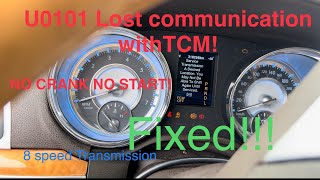
- Vehicle may not start, and the dash may display a "Transmission Not in Park" message even when it is. 🎬 Watch: Troubleshooting a no-start condition caused by TCM communication loss.
- Replacing the Transmission Control Module when the actual fault is a software glitch that requires a reflash, a corroded wire, a bad ground connection, or a simple blown fuse.
Most Likely Causes
- Software Anomaly in Control Modules 🔴 High Probability Manufacturer TSB #18-013-22 specifically identifies this code as a known issue on related models that can be fixed with a software update targeting the BCM, ABS, and ESM.
How to confirm: A Chrysler dealer or a properly equipped independent shop can check the current software calibration of the vehicle's modules against the latest available versions using the wiTECH scan tool.
Typical fix: Perform a software update (reflash) of the affected control modules as per TSB #18-013-22.
Est. part cost: $0-$200 - Wiring Harness or Connector Issue 🟡 Medium Probability Wiring for the CAN bus network can be susceptible to damage from chafing, moisture intrusion, or corrosion, interrupting the signal. Connectors at the TCM can also become contaminated with fluid.
How to confirm: Visually inspect the wiring harness leading to the TCM for any signs of damage, corrosion, or loose pins. A multimeter can be used to check for continuity and proper resistance (around 60 Ω) on the CAN bus wires. Check for corroded grounds, especially in the passenger footwell/kick panel area.
Typical fix: Repair the damaged section of the wire or replace the faulty connector. Clean contaminated connectors with electrical contact cleaner and ensure all connections are clean and secure.
Est. part cost: $10-$100 - Low Battery Voltage or Poor Ground Connection 🟡 Medium Probability → Shop Vehicle Battery Modern vehicles are highly sensitive to voltage. A weak battery or a corroded ground strap can cause unpredictable communication errors between modules.
How to confirm: Test the battery voltage (should be ~12.6V with engine off, ~14V with engine running). Check the main battery terminals and chassis ground connections for tightness and corrosion.
Typical fix: Recharge or replace the battery. Clean or replace corroded terminals and ground straps.
Est. part cost: $0-$250 - Failed Transmission Control Module (TCM) ⚪ Low Probability → Shop Transmission Assembly
How to confirm: This is typically diagnosed by exclusion. If the software is up to date, and all wiring, power, and grounds to the TCM test good, the module itself is the likely culprit. A professional scan tool may also show the TCM as 'offline'.
Typical fix: Replace the Transmission Control Module. The new module will require programming to the vehicle's VIN.
Est. part cost: $600-$900
Rare But Worth Checking
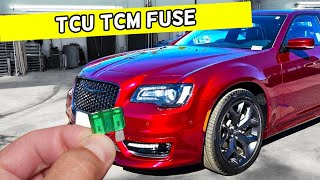
- Blown Fuse for the TCM: A simple but often overlooked cause. A blown fuse will cut all power to the module, causing a communication loss. Always check fuses before proceeding with more complex diagnostics. A YouTube video for Chrysler 300s identifies fuses F29 and F37 in the front fuse box and F26 in the trunk fuse box as related to the TCM. 🎬 See this walkthrough to locate and replace your TCM fuses.
- Faulty Powertrain Control Module (PCM): → Shop Engine Control Module (ECM) While less common, the PCM is the central hub for communication. If it fails, it can stop listening for signals from the TCM, triggering a U0101 code.
- Faulty Gear Shifter Module or RF Hub: On the LX platform, other modules on the CAN bus can fail and disrupt the entire network. Forum users have reported that a faulty electronic gear shifter module or a bad Radio Frequency (RF) Hub (part of the security system) can cause a U0101 code as a side effect.
Diagnosis Steps
- Check for TSBs: The first step for this specific vehicle is to check for TSB #18-013-22, which points to a software update.
- Scan for All Codes: Use a high-quality OBD-II scanner to read codes from all vehicle modules, not just the engine computer. Note any other communication codes (U-codes) to understand the scope of the failure.
- Check Battery and Grounds: Test the battery and charging system. Ensure battery terminals and the main chassis grounds are clean and tight.
- Inspect Fuses: Locate and inspect all fuses related to the TCM, PCM, and BCM in the under-hood and interior fuse panels.
- Visual Wiring Inspection: Carefully inspect the wiring harness and connectors going to the Transmission Control Module. Look for any signs of chafing, melting, corrosion, or loose pins. Pay close attention to where the harness may rub against the chassis or engine components.
- Check for Aftermarket Devices: Inspect for poorly installed remote starters, alarms, or audio equipment, as these are common sources of CAN bus interference.
- Test CAN Bus Network: Using a multimeter, check for approximately 60 ohms of resistance across Pin 6 (CAN High) and Pin 14 (CAN Low) of the OBD-II port with the battery disconnected. This confirms the integrity of the main bus and its terminating resistors.
- Verify Power and Ground at TCM: Using a wiring diagram and multimeter, confirm the TCM is receiving proper battery voltage and has a solid ground connection at its connector.
- Module Isolation: If all wiring, power, and grounds are good, the final step is to suspect a faulty TCM. This is best confirmed by a professional with advanced diagnostic tools that can attempt to communicate directly with the module.
Parts You'll Likely Need
- Transmission Control Module (TCM)
(OEM #68347574AA (representative, VIN specific))— If wiring and software are ruled out, the module itself may have failed internally. This is the most expensive component to replace for this code. The exact part number is VIN-dependent and must be verified with a dealer.
Trusted brands: Mopar (OEM)
OEM price range: $600-$900
Aftermarket price range: $400-$700
Related Codes That Often Appear With This One
- U0102 — Lost Communication With Transfer Case Control Module. This often appears alongside U0101 per TSB #18-013-22, suggesting a broader network issue or a software problem affecting multiple modules.
- U0103 — Lost Communication With Electric Gear Shift Module. Also mentioned in TSB #18-013-22, its presence reinforces the likelihood of a software or network-level fault rather than an isolated TCM failure.
Technical Service Bulletins (TSBs) & Recalls
- Bulletin #18-013-22: Addresses Malfunction Indicator Lamp (MIL) illumination and lists DTC U0101 - Lost Communication With TCM as a primary fault that can be resolved with a software update. It also includes codes U0102 and U0103.
Platform-Specific Known Issues
- A known software issue exists for the 2021 model year and similar platforms that can cause U0101, along with other communication codes. Chrysler released TSB #18-013-22 to address this with a software reflash of the BCM, ABS, and ESM modules.
Mechanic-Grade Diagnostic Values
- CAN Bus Network Resistance — expected: 53.5 to 67 Ohms. Failure: A reading of ~120 Ohms indicates an open circuit or a missing terminating resistor. A reading significantly lower than 53 Ohms suggests a short between the CAN high and CAN low wires.
- TCM Power Supply Voltage — expected: 12.0 - 12.6 Volts (Ignition On, Engine Off). Failure: Low or no voltage indicates a blown fuse, open wire, or faulty relay.
- TCM Ground Circuit Resistance — expected: Less than 0.5 Ohms. Failure: High resistance indicates a corroded or loose ground connection.
- Transmission Solenoid Resistance (NAG1 5-speed) — expected: Line Pressure: ~5.5 Ω (Pins 38 & 36), 2-3 Shift: ~4.5 Ω (Pins 38 & 16), TCC Lock-up: ~2.7 Ω (Pins 38 & 17). Failure: Readings that are open (OL) or significantly different from specifications indicate a faulty solenoid or internal wiring.
Scan Tool Commands That Help
- wiTECH: ECU View / Network Topology — This is the first step to visualize the entire CAN bus network. It will show which modules are communicating (green check) and which are offline (red X), immediately confirming if the TCM is the only module that is not responding.
- wiTECH: Flash TCM/PCM — Used to perform software updates as specified by Technical Service Bulletins like TSB #18-013-22. This should be done after confirming power and ground to the module are good, but before replacing the module itself.
Wiring & Ground Locations
- Security Gateway Module (SGW) — For 2018 and newer models, the SGW is located behind the OBD-II port / under the steering wheel.. Most aftermarket scan tools cannot perform advanced functions (like bidirectional commands or module resets) without bypassing the SGW. A 12+8 bypass cable is required to connect directly to the vehicle's diagnostic network.
- Star Connector (CAN-C Diagnostic Connector) — On 2018 and newer models, this is often located in the trunk, near the battery and rear fuse box, under the trunk floor cover.. The Star Connector provides a central point to access the CAN bus network. It is used for certain programming functions and can be a valuable access point for network diagnostics, separate from the SGW-protected OBD-II port.
- TCM Fuses (Underhood) — In the front fuse box (engine bay, passenger side), fuses F29 (15A) and F37 are commonly associated with the TCM.. A blown F29 or F37 fuse will cut power to the TCM, causing an immediate U0101 code. This is a critical and simple check before attempting complex wiring diagnostics.
- TCM Fuse (Trunk) — In the rear fuse box (in the trunk, behind the battery), fuse F26 may also be related to the transmission module.. This is another potential point of power loss for the TCM that can be easily overlooked if a technician only checks the front fuse box.
- TCM Connector (8-Speed Transmission) — On the transmission housing itself. Access often requires raising the vehicle.. This is the primary connection point for testing power, ground, and CAN signals directly at the module. Pin 13 is typically power, and Pin 14 is ground.
Real Owner Repair Stories
- YouTube channel 'Fix it All' (2012 Chrysler 300 AWD 3.6L with 8-speed transmission) — No crank, no start. Vehicle stuck in 'RUN' mode, would not turn off. Dash displayed 'Vehicle Not in Park'. U0101 code stored.
❌ Tried (didn't work) Checking fuses F2 and F29, which were both good., Checking for power at the shifter module, which was present.
✅ What actually fixed it A broken power wire leading to the TCM. The technician found no voltage at Pin 13 of the TCM connector. By running a temporary jumper wire from the battery to the power wire near the TCM, communication was restored, and the car started. The final fix was to locate and repair the break in the power wire between a junction connector and the TCM.
Helpful Videos
We Have This Part in Stock


The information in this article is provided for general reference and educational purposes only. Vehicle specifications, procedures, and part compatibility can vary by production date, trim level, and region. Always consult your vehicle's factory service manual and verify part numbers before purchasing or performing repairs. Safety-critical components such as airbags, seat belts, and braking systems should be installed by a qualified professional.
- Chrysler 300:
- 🧭 Diagnostic Flowchart
- 🎬 Helpful Videos
- 🛍️ Shop This Part
- What's Unique About the 2021-2021 Chrysler 300
- Symptoms You May Notice
- Most Likely Causes
- Rare But Worth Checking
- Diagnosis Steps
- Parts You'll Likely Need
- Related Codes That Often Appear With This One
- Technical Service Bulletins (TSBs) & Recalls
- Platform-Specific Known Issues
- Mechanic-Grade Diagnostic Values
- Scan Tool Commands That Help
- Wiring & Ground Locations
- Real Owner Repair Stories
- 🎟️ Get 5% Off