

U0101 on 2009-2019 Ford Flex: Lost Communication With TCM Causes and Fixes
This code means the Transmission Control Module (TCM) has gone offline. The most common causes are wiring issues, a weak battery, or a blown fuse. On the Flex, the TCM is located inside the transmission, making wiring checks at the main connector critical before suspecting the module itself. Before replacing the expensive TCM, thoroughly inspect the wiring harness leading to the transmission for damage or corrosion and test the battery.
- U0101 means the Transmission Control Module (TCM) is offline, causing serious shifting problems and likely putting the vehicle in limp mode.
- Before suspecting a failed TCM, always start with the simplest and most common causes: check the battery condition, inspect TCM-related fuses, and perform a thorough visual inspection of the wiring harness and its main connector.
- On the Ford Flex, the TCM is located inside the transmission, so a failed module is a more labor-intensive and expensive repair. This elevates the importance of ruling out all external electrical issues first.
- A weak battery is a documented cause of this code on similar Ford platforms; do not overlook it.
- If the TCM must be replaced, the new module will require programming to the vehicle with a Ford-specific scan tool.
What's Unique About the 2009-2019 Ford Flex
The Ford Flex was produced for a single generation (2009-2019) and primarily used the 6F50 and 6F55 automatic transmissions. For this platform, the Transmission Control Module (TCM) is integrated with the valve body *inside* the transmission itself. This makes the external wiring harness and its main connector the most critical diagnostic checkpoint. Unlike some other Ford models that have well-documented, specific external component failures causing U0101 (like the lead frame in F-150s), the Flex does not have a single 'smoking gun' issue. Therefore, diagnosis relies on a fundamental approach, starting with the most vulnerable and common failure points like wiring, connectors, and power supply before suspecting the internal module.
Symptoms You May Notice
- Check Engine Light is on
- Transmission warning light (wrench icon) is illuminated
- Vehicle is stuck in 'limp mode' (usually 2nd or 3rd gear).
- Harsh or erratic shifting.
- Inability to shift out of Park or Neutral
- The gear indicator (PRNDL) on the dashboard may be blank or incorrect. Manufacturer Bulletin #TSB 16-0129 notes that the PRNDL/S gear selector on the instrument cluster may flash when this code is present.
- Vehicle may not start
- Hard clunk when shifting into gear.
- Replacing the TCM without first thoroughly checking the wiring harness, connector pins, and power/ground circuits.
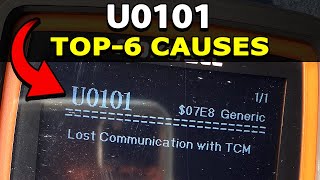
- Assuming an internal transmission mechanical failure when the issue is purely electrical or network-related. 🎬 Watch: Top 6 causes for the U0101 fault code
- Overlooking a weak battery as the source of the communication fault.
Most Likely Causes
- Wiring Harness or Connector Damage 🔴 High Probability The wiring harness to the TCM is routed underneath the vehicle and is exposed to road debris, moisture, and engine/exhaust heat, which can cause wires to chafe, break, or corrode over time. A very common failure point is pin tension within the main connector, where the female pin in the harness connector fails to make a solid connection with the male pin on the TCM.
How to confirm: Visually inspect the entire wiring harness leading to the TCM on the transmission case. Pay close attention to where the harness is secured or bends. Disconnect the main round connector at the transmission and check for corroded, bent, or backed-out pins. Also check for any signs of moisture or oil contamination inside the connector.
Typical fix: Repair the damaged section of wire or replace the connector pigtail. If corrosion or contamination is present, clean the connector pins thoroughly with electrical contact cleaner and apply dielectric grease before reconnecting. If pin tension is the issue, the specific female terminal may need to be replaced.
Est. part cost: $20-$150 - Low Battery Voltage or Poor Ground Connection 🟡 Medium Probability → Shop Vehicle Battery All modern vehicles are sensitive to low voltage. A weak or failing battery can cause unpredictable communication errors between modules before the car fails to start. There are documented cases where simply replacing an old, weak battery resolved the U0101 code.
How to confirm: Test the battery with a multimeter; it should have at least 12.4 volts with the engine off. Perform a load test to confirm its health. Check battery terminals for corrosion. Inspect the main body and engine ground straps (specifically G100 on the passenger side and G101 which grounds the TCM) to ensure they are clean, tight, and free of corrosion.
Typical fix: Replace the battery if it fails a load test. Clean or replace corroded terminals and ground straps.
Est. part cost: $150-$300 - Blown Fuse for the TCM 🟡 Medium Probability
How to confirm: Consult the owner's manual to locate the fuse(s) for the Transmission Control Module (TCM) in the under-hood fuse panel (Battery Junction Box). On some models, these may be fuses F26 (10A) and F53 (5A). Pull the fuse and visually inspect if the internal wire is broken or test for continuity with a multimeter.
Typical fix: Replace the blown fuse. If the fuse blows again immediately, it indicates a short circuit in the TCM power supply wiring that must be diagnosed.
Est. part cost: $1-$5 - Failed Transmission Control Module (TCM) ⚪ Low Probability → Shop Transmission Assembly The TCM is an electronic component that can fail internally due to heat, vibration, and age, though it is less common than wiring or power issues. On the Flex, the TCM is part of the valve body assembly inside the transmission, which subjects it to constant heat and vibration.
How to confirm: This is a process of elimination. If the battery is good, fuses are intact, and the wiring, connectors, power, and grounds at the main transmission connector have all been tested and confirmed to be good, the module itself is the likely culprit. A scan tool that cannot communicate with the TCM at all points towards a power, ground, or module failure.
Typical fix: Replace the Transmission Control Module/valve body assembly. This requires draining the transmission fluid and removing the side cover of the transmission. 🎬 Watch: How to perform a transmission fluid exchange procedure The new module must be programmed to the vehicle's VIN and configuration using a Ford-specific diagnostic tool.
Est. part cost: $600-$1000
Rare But Worth Checking
- CAN Bus Network Fault: The entire communication network can be brought down by a fault in another module or a short in the CAN wiring anywhere in the vehicle. A technician can test the network's resistance at the OBD-II port (should be 60 ohms with the battery disconnected) to check its integrity.
Diagnosis Steps
- Scan for all codes in all modules. Note any other 'U' codes or codes related to power supply.
- Check the battery. Ensure it has a full charge (12.4V+ engine off) and perform a load test. Ensure terminals are clean and tight.
- Inspect all relevant fuses. Check the owner's manual for any fuses labeled TCM, PCM, or Transmission (e.g., F26, F53) and verify they are not blown.
- Perform a thorough visual inspection of the wiring harness that runs to the transmission's main connector. Look for any signs of chafing, melting on the exhaust, or physical damage.
- Disconnect the large, round transmission connector and inspect for corrosion, moisture, bent/damaged pins, or oil intrusion. Clean with electrical cleaner and apply dielectric grease if needed.
- With the key on, use a multimeter to verify that the TCM is receiving battery voltage on the correct pins (e.g., pins 9 and 14 on some models) and has a good ground connection on its ground pins (e.g., pins 13 and 16). Resistance to the negative battery terminal should be less than 1 ohm.
- If power and ground are good, test the CAN bus wires at the TCM connector for proper voltage (around 2.5V on each line, with slight fluctuations).
- If all wiring, power, and grounds are confirmed to be good, the internal TCM is the most likely point of failure and should be considered for replacement.
Parts You'll Likely Need
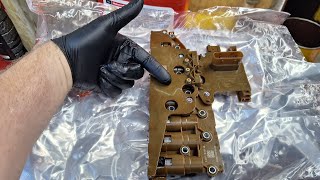
- Transmission Control Module (TCM) — This module is the final point of failure after all wiring, power, and ground issues have been ruled out. For the 6F50/55, it is typically sold as part of the complete valve body assembly. 🎬 See this walkthrough on replacing the solenoid and valve body It is the 'brain' for the transmission.
Trusted brands: Motorcraft, Dorman (Remanufactured)
OEM price range: $700-$1000
Aftermarket price range: $350-$800. - Wiring Harness Pigtail Connector — The main connector at the transmission is a common failure point due to corrosion or damaged pins, and replacing the pigtail is often easier than repairing individual wires.
Trusted brands: Motorcraft, Dorman
OEM price range: $50-$100
Aftermarket price range: $25-$60 - Battery — A weak or failing battery is a known cause of intermittent communication faults between modules on modern vehicles.
Trusted brands: Motorcraft, Interstate, DieHard
OEM price range: $200-$300
Aftermarket price range: $150-$250
Related Codes That Often Appear With This One
- U0100 — Lost Communication With ECM/PCM. This can appear alongside U0101 if there is a broader network issue affecting multiple modules.
- U0073 — Control Module Communication Bus 'A' Off. This is a general CAN bus fault code that points to a problem with the entire network rather than just one module.
Technical Service Bulletins (TSBs) & Recalls
- While no TSB was found specifically for U0101 on the Ford Flex, Ford has issued TSBs like SSM 48563 and SSM 47097 for the F-150 (which shares engine architecture) that point directly to a chafed '15525 transmission wire harness' as the primary cause for this code, reinforcing the high probability of a wiring issue.
- Bulletin #SSM 48563 notes that U0101 can be set in the PCM or TCM alongside transmission shift concerns and other network codes like U0140 and U0401.
- Bulletin #TSB 16-0129 describes a condition where the transmission PRNDL/S gear selector may flash and DTCs U0100, U0101, or P0606 are stored in the PCM memory.
Mechanic-Grade Diagnostic Values
- HS-CAN Bus Resistance — expected: ~60 Ohms. Failure: A reading of ~120 Ohms indicates a missing terminating resistor or an open circuit. A reading near 0 Ohms indicates a short between the CAN High and CAN Low wires.
- TCM Power Supply Voltage at Connector — expected: 12.0V+. Failure: Low or no voltage indicates a blown fuse (F26, F53) or a break in the power wire.
- TCM Ground Circuit Resistance at Connector — expected: < 1.0 Ohm. Failure: High resistance (OL) indicates a broken or corroded ground wire or a bad ground point (G101, G103, G104).
- HS-CAN Bus Voltage (Key On) — expected: CAN-H and CAN-L should both read approximately 2.5V, with CAN-H fluctuating slightly above 2.5V and CAN-L fluctuating slightly below 2.5V during communication.. Failure: Voltages that are stuck high, low, or at 0V indicate a short to power, a short to ground, or an open circuit.
Scan Tool Commands That Help
- Ford IDS (or equivalent): Programmable Module Installation (PMI) — This is required after installing a new Transmission Control Module (TCM). The function downloads the vehicle's configuration data (either from the old module or from Ford's As-Built data) and programs it into the new module to ensure it works correctly with the specific vehicle options.
- Ford IDS / FORScan: TCM Adaptive Learning / Clutch Adaptive Learn — After replacing a TCM or performing major transmission work, this function must be run. It forces the TCM to relearn clutch touch-points and shift drum positions, which is critical for proper shift quality.
- Ford IDS / High-End Scan Tool: Network Test / Self-Test — This command pings all modules on the network to see which ones respond. If the TCM does not respond during this test, it confirms it is offline and helps differentiate between a single module failure and a total network failure.
Wiring & Ground Locations
- Main Transmission Connector — On the driver's side of the 6F50/55 transmission case, where the main vehicle harness connects to the internal transmission components (TCM/valve body).. This is the single most important checkpoint. All power, ground, and communication signals for the TCM pass through this connector. Corrosion, fluid intrusion, or backed-out pins here are a primary cause of U0101.
- G101 — On the lower front of the engine block.. This ground point is specifically listed as providing the ground path for the Transmission Control Module. A loose or corroded connection here will cause a loss of power and communication.
- G103 / G104 — G103 is located on the top of the transmission; G104 is on the transmission assembly.. These are primary ground points located directly on the transmission case. Corrosion or looseness at these points can cause a variety of transmission-related electrical faults, including communication loss.
- G100 — In the engine compartment on the right (passenger) side frame rail.. This is a major chassis ground. While not exclusive to the TCM, a poor connection here can cause widespread electrical issues and voltage fluctuations that can trigger communication codes.
Real Owner Repair Stories
- Ford Truck Enthusiasts Forum user (2009 Ford PK Ranger (similar powertrain logic)) — Vehicle shifted very hard under load, wrench light and traction control light came on, stuck in high gear. Ignition cycle would temporarily fix it. Code U0101 present.
❌ Tried (didn't work) Unplugging and replugging connectors, which provided a temporary fix but the problem returned.
✅ What actually fixed it Replacing a weak battery. The user noted the battery was old and would die if the door was left open, and a new battery permanently solved the U0101 code, stating 'batteries can fail in many ways and the TCM does not play well' with low voltage. - Reddit user on r/AskMechanics (Vehicle with a remanufactured transmission installed) — After installing a remanufactured transmission, the vehicle started but had a permanent U0101 code, would not shift, and the gear indicator on the dash was blank.
❌ Tried (didn't work) Erasing codes with a consumer scan tool, disconnecting the battery.
✅ What actually fixed it The user found transmission fluid inside the main electrical connector. Although cleaning it did not immediately solve the problem, it identified the root cause of the communication failure as contamination at the primary connection point. The final resolution was not posted, but the diagnosis pointed directly to the connector integrity.
Documented NHTSA Reports
- An owner reported in NHTSA ODI #11389931 that a check engine light finally appeared with codes U0101 and P07A3 after being turned away by dealerships when no light was present; while the clutch was out of warranty, the TCM was still covered.
- NHTSA ODI #11487894 describes a vehicle that produced codes P090C, U0100, U3003, and U0101, but the failure could not be duplicated by the dealer and remained unrepaired.
- In NHTSA ODI #11330875, a vehicle was returned with no cause or correction found after a test drive, despite a long list of communication codes including U0101, U0103, and U0121.
Model Year Variations Within This Range
- 2009-2012 vs. 2013-2019: The Ford Flex received a major facelift for the 2013 model year. While the 6F50/55 transmission remained, wiring harnesses, fuse panel layouts, and module software calibrations may differ between pre-facelift (2009-2012) and post-facelift (2013-2019) models. Diagnostic procedures and part numbers should be verified for the specific year, especially concerning wiring diagrams and TCM compatibility.
- All years: Ford frequently updates TCM software calibrations over a vehicle's life. It is possible for a 2009 Flex to have a different software version than a 2012, even with identical hardware. When replacing a TCM, using a module from a donor vehicle of a significantly different year without proper reprogramming via PMI can lead to subtle or severe shifting problems.
Diagnostic Flowchart
Other Known Issues on This Vehicle
Issues unrelated to this code that are worth knowing about as an owner of this generation:
- Internal Water Pump Failure (3.5L Duratec V6) 🔴 High — Can occur around 100,000 miles. Failure leads to coolant mixing with engine oil, causing catastrophic engine damage if not addressed immediately. (Ref: No recall, but the subject of class-action lawsuits. The repair is extremely labor-intensive, often costing $2,000-$4,000.)
- Power Transfer Unit (PTU) Leak/Failure (AWD Models) 🔴 High — The PTU is located near the hot exhaust, which can cook the gear oil, leading to seal failure and fluid leaks. Lack of a drain plug makes servicing difficult, often leading to unit failure. (Ref: No recall. Aftermarket solutions from companies like Dorman offer units with drain plugs and better heat shielding.)
- Faulty Door Latches 🟠 Medium — Widespread issue where a pawl spring tab in the door latch can break, preventing the door from closing or causing it to open while driving. (Ref: Multiple recalls issued, including 20S30, which superseded earlier attempts (15S16, 16S30) that may not have been performed correctly.)
- Fractured Rear Suspension Toe Links 🔴 High — Affects 2013-2018 models. The toe links can fracture under stress, leading to a loss of steering control. (Ref: Ford Recall 20V072. Dealers will replace both rear suspension toe links free of charge.)
- Electronic Power-Assisted Steering (EPAS) Failure 🟠 Medium — Owners report random shutdowns of the power steering assist while driving, requiring significant effort to steer the vehicle. This issue was most prominent in earlier model years, particularly 2013-2014. (Ref: NHTSA Recall 15V340 for some 2013 models.)
Used vs. New Parts: Buying Guide for This Vehicle
When a used part is the smart pick: A used wiring harness or pigtail connector from a junkyard is an excellent, cost-effective choice, provided it is in good physical condition with no corrosion or cut wires. These parts are not electronically complex and their condition is easy to verify visually.
Donor-vehicle mileage cap: roughly under 120000 miles for the part to have meaningful remaining life.
What to inspect on the donor part:
- For wiring harnesses: Check for flexibility (not brittle), intact connector locks, and no signs of melting or chafing.
- For connectors: Inspect the pins to ensure they are straight, clean, and free of green or white corrosion.
- Check the donor vehicle's history if possible to avoid parts from flood or fire-damaged cars.
OEM-only on this vehicle (don't cheap out):
- Transmission Control Module (TCM) / Valve Body: Strongly recommended to use a new OEM (Motorcraft) part. Used TCMs are often VIN-locked to their original vehicle and will not function without specialist reprogramming that can be as expensive as a new part. While some services can 'clone' a module, this requires your original module to be at least partially functional.
Aftermarket brands forum-validated for this vehicle:
- Dorman (for remanufactured TCMs and new connectors)
Brands owners have reported issues with on this vehicle:
- Unknown, no-name online marketplace TCMs that claim to be 'pre-programmed' without requesting a VIN. These often have incorrect or outdated software.
Real Owner Stories
Aggregated from forums and TSBs cited above. Mileages and costs reflect what owners reported in those sources.
2007 Ford Explorer (Similar Powertrain Era)
Symptoms: The vehicle experienced U0101 with harsh shifting symptoms.
What fixed it: Replacing a weak/bad battery permanently solved the problem after other troubleshooting steps failed.
Source hint: Ford Truck Enthusiasts Forum: U0101 code help!!
Ford Flex (General Generation)
Symptoms: Limp mode, a hard clunk when shifting into reverse, and a blank gear indicator on the dashboard.
What fixed it: The owner noted that electrical and wiring problems are the most common root causes cited for these symptoms.
Source hint: Reddit r/MechanicAdvice: U0101 code. Lost communication with TCM.
Ford F-150 (Shared Architecture)
Symptoms: Erratic RPMs, wrench light, traction control light, and a dead speedometer.
What fixed it: Diagnosis suggested electrical causes ranging from wiring shorts to issues with the bulkhead connector.
Source hint: Ford F150 Forum: U0101???
Related OBD-II Codes
Frequently Asked Questions
Does Ford TSB SSM 48563 or SSM 47097 apply to my Ford Flex?
Where are the TCM fuses located on the 2009-2019 Ford Flex?
Why is my Ford Flex gear indicator (PRNDL) blank when the U0101 code is active?
Can a weak battery really cause a transmission communication code on my Flex?
Where is the TCM located on the Ford Flex if I need to replace it?
Which ground connections should I check for a U0101 code on my Flex?
Helpful Videos
We Have This Part in Stock



The information in this article is provided for general reference and educational purposes only. Vehicle specifications, procedures, and part compatibility can vary by production date, trim level, and region. Always consult your vehicle's factory service manual and verify part numbers before purchasing or performing repairs. Safety-critical components such as airbags, seat belts, and braking systems should be installed by a qualified professional.
- Ford Flex:
- 🧭 Diagnostic Flowchart
- 🎬 Helpful Videos
- 🛍️ Shop This Part
- What's Unique About the 2009-2019 Ford Flex
- Symptoms You May Notice
- Most Likely Causes
- Rare But Worth Checking
- Diagnosis Steps
- Parts You'll Likely Need
- Related Codes That Often Appear With This One
- Technical Service Bulletins (TSBs) & Recalls
- Mechanic-Grade Diagnostic Values
- Scan Tool Commands That Help
- Wiring & Ground Locations
- Real Owner Repair Stories
- Documented NHTSA Reports
- Model Year Variations Within This Range
- Other Known Issues on This Vehicle
- Used vs. New Parts: Buying Guide for This Vehicle
- Real Owner Stories
- 2007 Ford Explorer (Similar Powertrain Era)
- Ford Flex (General Generation)
- Ford F-150 (Shared Architecture)
- Related OBD-II Codes
- Frequently Asked Questions
- 🎟️ Get 5% Off