

U0101 on 2013-2018 Hyundai Santa Fe: Lost Communication with TCM Causes and Fixes
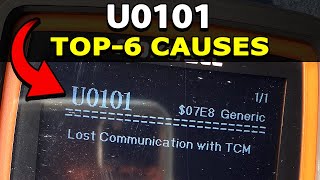
Code U0101 on a 2013-2018 Santa Fe means the Transmission Control Module (TCM) has stopped communicating. This is most often caused by a simple electrical issue like a blown fuse, bad ground, or corroded wiring, not a failed transmission. Check fuses and wiring, especially the main TCM connector under the battery, before suspecting the TCM itself.
- U0101 is an electrical communication error, not a mechanical transmission failure.
- Always start diagnosis with the simplest and cheapest things: check the battery, fuses, and ground connections.
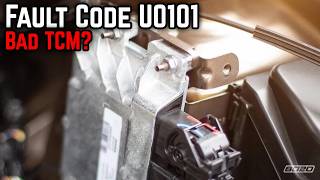
- The TCM is located under the battery; carefully inspect its main connector for corrosion, which is a common failure point on this vehicle.
- Do not replace the expensive TCM unless all wiring and power supply issues have been professionally ruled out.
- Driving with this code is not advised as the vehicle will be in a limited 'limp mode' and could behave unpredictably.
What's Unique About the 2013-2018 Hyundai Santa Fe
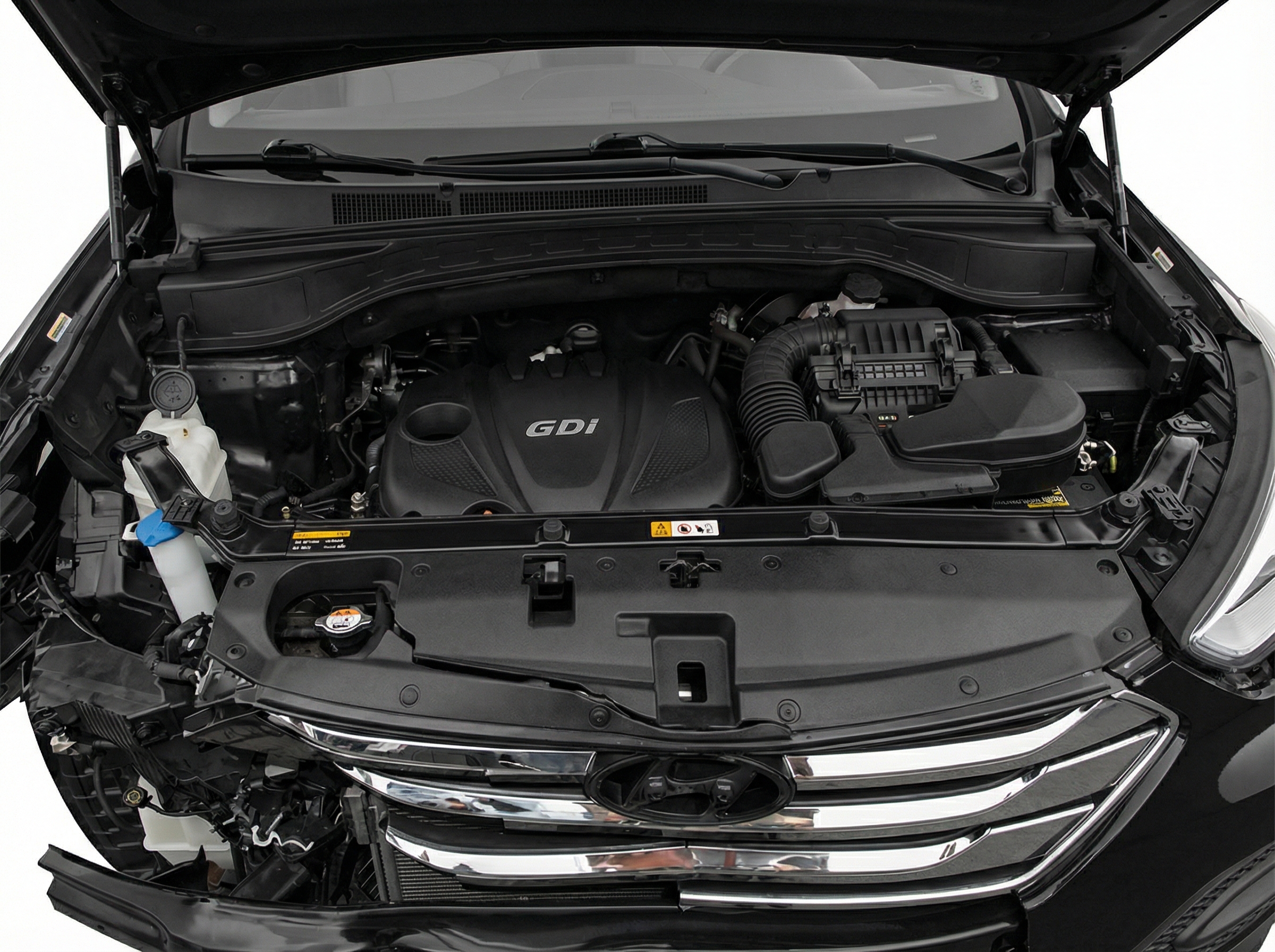
On the 2013-2018 Hyundai Santa Fe (both the 2-row Sport and 3-row models), the TCM is a separate module located in the engine bay, underneath the battery and air cleaner assembly. This is good news for diagnosis, as it's accessible without removing the transmission. However, its location makes its wiring harness and connectors extremely vulnerable to engine bay heat, vibration, and especially moisture and battery acid fumes. This exposure is a primary reason that corrosion on the TCM connector pins is a leading cause of U0101 on this specific vehicle.
Generation note: The 2013-2018 model years cover the entire third generation (DM) of the Hyundai Santa Fe. This includes the smaller 2-row 'Santa Fe Sport' (2.0L Turbo & 2.4L engines) and the larger 3-row 'Santa Fe' (3.3L V6 engine). The causes and diagnostic steps for U0101 are consistent across both versions as they share a similar electrical architecture and TCM location.
Symptoms You May Notice
- Check Engine Light is on
- Transmission warning light may be illuminated
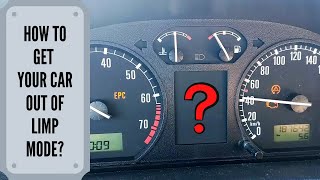
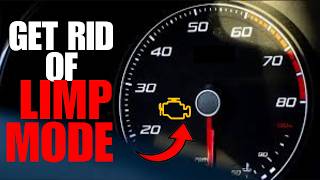
- Vehicle enters 'limp mode' (stuck in a single gear) 🎬 See this guide on understanding and resetting limp mode.
- Harsh, erratic, or no shifting
- Inability to shift out of Park
- The PRNDL gear position indicator on the dashboard disappears or is incorrect
- Vehicle may not start, displaying a 'Transmission not in Park' message
- A scan tool may fail to connect to the TCM
- Replacing the entire transmission. U0101 is an electrical/communication fault, not a mechanical failure inside the transmission.
- Replacing the TCM without first thoroughly checking all fuses, grounds, and wiring. The problem is more often in the supporting electrical circuits than the module itself.
Most Likely Causes
- Corroded or Damaged Wiring Harness/Connectors 🔴 High Probability → Shop Engine Wiring Harness Connector The TCM is located under the battery, an area where battery acid fumes, moisture, and road salt accumulate. This leads to green/white corrosion on the connector pins or damage to the wiring insulation, causing a loss of power, ground, or communication signal.
How to confirm: Disconnect the battery. Remove the battery and battery tray to access the TCM. Unplug the main connector at the TCM and visually inspect the pins and wiring for any corrosion, bent pins, or frayed wires. A user on a forum found that wiggling the harness would temporarily restore function, pointing to a bad connection.
Typical fix: Clean the connector pins meticulously with an electrical contact cleaner and a small brush. If wiring is damaged, it must be repaired or the harness section replaced. In cases of severe corrosion, the connector itself may need to be replaced. As noted in NHTSA ODI #10862093 regarding a similar Hyundai system, simply examining pins and connectors and replugging the TCM can sometimes restore transmission function if the connection was poor.
Est. part cost: $10-$30 for cleaning supplies and basic wiring repair materials - Blown Fuse or Power Supply Issue 🔴 High Probability Control modules require stable voltage; aging batteries or alternators can cause intermittent power drops that trigger communication faults. A short in the circuit can also repeatedly blow the fuse.
How to confirm: Check the vehicle's battery voltage (>12.4V engine off, ~14V engine on). Inspect fuses labeled 'TCM', 'ATM', or 'Trans' in both the interior and engine bay fuse panels. In one documented case, a hidden fuse carrier under the main fuse box had water damage, causing an open circuit to the TCM fuse.
Typical fix: Replace the blown fuse. If the fuse blows again, it indicates a short circuit in the wiring that needs to be traced. If the battery is weak, replace it.
Est. part cost: $1-$5 for fuses, $150-$300 for a new battery - Poor Ground Connection 🟡 Medium Probability The main ground straps for the powertrain can corrode or loosen over time, creating high resistance and preventing the TCM from operating correctly. The ground point for the TCM is often shared with other components and located on the chassis frame rail or inner fender.
How to confirm: Locate the main ground points for the TCM and ECU. On some models, a key ground is located on the passenger side frame rail. Ensure they are clean, tight, and free of rust. Use a multimeter to check for low resistance (<0.5 ohm) between the TCM ground pins (e.g., pins 13 and 16 on some connectors) and the battery negative terminal.
Typical fix: Remove, clean the connection point to bare metal, and securely re-tighten the ground bolt/nut. Applying dielectric grease can prevent future corrosion.
Est. part cost: $5 for cleaning supplies - Failed Transmission Control Module (TCM) ⚪ Low Probability → Shop Transmission Assembly While less common, internal components of the TCM can fail due to heat cycles and vibration over many years. This should be the last resort after all other possibilities are exhausted.
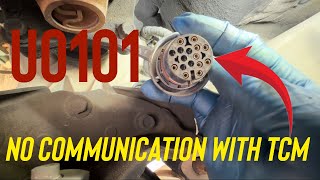
How to confirm: This is a process of elimination. If power, ground, and the CAN bus communication wires all test good at the TCM connector, the module itself is the likely point of failure. A professional scan tool that can perform a bidirectional communication test can confirm if the module is unresponsive. 🎬 Watch: How to check for no communication with the TCM. An owner report in NHTSA ODI #11578139 describes a TCM failure where gears got stuck while driving, the car would no longer start, and the ECS light illuminated alongside code U0101.
Typical fix: Replace the Transmission Control Module. The new module must be programmed or configured to the vehicle's VIN and specific calibration files using a factory-level scan tool.
Est. part cost: $400-$800 for a used or remanufactured unit, $900+ for a new OEM part.
Rare But Worth Checking
- Faulty Transmission Inhibitor Switch (Neutral Safety Switch): → Shop Transmission Park Inhibitor Switch While not a direct cause of U0101, a failing inhibitor switch can send erratic gear position signals to the TCM. This can cause shifting problems and, in some cases, may lead to network conflicts that contribute to or are misdiagnosed as a U0101 fault. It's worth considering if other symptoms like an incorrect gear display or no-start issues were present before the U0101 code appeared.
- CAN Bus Network Fault: A short or open in the CAN bus wiring itself, away from the TCM, can bring down the entire network or prevent specific modules from communicating. This is more likely if multiple 'U' codes (like U0100) are present. Diagnosis involves checking for 60 ohms of resistance across the CAN High and CAN Low pins at the DLC.
Diagnosis Steps
- Scan for all stored trouble codes in all modules. Note any other 'U' codes or transmission-related 'P' codes.
- Check the battery. Ensure it has a full charge (>12.4V) and that the terminals are clean and tight.
- Inspect all fuses related to the TCM, ECU, and transmission. Look for fuses labeled 'ATM', 'TCM', or 'TRANS' in both engine bay and interior fuse panels.
- Locate the TCM under the battery tray. Discomection the battery and remove the tray for access.
- Unplug the TCM connector and carefully inspect it and the module's pins for any signs of corrosion (green/white powder), moisture, or bent/damaged pins.
- With the key on and TCM unplugged, use a multimeter to verify that the power supply wires at the TCM connector have battery voltage (~12V).
- Check for a good ground at the TCM connector by measuring resistance between the ground pin(s) and the battery's negative terminal. It should be very low (under 0.5 ohms).
- If power and ground are good, check the CAN bus wiring. With the battery disconnected, measure resistance between the CAN High and CAN Low pins at the DLC. It should be ~60 ohms. If it's 120 ohms, there's an open circuit or a terminating resistor is missing.
- If all wiring, power, and grounds are confirmed to be good, the TCM is the most likely failed component. Confirm with a bidirectional scan tool if possible.
Parts You'll Likely Need
- Transmission Control Module (TCM)
(OEM #Varies by year/engine. Ex: 39130-2GAE2 (for some 2.4L models))— This is the part to replace ONLY after all wiring, fuse, and ground issues have been ruled out. It is the 'brain' of the transmission.
Trusted brands: Hyundai (OEM), Remanufactured (e.g., from Flagship One, Module Experts)
OEM price range: $900+
Aftermarket price range: $400-$800 (Remanufactured) - Automotive Fuses — A blown fuse is a common and inexpensive cause that cuts power to the TCM.
Related Codes That Often Appear With This One
- U0100 — This is a similar code for 'Lost Communication with ECM/PCM'. If both appear, it may point to a more widespread network issue, like a problem with the main CAN bus wiring or a faulty gateway module.
- P0705 — This code relates to a fault in the Transmission Range Sensor (Inhibitor Switch) circuit. If seen with U0101, it strongly suggests the inhibitor switch or its wiring is the root cause or a significant contributing factor to the communication problem.
- P0712 / P0713 — These codes relate to the transmission fluid temperature sensor circuit. A TSB (20-AT-004H) exists for these codes on some Santa Fe models, requiring replacement of an internal wiring harness. A short in this internal harness could potentially disrupt TCM operation and lead to a U0101 code.
Technical Service Bulletins (TSBs) & Recalls
- TSB 18-AT-004: While not a direct fix for U0101, this TSB addresses customer complaints of harsh or delayed shifting on a wide range of Hyundai vehicles, including the 2013-2018 Santa Fe. It outlines a diagnostic procedure using the GDS tool to measure shift times. Persistent electronic control issues can sometimes manifest as communication codes.
- TSB 17-ST-001: Details the replacement of the flexible steering coupler (56315-2K000-FFF) to fix a common clicking noise. This is a well-known platform issue unrelated to the U0101 code.
Platform-Specific Known Issues
- A user on hyundai-forums.com with a 2013 Santa Fe Sport 2.0T reported a U0101 code along with the vehicle being stuck in limp mode. The cause was found to be corrosion inside the main wiring harness connector for the TCM, located under the battery tray. Cleaning the connector resolved the issue.
- Another owner of a 2014 Santa Fe on the same forum experienced the U0101 code intermittently. The dealer eventually traced the problem to a faulty ground wire in the engine bay harness, which had high resistance.
- A YouTube video demonstrates diagnosing a no-communication issue on a similar Hyundai/Kia platform where the ground pins (13 and 16) at the TCM connector showed no ground. The fault was traced to a corroded splice connector between the TCM and the main chassis ground point.
Mechanic-Grade Diagnostic Values
- CAN Bus Network Resistance — expected: ~60 Ω. Failure: A reading of ~120 Ω indicates an open circuit or one of the two terminating resistors is offline. A reading near 0 Ω indicates a short between the CAN High and CAN Low wires.
- TCM Power Supply Voltage — expected: 12.0 - 12.6 V (or battery voltage). Failure: Voltage below 12.0V or no voltage indicates a blown fuse, open in the power wire, or a charging system issue.
- TCM Ground Circuit Resistance — expected: < 0.5 Ω. Failure: Resistance higher than 0.5 Ω indicates a corroded, loose, or broken ground connection, which can cause the module to malfunction.
- CAN Bus Voltage (Key On, Engine Off) — expected: CAN-H: ~2.5-3.5V, CAN-L: ~1.5-2.5V. Failure: If either wire is stuck at 0V, 5V, or battery voltage, it indicates a short to ground or power.
Scan Tool Commands That Help
- Hyundai GDS (Global Diagnostic System): TCM Neutral Mode — This function is required before replacing a TCM on vehicles with an immobilizer system. It puts the old module in a state that allows the vehicle to accept a new one.
- Hyundai GDS (Global Diagnostic System): Key Teaching — After installing a new TCM and performing the 'Neutral Mode' procedure, this function is used to teach the new module the vehicle's key information.
- Advanced Scan Tool (e.g., Autel, Launch): Bidirectional Communication Test / Active Test — This function sends a direct request to the TCM and waits for a response. If the scan tool cannot get a response from the TCM, but power, ground, and CAN wiring are confirmed good, it strongly indicates the TCM itself has failed internally.
Wiring & Ground Locations
- TCM Connector — Underneath the battery and battery tray in the engine compartment.. This is the main electrical interface for the TCM. Its location makes it highly susceptible to corrosion from battery fumes and moisture, which is a primary cause of U0101 on this vehicle.
- TCM Power Pins — Pins 67 and 88 on the main TCM connector (for some models).. These pins supply battery voltage to the TCM. A voltage test here is critical to confirm the module is receiving power and that the fuse is not blown.
- TCM Ground Pins — Pins 44 and 45 on the main TCM connector (for some models).. These pins provide the ground path for the TCM. A resistance test here confirms the integrity of the ground strap/wire, which is a common failure point.
- OBD-II DLC (Data Link Connector) — Under the driver's side dashboard.. Pins 6 (CAN-H) and 14 (CAN-L) are used to test the resistance and voltage of the entire CAN bus network, providing a quick health check of the communication system.
Real Owner Repair Stories
- Forum User Report (2014 Hyundai Santa Fe) — Check engine light on, transmission in limp mode, U0101 code present.
❌ Tried (didn't work) Checking fuses., Inspecting wiring harness for visible damage.
✅ What actually fixed it The owner disconnected the battery and removed the TCM connector. Upon inspection, the connector pins were clean. However, they located the main ground wire for the TCM bolted to the chassis nearby. The bolt was tight, but upon removal, significant corrosion was found underneath the terminal. Cleaning the corrosion from the terminal and the chassis mating surface to bare metal and re-securing the ground wire resolved the U0101 code and restored normal transmission function. - NHTSA ODI #10862093 — An owner reported that after their vehicle was towed due to transmission issues, technicians pulled code U0101. After examining the pins and connectors and plugging the TCM back in, the transmission function was restored.
- NHTSA ODI #11578139 — A report describes a situation where the TCM failed and gears became stuck while driving. The owner had to use a bypass switch to park the car, which would no longer start, showing code U0101 and an ECS light.
Diagnostic Flowchart
Other Known Issues on This Vehicle
Issues unrelated to this code that are worth knowing about as an owner of this generation:
- Theta II Engine Failure (2.0L & 2.4L) 🔴 High — Widespread across 2013-2018 models. Can occur suddenly, often between 80,000 and 120,000 miles. Symptoms include engine knocking, stalling, and excessive oil consumption. (Ref: Multiple recalls and a class-action lawsuit (NHTSA Campaign 17V226000, among others) led to extended warranties and engine replacements for affected vehicles. A Knock Sensor Detection System (KSDS) software update was deployed to detect early signs of failure.)
- Worn MDPS Steering Coupler 🟠 Medium — Very common. Owners typically notice a clicking or clunking sound from the steering column when turning the wheel, which becomes progressively worse. Does not typically affect steering control. (Ref: TSB 17-ST-001 describes the procedure to replace the flexible rubber coupler (Part No. 56315-2K000-FFF) with an improved, more durable version.)
- Excessive Oil Consumption 🟠 Medium — Commonly reported, especially on the 2.4L GDI engine. Owners may need to add oil between changes. Can be a precursor to more serious engine problems.
- Peeling or Fading Paint 🟡 Low — Affects certain colors, particularly white paint, on 2013-2016 models. The paint can begin to peel in large sheets, often starting on the roof or hood. (Ref: Subject of a class-action lawsuit, but no general recall was issued.)
- Transmission Hesitation and Harsh Shifting 🟠 Medium → Shop Transmission Assembly — Reported by many owners, especially on the 2017 model, where the transmission may hesitate on acceleration or shift harshly. (Ref: TSB 18-AT-004 and 18-AT-005 provide diagnostic procedures for harsh/delayed shifts using a GDS tool but do not point to a single universal fix.)
Used vs. New Parts: Buying Guide for This Vehicle
When a used part is the smart pick: A used part is a smart choice for purely physical components like a connector pigtail from a salvage yard harness if yours is corroded, or a replacement transmission ground cable. These parts have no electronic logic and their condition is easy to verify visually.
Donor-vehicle mileage cap: roughly under 100000 miles for the part to have meaningful remaining life.
What to inspect on the donor part:
- For a used TCM: Ask for the VIN of the donor vehicle to verify compatibility and check its history. Inspect connector pins for any sign of corrosion or damage.
- For a wiring harness/pigtail: Ensure there are no cut/frayed wires, and that the plastic connector body is not cracked or brittle. Check for green/white powder indicating corrosion.
- For a ground cable: Verify the cable is not frayed and the metal eyelets are not heavily corroded or damaged.
OEM-only on this vehicle (don't cheap out):
- Transmission Control Module (TCM): While used OEM modules are an option, they absolutely require programming to your vehicle's VIN by a dealer or a specialized shop with Hyundai's GDS software. A new OEM or professionally remanufactured/pre-programmed module is often a safer bet to avoid compatibility headaches.
Aftermarket brands forum-validated for this vehicle:
- Flagship One (For pre-programmed/remanufactured TCMs)
- Module Experts (For pre-programmed/remanufactured TCMs)
Brands owners have reported issues with on this vehicle:
- Generic, unbranded TCMs from online marketplaces without a clear programming service or warranty should be avoided. The risk of software incompatibility is very high.
Real Owner Stories
Aggregated from forums and TSBs cited above. Mileages and costs reflect what owners reported in those sources.
2013 Santa Fe Sport 2.0T
Symptoms: The vehicle was stuck in limp mode and threw a U0101 code.
What fixed it: Cleaning corrosion found inside the main wiring harness connector for the TCM, located under the battery tray.
Source hint: hyundai-forums.com - Thread Title: '2013 Santa Fe Sport 2.0T U0101 Code'
2014 Santa Fe
Symptoms: Experienced the U0101 code intermittently.
What fixed it: The dealer traced the problem to a faulty ground wire in the engine bay harness which had high resistance.
Source hint: hyundai-forums.com - Thread Title: '2013 Santa Fe Sport 2.0T U0101 Code'
2013-2018 Hyundai Santa Fe (Generic Platform)
Symptoms: No-communication issue where ground pins 13 and 16 at the TCM connector showed no ground.
What fixed it: Repaired a corroded splice connector located between the TCM and the main chassis ground point.
Source hint: YouTube video demonstrates diagnosing a no-communication issue on a similar Hyundai/Kia platform
Related OBD-II Codes
Frequently Asked Questions
Where is the Transmission Control Module (TCM) located on my 2013-2018 Santa Fe?
My Santa Fe is stuck in one gear and the PRNDL display disappeared. Is this related to U0101?
Does TSB 18-AT-004 fix the U0101 communication error?
Can a bad battery cause a U0101 code on a 2014 Santa Fe?
I'm seeing a 'Transmission not in Park' message and the car won't start. Is the TCM dead?
Is the U0101 code related to the steering clicking noise mentioned in TSB 17-ST-001?
Helpful Videos

Used OEM Parts in Stock
New Aftermarket Parts Available


The information in this article is provided for general reference and educational purposes only. Vehicle specifications, procedures, and part compatibility can vary by production date, trim level, and region. Always consult your vehicle's factory service manual and verify part numbers before purchasing or performing repairs. Safety-critical components such as airbags, seat belts, and braking systems should be installed by a qualified professional.
- Hyundai Santa Fe:
- 🧭 Diagnostic Flowchart
- 🎬 Helpful Videos
- 🛍️ Shop This Part
- What's Unique About the 2013-2018 Hyundai Santa Fe
- Symptoms You May Notice
- Most Likely Causes
- Rare But Worth Checking
- Diagnosis Steps
- Parts You'll Likely Need
- Related Codes That Often Appear With This One
- Technical Service Bulletins (TSBs) & Recalls
- Platform-Specific Known Issues
- Mechanic-Grade Diagnostic Values
- Scan Tool Commands That Help
- Wiring & Ground Locations
- Real Owner Repair Stories
- Other Known Issues on This Vehicle
- Used vs. New Parts: Buying Guide for This Vehicle
- Real Owner Stories
- 2013 Santa Fe Sport 2.0T
- 2014 Santa Fe
- 2013-2018 Hyundai Santa Fe (Generic Platform)
- Related OBD-II Codes
- Frequently Asked Questions
- 🎟️ Get 5% Off