

U0101 on 2023-2025 Jeep Wagoneer: Lost Communication with TCM Causes and Fixes
This code means your Wagoneer's main computer has lost contact with the Transmission Control Module (TCM). The most common causes are low battery voltage, a software glitch needing an update, a wiring issue, or a known fault within the transmission valve body. Check the battery first; if it's healthy, a trip to the dealer for diagnostics is required, as a TSB points to an internal valve body issue requiring replacement.
- U0101 means the Transmission Control Module (TCM) has stopped communicating with the rest of the vehicle.
- Before suspecting expensive parts, fully test the battery and charging system. Low voltage is a very common cause. [TSB #9100641]
- Symptoms are serious and include the vehicle being stuck in gear or entering limp mode, making it unsafe to drive.
- The fix could be as simple as a battery replacement or a software update from the dealership.
- Do not replace the TCM unless all wiring, connectors, power, and grounds have been thoroughly tested and confirmed to be good.
What's Unique About the 2023-2025 Jeep WAGONEER
The modern Jeep Wagoneer (WS platform) has a highly complex and sensitive electrical network. The provided manufacturer bulletins emphasize that issues like low battery voltage can trigger a cascade of communication codes, including U0101. [TSB #9100641] Furthermore, a specific Technical Service Bulletin (21-016-25 REV. C) identifies a known failure point for this platform: corrosion of CAN terminals inside the transmission valve body, which requires replacing the entire valve body assembly to fix. This makes the issue more than just a simple wiring or software problem in many cases. The TCM also acts as a gateway between the standard CAN-C bus and a separate D-PT (Drivetrain-Powertrain) CAN bus, meaning its failure can bring down two networks. [TSB #9100437Rev1, 19]
Diagnostic Flowchart
Tap your situation to follow the diagnostic path that matches what you're seeing on this vehicle.
Symptoms You May Notice
- Check Engine Light (Malfunction Indicator Lamp) is on. 🎬 Watch: A quick breakdown of what the U0101 code means. [TSB #21-016-25 REV. C]
- Transmission warning light on the dashboard.
- Vehicle enters "limp mode," limiting speed.
- Erratic, harsh, or delayed shifting.
- Transmission gets stuck in a gear and will not shift.
- After entering limp mode, vehicle may not shift out of Park.
- Inability to select gears, or the gear selector display is blank or incorrect.
- Vehicle may not start.
- Sudden loss of power while driving.
- Replacing the entire transmission when the issue is purely electronic or related to the valve body.
- Replacing the TCM/Valve Body without first verifying its power, ground, and CAN bus connections are intact and that the battery/charging system is healthy.
Most Likely Causes
- Internal Transmission Valve Body Failure 🔴 High Probability → Shop Transmission Valve Body TSB 21-016-25 REV. C specifically calls out this issue for 2023-2025 Wagoneers. The cause is identified as corrosion on the CAN terminals inside the transmission valve body, which severs communication with the rest of the vehicle.
How to confirm: A technician at a dealership will confirm if the vehicle's build date and symptoms align with the TSB. The presence of U0101 along with U0402 and/or U0418 strongly points to this cause. Diagnosis is confirmed after ruling out external wiring, power, and ground issues.
Typical fix: Replace the entire transmission valve body assembly, which includes the integrated TCM. The new module must then be programmed to the vehicle. 🎬 Watch: A professional walkthrough of the 8HP valve body replacement.
Est. part cost: $700-$1300 - Low Battery Voltage or Charging System Fault 🔴 High Probability → Shop Vehicle Battery Modern vehicles like the Wagoneer are packed with electronics that are highly sensitive to voltage. A weak battery or failing alternator can cause modules to drop off the communication network.
How to confirm: Test the battery with a multimeter or electronic battery tester. With the engine off, a healthy battery should read at least 12.4V. With the engine running, the alternator should produce between 13.7V and 14.7V. A Jeep TSB specifically recommends checking battery health and system voltage first when multiple communication codes are present. [TSB #9100641, 5, 12]
Typical fix: Recharge or replace the battery. If the charging system is at fault, replace the alternator.
Est. part cost: $200-$450 - Damaged Wiring or Loose/Corroded Connectors 🟡 Medium Probability The wiring harness to the transmission is exposed to heat, vibration, and potential road debris. Owners of platform-mate vehicles (Ram 1500) have reported water intrusion in large harness connectors located along the driver's side frame, causing this code. A common failure point is the main connector at the transmission itself, where pins can corrode and break off or the plastic locking tab fails, allowing the connector to back out.
How to confirm: Visually inspect the wiring harness and connectors going to the Transmission Control Module for any signs of damage, corrosion, or fluid intrusion. Pay special attention to large connectors along the frame rail. Check for power, ground, and CAN bus signal integrity at the TCM connector using a multimeter and wiring diagram.
Typical fix: Repair the damaged section of the wiring harness or clean/replace the faulty connector. Ensure connectors are dry and sealed.
Est. part cost: $20-$300 - Corrupted Software or Pending Updates ⚪ Low Probability As a newer platform, software bugs are possible. While a specific TSB points to a hardware (valve body) issue, other transmission problems on Stellantis vehicles are sometimes resolved with software updates.
How to confirm: A dealership or a qualified shop with a subscription to Jeep's technical information system can check for and apply any available software updates for the TCM or related modules using the wiTECH scan tool.
Typical fix: Perform a software re-flash or update of the affected control modules.
Est. part cost: $0-$250 - Faulty Transmission Control Module (TCM) ⚪ Low Probability → Shop Transmission Assembly On the 8HP75 transmission used in the Wagoneer, the TCM is integrated into the valve body. A failure of the TCM itself is addressed by the TSB that requires replacing the entire valve body assembly. An isolated TCM failure without the specific corrosion issue is less likely.
How to confirm: This is a process of elimination. If the TSB for valve body corrosion does not apply, and the battery, charging system, and all wiring are confirmed good, the module itself is the likely culprit.
Typical fix: Replace the Transmission Valve Body assembly, which contains the TCM. This part must be programmed to the vehicle's VIN.
Est. part cost: $700-$1300
Rare But Worth Checking
- Blown Fuse or Faulty Relay: Always check the simple things first. A fuse or relay that powers the TCM could have failed. On other Jeep models, a faulty K5 relay in the under-hood fuse box has been confirmed to cause a U0101 code by cutting power to the TCM. This is a quick and inexpensive check.
Diagnosis Steps
- Scan for all DTCs in all vehicle modules. Note if U0101 is accompanied by U0402 or U0418, which strongly suggests the TSB for valve body failure.
- Check and verify battery health and charging system voltage. Ensure voltage is stable and within specification (12.4V+ engine off, 13.7-14.7V engine on). [TSB #9100641, 5]
- Inspect all fuses and relays related to the TCM and powertrain control systems. Specifically check the TCM power relay (identified as K5 on some other Jeep platforms).
- Locate the TCM and its connectors. Perform a thorough visual inspection of the wiring harness for any chafing, melting, corrosion, or loose pins. Check large harness connectors along the driver-side frame for moisture or corrosion, as reported on platform mates.
- Using a wiring diagram, disconnect the TCM and verify it is receiving proper power and has a solid ground connection.
- If power and ground are good, check the resistance of the CAN bus wires at the connector (with the battery disconnected). It should be around 60 ohms.
- If all external wiring, power, and grounds are good, consult a dealer to check for applicability of TSB 21-016-25 REV. C regarding internal valve body corrosion.
- If the TSB applies, the fix is valve body replacement. If not, check for software updates.
- If no TSB or update applies and all other tests pass, the TCM/valve body assembly is likely faulty and requires replacement and programming.
Parts You'll Likely Need
- Transmission Valve Body
(OEM #68565455AA)— This is the official repair part listed in TSB 21-016-25 to fix the known issue of corroded internal CAN terminals causing code U0101. It includes the integrated TCM.
Trusted brands: Mopar
OEM price range: $700-$1300 - Battery — Low system voltage is a primary cause of communication codes on modern Jeeps, as noted in manufacturer TSBs. [TSB #9100641, 5]
Trusted brands: Mopar, Interstate, DieHard
OEM price range: $250-$400
Related Codes That Often Appear With This One
- U0402 — Implausible Data Received From TCM. This code is often logged by other modules when U0101 occurs and is specifically mentioned in the TSB for the valve body failure. [TSB #21-016-25 REV. C, 16, 22]
- U0418 — Implausible Data Received From Brake System Control Module. This indicates the network instability is affecting multiple systems and is also listed as a companion code in the valve body TSB. [TSB #9100437Rev1, 16, 22]
- U0140 — Lost Communication With Body Control Module. If multiple 'U' codes are present, it strongly points to a systemic network or power supply issue rather than a single faulty module. [TSB #9100641]
Technical Service Bulletins (TSBs) & Recalls
- Bulletin #21-016-25 REV. C: Confirms U0101 as 'Lost Communication With The Transmission Control Module (TCM)' and links it to MIL illumination.
- Bulletin #9100641: Lists U0101 as a relevant code and advises checking battery health and system voltage when multiple communication codes appear.
- Bulletin #9100437Rev1: Mentions U0101 as 'Lost communication with DTCM' in a list of possible communication-related DTCs.
Platform-Specific Known Issues
- TSB 21-016-25 REV. C: Internal Valve Body Corrosion: → Shop Transmission Valve Body A known TSB for 2023-2025 Wagoneers with the 3.0L Hurricane engine and 8HP75 transmission explicitly states that U0101, U0402, and U0418 can be caused by corrosion of the CAN terminals inside the transmission valve body. The official repair is to replace the valve body assembly and reprogram the new module.
- TSB #9100641: Systemic Power Issues: Another TSB highlights that when multiple communication (LOC) DTCs like U0101 are present, the first diagnostic step should always be to check battery health and system voltage before suspecting any modules. [TSB #9100641]
- Owner Experience: Frame Harness Connector: On the related Ram 1500 platform, owners have traced a U0101 code to water intrusion and corrosion in a large wiring harness connector located on the driver's side frame rail. This is a practical place to inspect for damage.
Mechanic-Grade Diagnostic Values
- CAN Bus Network Resistance — expected: Approximately 60 Ohms (measured between CAN_H and CAN_L pins at the DLC with battery disconnected).. Failure: A reading of 120 Ohms indicates an open circuit or a missing terminating resistor. A reading near 0 Ohms indicates a short between the two lines.
- CAN High Voltage (Key On, Engine Off) — expected: 2.5V to 3.5V (referenced to ground).. Failure: Voltage outside this range, or a flat 0V or 5V, indicates a short to ground or power.
- CAN Low Voltage (Key On, Engine Off) — expected: 1.5V to 2.5V (referenced to ground).. Failure: Voltage outside this range, or a flat 0V, indicates a short to ground.
- TCM Ground Circuit Resistance — expected: Below 0.5 Ohms (measured between the TCM connector ground pin and a clean chassis ground).. Failure: Higher resistance indicates a poor ground connection, which can cause intermittent communication issues.
Scan Tool Commands That Help
- wiTECH 2.0: Network Topology View — This is the initial view after connecting to the vehicle. It provides a color-coded map of all modules. A red or non-responsive TCM immediately points to a communication issue.
- wiTECH 2.0: Loss of Communication Test — This function continuously 'pings' all modules on the network to check for intermittent connectivity. It's useful for performing a 'wiggle test' on the wiring harness to see if movement causes the TCM to drop off the network.
- wiTECH 2.0: Reset Adaptive Values — After replacing the valve body/TCM or performing other transmission repairs, this function must be used to clear the old learned shift data before performing a Quick Learn.
- wiTECH 2.0: Quick Learn — This is a required procedure after replacing the TCM/valve body or resetting adaptive values. The tool commands the transmission to perform a sequence of clutch engagements to learn the new component's hydraulic characteristics.
- wiTECH 2.0: PROXI Configuration Alignment — Required after replacing and programming a new TCM/valve body to ensure all modules on the vehicle recognize the new component and its configuration.
Wiring & Ground Locations
- TCM / Valve Body Connector — On the driver's side of the 8HP75 transmission housing.. This is the primary connection point for all power, ground, and CAN bus signals to the TCM. It is a common point of failure due to corrosion, broken locking tabs, or chafed wires in the harness leading to it.
- D-PT CAN Bus — A dedicated network between the Transmission Control Module (TCM) and the Electronic Shift Module (ESM).. TSB #9100437Rev1 mentions 'TCM Lost communication with ESM on D-PT CAN'. This indicates a specific sub-network failure. If both U0101 (Lost Comm with TCM) and U11E3 (Lost Comm with ESM) are present, it points strongly to an issue with the TCM, as it acts as a gateway between the D-PT bus and the main vehicle CAN-C bus. [TSB #9100437Rev1, 19]
Real Owner Repair Stories
- RamForum.com user (Ram 1500 (platform mate with 8HP transmission)) — No start, gear shift errors on dash, code U0101.
❌ Tried (didn't work) Initial diagnosis was unclear.
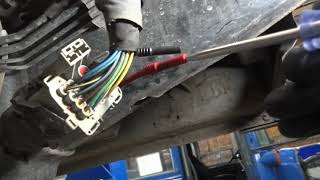
✅ What actually fixed it The user found a pin had completely corroded and broken off inside the main transmission harness connector. The fix required replacing the valve body (which contains the male side of the connector) and the pigtail for the vehicle harness. - YouTube video by 'T Automotive' (2018 Dodge Ram (platform mate)) — No crank, no start, limp mode, code U0101.
❌ Tried (didn't work) Scanning for codes initially showed no communication with TCM.
✅ What actually fixed it The plastic locking tab on the main transmission harness connector was broken, allowing the connector to back out slightly and lose connection. Securing the connector with a zip tie restored the connection and power to the TCM, allowing the truck to start. The permanent fix was to replace the faulty harness/connector. - YouTube video by 'Jeep Masters' (2021 Jeep Wrangler Rubicon (similar CAN architecture)) — Multiple CAN bus errors, dash lights flashing, wipers coming on, loss of power steering, U0101.
❌ Tried (didn't work) Isolating modules one-by-one at the star connector behind the glovebox.
✅ What actually fixed it The CAN bus wiring harness had chafed through where it passed near the transmission. The exposed CAN low wire was shorting out, taking down the entire network intermittently. The fix was to repair the damaged wires.
OEM Part Supersession History
68565455AA→Current— This is the specified part in TSB 21-016-25 REV. C. No supersession is noted as of early 2026, but always verify with a dealer using the vehicle's VIN.
Heads up: This part fits 2022-2023 Wagoneer and Grand Wagoneer with both the 3.0L I6 and 5.7L V8 MHEV engines. A core charge applies, indicating the old part must be returned.
Model Year Variations Within This Range
- 2023 vs 2024: The 5.7L V8 HEMI engine option was phased out for the 2024 model year. All 2024+ Wagoneers come standard with the 3.0L Hurricane Twin-Turbo I6. While the transmission (8HP75) and the U0101 fault remain the same, this eliminates any engine-specific variables when diagnosing on a 2024+ model.
Helpful Videos
We Have This Part in Stock

The information in this article is provided for general reference and educational purposes only. Vehicle specifications, procedures, and part compatibility can vary by production date, trim level, and region. Always consult your vehicle's factory service manual and verify part numbers before purchasing or performing repairs. Safety-critical components such as airbags, seat belts, and braking systems should be installed by a qualified professional.
- Jeep WAGONEER:
- 🧭 Diagnostic Flowchart
- 🎬 Helpful Videos
- 🛍️ Shop This Part
- What's Unique About the 2023-2025 Jeep WAGONEER
- Symptoms You May Notice
- Most Likely Causes
- Rare But Worth Checking
- Diagnosis Steps
- Parts You'll Likely Need
- Related Codes That Often Appear With This One
- Technical Service Bulletins (TSBs) & Recalls
- Platform-Specific Known Issues
- Mechanic-Grade Diagnostic Values
- Scan Tool Commands That Help
- Wiring & Ground Locations
- Real Owner Repair Stories
- OEM Part Supersession History
- Model Year Variations Within This Range
- 🎟️ Get 5% Off