

U0101 on 2016-2020 Kia Optima: Lost Communication with TCM Causes and Fixes
On a 2016-2020 Kia Optima, U0101 means the Transmission Control Module (TCM) has stopped communicating. This is often a software glitch after a dealer ECU update, especially on 2016 models, related to anti-theft or other service campaigns. Otherwise, suspect a damaged wiring harness, poor ground connection, or a faulty TCM.
- For a 2016-2020 Kia Optima, especially a 2016, the first step is to ask if the check engine light appeared right after a dealer service. If so, the problem is likely a software glitch that the dealer must fix.
- This code is serious and makes the car unsafe to drive. The transmission can get stuck in gear, creating a hazard.
- Do not immediately assume the expensive TCM has failed. A thorough inspection of the wiring harness for damage is the most important hardware check.
- This is not a DIY-friendly repair. Diagnosing and fixing network issues or replacing a TCM requires professional tools and expertise.
What's Unique About the 2016-2020 Kia Optima
For the 2016-2020 Optima (JF generation), this code has a unique and well-documented software-related cause. Numerous owners, particularly of the 2016 model year, have reported the U0101 code appearing immediately after receiving a factory software update at a dealership, such as the anti-theft logic update. A Kia technician confirmed that certain PCM updates were known to inadvertently trigger this communication fault, with Kia being aware of the issue and working on a software fix. This means that unlike in many other vehicles, the first question to ask is whether the car was recently serviced or updated.
Symptoms You May Notice
- Check Engine Light is on
- Transmission warning light is illuminated
- Vehicle is stuck in one gear (fail-safe or 'limp mode')
- Harsh, erratic, or delayed shifting
- Inability to shift out of Park or Neutral
- Gear selector indicator on the dashboard may be blank or incorrect
- Vehicle may stall or lose power while driving
- Replacing the entire transmission when the fault is purely electrical or software-based.
- Replacing the TCM when the actual problem is a simple broken wire, blown fuse, or corroded ground.
- Blaming an aftermarket remote start/alarm system, although it can sometimes be a factor if wired improperly into the CAN bus.
Most Likely Causes
- Software Glitch After ECU Update 🔴 High Probability Specifically noted on 2016 models after dealership software updates for recalls or service campaigns (e.g., anti-theft or knock sensor detection). The update to the PCM can create a communication conflict with the existing TCM software.
How to confirm: Check service records or ask the owner if the fault appeared immediately after a visit to a Kia dealership for a software update. A Kia technician on forums confirmed this is a known issue Kia is working to resolve.
Typical fix: The vehicle requires a subsequent patch or corrected software version from a Kia dealer to resolve the communication conflict. In some cases, the dealer may need to re-flash or, as a last resort, replace the TCM if it cannot be updated correctly.
Est. part cost: $0 - Damaged Wiring Harness or Connectors 🟡 Medium Probability Wiring for the transmission runs under the vehicle and is exposed to heat, vibration, and potential road debris, which can cause chafing, breaks, or corrosion over time. Moisture can also enter connectors, causing pin corrosion. Rodent damage to the front control harness has also been reported.
How to confirm: Visually inspect the wiring harness leading to the transmission and the TCM. Check for chafed wires, loose pins, and corrosion in the connectors. A multimeter is used to check for continuity and shorts in the CAN bus wires (pins 6 & 14 on the OBD-II port). Resistance between CAN High and CAN Low should be ~60 ohms with the battery disconnected.
Typical fix: Repairing the damaged section of the wire or replacing the affected connector. In severe cases, a new harness section may be needed.
Est. part cost: $10-$300 - Failed Transmission Control Module (TCM) 🟡 Medium Probability → Shop Transmission Assembly Electronic modules can fail due to internal component breakdown from heat, vibration, or age. The TCM is often located on or near the transmission, exposing it to harsh conditions.
How to confirm: This is typically diagnosed by exclusion. If the power, ground, and CAN bus network wiring to the TCM are all confirmed to be good using a multimeter, the module itself is the likely culprit. A high-end scan tool will show the TCM as 'offline' and will be unable to communicate with it.
Typical fix: Replacement of the TCM. The new module will require programming by a dealer or a qualified shop to work with the vehicle's specific VIN.
Est. part cost: $400-$900 - Poor Power or Ground Connection ⚪ Low Probability Control modules are sensitive to voltage. A weak battery, failing alternator, or corroded ground strap can cause intermittent communication dropouts. Cleaning battery terminals has been reported to fix this code on other vehicles.
How to confirm: Test the battery voltage (should be >12.4V with engine off) and the charging system output (should be 13.5-14.5V with engine running). Inspect and clean the main battery terminals and the chassis ground points, especially the main ground strap from the battery to the chassis and engine.
Typical fix: Replace a weak battery, repair the charging system, or clean/tighten ground connections. A faulty ground junction connector can also be a root cause.
Est. part cost: $5-$400
Diagnosis Steps
- Check Service History: Before any diagnosis, determine if the vehicle recently had a software update at a Kia dealership (e.g., for the anti-theft campaign). If so, the issue is highly likely to be software-related and should be taken back to the dealer for resolution.
- Scan for All Codes: Use an advanced OBD-II scanner to check for any other codes in the PCM, TCM, ABS, or other modules. Note if the scanner is unable to communicate with the TCM at all, which is a key symptom.
- Check Battery and Charging System: Ensure the battery has a full charge (>12.4V) and that the alternator is providing stable voltage (13.5-14.5V) when the engine is running. Low or fluctuating voltage can cause communication errors.
- Inspect Fuses: Check all fuses related to the Powertrain Control Module (PCM) and Transmission Control Module (TCM) in both the engine bay and interior fuse panels. For the JF Optima, check fuses labeled 'TCU 1' (10A) and 'TCU 2' (15A) in the engine bay fuse box.
- Visual Wiring Inspection: Thoroughly inspect the wiring harness that runs to the transmission. Look for any signs of physical damage, chafing against the frame or engine components, or melted plastic near the exhaust.
- Check Connectors: Disconnect and inspect the main electrical connectors at the TCM and the transmission housing. Look for green or white corrosion, bent pins, or backed-out pins. Clean with electrical contact cleaner and apply dielectric grease if needed.
- Verify Power and Ground at the TCM: Using a multimeter and a vehicle-specific wiring diagram, confirm that the TCM connector is receiving proper battery voltage (12.0-12.6V) and has a solid ground connection (resistance to chassis ground < 0.5 Ω). A voltage drop test is more effective; if voltage disappears when the TCM is connected, it points to a high-resistance fault in the power or ground circuit.
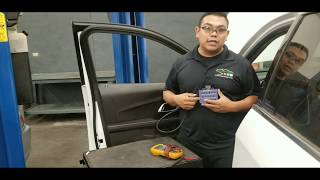
- Test CAN Bus Circuit: This is an advanced step. With the battery disconnected, measure the resistance between the CAN High and CAN Low pins at the DLC (pins 6 and 14). 🎬 Watch: How to test a CAN bus network with a meter It should be approximately 60 ohms. If it's 120 ohms, there's likely an open circuit or a terminating resistor is offline. If it's near 0 ohms, the wires are shorted together.
- Suspect the TCM: If all wiring, power, grounds, and the CAN network test good, the TCM itself is the most likely point of failure.
Parts You'll Likely Need
- Transmission Control Module (TCM)
(OEM #95440-2DBE0 (for 2016 models, 09/2015-04/2017 production) or 95440-2DBE1 (for later models, 04/2017-02/2018 production). Note: Part numbers can be superseded; always verify with VIN.)— If wiring and software are ruled out, the module itself is the cause of the communication loss.
Trusted brands: Kia (OEM)
OEM price range: $470-$750
Aftermarket price range: $400-$700 (Remanufactured) - Transmission Wiring Harness
(OEM #91860-D5110 (Verify with VIN))— Often gets damaged from heat or chafing, leading to an open or short in the CAN bus communication lines.
Trusted brands: Kia (OEM)
OEM price range: $200-$500
Related Codes That Often Appear With This One
- P0700 — P0700 is a generic code that means the TCM has stored a fault. It often appears alongside more specific codes like U0101 to indicate the problem originates in the transmission control system.
- P0880 — This code indicates a TCM Power Input Signal fault. It can be set along with U0101 if the power supply to the TCM is compromised, which would also cause a loss of communication.
Technical Service Bulletins (TSBs) & Recalls
- While no TSB directly addresses U0101 caused by a software update, TSB TRA098 for the 2016-2020 Optima shows a procedure for updating the DCT logic for other issues, demonstrating the process dealers would follow.
- Service Campaign CS2312 details the installation of an anti-theft ignition protector, a campaign often performed alongside the software update that has been linked to the U0101 code.
- Service Action SA499 (NHTSA ID: 10212235) addresses DTC P0880 on some 2019-2020 Optimas by upgrading the transmission harness due to potential heat damage, which could also be a root cause for U0101.
Platform-Specific Known Issues
- A significant number of 2016 Kia Optima owners have experienced this U0101 code immediately following a dealership visit for a software update related to other recalls or service campaigns, most notably the anti-theft software logic update. In these cases, the fault is not with a physical part but with a software incompatibility created by the update, requiring further dealer intervention. A Kia technician publicly acknowledged this as a known issue that Kia was developing a fix for.
Mechanic-Grade Diagnostic Values
- CAN Bus Network Resistance — expected: ~60 Ω (Ohms). Failure: A reading of ~120 Ω indicates an open circuit or one terminating resistor is offline. A reading near 0 Ω indicates a short between the CAN High and CAN Low wires.
- CAN High Voltage (Key On, Engine Off) — expected: ~2.6V - 2.7V. Failure: Voltage significantly different, or matching CAN Low voltage, indicates a short or open.
- CAN Low Voltage (Key On, Engine Off) — expected: ~2.3V - 2.4V. Failure: Voltage significantly different, or matching CAN High voltage, indicates a short or open.
- TCM Power Supply Pin Voltage — expected: 12.0V - 12.6V (Key On, Engine Off). Failure: Low or no voltage indicates a fuse or wiring issue. A significant voltage drop when the module is connected points to high resistance in the circuit.
- TCM Ground Pin Resistance — expected: < 0.5 Ω to a known good chassis ground. Failure: High resistance indicates a poor ground connection, which can cause intermittent communication failures.
Scan Tool Commands That Help
- Kia GDS/KDS: TCM Upgrade (Auto or Manual Mode) — Used to re-flash the TCM with updated software from Kia. This is the primary fix for software-induced U0101 codes and is also required after replacing the TCM.
- Kia GDS/KDS: Reset TCM Adaptive Learning Values — This procedure should be performed after a software update or TCM replacement to ensure smooth shifting. It resets the learned values for clutch engagement and shift timing.
- Kia GDS/KDS: Variant Coding — When installing a new or used TCM, the module must be coded to the vehicle's specific options (engine, trim, etc.) to ensure it communicates correctly with other modules. This is a mandatory step for replacement.
Wiring & Ground Locations
- TCM Fuses — In the main engine compartment fuse box.. The TCM receives power through two dedicated fuses, often labeled 'TCU 1' (10A) and 'TCU 2' (15A). A blown fuse will cut all power to the module, causing an immediate U0101 code.
- Transmission Harness Connector — On the exterior of the transmission case, typically where the main harness connects to the transmission.. This is a primary point for corrosion, moisture intrusion, or pin damage. All power, ground, and communication signals for the TCM pass through this connector.
- Main Chassis Ground — A strap connecting the negative battery terminal to the vehicle's chassis/frame, and another from the chassis to the engine/transmission block.. A corroded or loose main ground can create unstable voltage across all vehicle electronics, leading to intermittent communication codes like U0101.
Real Owner Repair Stories
- Reddit user post on r/kia (2016 Kia Optima) — Check engine light with code U0101 appeared immediately after the car was serviced at a dealership for recalls.
❌ Tried (didn't work) Dealer cleared the code, but it came back on immediately upon starting the car.
✅ What actually fixed it The dealership diagnosed a faulty Powertrain Control Module (PCM) and stated it needed to be replaced. The implication is that the software update damaged or created an unrecoverable conflict with the original PCM, leading to the communication loss with the TCM. - NHTSA ODI #11570456 — An owner of a similar Kia model reported that their scanner could not communicate with the ECM/TCM, resulting in a U0101 code accompanied by shifting and starting issues.
Model Year Variations Within This Range
- 2016: The 2016 model year is most frequently cited in owner complaints for the U0101 code appearing immediately after a dealership software update (e.g., anti-theft logic). While later years received similar updates, the 2016 models appear uniquely susceptible to this specific software conflict.
- 2019-2020: Kia issued Service Action SA499 for some 2019-2020 Optimas to upgrade the transmission wiring harness due to heat exposure causing high resistance. This suggests later models may have a higher probability of a wiring-related failure near the transmission compared to the software issues of earlier models.
Diagnostic Flowchart
Used vs. New Parts: Buying Guide for This Vehicle
When a used part is the smart pick: A used wiring harness from a low-mileage donor vehicle that shows no signs of corrosion or damage can be a cost-effective alternative to a new OEM harness.
Donor-vehicle mileage cap: roughly under 60000 miles for the part to have meaningful remaining life.
What to inspect on the donor part:
- For a wiring harness, inspect all connector pins for corrosion (green/white powder) or damage.
- Check the plastic conduit and wire insulation for brittleness, cracking, or signs of melting from exhaust heat.
- Ensure all locking tabs on connectors are intact and not broken.
- Avoid harnesses from vehicles in salt-belt regions if possible, as they are more prone to corrosion.
OEM-only on this vehicle (don't cheap out):
- Transmission Control Module (TCM)
Brands owners have reported issues with on this vehicle:
- Used or remanufactured TCMs from unknown sources are a major gamble. These modules are VIN-specific and require dealer-level programming. A used module may not be programmable to a new vehicle, leading to wasted money and time. It is strongly recommended to use a new OEM part or a remanufactured unit from a highly reputable specialist like Flagship One that pre-programs the module to your VIN before shipping.
Real Owner Stories
Aggregated from forums and TSBs cited above. Mileages and costs reflect what owners reported in those sources.
2016 Kia Optima
Symptoms: U0101 appeared immediately after a dealer service for recalls.
What fixed it: This was identified as a known software issue caused by a PCM update. The fix requires a subsequent software patch from a Kia dealer to resolve the communication conflict.
Source hint: reddit.com/r/kia/comments/1c82531/kia_optima_2016/
2016-2020 Kia Optima
Symptoms: Check engine light came on, OBD reader showed U0101 related to transmission communication.
What fixed it: The owner took the car back to the dealer, but they initially reported that they could not find anything wrong.
Source hint: Reddit r/kia
Kia Communication Fault
Symptoms: Shifting and starting issues accompanied by a U0101 code.
What fixed it: According to NHTSA ODI #11570456, the scanner was unable to communicate with the ECM/TCM, confirming a total loss of network visibility for the modules.
Related OBD-II Codes
Frequently Asked Questions
My 2016 Optima got a U0101 code right after the dealer did the anti-theft software update. Is this a known problem?
Could a bad wiring harness cause the U0101 code on my 2019 Optima? I saw a service action for that.
What fuses should I check first for a U0101 code on my Kia Optima?
My mechanic says the Transmission Control Module (TCM) failed. What is the estimated part cost for a 2016-2020 Optima?
I'm testing the CAN bus for the U0101 code. What resistance should I see at the OBD-II port?
I have a 2017 Hyundai Sonata with a U0101 code. Is the information for the Optima relevant to my car?
Helpful Videos
We Have This Part in Stock


The information in this article is provided for general reference and educational purposes only. Vehicle specifications, procedures, and part compatibility can vary by production date, trim level, and region. Always consult your vehicle's factory service manual and verify part numbers before purchasing or performing repairs. Safety-critical components such as airbags, seat belts, and braking systems should be installed by a qualified professional.
- Kia Optima:
- 🧭 Diagnostic Flowchart
- 🎬 Helpful Videos
- 🛍️ Shop This Part
- What's Unique About the 2016-2020 Kia Optima
- Symptoms You May Notice
- Most Likely Causes
- Diagnosis Steps
- Parts You'll Likely Need
- Related Codes That Often Appear With This One
- Technical Service Bulletins (TSBs) & Recalls
- Platform-Specific Known Issues
- Mechanic-Grade Diagnostic Values
- Scan Tool Commands That Help
- Wiring & Ground Locations
- Real Owner Repair Stories
- Model Year Variations Within This Range
- Used vs. New Parts: Buying Guide for This Vehicle
- Real Owner Stories
- 2016 Kia Optima
- 2016-2020 Kia Optima
- Kia Communication Fault
- Related OBD-II Codes
- Frequently Asked Questions
- 🎟️ Get 5% Off