

U0101 on 2008-2010 Mazda 5: Lost Communication With TCM Causes and Fixes
On a 2008-2010 Mazda 5, code U0101 almost always means the Transmission Control Module (TCM) has failed due to its mounting location on the hot transmission case. This causes the 'AT' light to flash and the car to enter 'limp mode,' typically stuck in 3rd gear. Expect to pay $450-$900 for a replacement or repair service. The OEM part number is L39C-18-9E1E, which supersedes earlier versions.
- U0101 on a 2008-2010 Mazda 5 means the Transmission Control Module (TCM) has stopped communicating with the rest of the car.
- The most probable cause by a wide margin is the failure of the TCM itself due to a design flaw where it's mounted to the hot transmission case.
What's Unique About the 2008-2010 Mazda 5
The Mazda 5 from this era, along with its platform-mate the Mazda 3, is notorious for TCM failure. The primary reason is the module's design and placement: it is bolted directly to the transmission case. This location subjects the TCM to constant, excessive heat and vibration, which eventually causes weak internal solder joints on the circuit board to crack and fail, leading to communication loss and the U0101 code. Many owners and repair shops have noted this as a very common failure point.
Symptoms You May Notice
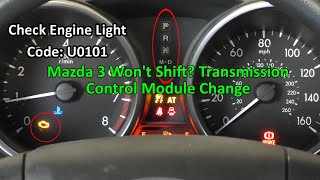
- Flashing 'AT' (Automatic Transmission) light on the dashboard
- Check Engine Light is on
- Vehicle is stuck in one gear (usually 3rd), also known as 'limp mode' 🎬 Watch: A quick hack for Mazda 5 limp mode
- Harsh or erratic shifting
- A noticeable 'clunk' when shifting from Park to Reverse or Drive
- Difficulty or failure to shift gears
- Poor acceleration
- Gear position indicator on the dashboard may go blank or not illuminate
- Replacing the entire transmission. U0101 is an electrical communication code, not a sign of internal mechanical failure.
- Replacing transmission solenoids or fluid. These components will not fix a communication failure between control modules.
- Replacing the vehicle speed sensor. One owner on a forum replaced this part first, but the U0101 code and symptoms returned, pointing to the TCM as the actual culprit.
Most Likely Causes
- Internal Failure of the Transmission Control Module (TCM) 🔴 High Probability → Shop Transmission Assembly The TCM is mounted directly to the transmission, causing it to overheat and 'bake' over time. This constant heat and vibration lead to the failure of weak internal solder joints. This is a widely documented design flaw for this platform.
How to confirm: After verifying power, ground, and CAN bus wiring to the TCM are intact, the module itself is the culprit. A professional scan tool can attempt to communicate directly with the TCM; a lack of response points to a failed module. The module is located underneath the battery tray in the engine bay. 🎬 See this quick walkthrough of the TCM removal steps
Typical fix: Replace the TCM with a new or remanufactured unit, or send the original unit to a specialist for repair and rebuilding. The replacement or repaired unit must be programmed to the vehicle, though many remanufactured units now come pre-programmed. Some owners have successfully relocated the new or repaired TCM to a cooler location away from the transmission to prevent repeat failures. 🎬 Watch: How to repair and relocate your Mazda TCM
Est. part cost: $400-$900 - Damaged Wiring or Poor Connections 🟡 Medium Probability
How to confirm: Visually inspect the wiring harness and connector at the TCM for any signs of corrosion, chafing, or bent pins. Check for stable 12V power and a clean ground connection at the TCM connector with a multimeter.
Typical fix: Repair the damaged section of the wiring harness or clean/replace the connector.
Est. part cost: $10-$100 - Blown Fuse or Faulty Relay ⚪ Low Probability
How to confirm: Check the vehicle's fuse boxes (both in the engine bay and inside the cabin) for any fuses related to the TCM or transmission. A user on Mazdas247 suggested checking the 'TCM' fuse in the engine compartment fuse box as a first step. Consult the owner's manual for specific fuse locations.
Typical fix: Replace the blown fuse.
Est. part cost: $1-$5
Rare But Worth Checking
- Faulty Powertrain Control Module (PCM): → Shop Engine Control Module (ECM) While possible, it is much less common for the PCM to fail than the TCM. This should only be considered after all other possibilities, especially the TCM itself, have been ruled out.
- Low Battery Voltage: → Shop Vehicle Battery On some modern vehicles, low system voltage can cause communication errors between modules. While less documented for this specific Mazda 5, it's a simple and important check to perform before more complex diagnostics.
Diagnosis Steps
- Scan for all stored trouble codes in all modules. Note if other 'U' codes are present, which could indicate a wider network problem.
- Check the battery and charging system to ensure voltage is stable and within specification (typically above 12.4V with the engine off).
- Inspect the fuses related to the TCM and transmission.
- Locate the TCM on the transmission housing, underneath the battery and battery tray. Carefully inspect the main electrical connector and wiring harness for any visible damage, corrosion, or loose connections.
- Using a multimeter and a wiring diagram, verify that the TCM is receiving proper power and has a solid ground connection.
- Test the CAN bus wires between the PCM and TCM for continuity and resistance. With the battery disconnected, the resistance between the CAN High and CAN Low wires should be approximately 60 ohms. A reading of 120 ohms suggests a problem in the circuit.
- If all wiring, power, and grounds are good, the TCM is highly likely to have failed internally.
Parts You'll Likely Need
- Transmission Control Module (TCM)
(OEM #L39C-18-9E1E (supersedes L39C-18-9E1B, L39C-18-9E1C, L39C-18-9E1D))— This is the most common failure point for the U0101 code on this vehicle due to its design and mounting location, which exposes it to excessive heat and vibration.
Trusted brands: Mazda (OEM), UpFix (Repair Service), Circuit Board Medics (Repair Service), Flagship One (Remanufactured), Module Repair Pro (Repair Service), XeMODeX Inc (Repair Service)
OEM price range: $700-$900
Aftermarket price range: $400-$600 (for repair/remanufactured)
Related Codes That Often Appear With This One
- U0100 — This code also indicates a loss of communication with the ECM/PCM and often appears with U0101 when there are network-wide issues.
- U0073 — This code means 'Control Module Communication Bus Off' and can be set alongside U0101, indicating a general CAN bus network problem.
- P0753, P0758, P0763 — These are shift solenoid malfunction codes that can appear when the TCM fails internally and can no longer control the solenoids, even if the solenoids themselves are functional.
Technical Service Bulletins (TSBs) & Recalls
- While no specific TSB for the U0101 code on the Mazda 5 was found, a related TSB 05-005/15 exists for other Mazda models regarding a whining noise from the transaxle, indicating Mazda has addressed other transmission issues in this era.
Platform-Specific Known Issues
- The TCM on 2006-2015 Mazda 3 and Mazda 5 models has an extremely high failure rate due to being mounted directly on the transmission. The constant heat cycles and vibration cause internal solder joints to crack, leading to intermittent or total loss of communication.
Mechanic-Grade Diagnostic Values
- CAN Bus Network Resistance — expected: Approximately 60 Ω (with battery disconnected). Failure: A reading of ~120 Ω indicates an open circuit or a missing terminating resistor. A reading near 0 Ω indicates a short between the CAN High and CAN Low wires.
- CAN High Wire Voltage — expected: ~2.5V - 3.5V (Key On, Engine Off). Failure: Voltage stuck at 0V, 5V, or battery voltage indicates a short to ground or power.
- CAN Low Wire Voltage — expected: ~1.5V - 2.5V (Key On, Engine Off). Failure: Voltage stuck at 0V, 5V, or battery voltage indicates a short to ground or power.
- TCM Power Supply Voltage — expected: 12.0V - 12.6V (at the module's supply pin with ignition on). Failure: Significantly lower or no voltage indicates a problem with the power supply wire or fuse.
- TCM Ground Resistance — expected: Below 0.5 Ω. Failure: Higher resistance indicates a poor ground connection, which can cause communication errors.
Scan Tool Commands That Help
- Mazda IDS (Integrated Diagnostic System): Module Programming — Used to configure and calibrate a new or replacement TCM to the vehicle using its VIN. This is often required to ensure the module communicates correctly with other vehicle systems.
- Mazda IDS (Integrated Diagnostic System): Self-Test — To command the TCM to perform an internal diagnostic routine. The IDS can send signals to all modules on the CAN bus and report which ones fail to respond, directly confirming a communication loss with the TCM.
- Mazda IDS (Integrated Diagnostic System): Live Data Display / Data Logger — To monitor real-time data from various transmission sensors and solenoids. If the scan tool cannot display any data from the TCM, it strongly suggests the module is offline or has failed.
Wiring & Ground Locations
- Main Transmission Ground — A ground cable from the negative battery terminal is bolted to a bracket on top of the transmission case.. A loose or corroded main ground for the transmission can cause a variety of electrical issues, including intermittent communication faults with the TCM, which is mounted directly to the case.
- TCM Connector — On the TCM itself, which is located under the battery and battery tray, mounted on top of the transmission.. This is the primary connection point for power, ground, and CAN bus signals to the TCM. It should be inspected for corrosion, moisture, or bent pins as a primary diagnostic step.
- G14 Ground Point — Located at the rear of the engine.. Wiring diagrams indicate this is a relevant ground point for the overall engine and transmission control system. A fault here could potentially impact TCM communication.
Real Owner Repair Stories
- All Computer Resources YouTube Channel (2006-2010 Mazda 3 or 5) — AT light on, Check Engine light on, stuck in gear (limp mode).
❌ Tried (didn't work) The video focuses on the common failure and doesn't list misdiagnoses, but implies that mechanics should first rule out shorted wires, solenoid issues, and bad grounds before condemning the TCM.
✅ What actually fixed it The TCM was repaired and, crucially, relocated away from its original position on the hot transmission case. The video demonstrates mounting the repaired TCM to a bolt on the firewall using a provided lock nut to prevent future heat-related failures. - NHTSA ODI #10443803 (Mazda 3 Platform Reference) — An owner reported that the vehicle randomly changed gears without warning, causing major safety issues. When the vehicle was scanned, it returned error code U0101, indicating the computer was failing.
- NHTSA ODI #11556887 (Mazda 3 Platform Reference) — A report notes that there were no warning lights before the transmission malfunctioned, after which a code scan revealed U0101 for lost communication with the TCM.
OEM Part Supersession History
L39C-18-9E1B, L39C-18-9E1C, L39C-18-9E1D→L39C-18-9E1E— Revisions by the manufacturer to address issues or improve the component.
Heads up: The final version, L39C-18-9E1E, is the correct replacement for all previous versions for the 2008-2010 Mazda 5.
Diagnostic Flowchart
Documented NHTSA Reports
NHTSA ODI #11388410
An owner reported that after suspecting a specific issue, a code scan confirmed their belief that the most likely culprit would be U0101, indicating lost communication with the TCM.
NHTSA ODI #11171737
A report filed with the NHTSA describes the presence of code U0101, defined as lost communication with the transmission control module, which was accompanied by a dashboard light.
Other Known Issues on This Vehicle
Issues unrelated to this code that are worth knowing about as an owner of this generation:
- Rattling/Clunking from Rear Suspension 🟠 Medium — Common issue, often caused by worn rear shock absorbers, sway bar links, or sway bar bushings. Some owners report the upper spring insulation cup becoming displaced.
- Sliding Door Latch/Actuator Failure 🟠 Medium — Sliding doors may fail to latch, lock, or unlock properly. This can be caused by faulty lock actuators or a dirty/binding latch mechanism. A recall (06V-463 / 4306K) was issued for latches freezing in cold weather. (Ref: 06V-463 / 4306K)
- Defective Engine Mounts 🟠 Medium — Worn or failed engine mounts can cause excessive engine vibration and noise to be felt in the cabin.
- Rust on Rear Wheel Arches and Undercarriage 🔴 High — The 2006-2010 models are particularly prone to rust, especially in regions that use road salt.
- Stuck Open Thermostat 🟡 Low — A failing thermostat can cause a Check Engine Light, often with codes P0126 or P0128, and may lead to poor heater performance.
Used vs. New Parts: Buying Guide for This Vehicle
When a used part is the smart pick: Buying a used TCM from a junkyard is STRONGLY DISCOURAGED for this vehicle. The part has an extremely high failure rate due to a known design flaw (heat exposure). A used part is likely to have the same internal damage and will probably fail soon after installation.
What to inspect on the donor part:
- Not applicable, as used parts are not recommended.
OEM-only on this vehicle (don't cheap out):
- While a new OEM part is an option, the most cost-effective and reliable solution is a remanufactured/repaired original module from a reputable specialist. These services address the root cause of the failure by using stronger components and improving thermal management.
Aftermarket brands forum-validated for this vehicle:
- Circuit Board Medics (Repair/Exchange Service)
- UpFix (Repair Service)
- Module Repair Pro (Repair/Exchange Service)
- All Computer Resources (Repair Service)
Brands owners have reported issues with on this vehicle:
- Be cautious of sellers on platforms like eBay or Amazon advertising "new" or "refurbished" units from China. Reports indicate these are often old, faulty cores that have been spray-painted and resold without any actual repairs, and they may fail quickly.
Real Owner Stories
Aggregated from forums and TSBs cited above. Mileages and costs reflect what owners reported in those sources.
2008 Mazda 5
Symptoms: The owner initially suspected a speed sensor issue but experienced symptoms consistent with TCM failure. The TCM was located under the battery.
What fixed it: Replacement of the TCM (upgrading part L39C189E1B to L39C189E1E).
Cost: $455-$455
Source hint: Mazdas247 - Thread '2008 Mazda5 Transmission Control Module Replacement *Experience*'
2009 Mazda 5 — 97000 miles
Symptoms: Vehicle threw error code U0101.
What fixed it: The dealer replaced the TCM under an extended warranty.
Source hint: Mazdas247 - Thread '2009 Mazda5 error code U0101 transmission'
2006-2010 Mazda 5
Symptoms: U0101 code caused by heat from the transmission affecting the solder on the TCM's circuit board.
What fixed it: Repairing the original module via a service like XeMODeX and relocating the unit away from the transmission to prevent future heat-related failures.
Source hint: Reddit (r/mazda5) - Thread 'Tcm'
Related OBD-II Codes
Frequently Asked Questions
Where is the Transmission Control Module (TCM) located on my 2008-2010 Mazda 5?
Why does the TCM fail so frequently on the Mazda 5 platform?
Should I buy a used TCM from a junkyard to fix the U0101 code?
Is there a way to prevent a replacement TCM from failing again?
Does TSB 05-005/15 cover my U0101 communication issue?
What are the symptoms of a failing TCM on a 2009 Mazda 5?
Are there any recalls for the transmission or TCM on this vehicle?
Helpful Videos

We Have This Part in Stock

The information in this article is provided for general reference and educational purposes only. Vehicle specifications, procedures, and part compatibility can vary by production date, trim level, and region. Always consult your vehicle's factory service manual and verify part numbers before purchasing or performing repairs. Safety-critical components such as airbags, seat belts, and braking systems should be installed by a qualified professional.
- Mazda 5:
- 🧭 Diagnostic Flowchart
- 🎬 Helpful Videos
- 🛍️ Shop This Part
- What's Unique About the 2008-2010 Mazda 5
- Symptoms You May Notice
- Most Likely Causes
- Rare But Worth Checking
- Diagnosis Steps
- Parts You'll Likely Need
- Related Codes That Often Appear With This One
- Technical Service Bulletins (TSBs) & Recalls
- Platform-Specific Known Issues
- Mechanic-Grade Diagnostic Values
- Scan Tool Commands That Help
- Wiring & Ground Locations
- Real Owner Repair Stories
- OEM Part Supersession History
- Documented NHTSA Reports
- NHTSA ODI #11388410
- NHTSA ODI #11171737
- Other Known Issues on This Vehicle
- Used vs. New Parts: Buying Guide for This Vehicle
- Real Owner Stories
- 2008 Mazda 5
- 2009 Mazda 5 — 97000 miles
- 2006-2010 Mazda 5
- Related OBD-II Codes
- Frequently Asked Questions
- 🎟️ Get 5% Off