

U0101 on 2015-2018 Nissan Murano: Lost Communication with TCM Causes and Fixes
The U0101 code on a 2015-2018 Nissan Murano means the Transmission Control Module (TCM) has stopped communicating with other vehicle computers. This is often caused by wiring issues, a faulty TCM, or low battery voltage. The vehicle may enter a 'limp mode' with harsh or no shifting. Because the TCM is located inside the transmission, diagnosis and repair can be complex.
- U0101 means the Transmission Control Module (TCM) is offline; it's a communication error, not a mechanical failure.
- Always start diagnosis with the simplest things: check the battery, grounds, and fuses related to the TCM.
- Thoroughly inspect the wiring harness and connectors to the TCM for damage or corrosion before considering replacing the expensive module.
- Due to the complexity of network diagnostics, professional help is strongly recommended if the issue isn't a simple fuse or battery problem.
- If the TCM does need replacement, it will likely require programming to your vehicle's VIN.
What's Unique About the 2015-2018 Nissan Murano
The 2015-2018 Murano uses a Continuously Variable Transmission (CVT). On these models, the Transmission Control Module (TCM) is not a separate, externally-mounted box. Instead, it is integrated with the transmission's valve body, located inside the transmission pan and submerged in fluid. This design makes the TCM highly susceptible to heat and vibration, but more importantly, it means that replacing the TCM requires removing the transmission pan, draining the fluid, and replacing the entire valve body assembly. This significantly increases the labor and cost compared to a vehicle with an external TCM. While simple electrical faults should be checked first, a confirmed TCM failure is a major repair.
Symptoms You May Notice
- Check Engine Light is on
- Transmission warning light is on
- Vehicle enters 'limp mode,' limiting speed
- Harsh or erratic shifting
- Transmission will not shift out of Park or Neutral
- Gear position indicator (PRNDL) on the dash may be blank or incorrect
- Vehicle may not start
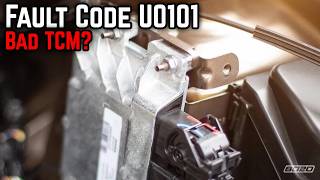
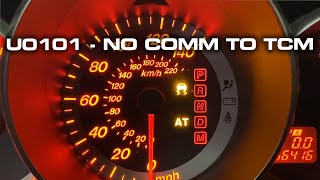
- Scan tool cannot communicate with the TCM 🎬 Watch: A quick breakdown of the U0101 code and common fixes.
- Replacing the entire transmission when the fault is electrical.
- Replacing the TCM/Valve Body when the actual problem is a simple broken wire, corroded ground under the battery, or a loose main harness connector.
Most Likely Causes
- Wiring or Connector Issues 🔴 High Probability Wiring harnesses near the transmission are exposed to heat, vibration, and moisture. The main harness connector at the transmission case is a common point for corrosion, fluid contamination, or loose pins.
How to confirm: Visually inspect the main wiring harness and connector going into the transmission case for any signs of damage, corrosion, or fluid intrusion. Check for power and ground at the TCM connector using a multimeter and the vehicle's wiring diagram. Poor pin tension at the connector is a known issue that can cause intermittent communication loss.
Typical fix: Repair or replace the damaged section of the wiring harness. Clean the connector pins and sockets thoroughly with contact cleaner and ensure a secure, latched connection. Applying dielectric grease can help prevent future moisture intrusion.
Est. part cost: $10-$300 - Low Battery Voltage or Poor Ground 🟡 Medium Probability → Shop Vehicle Battery Control modules require a stable voltage to communicate properly. A weak battery or failing alternator can cause intermittent communication dropouts. Nissans of this era are also known for having issues with body ground points, particularly the main ground strap under the battery tray, which can corrode and create a poor connection.
How to confirm: Test the battery voltage with the engine off (should be ~12.6V) and running (should be ~13.7-14.7V). Inspect the main battery terminals and chassis ground connections, especially the one located under the battery tray, for corrosion and tightness. 🎬 See how to remove the battery tray to access these grounds.
Typical fix: Charge or replace the battery. Clean or tighten ground connections. If the ground strap under the battery is corroded, it should be replaced.
Est. part cost: $150-$400 - Blown Fuse 🟡 Medium Probability
How to confirm: Consult the owner's manual to locate the fuse(s) that provide power to the Transmission Control Module (TCM) and Engine Control Module (ECM). Pull the fuse(s) and visually inspect if they are blown.
Typical fix: Replace the blown fuse. If the fuse blows again immediately, it indicates a short circuit in the TCM power supply that needs to be diagnosed.
Est. part cost: $1-$5 - Faulty Transmission Control Module (TCM) / Valve Body ⚪ Low Probability → Shop Transmission Assembly The TCM is integrated into the valve body, located inside the transmission. Constant exposure to heat and vibration can lead to internal failure of the module's electronics, preventing communication. A manufacturer service bulletin for other Nissan models, TSB Bulletin #NTB21-002, notes that a faulty TCM can result in the module showing as "UNKNOWN" in the scan tool results.
How to confirm: This is typically a diagnosis of exclusion after confirming the wiring, power, grounds, and CAN network are all good. A professional scan tool will be unable to establish communication with the TCM, pointing to an internal module fault.
Typical fix: Replace the entire transmission valve body assembly, which includes the new TCM. The new module must then be programmed to the vehicle using a Nissan-specific scan tool (CONSULT-III).
Est. part cost: $600-$1200
Diagnosis Steps
- Check for other stored DTCs. Multiple 'U' codes suggest a wider network problem.
- Check the battery voltage and charging system output to rule out low voltage issues.
- Inspect all fuses related to the TCM and ECM in both the engine bay and interior fuse panels.
- Perform a thorough visual inspection of the TCM wiring harness and the main circular connector at the transmission case. Look for obvious damage, corrosion, or fluid contamination.
- Inspect the main chassis ground points, paying close attention to the ground strap located under the battery and battery tray, as it is a known corrosion point.
- Using a wiring diagram, disconnect the TCM and check for proper 12V power and clean ground at the connector pins.
- If power and ground are good, check the resistance of the CAN bus wires at the DLC (OBD-II port). With the battery disconnected, resistance between Pin 6 (CAN High) and Pin 14 (CAN Low) should be approximately 60 ohms. A reading of 120 ohms suggests a break in the circuit or a missing terminating resistor (module).
- If all wiring, power, and grounds are confirmed to be good, and a scan tool still cannot communicate with the TCM, the TCM/Valve Body assembly is the likely culprit.
Parts You'll Likely Need
- Transmission Control Module / Valve Body Assembly
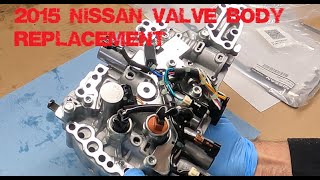
(OEM #3170E-28X0B (this is a superseding part number; it replaces 31705-28X0B, 31705-28X0A, etc.))— If all wiring and power supply checks pass, the module itself, which is integrated into the valve body, has likely failed internally. Replacement requires dropping the transmission pan. 🎬 Watch this step-by-step walkthrough of a Murano valve body replacement.
Trusted brands: Nissan OE
OEM price range: $370-$550 - Battery — A weak or failing battery can cause low voltage, leading to intermittent communication failures between modules.
Trusted brands: Interstate, DieHard, Bosch
OEM price range: $200-$300
Aftermarket price range: $150-$250 - Chassis Ground Strap — The ground strap under the battery tray is a common failure point due to corrosion, leading to a host of electrical and communication issues.
Trusted brands: Nissan OE, Dorman
OEM price range: $20-$40
Aftermarket price range: $10-$25
Related Codes That Often Appear With This One
- U1000 — This is a general Nissan code for a CAN Communication Circuit failure. It often appears alongside more specific U-codes like U0101 to indicate a broader network problem.
- U0100 — This code indicates a Lost Communication with the ECM/PCM. It can appear with U0101 if there is a major network disruption affecting multiple modules.
- P17F0 / P17F1 — These codes relate to CVT judder and often trigger TSB NTB17-039. While not communication codes, they point to internal CVT issues and may appear if the TCM is beginning to fail or has stored multiple faults before losing communication entirely.
Technical Service Bulletins (TSBs) & Recalls
- NTB17-039N (and subsequent revisions like 'h', 'o'): While for DTCs P17F0/P17F1, this TSB is highly relevant. It outlines the procedure for addressing CVT judder, which involves inspecting the CVT chain and, if necessary, replacing the control valve (valve body). Since the TCM is integrated with the valve body, this TSB provides context for related major transmission repairs.
- NTB12-103f (and subsequent revisions like 'H'): This bulletin is critical as it details the specific 'CVT / TCM CALIBRATION DATA “WRITE” PROCEDURE' required when replacing the CVT assembly, valve body, or just the TCM. It outlines the exact steps needed using the CONSULT-III plus tool.
- TSB Bulletin #NTB21-002A: This manufacturer bulletin notes that if U0101 is stored in the ECU or Shifter Control Unit (SCU) as past or current, it may be associated with a no-crank and no-start condition.
Platform-Specific Known Issues
- Intermittent U0101 after Transmission Replacement: → Shop Transmission Assembly A user on the r/AskMechanics subreddit reported a persistent U0101 code immediately after installing a remanufactured transmission. Their diagnostic process included checking fuses, inspecting the harness with an endoscope, and cleaning fluid from the main connector. This highlights the sensitivity of the CAN bus system and how even minor issues during a major repair can trigger communication faults.
- Corroded Ground Under Battery Tray: → Shop Vehicle Battery Multiple Nissan forums and videos for vehicles of this generation (including Murano) point to the ground connection point on the chassis, located beneath the battery tray, as a frequent source of electrical problems. Corrosion builds up, creating high resistance and causing intermittent issues that are difficult to diagnose, including communication codes.
Mechanic-Grade Diagnostic Values
- CAN Bus Network Resistance — expected: ~60 Ohms. Failure: A reading of ~120 Ohms indicates a break in the circuit or a missing terminating module. A reading of ~40 Ohms or less suggests an extra terminating resistor or a short in the wiring.
- CAN High (Pin 6 at DLC) to Ground Voltage — expected: 2.5 to 3.5 Volts (during active communication). Failure: Voltage outside this range indicates a potential short or open on the CAN High line.
- CAN Low (Pin 14 at DLC) to Ground Voltage — expected: 1.5 to 2.5 Volts (during active communication). Failure: Voltage outside this range indicates a potential short or open on the CAN Low line.
- TCM Power Supply at Connector — expected: ~12.6 Volts (Key On, Engine Off). Failure: Low or no voltage indicates a problem with the fuse, relay, or power supply wire to the TCM.
- TCM Ground at Connector to Chassis Ground — expected: Less than 0.5 Ohms. Failure: High resistance indicates a poor ground connection, which is a common cause of module communication issues.
Scan Tool Commands That Help
- Nissan CONSULT-III plus: Save/Write Calibration Data — This function is required when only the TCM is being replaced. The calibration data from the old TCM must be saved and then written to the new module.
- Nissan CONSULT-III plus: Erase/Write Calibration Data (Write IP CHARA) — This is used when the entire CVT assembly or the valve body (which includes the TCM) is replaced. The new calibration data comes on a CD or via a QR code with the new part and must be written to the vehicle.
- Nissan CONSULT-III plus: Clutch Point Learning — This procedure is required after replacing the valve body or TCM to allow the module to learn the clutch engagement points. Failure to perform this can result in the vehicle not moving when put in gear.
- Nissan CONSULT-III plus: Select Learning (Drive / Reverse Learning) — Required after replacing the CVT, valve body, or TCM to fine-tune shift quality. It involves a specific sequence of shifting between N, D, and R.
- Nissan CONSULT-III plus: SELF-DIAG RESULTS — Used to view current and past diagnostic trouble codes stored in the TCM. This is the first step to confirm which modules are reporting communication loss.
Wiring & Ground Locations
- Main Transmission Harness Connector — On the transmission case itself. It is a large, circular, multi-pin connector that twists to lock and unlock.. This is the single point of connection for all power, ground, and communication lines to the internal TCM. Corrosion, fluid intrusion, or bent pins here are a primary cause of U0101.
- E13 / E21 — Engine compartment ground points, typically on the left side of the engine bay near the front or rear.. These are chassis ground points for various engine compartment components. While not the direct TCM ground, a poor connection here can introduce electrical noise and voltage stability problems affecting the entire network.
- Ground Point Under Battery Tray — On the chassis frame, directly underneath the plastic battery tray. Requires removal of the battery and the tray to access.. This is a notorious failure point for corrosion on many Nissans. A bad ground here can cause a wide range of intermittent electrical faults, including module communication codes like U0101.
Real Owner Repair Stories
- YouTube channel 'GT's AM' (2016 Nissan Sentra (uses a similar CVT8 and valve body/TCM design)) — Transmission issues, no gear indicator for Park/Neutral on the dash, multiple communication codes including with the BCM.
❌ Tried (didn't work) Fluid and filter changes., Attempting to program the 'new' valve body with a professional scan tool., Taking the vehicle to a Nissan dealership, who were also unable to communicate with or program the new part.
✅ What actually fixed it The 'new' valve body purchased from an online marketplace was faulty. Re-installing the original valve body allowed communication to be restored and confirmed the new part was defective. The underlying issue was a failed CVT belt, but the diagnostic process was severely hampered by the bad replacement part. - NHTSA ODI #11114960 — An owner reported that multiple dashboard lights were illuminating and the vehicle was found to have a U0101 lost communication code.
OEM Part Supersession History
31705-28X9B, 31705-28X0A, 31705-28X0B→3170E-28X0B— Part revision and consolidation by Nissan for the Valve Assembly Kit.
Heads up: When replacing the valve body/TCM, it is critical to use the calibration data that comes with the new part. A new part must be programmed to the vehicle using Nissan's CONSULT-III plus tool; it is not a plug-and-play component.
Model Year Variations Within This Range
- 2015-2018: There were no major mechanical or electronic changes to the CVT, TCM, or CAN bus system within this specific year range for the Murano (Z52 generation pre-facelift). The diagnostic and repair procedures are consistent across these model years.
Diagnostic Flowchart
Other Known Issues on This Vehicle
Issues unrelated to this code that are worth knowing about as an owner of this generation:
- CVT Judder, Hesitation, and Premature Failure 🔴 High — Very common across this generation. Problems can start at any mileage but are frequently reported between 60,000 and 120,000 miles. (Ref: NTB17-039N (and its many revisions like NTB17-039o) addresses diagnosing and repairing CVT judder, often leading to valve body or full transmission replacement.)
- ABS Actuator Leaking Brake Fluid onto Circuit Board 🔴 High — Affects a large number of vehicles, though Nissan estimated only 1% of the recalled population had the defect. The leak can cause an electrical short and potential fire. (Ref: Multiple recalls, including NHTSA #18V-601, were issued. Owners are advised to park outdoors if the ABS light stays on after starting the vehicle.)
- Leaking Sunroof Drains 🟠 Medium — Common complaint where the sunroof drain tubes become clogged or disconnected, causing water to leak into the cabin, often damaging headliners, carpets, and potentially electronics.
- Faulty Fuel Level Sensor 🟡 Low — A number of owners report the check engine light coming on and an inaccurate fuel gauge reading due to a faulty fuel level sending unit in the tank.
Used vs. New Parts: Buying Guide for This Vehicle
When a used part is the smart pick: For this specific repair, sourcing a used TCM/Valve Body assembly from a junkyard is NOT recommended. The module is VIN-locked and requires specific calibration data that is provided on a CD or QR code with a NEW OEM part. Attempting to install a used unit often fails because this data is missing, and the module cannot be correctly programmed to the new vehicle.
Donor-vehicle mileage cap: roughly under 30000 miles for the part to have meaningful remaining life.
What to inspect on the donor part:
- If attempting to source a used part is the only option, it is critical to get the calibration CD that was associated with the donor vehicle's original valve body, which is nearly impossible.
- Ensure the donor vehicle was not involved in a front-end collision that could have damaged the transmission or wiring.
- Check the donor vehicle's service history for regular CVT fluid changes, if possible.
OEM-only on this vehicle (don't cheap out):
- Transmission Control Module / Valve Body Assembly
Aftermarket brands forum-validated for this vehicle:
- For the electronic TCM/Valve body itself, only Nissan OE is recommended. For related mechanical parts inside the valve body, some specialists use TransGo kits for repairs like stuck flow control valves, but this is an advanced repair, not a simple replacement.
Brands owners have reported issues with on this vehicle:
- Unbranded or 'no-name' valve bodies from online marketplaces like eBay or Amazon. These are frequently reported as being defective on arrival or failing shortly after installation, often causing more diagnostic confusion.
Real Owner Stories
Aggregated from forums and TSBs cited above. Mileages and costs reflect what owners reported in those sources.
2015-2018 Nissan Murano
Symptoms: Persistent U0101 code immediately after installing a remanufactured transmission; symptoms included checking the harness with an endoscope and finding fluid in the main connector.
What fixed it: Cleaning fluid from the main connector and ensuring the wiring integrity of the harness.
Source hint: Reddit r/AskMechanics
2015-2018 Nissan Murano — ~90000 miles
Symptoms: Intermittent electrical issues and communication codes (U-codes).
What fixed it: Cleaning and tightening the ground connection point on the chassis located beneath the battery tray to remove corrosion.
Source hint: NissanMurano.org / NICOclub Forums
2015-2018 Nissan Murano
Symptoms: An owner reported dangerous lurching and instances where the transmission would not engage.
What fixed it: Diagnostic code U0101 was identified as bad communication between the TCM and the vehicle (NHTSA ODI #11631268).
Related OBD-II Codes
Frequently Asked Questions
Does TSB NTB17-039N apply to my 2015-2018 Nissan Murano if I have transmission issues?
I'm replacing my own TCM/Valve Body; do I need special tools for the 2015-2018 Murano?
Where is the common ground issue located on the 2015-2018 Murano that causes U0101?
Can a weak battery cause a U0101 code on my Murano?
Is the TCM a separate part I can easily swap on the 2015-2018 Murano?
Why is my Murano stuck in Park and showing a blank gear indicator with U0101?
Helpful Videos
We Have This Part in Stock

The information in this article is provided for general reference and educational purposes only. Vehicle specifications, procedures, and part compatibility can vary by production date, trim level, and region. Always consult your vehicle's factory service manual and verify part numbers before purchasing or performing repairs. Safety-critical components such as airbags, seat belts, and braking systems should be installed by a qualified professional.
- Nissan Murano:
- 🧭 Diagnostic Flowchart
- 🎬 Helpful Videos
- 🛍️ Shop This Part
- What's Unique About the 2015-2018 Nissan Murano
- Symptoms You May Notice
- Most Likely Causes
- Diagnosis Steps
- Parts You'll Likely Need
- Related Codes That Often Appear With This One
- Technical Service Bulletins (TSBs) & Recalls
- Platform-Specific Known Issues
- Mechanic-Grade Diagnostic Values
- Scan Tool Commands That Help
- Wiring & Ground Locations
- Real Owner Repair Stories
- OEM Part Supersession History
- Model Year Variations Within This Range
- Other Known Issues on This Vehicle
- Used vs. New Parts: Buying Guide for This Vehicle
- Real Owner Stories
- 2015-2018 Nissan Murano
- 2015-2018 Nissan Murano — ~90000 miles
- 2015-2018 Nissan Murano
- Related OBD-II Codes
- Frequently Asked Questions
- 🎟️ Get 5% Off