

U0101 on 2008-2009 Saturn AURA: Lost Communication With TCM Causes and Fixes
On a 2008-2009 Saturn Aura, code U0101 typically means the Transmission Control Module (TCM) is offline. The most common cause, cited in GM Technical Service Bulletins, is a poor electrical connection or broken/chafed wire at the TCM connector, underhood fuse block, or a bad ground. A faulty TCM is also a possibility, but wiring should be inspected first.
- U0101 on a Saturn Aura means the Transmission Control Module (TCM) has lost communication.
- Before replacing any parts, thoroughly inspect the wiring and connector at the TCM and the underhood fuse block, as recommended by GM service bulletins.
- Check the TCM fuse first, as it's a simple fix that can cause the entire module to go offline.
- If wiring and fuses are good, the TCM itself is the likely culprit. Look for a replacement that is pre-programmed to your VIN to simplify installation.
- Driving with this code is unsafe due to the risk of sudden shifting problems or the vehicle entering limp mode.
What's Unique About the 2008-2009 Saturn AURA
For the Saturn Aura, which is built on the GM Epsilon platform, this code is frequently linked to specific wiring and connector problems. Manufacturer TSBs for this vehicle specifically advise technicians to investigate poor terminal pin fit at the transmission connector and the underhood fuse block. This suggests a known weakness in the wiring harness or connectors rather than just random component failure. The TCM is mounted externally on the driver's side frame rail, making it and its wiring susceptible to corrosion and physical damage from road debris and engine bay conditions.
Diagnostic Flowchart
Tap your situation to follow the diagnostic path that matches what you're seeing on this vehicle.
Symptoms You May Notice
- Check Engine Light is on
- Service Traction Control light may be on
- Transmission may be stuck in one gear (limp mode), often 2nd or 3rd gear.
- Harsh, erratic, or delayed shifting
- Vehicle may not shift out of Park.
- Speedometer may not work.
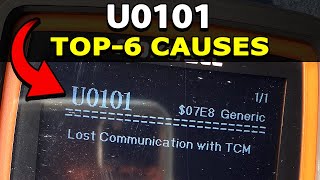
- PRNDL display on the instrument cluster 🎬 See a breakdown of the top causes for these symptoms. may be incorrect or missing
- Replacing the Engine Control Module (ECM) when the fault lies with the TCM or its wiring.
- Condemning the entire transmission for an internal failure when the problem is purely electronic.
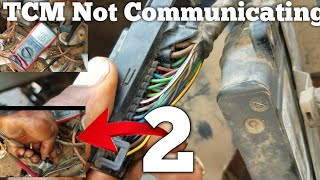
- Replacing the TCM without first thoroughly inspecting and load-testing the power, ground, and communication 🎬 Follow this troubleshooting guide to test TCM communication. circuits as recommended by GM TSBs.
Most Likely Causes
- Wiring or Connector Issues at TCM/Fuse Block/Grounds 🔴 High Probability Manufacturer TSB #PIP4990D explicitly lists poor terminal fit at the transmission connector, issues at the underhood fuse block, chafed harnesses, and bad grounds as the most frequent causes, advising against immediate TEHCM (TCM) replacement. The TCM's location on the frame rail exposes its connector to the elements. Fretting corrosion, a type of wear from micro-motion, is a known GM issue that can cause high resistance at connector pins.
How to confirm: Visually inspect the wiring harness and connector going to the TCM for damage, corrosion, or loose pins. Per TSB #PIP4990D, check for chafing on sharp objects, especially on top of the transmission. Check for power (ignition and battery) and ground at the TCM connector with a multimeter; a diagnostic video shows these checks being performed. A bad ground (often G105, G106, or G107 on GM vehicles) is a common culprit.
Typical fix: Repair the damaged section of the wiring harness, clean the connectors with electrical cleaner and apply dielectric grease to prevent fretting corrosion. Replace faulty connector pins or splice in a new connector pigtail. Clean and secure the main TCM ground connection to bare metal.
Est. part cost: $10-$75 - Faulty Transmission Control Module (TCM) 🟡 Medium Probability → Shop Transmission Assembly While wiring is the first check, the module itself can fail internally due to heat and vibration. The TCM on the Aura is a separate unit (T42 type) mounted on the driver's side frame rail, exposed to engine bay conditions.
How to confirm: If all power, ground, and communication wires to the TCM test good (including checking for 60 ohms resistance on the CAN bus), the module itself is the likely culprit. A professional scan tool will be unable to establish communication with the TCM, while still being able to talk to other modules like the ECM.
Typical fix: Replace the Transmission Control Module. Many replacement units for the Saturn Aura can be purchased pre-programmed to the vehicle's VIN, allowing for direct installation without needing a trip to the dealer. An unprogrammed module will not function and requires programming with a tool like a GM Tech 2 or a J2534 pass-thru device.
Est. part cost: $150-$400 - Blown Fuse or Power Supply Issue 🟡 Medium Probability A simple blown fuse can disable the TCM. On the related Pontiac G6, the 10A 'TRANS' (Fuse #4) and 10A 'TCM' (Fuse #42) in the underhood fuse block are critical. TSB #PIP4990D also points to mispositioned fuses as a possible cause.
How to confirm: Check the fuses related to the TCM in the underhood fuse block. A diagnostic video for a similar GM vehicle shows checking for both constant battery power and ignition-on power at the TCM connector pins. A weak battery or failing alternator can also cause low voltage issues that trigger communication codes.
Typical fix: Replace the blown fuse. If the fuse blows again immediately, it indicates a short circuit in the wiring that must be found and repaired.
Est. part cost: $1-$5 - CAN Bus Network Fault ⚪ Low Probability
How to confirm: This requires advanced diagnostics, such as checking for approximately 60 ohms of resistance across pins 6 and 14 of the OBD-II port with the battery disconnected. A reading of 120 ohms may indicate a break in the circuit or a disconnected module. This confirms the integrity of the main communication network.
Typical fix: Find and repair the break or short in the CAN bus wiring harness. This can be a time-consuming process of checking wiring between modules.
Est. part cost: $50-$200
Diagnosis Steps
- Scan for all diagnostic trouble codes in all modules. Note any other 'U' codes, as they can help pinpoint the location of the network failure.
- Check the battery voltage and charging system to rule out low voltage as a cause.
- Check the TCM-related fuses in the underhood fuse block (e.g., 'TRANS' and 'TCM' fuses). Ensure they are not blown and are properly seated.
- Locate the TCM. On the Saturn Aura, 🎬 Watch this quick video to find the TCM location. it is mounted on the driver's side (LH) frame rail in the engine bay, near the battery and radiator.
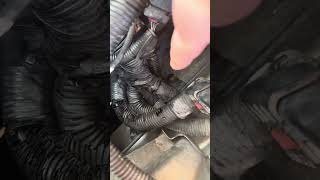
- Visually inspect the TCM connector and its wiring harness for any signs of physical damage, corrosion, chafing, or moisture intrusion.
- Following the guidance from TSB #PIP4990D, pay close attention to the fit of the pins within the connector. Loose pins are a known issue.
- Using a multimeter and wiring diagram, disconnect the TCM and check for proper battery power, ignition power, and ground at the connector pins. It is critical to load-test these circuits.
- Check the TCM ground connection (e.g., G105/G106/G107) on the transmission or frame for corrosion or looseness. Clean and re-secure it.
- If power and grounds are good, check the CAN bus wires for continuity and resistance. You should measure approximately 60 ohms between the two CAN lines at the connector or at pins 6 and 14 of the DLC.
- If all wiring, power, and grounds test good, the Transmission Control Module (TCM) is the most likely failed component.
Parts You'll Likely Need
- Transmission Control Module (TCM)
(OEM #24239224, 24235732 (superseded by 24256861))— If wiring and power are confirmed to be good, the module itself is the point of failure, unable to communicate on the network. Part number 24256861 is a common ACDelco replacement, but requires programming. Some vendors sell pre-programmed modules using the VIN.
Trusted brands: ACDelco (GM OE), Dorman
OEM price range: $250-$500
Aftermarket price range: $150-$350 - TCM Connector Pigtail — If the connector housing or pins are corroded or damaged beyond repair, a new pigtail must be spliced into the harness to ensure a solid connection.
Trusted brands: ACDelco, Dorman
OEM price range: $40-$75
Aftermarket price range: $25-$50
Related Codes That Often Appear With This One
- P0700 — P0700 is a generic code that means the TCM has requested the Check Engine Light to be turned on. It is a gateway code that is almost always present when there is a more specific transmission-related fault, including a communication failure like U0101.
- U0100 — This code indicates 'Lost Communication with ECM'. It can appear alongside U0101 if the network fault is severe, or as a supporting code in other modules indicating a wider communication breakdown on the CAN bus.
- U0140 — This code means 'Lost Communication with Body Control Module (BCM)'. Seeing multiple U-codes for different modules strongly points to a wiring problem on the main CAN bus network rather than a single failed module.
Technical Service Bulletins (TSBs) & Recalls
- PIP4990D: Advises technicians to review service information for DTC U0101 and gather all other codes. Stresses checking wiring, grounds, and fuse block connections before replacing the TCM.
- PIP4990C: Earlier version of the TSB, also pointing to terminal pin fit at the transmission connector and underhood fuse block as likely causes. [NHTSA Citation]
Platform-Specific Known Issues
- GM Technical Service Bulletin #PIP4990D is the most comprehensive guide, superseding #PIP4990C. It explicitly warns against replacing the TCM before thoroughly checking wiring, connector pin fit, fuse block integrity, and grounds.
- A common point of failure is the wiring harness chafing on sharp edges of the engine block or transmission case.
- The external mounting location of the TCM on the driver's side frame rail makes it and its connector vulnerable to weather and physical damage.
Mechanic-Grade Diagnostic Values
- CAN Bus Network Resistance (TCM connected) — expected: ~60 Ohms. Failure: A reading significantly different from 60 Ohms indicates a problem on the bus, such as a faulty terminating resistor or wiring issue.
- CAN Bus Network Resistance (TCM disconnected) — expected: ~120 Ohms. Failure: If the reading is still ~60 Ohms, another module may be shorted. If it's open (OL), there's a break in the wiring. This test isolates the TCM's internal terminating resistor.
- TCM Power Supply Voltage — expected: 12V (Battery Voltage). Failure: Low or no voltage indicates a problem with the fuse, wiring, or power source.
- TCM Ground Continuity — expected: < 0.5 Ohms. Failure: High resistance indicates a poor ground connection, which can prevent the module from powering on and communicating.
Scan Tool Commands That Help
- GM Tech 2 / GDS2: Module Communication Status — Used to verify which modules on the High Speed GMLAN are actively communicating. If the TCM is listed as 'Not Communicating', it confirms the fault and allows the technician to proceed with electrical checks on that specific module.
- J2534 Pass-Thru Device with GM SPS: TCM Programming/Setup — This is required after installing a new, unprogrammed TCM. The tool downloads the correct VIN-specific software from GM's servers and flashes it to the new module, allowing it to function in the vehicle.
Wiring & Ground Locations
- G105 — On some Epsilon platform vehicles, this ground is located under the left intake manifold, on the rear of the cylinder head.. Provides a ground path for several engine and transmission components. Corrosion or looseness here can cause intermittent communication issues.
- G106 — On the 2.4L engine, it's located at the rear of the engine near the Park/Neutral Position switch. On the 3.5L, it's at the rear of the engine above the oil filter.. This is a primary engine/transmission ground. A poor connection at G106 is a very common cause for various electrical faults, including module communication loss.
- G107 — Located on the right front of the engine.. Serves as another critical ground point for the engine and transmission control systems.
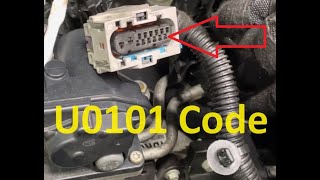
- TCM Connector (T42 Type) — Located on the driver's side frame rail in the engine bay, near the battery.. This is the main interface for the TCM. Pins 6 (TAN) and 7 (TAN/BLK) are the High Speed GMLAN communication lines. TSBs specifically point to poor pin fit and fretting corrosion in this connector as a primary cause of U0101.
- Underhood Fuse Block — Located in the engine compartment, typically on the driver's side near the battery.. TSB #PIP4990D points to bent, twisted, or mispositioned terminals within the fuse block connectors as a cause for power loss to the TCM.
Real Owner Repair Stories
- Reddit user in r/MechanicalAdvice (2007 Saturn Aura 3.6L V6 with 6T70 6-speed auto) — U0101 (from ECM) and U2106 (from BCM). Speedometer not working, transmission stuck in 1st gear. Could not communicate with TCM using a GM Tech 2 scanner.
❌ Tried (didn't work) Double-checked 3 grounds on the front core support after collision repair.
✅ What actually fixed it The user found that the 10-amp TCM battery fuse (#4 in the engine bay fuse box) was blown. Replacing the fuse was the initial step, though the root cause of the blown fuse (a potential short) was not detailed in the post.
OEM Part Supersession History
24239224, 24235732→24256861— Part consolidation and potential internal revisions for reliability.
Heads up: While 24256861 is a common service replacement, it is also used for Allison transmissions in heavy-duty trucks and may have different hardware/software baselines. It is critical to ensure the supplied part is designated for the Epsilon platform (Aura/Malibu/G6) and programmed with the correct VIN-specific software.
Model Year Variations Within This Range
- 2009: For the 2009 model year, the standard 2.4L 4-cylinder engine was upgraded from the 4-speed 4T45-E automatic to the new 6-speed 6T40 automatic with TAPshift. This means a 2009 4-cylinder Aura uses a different transmission and potentially different TCM software than a 2008 4-cylinder model.
Helpful Videos
We Have This Part in Stock

The information in this article is provided for general reference and educational purposes only. Vehicle specifications, procedures, and part compatibility can vary by production date, trim level, and region. Always consult your vehicle's factory service manual and verify part numbers before purchasing or performing repairs. Safety-critical components such as airbags, seat belts, and braking systems should be installed by a qualified professional.
- Saturn AURA:
- 🧭 Diagnostic Flowchart
- 🎬 Helpful Videos
- 🛍️ Shop This Part
- What's Unique About the 2008-2009 Saturn AURA
- Symptoms You May Notice
- Most Likely Causes
- Diagnosis Steps
- Parts You'll Likely Need
- Related Codes That Often Appear With This One
- Technical Service Bulletins (TSBs) & Recalls
- Platform-Specific Known Issues
- Mechanic-Grade Diagnostic Values
- Scan Tool Commands That Help
- Wiring & Ground Locations
- Real Owner Repair Stories
- OEM Part Supersession History
- Model Year Variations Within This Range
- 🎟️ Get 5% Off