

U0101 on 2001-2007 Volvo V70: Lost Communication With TCM Causes and Fixes
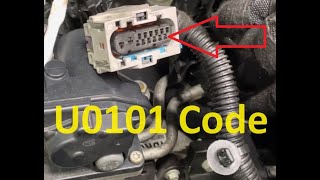
On a 2001-2007 Volvo V70, code U0101 almost always points to a failed Transmission Control Module (TCM). This is a very common failure for this platform due to the module's susceptibility to heat and vibration. The most common and cost-effective fix is to have the original TCM rebuilt by a specialist service like XeMODeX, which costs around $200-$500 and avoids expensive dealer programming, making it a plug-and-play repair upon return.
- On a 2001-2007 V70, U0101 is most likely a failed Transmission Control Module (TCM).
- Before replacing the TCM, always inspect the connectors in the engine bay electronics box for corrosion, as this is a known and cheaper-to-fix issue.
- Do not replace the transmission or its solenoids to fix a U0101 code; this is an electronic communication fault.
- The most cost-effective repair is sending your original TCM to a specialist for rebuilding, which avoids the need for expensive dealer programming.
- This is not a beginner-friendly DIY repair due to the complex diagnostics and potential need for module programming.
What's Unique About the 2001-2007 Volvo V70
The 2001-2007 V70 (P2 platform) is notorious for a high failure rate of its Transmission Control Module (TCM). Unlike many other cars where U0101 is often a wiring or fuse issue, on this specific Volvo, the TCM itself is the most probable cause. The module is located in a plastic box in the engine bay, where it's susceptible to failure from heat and vibration over time, leading to internal electronic faults, specifically cracked solder joints on the main processor. This makes diagnosing a U0101 on a P2 Volvo a more direct path to suspecting the TCM than on other vehicles. Because the TCM's software is coded to the vehicle's Central Electronic Module (CEM), a used module cannot be simply swapped in; the original must be rebuilt or its software cloned.
Symptoms You May Notice
- "Transmission Service Required" or "Transmission Service Urgent" message on the instrument cluster
- Vehicle is stuck in a single gear (limp mode), typically 3rd or 4th
- Harsh or banging shifts, especially when moving from Park to Drive or Reverse
- The gear selector indicator on the dash may be blank or show a dash "-"
- Check Engine Light is on
- Inability to communicate with the TCM using a standard OBD-II scanner
- The 'W' (Winter mode) button may flash
- Odometer may stop working, as it relies on data that passes through the network
- Replacing the entire transmission. The U0101 code is an electrical communication fault, not a mechanical failure. 🎬 Watch: Understanding U0101 causes and fixes Many of the symptoms, like harsh shifting, can mimic internal transmission problems, but the code itself points to the control system.
- Replacing transmission solenoids. While solenoid failure is common on the AW55-50SN transmission used in these Volvos, 🎬 Watch: Volvo P2 transmission diagnostic and maintenance guide it typically generates different codes (e.g., P07xx series). Replacing solenoids will not fix a U0101 communication code.
Most Likely Causes
- Failed Transmission Control Module (TCM) 🔴 High Probability → Shop Transmission Assembly The TCM on the P2 platform is a known weak point. It is located in the engine bay's electronics box and is prone to internal failure of solder joints on the main processor due to years of heat and vibration cycles. This is the most common cause of U0101 on this platform.
How to confirm: After verifying power, ground, and CAN bus wiring are intact, the inability to communicate with the TCM using a Volvo-specific scanner (like VIDA) is a strong indicator. Often, the only definitive test is to send the module to a specialist like XeMODeX for bench testing. A CEM-1A61 code (communication with TCM missing) in VIDA is a direct pointer.
Typical fix: The most common and cost-effective solution is to remove the TCM and send it to a specialized electronics repair service (e.g., XeMODeX, RoachTech) for rebuilding. A new TCM from Volvo is expensive and requires dealer programming. A used module cannot be installed without cloning the software from the original, a service also offered by specialists.
Est. part cost: $200-$500 for a rebuild or cloning service. - Corrosion in ECM/TCM Connector Box 🟡 Medium Probability → Shop Transmission Wiring Harness The plastic box in the engine bay housing the ECM and TCM can allow moisture entry if the cover is not re-seated correctly, especially after service like a timing belt change. The drain holes for the cowl area above this box can also become clogged, causing water to overflow into the electronics box, corroding the pins and connectors for both modules.
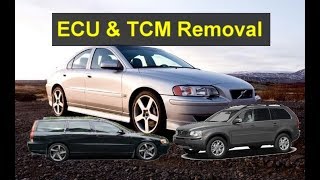
How to confirm: Visually inspect the connectors at the bottom of the ECM and TCM for any green or white corrosion, bent pins, or signs of water intrusion. The TCM is the module on the right (passenger side in LHD vehicles). 🎬 See how to remove the TCM using the removal tool
Typical fix: Disconnect the battery. Unplug the connectors and clean any corrosion from the pins and sockets using an electronics-safe contact cleaner and a small brush. Ensure the box is dry and properly sealed upon reassembly, making sure the large bottom clip is fully engaged.
Est. part cost: $5-$20 for contact cleaner. - Damaged Wiring or Connectors at the TCM ⚪ Low Probability While less common than module failure, the wiring harness leading to the transmission can be exposed to road debris, heat, and oil, potentially causing chafing or broken wires over time.
How to confirm: Visually inspect the wiring harness going to the transmission and the TCM. Check for continuity on the CAN bus high and low wires between the TCM and the ECM. With a Volvo-specific scanner, check for other communication codes that might point to a general network problem.
Typical fix: Repair any broken or chafed wires. Clean or replace damaged connectors.
Est. part cost: $10-$50 for wiring repair supplies.
Rare But Worth Checking
- Failed ABS Control Module: A failing ABS module can disrupt the CAN bus network by sending 'noise' or garbage data, causing communication codes for other modules, including the TCM. If you also have ABS or brake-related warning lights and codes (e.g., BCM-0070), this should be investigated as the root cause.
- Failed Central Electronic Module (CEM): The CEM is the main computer that acts as a gateway for the CAN bus. A failure here, often due to water intrusion from a bad cowl seal (especially on 2005+ models), can cause widespread communication issues, including U0101. Symptoms often include bizarre electrical behavior like random wipers, gauge cluster failure, and key recognition problems.
- Low Battery Voltage or Faulty Alternator: → Shop Alternator While less common as the root cause on this platform, low system voltage can cause unpredictable communication errors between modules. It's a simple and important first check. The system requires over 10V to operate correctly.
Diagnosis Steps
- Check Battery and Fuses: Ensure the battery is fully charged (12.4V+ with engine off) and terminals are clean. A low battery can cause various communication faults. Check all fuses related to the TCM and ECM in the engine bay and cabin fuse panels.
- Scan for All Codes: Use a high-quality scanner capable of reading Volvo-specific codes from all modules (e.g., VIDA). Note if codes like CEM-1A61 are present, or if other 'U' codes suggest a wider network issue.
- Attempt to Communicate with TCM: Using a professional scanner, try to directly access the TCM's data stream. If the scanner cannot establish communication, it strongly points to a power, ground, or module issue.
- Inspect ECM/TCM Connectors: Disconnect the battery. Open the black electronics box in the engine bay (passenger side cowl). Unplug the large connectors from the bottom of the TCM (the module on the right). Carefully inspect for any signs of corrosion, moisture, or bent pins.
- Check Power and Ground at the TCM: Using a wiring diagram, use a multimeter to verify that the TCM connector is receiving proper battery voltage and has a solid ground connection. On a 2006 V70, for example, power is at pin A35 and ground is at pin A53.
- Check CAN Bus Wiring: With the battery disconnected, measure the resistance between the CAN high and CAN low pins at the diagnostic port. It should be approximately 60 ohms. If it's 120 ohms, there's a break in the circuit or a terminating resistor in a module is offline. If it's near 0 ohms, the wires are shorted together.
- Condemn the TCM: If power, ground, and CAN bus wiring are all confirmed to be good, and no other module (like ABS or CEM) is causing network interference, the TCM itself is almost certainly faulty and should be sent for testing and rebuilding.
Parts You'll Likely Need
- Transmission Control Module (TCM) Rebuild Service
(OEM #Varies by year/model, e.g., 8602282, 30751633. Part number matching is critical if sourcing a used part for cloning.)
Related Codes That Often Appear With This One
- CEM-1A61 — This is the Volvo-specific code stored in the Central Electronic Module (CEM) that directly translates to 'Communication with the transmission control module (TCM) Signal missing'. It is the primary companion code to a generic U0101 reading.
- U0073 — This code for 'Control Module Communication Bus A Off' often appears with U0101, indicating a general CAN bus network problem rather than just an issue with a single module. It may point towards a wiring issue or a different module (like ABS or CEM) bringing the network down.
- P0700 — This is a general 'Transmission Control System Malfunction' code. It's an informational code requested by the TCM to let the ECM know that a transmission-related fault has been stored in the TCM. If you can communicate with the TCM, you'll find more specific codes stored there; if you can't, U0101 is the result.
Technical Service Bulletins (TSBs) & Recalls
- Volvo TNN 43-39 (April 14, 2005): Addresses intermittent TCM communication loss on 2001-2004 S60, V70, XC70, S80, and XC90 models. The fix involves installing a new wiring harness between the ECM and TCM to improve signal quality, suggesting that even Volvo recognized early on that the connection between the modules was a weak point.
Platform-Specific Known Issues
- The Aisin-Warner AW55-50/51SN transmission used in these cars is known for issues with its valve body and shift solenoids, which can cause harsh shifting. However, these are separate mechanical/hydraulic issues that generate P07xx codes and should not be confused with the U0101 electronic communication fault.
- The TCM is located in the same electronics box as the ECM, under the passenger side of the windshield cowl. Removal is straightforward after removing the cowl cover, but requires sliding two pink locking tabs forward to release the module.
Mechanic-Grade Diagnostic Values
- CAN Bus Network Resistance — expected: Approximately 60 Ω when measured between Pin 6 (CAN-H) and Pin 14 (CAN-L) at the OBD-II port with the battery disconnected.. Failure: A reading of 120 Ω indicates a missing terminating resistor (likely a disconnected or failed module like the ECM or TCM). A reading near 0 Ω indicates a short between the CAN-H and CAN-L wires.
- CAN Bus Voltage (Key On, Engine Off) — expected: CAN-H (Pin 6) to ground should be ~2.6V-3.0V. CAN-L (Pin 14) to ground should be ~2.4V-2.0V.. Failure: Voltages significantly outside these ranges, or a voltage below 2.0V on CAN-H, can indicate a faulty transceiver in a module or a wiring short.
- TCM Power and Ground at Connector A (2006 V70 2.5T) — expected: Pin A35 should have battery voltage (~12V) with key on. Pin A53 should have a good ground (less than 0.5 Ω resistance to chassis ground).. Failure: No voltage at A35 indicates a fuse or power supply wiring issue. High resistance at A53 indicates a bad ground connection, which can cause communication faults.
Scan Tool Commands That Help
- Volvo VIDA (Vehicle Information and Diagnostics for Aftersales): Network Test — This function actively polls all control modules on the high and low-speed CAN networks and displays their status (OK, Not Responding). It's the fastest way to confirm if the TCM is offline while other modules are still communicating.
- Volvo VIDA: TCM Software Reload — This is required after installing a new TCM to program it to the car. It can also be used as a last-ditch diagnostic step to rule out a software corruption issue on the original module, though it rarely fixes a U0101 caused by hardware failure.
Wiring & Ground Locations
- TCM Connector A — In the black electronics box at the base of the windshield on the passenger side (LHD). The TCM is the module on the right. Connector A is the larger of the two connectors.. This is the main connector for the TCM. Verifying power (Pin A35), ground (Pin A53), and the integrity of the CAN wires at this connector is a primary diagnostic step.
- CEM (Central Electronic Module) — Located under the driver's side dashboard, to the left of the steering column.. The CEM is the gateway for the CAN bus. The high-speed CAN wires from the TCM/ECM pass through the CEM. Water intrusion into the CEM (especially on 2005+ models) is a known cause of network failure that can manifest as a U0101 code.
- Ground Point 31/3 — On the A-pillar near the CEM.. This is a major ground point for several interior electronic components. While not the primary ground for the TCM, a poor connection here can cause general network instability.
Real Owner Repair Stories
- Reddit user u/Crunchycarrots79 (2006 Volvo V70 2.5T) — No communication with the TCM after an engine replacement, VIDA shows CEM-1A61. No gear position indicator on the shifter or dash. Car starts for one second and then dies.
❌ Tried (didn't work) Confirmed power at TCM pin A35 and ground at pin A53 were good.
✅ What actually fixed it The user was advised that communication failures are often caused by a faulty CEM due to moisture intrusion through the cowl wiring seal, a common issue on 2005+ models. The recommended fix was to remove the CEM, open it, clean any corrosion with contact cleaner and isopropyl alcohol, and reinstall it after sealing the wiring entry box. - Matthew's Volvo Site Forum User (2004 Volvo) — Five years of intermittent issues including acceleration problems, transmission slamming/shifting hard, and dash cluster malfunctions.
❌ Tried (didn't work) Rebuilding the CEM multiple times., Dealer diagnosis and repairs.
✅ What actually fixed it The owner discovered humidity and corrosion inside the main ECM/TCM connectors located in the engine bay electronics box. The cause was an improperly sealed lower section of the box, allowing moisture in. Cleaning the module and connector pins with contact cleaner resolved all symptoms.
Model Year Variations Within This Range
- 2005-2007 (Facelift Models): The high-speed CAN bus runs at 500 Kbps, compared to 250 Kbps on pre-facelift models. These later models are also more prone to CEM failure from water intrusion due to a poor wiring harness seal design at the cowl, which can lead to U0101 and other network codes.
- 2001-2002: Early P2 models had more electronic teething issues, including problems with cold solder joints in various modules. Some very early 2001 models had a transmission software feature that shifted the car into neutral at a stop, increasing wear, though this is not directly related to the U0101 communication fault.
Diagnostic Flowchart
Other Known Issues on This Vehicle
Issues unrelated to this code that are worth knowing about as an owner of this generation:
- Electronic Throttle Module (ETM) Failure 🔴 High — Extremely common on 1999-2002 models with the Magneti Marelli ETM. Less common on 2003+ models with the Bosch unit, but still a known issue. (Ref: Volvo had an extended warranty/recall program, but it has long since expired.)
- Front Upper Spring Seats / Strut Mounts Failure 🟠 Medium — Very common wear item. The rubber deteriorates and cracks, causing clunking noises over bumps. Failure is expected around 80,000-120,000 miles.
- AWD Angle Gear Collar Sleeve Stripping 🔴 High — A common failure point on all P2 AWD models. The splines on the collar sleeve connecting the transmission to the angle gear wear out, resulting in loss of power to the rear wheels. Often occurs after 100,000 miles.
- PCV System Clogging 🟠 Medium — The Positive Crankcase Ventilation system can become clogged over time, leading to high crankcase pressure, which can blow out engine seals (like the rear main seal) causing oil leaks. Recommended service interval is around 100,000 miles.
- Instrument Cluster (DIM) Failure 🟠 Medium — Common on 2002-2004 models. Symptoms include gauges going dead, flickering lights, and nonsensical error messages. Caused by bad solder joints on the circuit board.
- AW55-50SN Valve Body / Solenoid Issues 🔴 High → Shop Transmission Valve Body — Separate from the TCM communication issue, the transmission itself is known for harsh shifting (especially 2-3 and N-D 'shift flare') due to wear in the valve body and solenoids. Often requires a valve body replacement or solenoid kit. (Ref: Multiple TSBs exist regarding software updates and shift quality complaints.)
Used vs. New Parts: Buying Guide for This Vehicle
When a used part is the smart pick: A used TCM is almost never a direct plug-and-play solution. It only makes sense if you are sending both your original failed TCM and the used donor TCM to a specialist service (like XeMODeX) to have the software/immobilizer data cloned from your original module to the functional used one. This can be cheaper than rebuilding if your original module's board is physically damaged beyond repair.
Donor-vehicle mileage cap: roughly under 120000 miles for the part to have meaningful remaining life.
What to inspect on the donor part:
- Match the OEM part number EXACTLY. There are many variations.
- Source from a vehicle of the same model year if possible.
- Inspect the connector pins on the donor module for any signs of corrosion or physical damage before purchase.
OEM-only on this vehicle (don't cheap out):
- Transmission Control Module (TCM). Due to the vehicle-specific software, you cannot use a generic aftermarket part. The repair path is either rebuilding the original OEM unit, cloning the software to a used OEM unit, or buying a new, programmed OEM unit from a dealer.
Aftermarket brands forum-validated for this vehicle:
- XeMODeX (Rebuild/Cloning Service)
- RoachTech (Rebuild/Cloning Service)
Brands owners have reported issues with on this vehicle:
- No-name electronics repair services without a proven track record and warranty for Volvo modules.
Real Owner Stories
Aggregated from forums and TSBs cited above. Mileages and costs reflect what owners reported in those sources.
2006 Volvo V70
Symptoms: The owner diagnosed a CEM-1A61 code (communication with TCM missing) following an engine swap. They had to verify power and ground pins at the TCM connector to determine if the module was receiving electricity.
What fixed it: The diagnostic process involved confirming power at pin A35 and ground at pin A53 to isolate the communication failure.
Source hint: Reddit thread titled 'no communication with TCM' at r/Volvo
2001-2007 Volvo V70
Symptoms: Vehicle entered limp mode with a 'Transmission Service Required' message and a U0101 code.
What fixed it: The owner removed the TCM and had it rebuilt by XeMODeX.
Source hint: V70XC.com forum post titled 'TCM U0101 Code Limp Mode Transmission Service Required'
2001-2007 Volvo V70
Symptoms: The owner struggled for 5 years with intermittent transmission issues.
What fixed it: The problem was traced to moisture in the ECM/TCM box caused by an improperly sealed bottom cover.
Source hint: MatthewsVolvoSite.com thread titled 'intermittent transmission issues'
Related OBD-II Codes
Frequently Asked Questions
My 2003 V70 is stuck in 3rd gear and showing 'Transmission Service Urgent.' Does Volvo TNN 43-39 apply to me?
Can I just buy a used TCM from a junkyard for my V70 to fix the U0101 code?
Where exactly is the TCM located on my 2001-2007 V70?
I just had my timing belt changed and now I have a U0101 code. Could they be related?
How do I remove the TCM from the electronics box?
My V70 odometer stopped working at the same time the transmission light came on. Is this part of the U0101 issue?
Helpful Videos


We Have This Part in Stock

The information in this article is provided for general reference and educational purposes only. Vehicle specifications, procedures, and part compatibility can vary by production date, trim level, and region. Always consult your vehicle's factory service manual and verify part numbers before purchasing or performing repairs. Safety-critical components such as airbags, seat belts, and braking systems should be installed by a qualified professional.
- Volvo V70:
- 🧭 Diagnostic Flowchart
- 🎬 Helpful Videos
- 🛍️ Shop This Part
- What's Unique About the 2001-2007 Volvo V70
- Symptoms You May Notice
- Most Likely Causes
- Rare But Worth Checking
- Diagnosis Steps
- Parts You'll Likely Need
- Related Codes That Often Appear With This One
- Technical Service Bulletins (TSBs) & Recalls
- Platform-Specific Known Issues
- Mechanic-Grade Diagnostic Values
- Scan Tool Commands That Help
- Wiring & Ground Locations
- Real Owner Repair Stories
- Model Year Variations Within This Range
- Other Known Issues on This Vehicle
- Used vs. New Parts: Buying Guide for This Vehicle
- Real Owner Stories
- 2006 Volvo V70
- 2001-2007 Volvo V70
- 2001-2007 Volvo V70
- Related OBD-II Codes
- Frequently Asked Questions
- 🎟️ Get 5% Off