

OBD-II Code U0120: Lost Communication With Starter/Generator Control Module
What U0120 means, why it triggers, and how to fix it
- Code U0120 indicates the Starter/Generator Control Module is offline, which stops the alternator from charging and causes the engine to stall within 30 to 60 minutes of driving.
- Before replacing a $600 alternator, test the battery voltage (must be above 12.4V) and inspect the wiring harness for a single broken LIN communication wire, which causes 80% of these faults on Ford vehicles.
- Do not drive with an active U0120 code; the battery will fully deplete in under 1 hour, resulting in a sudden loss of power steering and brakes at highway speeds.
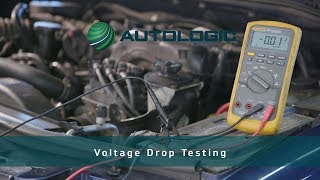
- Perform a voltage drop test on the module's ground circuit; a reading above 200mV confirms a corroded ground strap is the culprit, saving you a $300 diagnostic fee.
- If your scanner shows U0120 alongside other 'U' codes like U0100, stop diagnosing the alternator and inspect the main CAN bus wiring or gateway module for a network-wide short.
What Does U0120 Mean?
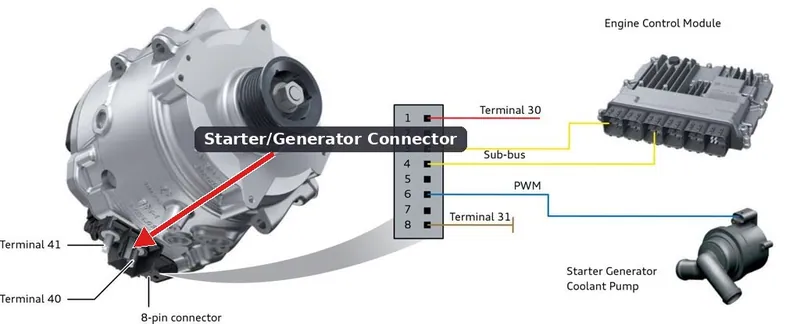
The U0120 code means your car's main computer, the Engine Control Module (ECM), lost its connection to the Starter/Generator Control Module (SGCM). This module commands the alternator to charge the battery and manages engine starting. When communication fails, the charging system shuts down, leading to a dead battery and a stalled engine.
Technical definition: The SAE/OBD-II definition is "Lost Communication With Starter / Generator Control Module." This indicates a fault on the Controller Area Network (CAN) bus or Local Interconnect Network (LIN) bus preventing the SGCM from sending or receiving data.
Can I Drive With U0120?
No — Do Not Drive. Do not drive with this code. The Starter/Generator Control Module manages the battery's charge. Without communication, the alternator stops charging the battery, causing it to deplete rapidly. This leads to engine stalling and a sudden loss of power-assisted steering and brakes, creating a severe safety hazard. Continuing to drive also causes a deep discharge that permanently ruins the battery, adding a $150-$350 replacement cost.
Common Causes

- Damaged, corroded, or loose wiring/connectors (Very Common) — Wires fray from rubbing against engine components, connectors corrode from moisture, or pins vibrate loose. This breaks the physical communication line to the module and is the most frequent cause of U0120.
- Low battery voltage or a failing battery (Common) — Electronic modules require a stable voltage above 12.0V to function. A weak battery drops system voltage below 9V during cranking, forcing modules to reset or drop off the communication network entirely.
- Poor ground connection (Common) — A corroded or broken main engine ground strap interrupts the electrical circuit. Without a solid ground, the module cannot power on or transmit data. This is frequently misdiagnosed as a failed module.
- Blown fuse or faulty relay (Common) — The SGCM relies on specific fuses and relays for power. A blown fuse instantly cuts power to the module, taking it offline.
- Faulty Starter/Generator Control Module (Less Common) — The module itself fails internally due to prolonged heat and engine vibration. Suspect this only after verifying the wiring, power, and ground circuits are fully intact.
- CAN/LIN Bus or Gateway Network Fault (Rare) — A short circuit elsewhere on the vehicle's communication network, or a malfunctioning gateway module routing the data, isolates the SGCM. This usually triggers multiple 'U' codes simultaneously.
- Corrupted module software (Rare) — An incomplete over-the-air (OTA) update or a severe voltage spike corrupts the module's internal software, preventing it from booting up and communicating.
Symptoms

- Engine will not crank or start — You turn the key or press the start button, and nothing happens despite the dashboard lights illuminating.
- Dashboard Warning Lights Illuminated — The red battery icon, a 'Check Charging System' message, and the Check Engine Light remain lit while driving.
- Engine stalls while driving — The alternator stops charging, draining the battery until it can no longer power the ignition system or fuel pump, forcing the engine to shut off.
- Reduced Engine Power ('Limp Mode') — The ECM intentionally limits engine speed and disables non-essential accessories to preserve remaining battery life.
- Start/Stop system disabled — The automatic start/stop feature deactivates because the system cannot verify the battery's state of charge.
Diagnostic Flowchart

Tap your situation to follow the diagnostic path that matches what you're seeing on this code.
Common Fixes & Costs
- Repairing Damaged Wiring or Cleaning Connectors — Parts: $5-$20, Labor: $125-$350, ~1.5 hr book time (Intermediate)
- Replacing the Vehicle's Battery — Parts: $150-$350, Labor: $50-$100, ~0.5 hr book time (DIY)
- Replacing a Blown Fuse or Faulty Relay — Parts: $1-$15, Labor: $25-$75, ~0.2 hr book time (DIY)
- Replacing the Starter/Generator Control Module (or Alternator) — Parts: $450-$900, Labor: $150-$400, ~2.5 hr book time (Professional)
- Reprogramming or Updating Module Software — Parts: $0, Labor: $100-$200, ~1 hr book time (Professional)
DIY vs Professional
- Replacing a Blown Fuse or Faulty Relay 🟢 Beginner
Tools: Owner's manual, fuse puller. - Replacing the Vehicle's Battery 🟢 Beginner
Tools: Socket set, terminal cleaner. - Repairing Damaged Wiring or Cleaning Connectors 🟢 Beginner
Tools: Multimeter, wire strippers, crimpers, heat shrink tubing. - Replacing the Alternator Assembly 🟢 Beginner
Tools: Socket set, serpentine belt tensioner tool. - Replacing and/or Reprogramming a Control Module 🟢 Beginner
Tools: OEM-level diagnostic scan tool, J2534 Pass-Thru device, stable power supply.
Used vs. New Parts: Buying Guide
When a used part is worth it: A used alternator assembly makes sense for vehicles over 10 years old where a new OEM part exceeds 20% of the car's value.
Donor-vehicle mileage cap: roughly under 80000 miles for the part to have meaningful remaining life.
Donor quality checklist:
- Verify the donor vehicle was not scrapped due to an engine fire or electrical flood damage.
- Spin the alternator pulley to ensure the bearings are smooth and silent.
- Match the OEM part number exactly to ensure communication protocol compatibility.
Decision logic:
- If The vehicle is less than 8 years old and you plan to keep it. → Buy a new OEM or premium remanufactured alternator for maximum reliability.
- If The vehicle is over 10 years old and budget is tight. → Purchase a used OEM part from a reputable auto dismantler with a 90-day warranty.
Warranty tradeoff: Used parts offer 30-90 days. Remanufactured parts offer 1-year to lifetime. New OEM parts offer 1-2 years.
Worst-case if a used part fails: $300-$800 if a cheap remanufactured part fails, requiring you to pay labor costs twice.
What Happens If You Wait — Timeline
- 0-30 minutes of driving: The battery warning light appears. The car runs entirely off the battery's reserve power. The PCM disables non-essential systems like the radio and A/C. (MPG impact: 0%% · Added cost: $0)
- 30-60 minutes of driving: The battery depletes. The engine stalls in traffic. You lose power-assisted steering and braking. (MPG impact: N/A% · Added cost: $75-$250 for a tow truck.)
- 1-3 deep discharge cycles: Repeatedly driving until the car dies permanently sulfates the lead-acid battery plates, destroying its ability to hold a charge. (MPG impact: N/A% · Added cost: $150-$350 for a ruined battery.)
Cost of Not Fixing It
- Immediate (0-1 hour of driving): The vehicle stalls in traffic once the battery depletes, causing a total loss of power steering and brakes. Requires an immediate tow. (Added cost: $75-$250 for towing.)
- 1-5 drive cycles: Repeatedly driving until the engine dies causes deep discharge cycles that permanently sulfate the lead plates inside the battery, ruining it. (Added cost: $150-$350 for a replacement battery.)
- 1+ month: Unstable voltage spikes from a failing communication circuit permanently damage sensitive modules like the PCM or ABS controller. (Added cost: $500-$2000+ for replacing fried control modules.)
Diagnosis Steps
- Check the Battery Health
Use a multimeter to check static voltage; it must be at least 12.4V with the car off. A reading below 12.2V indicates a discharged battery. Have the battery professionally load tested, as voltage alone does not guarantee sufficient cranking amperage.
Tools: Multimeter, Battery Load Tester (Beginner) - Inspect Fuses and Relays
Locate the fuse box using your owner's manual. Pull and inspect any fuses labeled for the starter, alternator, generator control module (GCM), or powertrain control module (PCM). Replace any blown fuses with the exact same amperage rating.
Tools: Owner's manual, fuse puller (Beginner) - Visually Inspect Wiring and Connectors
Locate the SGCM (often integrated into or near the alternator). Inspect the wiring harness for chafed wires, melted insulation, or corrosion on the connector pins. Pay strict attention to harnesses running along the engine block, as vibration causes wire fatigue.
Tools: Flashlight (Intermediate) - Check for Power and Ground at the Module
Disconnect the SGCM connector. Using a multimeter and a vehicle-specific wiring diagram, verify B+ voltage (>12.0V) at the power pin with the key on. Perform a voltage drop test on the ground pin by connecting the red lead to the ground pin and the black lead to the negative battery post; the reading must be less than 0.2V (200mV).
Tools: Multimeter, vehicle-specific wiring diagram (Advanced) - Test the CAN/LIN Bus Wires
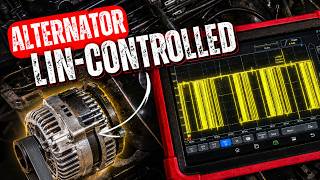
For a two-wire CAN bus, measure resistance between CAN High and CAN Low with the battery disconnected; it must be ~60Ω. With the key on, CAN-H should toggle to ~3.5V and CAN-L to ~1.5V. For a single-wire LIN bus (common on Fords), voltage must fluctuate between ~1V and ~12V. A constant voltage indicates a broken wire or dead module.
Tools: Multimeter, vehicle-specific wiring diagram (Advanced) - Scan for Network-Wide Codes
Use an OBD-II scanner to check for other 'U' codes. If multiple modules report lost communication (e.g., U0100, U0121), the fault is a network-wide issue like a shorted main CAN bus wire or a failed gateway module, not the SGCM itself.
Tools: OBD-II scanner (Intermediate) - Pro Tip: Perform a 'Wiggle Test'
While monitoring the communication line voltage with a multimeter, vigorously wiggle the wiring harness at the SGCM connector and along the engine bay. If the voltage drops out, you have pinpointed a loose connection or internal wire break.
Tools: Multimeter (Advanced)
When This Code Triggers (Freeze-Frame Conditions)
- Engine Coolant Temp: 180-200°F (82-93°C) (The fault frequently triggers after the engine reaches operating temperature, as heat increases resistance in failing wires.)
- RPM: 1500-2500 (Sets during steady-state cruising when the ECM expects continuous, uninterrupted communication from the alternator.)
- Control Module Voltage: 13.5-14.8V (Captures the exact voltage at the moment communication drops, differentiating between a dead battery and a pure data network failure.)
Related Codes
- U0100 — 'Lost Communication with ECM/PCM.' If present alongside U0120, the ECM or its power supply is the root cause. Diagnose the U0100 first, as the U0120 is merely a symptom of the main computer being offline.
- U0121 — 'Lost Communication with ABS Control Module.' Multiple U-codes indicate a network-wide failure, such as a shorted CAN bus wire or a failed gateway module, rather than an issue with the SGCM itself.
- P0A8F — '14 Volt Power Module System Voltage Unstable.' This is a direct consequence of U0120. The voltage is unstable because the module controlling the alternator is offline. Fixing the U0120 communication link resolves P0A8F.
- U012D — 'Lost Communication With Generator Control Module.' Used interchangeably by Ford. If seen with U0284 (Active Grille Shutter), it confirms a break in the shared LIN network wire connecting the PCM to both components.
Climate & Environmental Factors
- Road Salt / High Humidity (Rust Belt Regions): Saltwater spray acts as an electrolyte, rapidly accelerating corrosion on copper wires and connector pins. This increases resistance in the CAN/LIN bus wires, directly causing communication failures.
- Extreme Cold: Sub-zero temperatures drastically reduce a battery's cranking power, exposing weak cells and causing voltage drops below 9V that trigger communication codes. Plastic connectors also become brittle and snap under engine vibration.
- Extreme Heat: High under-hood temperatures increase electrical resistance in wiring and degrade the internal solder joints of the SGCM, leading to intermittent communication drops.
How to Talk to a Mechanic About This Code
Say this: "I have a U0120 code and a no-charge condition. I've confirmed the battery is healthy. Please perform a voltage, ground, and communication line test at the starter/generator module connector before quoting an alternator replacement."
This proves you understand the failure points. It forces the technician to perform proper electrical diagnostics, preventing them from immediately selling you a $600 alternator when a $10 wire repair is needed.
Avoid saying:
- My battery light is on, can you fix it?
- Just replace the alternator.
- My car won't start, I think it's the battery.
Questions to ask before authorizing the repair:
- Did you perform a voltage drop test on the ground circuit? What was the reading?
- Did you check the LIN or CAN bus wire for activity with an oscilloscope?
- Can you confirm this isn't just a broken wire in the harness?
- Does the alternator replacement include the required module programming?
Where to Take It: Dealer vs Independent vs Chain
- Dealer:
Use only if diagnosis confirms the module is dead and requires OEM software programming.
Best for: Vehicles under warranty., Complex cases requiring module replacement and OEM programming.
Downsides: Highest labor rates ($150-$250/hr)., Will replace an entire $800 wiring harness instead of repairing a single broken wire. (Typical cost: +50% vs. baseline) - Independent Shop:
The best choice. A competent auto electrician will find and fix the broken wire or bad ground for a fraction of the dealer cost.
Best for: Out-of-warranty vehicles., Diagnosing and repairing wiring, fuse, or ground issues.
Downsides: May lack the OEM J2534 Pass-Thru tools required for module programming. (Typical cost: +0% vs. baseline) - Chain Shop:
Avoid. They will misdiagnose a communication code as a bad alternator, wasting your money.
Best for: Simple battery testing and replacement.
Downsides: Technicians lack advanced electrical diagnostic skills., High pressure to sell unnecessary alternators. (Typical cost: -10% vs. baseline)
When to Walk Away From the Repair
If the estimated repair cost for the U0120 fault exceeds 40% of your car's private-party value, pause and consider if the investment is worthwhile.
- Car worth $4000, fix is $1300: Fix it. The repair is 32% of the car's value, which is a reasonable investment to restore a critical safety system.
- Car worth $3000, fix is $1500: Borderline. A 50% cost-to-value ratio is high. Get a second opinion to ensure a $150 wiring repair won't solve it.
- Car worth $2000, fix is $1400: Walk away. The repair cost is 70% of the vehicle's value. It is not financially sensible to proceed.
What Scan Tool You Need for This Code
Minimum: A code reader that displays live data PIDs, specifically for module voltage and charging system status.
A $20 code reader only shows the U0120 code. It cannot display live voltage or confirm if the module is online, which is mandatory for diagnosing wiring versus module failures.
Budget: BlueDriver Pro Scan Tool (~$100) — Pairs with a smartphone to read codes, view freeze-frame data, and graph live 'Control Module Voltage' to verify power.
Mid-range: Innova 5610 (~$350) — Offers OEM-level live data, tests the battery/alternator, and includes bidirectional controls to command components.
Professional: Autel MaxiCOM MK808 (~$500) — Provides full bidirectional control, views network topology to see offline modules, and performs mandatory BMS resets.
Rent vs buy: Buy the budget pick. A $100 scanner pays for itself immediately by preventing a shop from charging a $150 diagnostic fee for a loose battery terminal.
How to Clear the Code After You Fix It
- Reconnect the battery and ensure terminals are torqued to specification.
- Use an OBD-II scan tool to manually clear the U0120 code from the ECM.
- Perform a Battery Management System (BMS) reset using the scan tool if the battery was replaced.
- Complete a full drive cycle to reset emissions readiness monitors.
Drive cycle (~30 minutes): Start with a cold engine. Idle for 3 minutes with headlights and defroster on. Drive in stop-and-go traffic for 15 minutes, then cruise at a steady 55 mph for 10 minutes. Let the vehicle cool down completely.
Readiness monitors affected: Comprehensive Component Monitor (CCM), Catalyst Monitor, EVAP System Monitor
Before emissions retest: drive at least 50 miles to fully set monitors.
Watch out for:
- Disconnecting the battery clears the dashboard light but resets all emissions monitors to 'Not Ready', guaranteeing an emissions test failure.
- Failing to perform a BMS reset on modern vehicles causes the alternator to overcharge and destroy the new battery.
Will This Fail Emissions / State Inspection?
Yes — this code typically fails an OBD-II emissions inspection.
- California: An active U0120 code illuminates the Check Engine Light, resulting in an automatic smog check failure. All readiness monitors must be set before a re-test.
- New York: NYS DMV inspections fail any vehicle with an illuminated Malfunction Indicator Lamp caused by a U-code.
- Texas: In emissions-testing counties, the vehicle fails immediately. After repair, the Comprehensive Component Monitor must read 'Ready' to pass.
Most Commonly Affected Vehicles
- Ford Fiesta, Focus, Transit, Ranger (2011-2019) — Extremely common issue caused by a single broken violet LIN wire in the alternator harness. The wire fatigues from engine vibration. Mechanics fix this by running a new bypass wire from the alternator to the PCM.
- Chevrolet / GMC Silverado, Sierra (2016-2024) — On e-Assist models, the Generator Control Module itself fails frequently. A 2024 Silverado recall (N242435631) for battery drain after an OTA update causes identical symptoms and codes.
- Mazda Mazda3, CX-30 (SKYACTIV-X) (2019-2021) — Code points to a communication error with the Integrated Starter Generator (ISG). TSB 01-010/20 addresses improper BCM logic causing excessive parasitic draw, dead batteries, and subsequent U-codes.
- Hyundai / Kia Tucson Hybrid, Sonata Hybrid (2022-2024) — Triggered by software logic errors in the Central Communication Unit (CCU) causing battery discharge. Dealership software updates resolve the issue.
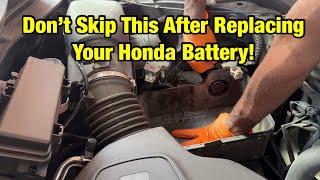
- Honda Accord, CR-V (2018-2024) — Frequently occurs immediately after battery replacement if the terminals are loose or the technician fails to perform a mandatory Battery Management System (BMS) reset.
Manufacturer-Specific Notes
- Ford: On 'Smart Charge' systems, U0120 is almost exclusively caused by a broken violet LIN wire near the alternator connector. Always perform a continuity test on this specific wire before replacing the alternator.
- Mazda: On SKYACTIV-X engines, U0120 disables the i-stop and mild-hybrid features. TSB 01-010/20 requires a BCM software update to fix a parasitic draw that causes the low voltage triggering this code.
- General Motors (GM): Sets this code due to a faulty ECM ignition relay or a corroded ground connection on the engine block. On e-Assist models, the Generator Control Module requires frequent replacement.
- Audi: On 48V mild-hybrid systems, the related code U046900 (Invalid Data Received) is more common. This indicates an internal hardware failure within the Belt Starter Generator (BSG) requiring full replacement.
Real Owner Stories
2012 Ford Fiesta, 110K miles - The Classic LIN Wire Break
The battery warning light illuminated, and the start/stop system failed. A scan revealed code U0120.
Outcome: They found the single violet LIN wire in the alternator harness was broken from vibration. They spliced in a new bypass wire, clearing the code and restoring the 14.8V charging system for under $10.
Lesson: On Ford vehicles, always inspect the LIN communication wire for breaks before replacing an expensive alternator.
2016 Ford Focus - A $600 Misdiagnosis
The battery light came on, the battery drained rapidly, and the scanner showed U0120.
Outcome: The root problem was a corroded ground wire in the main harness, not the alternator. The owner wasted $600 on parts and had to pay an auto electrician $250 to fix the actual wiring fault.
Lesson: Throwing parts at a communication code is a costly mistake. If a new alternator doesn't fix U0120, the root cause is in the wiring or grounds.
2018 Honda Accord - Post-Battery Replacement Gremlins
Code U0120 appeared immediately after a chain shop installed a new battery. The car displayed charging system warnings.
Outcome: The shop discovered the technician left the negative battery terminal loose. The unstable connection caused massive voltage drops, triggering the communication loss. Tightening the terminal cleared the code permanently.
Lesson: If a U-code appears immediately after a repair, inspect the work just performed. Loose battery terminals are a primary cause of communication faults.
How to Prevent This Code From Triggering
- Clean Battery Terminals and Ground Points (Annually, before winter) — Corrosion acts as a resistor, impeding current flow and causing low voltage conditions that trigger communication faults. Cleaning ensures a solid electrical foundation.
- Apply Dielectric Grease to Connectors (Whenever a connector is disconnected) — Dielectric grease seals electrical connectors against moisture and salt, preventing the pin corrosion that causes U0120.
- Replace the Battery Proactively (Every 4-5 years) — Aging batteries lose their ability to provide stable voltage during cranking. Replacing them prevents voltage drops that knock modules offline.
Frequently Asked Questions
Can a bad battery cause a U0120 code?
Yes. A weak battery that drops below 9 volts during engine cranking forces electronic modules to reset or drop off the communication network entirely.
What is the most common misdiagnosis for U0120?
Mechanics frequently replace the expensive alternator assembly without checking the wiring. On many vehicles, a single broken communication wire or a blown $5 fuse is the actual culprit.
Will the U0120 code clear itself?
If the issue was a temporary voltage drop, the code becomes a 'history' code and the light turns off after a few drive cycles. If the light stays on, you have a hard physical fault like a broken wire.
Is it expensive to fix code U0120?
Costs range from $15 for a fuse to $350 for a wiring repair. If the alternator or control module requires replacement and programming, expect a bill between $600 and $1,300.
What is a Starter/Generator Control Module?
It is a computer that commands the alternator to charge the battery and manages the engine's start/stop system. When it goes offline, your car stops charging.
My battery and alternator tested fine, so what else is it?
The fault lies in the communication circuit between the alternator and the main computer. This points directly to a broken LIN/CAN wire, a corroded connector, or a bad engine ground.
What is a LIN bus?
A Local Interconnect Network (LIN) is a single-wire communication system used for components like alternators. A break in this single wire completely severs communication, triggering U0120.
How do you reset the Starter/Generator Control Module?
Disconnect the negative battery cable for 15 minutes to perform a hard reset. However, modern vehicles often require a scan tool to perform a specific Battery Management System (BMS) reset after repairs.
Do I have to go to the dealer to fix this?
Any competent auto electrician can fix the wiring or ground issues that usually cause this code. You only need a dealer if the module itself requires replacement and OEM software programming.
Key Takeaways
- Code U0120 indicates the Starter/Generator Control Module is offline, which stops the alternator from charging and causes the engine to stall within 30 to 60 minutes of driving.
- Before replacing a $600 alternator, test the battery voltage (must be above 12.4V) and inspect the wiring harness for a single broken LIN communication wire, which causes 80% of these faults on Ford vehicles.
- Do not drive with an active U0120 code; the battery will fully deplete in under 1 hour, resulting in a sudden loss of power steering and brakes at highway speeds.
- Perform a voltage drop test on the module's ground circuit; a reading above 200mV confirms a corroded ground strap is the culprit, saving you a $300 diagnostic fee.
- If your scanner shows U0120 alongside other 'U' codes like U0100, stop diagnosing the alternator and inspect the main CAN bus wiring or gateway module for a network-wide short.
Helpful Videos

Shop the Parts Behind U0120
Below are the parts most often responsible for code U0120, ranked by how frequently each one is the actual culprit (per the diagnosis above). Tap any to see what we have for your vehicle.



The information in this article is provided for general reference and educational purposes only. Vehicle specifications, procedures, and part compatibility can vary by production date, trim level, and region. Always consult your vehicle's factory service manual and verify part numbers before purchasing or performing repairs. Safety-critical components such as airbags, seat belts, and braking systems should be installed by a qualified professional.
- 🧭 Diagnostic Flowchart
- 🎬 Helpful Videos
- 🛍️ Shop This Part
- What Does U0120 Mean?
- Can I Drive With U0120?
- Common Causes
- Symptoms
- Common Fixes & Costs
- DIY vs Professional
- Used vs. New Parts: Buying Guide
- What Happens If You Wait — Timeline
- Cost of Not Fixing It
- Diagnosis Steps
- When This Code Triggers (Freeze-Frame Conditions)
- Related Codes
- Climate & Environmental Factors
- How to Talk to a Mechanic About This Code
- Where to Take It: Dealer vs Independent vs Chain
- When to Walk Away From the Repair
- What Scan Tool You Need for This Code
- How to Clear the Code After You Fix It
- Will This Fail Emissions / State Inspection?
- Most Commonly Affected Vehicles
- Manufacturer-Specific Notes
- Real Owner Stories
- 2012 Ford Fiesta, 110K miles - The Classic LIN Wire Break
- 2016 Ford Focus - A $600 Misdiagnosis
- 2018 Honda Accord - Post-Battery Replacement Gremlins
- How to Prevent This Code From Triggering
- Frequently Asked Questions
- Can a bad battery cause a U0120 code?
- What is the most common misdiagnosis for U0120?
- Will the U0120 code clear itself?
- Is it expensive to fix code U0120?
- What is a Starter/Generator Control Module?
- My battery and alternator tested fine, so what else is it?
- What is a LIN bus?
- How do you reset the Starter/Generator Control Module?
- Do I have to go to the dealer to fix this?
- Key Takeaways
- 🎟️ Get 5% Off