

U0121 on 2010-2014 Cadillac SRX: Lost Communication with ABS Module Causes & Fixes
On a 2010-2014 Cadillac SRX, code U0121 most often points to a known software glitch that requires a dealer update or a poor connection at the transmission connector, as cited in official GM Technical Service Bulletins. Before replacing the expensive ABS module, these two possibilities should be investigated first. A faulty EBCM is also possible, but replacement requires specific VIN programming that can even be performed on used modules.
- Code U0121 on a 2010-2014 SRX means the ABS module has lost communication, disabling safety features like ABS and StabiliTrak.
- Before suspecting a bad ABS module, check for official GM Service Bulletins. A software update (TSB PI1158) or a transmission connector check (TSB PIC4740E) are very common fixes.
- Driving is possible but risky. Your vehicle will not have anti-lock brakes or stability control, which is critical in emergencies.
- Do not immediately replace the ABS module. It's an expensive part that requires programming, and it may not be the root cause.
- This is a complex electrical issue. Professional diagnosis with a proper scan tool is highly recommended to avoid unnecessary parts replacement.
What's Unique About the 2010-2014 Cadillac SRX

What makes the 2010-2014 SRX unique regarding code U0121 is that General Motors has issued specific Technical Service Bulletins (TSBs) acknowledging common platform-specific faults. One TSB points to a software issue where the code can be set falsely without any real problem, while another identifies a problematic transmission connector (X1) that can disrupt communication across multiple modules. These known issues mean that the fix is often not a failed ABS module, but rather a software update or a simple connector repair. Furthermore, this platform (GM Global A) has been shown by owners to accept programming of used EBCM modules, which can be a significant cost savings.
Diagnostic Flowchart

Tap your situation to follow the diagnostic path that matches what you're seeing on this vehicle.
Symptoms You May Notice

- ABS warning light is on
- Traction Control System (TCS) or StabiliTrak warning light is on
- "Service StabiliTrak" message on the driver information center
- "Service Power Steering" message may appear, with noticeably heavier steering (as the EBCM is involved in variable-effort steering).
- Loss of anti-lock braking function (wheels may lock up during hard braking)
- Loss of traction and stability control
- Cruise control may not work
- Replacing the Electronic Brake Control Module (EBCM) without first checking for software updates (TSB #PI1158) or inspecting the transmission X1 connector (TSB #PIC4740E), which are the most common documented fixes. 🎬 Watch: Check this common wiring fault before buying expensive parts.
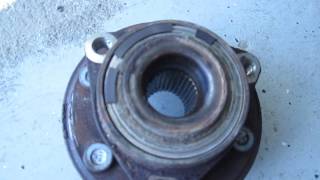
- Replacing wheel speed sensors. While related to the ABS system, a faulty wheel speed sensor will typically set its own specific C-prefix trouble code (like C0035-C0050) and not a U0121 communication code. A failed reluctor ring on the wheel bearing is also a common SRX issue but sets WSS codes, not communication codes.
Most Likely Causes

- Software Anomaly 🔴 High Probability GM issued TSB #PI1158 specifically for this issue, stating that DTC U0121 can be falsely set in history with no other symptoms due to a software problem.
How to confirm: A GM dealership or a qualified shop with access to GM's software (ACDelco TDS) can check the current software calibration of the modules and determine if an update is available. This is typically the cause if the code is only in history and no warning lights are on.
Typical fix: Reprogramming the relevant control module with the latest software version. This is a dealer or specialty shop-level repair.
Est. part cost: $0 - Poor Connection at Transmission X1 Connector 🔴 High Probability → Shop Transmission Assembly TSB #PIC4740E (and later versions like F) points to loose or poor-fitting terminals in the transmission X1 connector as a cause for U0121 and a host of other communication codes. This connector is a major junction for the high-speed CAN bus, and a poor connection here can disrupt communication between many modules, including the EBCM.
How to confirm: Locate the main harness connector on the transmission housing. Disconnect it and visually inspect the terminals for looseness, corrosion, or damage. Per the TSB, a technician should perform a 'tug test' by gently pulling on each wire to ensure the pin is securely seated in the connector.
Typical fix: Repairing or replacing the affected terminals or the connector itself. This can involve re-seating a loose pin or replacing a damaged terminal using a special tool.
Est. part cost: $10-$50 for terminals or a pigtail connector. - Faulty Electronic Brake Control Module (EBCM / ABS Module) 🟡 Medium Probability → Shop ABS Control Module Like any electronic component, the module can fail internally over time due to heat, vibration, or internal circuit board issues. On the SRX, the EBCM is mounted directly to the ABS hydraulic block in the engine compartment.
How to confirm: This is diagnosed by exclusion. If power, ground, and CAN bus communication lines to the module are all verified as good, and the software is up to date, the module itself is the likely culprit.
Typical fix: Replacement of the EBCM. This part requires programming to the vehicle's VIN after installation using GM's Techline Connect (SPS2) software. A single-VIN subscription costs approximately $45. It has been demonstrated that a used EBCM can be successfully programmed by selecting the "Replace and Reprogram" o 🎬 Watch: How to successfully program a used module on Global A.ption in the software.
Est. part cost: $250-$650 - Wiring Harness or Connector Issues 🟡 Medium Probability Wiring leading to the EBCM can be damaged by road debris, corrosion from moisture and salt, or chafing against chassis components. A specific area to check is the wheel speed sensor harness in the wheel wells, as damage here can sometimes short the module's internal circuits.
How to confirm: Visually inspect the wiring harness for damage. Use a multimeter to check for continuity, shorts to ground, or shorts to power on the CAN bus and power/ground circuits at the EBCM connector.
Typical fix: Repairing the damaged section of the wire or replacing the affected connector.
Est. part cost: $5-$100 - Low Battery Voltage or Poor Ground Connection ⚪ Low Probability → Shop Vehicle Battery Control modules require a stable voltage to operate correctly. A weak battery or corroded ground strap can cause intermittent communication dropouts, especially during engine cranking.
How to confirm: Test the battery voltage with the engine off (should be >12.4V) and while running (should be 13.7-14.7V). Inspect the main battery terminals and the EBCM ground connection for corrosion or looseness.
Typical fix: Charging or replacing the battery, or cleaning and tightening the ground connections.
Est. part cost: $0-$250
Diagnosis Steps
- Check for Technical Service Bulletins (TSBs). For this vehicle, specifically look for #PI1158 (software glitch) and #PIC4740E/F (transmission connector).
- Scan all vehicle modules with a professional scan tool that can read manufacturer-specific codes. Note all present codes. If many 'U' codes are present, suspect a network-wide issue like the X1 connector.
- If U0121 is stored in history with no other symptoms or current warning lights, suspect the software glitch (TSB #PI1158). Consult a dealer for a potential software update.
- If other communication codes (like U0073, U0100, etc.) are present, inspect the transmission X1 connector on the transmission housing for loose or damaged pins as per TSB #PIC4740E. Perform a gentle tug test on the wires.
- Check the vehicle's battery voltage and inspect battery terminals and the EBCM ground connection for tightness and corrosion.
- Visually inspect the wiring harness leading to the Electronic Brake Control Module (EBCM) for any signs of chafing, melting, or corrosion. Pay close attention to the harnesses in the front wheel wells.
- Using a multimeter and wiring diagram, verify that the EBCM has proper power and ground at its electrical connector. In service manuals, connectors are often identified by color codes (e.g., X1 is Black with a Blue TPA).
- Test the CAN bus wires at the EBCM connector for proper resistance (should be around 60 ohms with the battery disconnected) and check for shorts to power or ground.
- If all wiring, connectors, and software are confirmed to be good, the EBCM itself is the most likely cause. Replacement will require programming.
Parts You'll Likely Need
- Electronic Brake Control Module (EBCM)
(OEM #25896031)— This is the control computer for the ABS and stability systems. It may fail internally after all other causes (wiring, software) have been ruled out. Replacement requires VIN-specific programming.
Trusted brands: ACDelco, GM Genuine
OEM price range: $450-$650
Aftermarket price range: $250-$450 - GM Programming Subscription (1 VIN) — Required to program a new or used EBCM to the vehicle. This is purchased through the ACDelco Technical Delivery System (TDS) website.
Trusted brands: ACDelco
OEM price range: $45-$55
Related Codes That Often Appear With This One
- U0073 — Control Module Communication Bus 'A' Off. This is a general network code often seen with specific module communication loss codes like U0121, as noted in TSB #PIC4740E.
- U0100 — Lost Communication With ECM/PCM. This can appear alongside U0121 if the network issue is widespread, such as a problem with the transmission connector mentioned in TSB #PIC4740E.
- C0561 — System Disabled Information Stored. This is a common code in GM vehicles that indicates the stability control system has been disabled, often as a result of a communication fault like U0121.
Technical Service Bulletins (TSBs) & Recalls
- PI1158: Addresses a condition where DTC U0121 may be falsely set due to a software issue.
- PIC4740E / PIC4740F: Points to inspecting the transmission X1 connector for loose or poor-fitting terminals when U0121 is present with other communication codes.
Platform-Specific Known Issues
- A known software issue can cause DTC U0121 to be stored in history without any actual fault, as documented in GM TSB #PI1158.
- The transmission X1 connector has been identified as a common point of failure for network communication, causing U0121 and other codes, according to GM TSB #PIC4740E.
Mechanic-Grade Diagnostic Values
- High-Speed GMLAN Bus Resistance — expected: 60 ohms (+/- 5 ohms) when measured between Pin 6 and Pin 14 of the Data Link Connector (DLC) with the battery disconnected.. Failure: A reading of ~120 ohms indicates an open in the circuit or a missing termination resistor. A reading near 0 ohms indicates the CAN High and CAN Low wires are shorted together. A reading below 55 ohms may suggest a third, unintended termination resistor or a failing module.
- CAN Bus Voltage (Key On, Engine Off) — expected: CAN High (Pin 6 at DLC) should toggle between 2.5V and 3.5V. CAN Low (Pin 14 at DLC) should toggle between 2.5V and 1.5V. Both lines idle at approximately 2.5V.. Failure: A line shorted to ground will read 0V. A line shorted to power will read battery voltage (~12V). Lines shorted together will equalize their voltage. These measurements are best observed with an oscilloscope.
- EBCM Power Supply Voltage — expected: Battery voltage (12.4V+ with engine off, 13.7-14.7V with engine running) should be present at the main power feed pin(s) at the EBCM connector, relative to a known good ground.. Failure: Low or no voltage indicates a problem with the fuse, wiring, or fuse block, not the module itself.
Scan Tool Commands That Help
- GM GDS2 / Tech2: Module Status / Communication Check — This is the initial step to see which modules are actively communicating on the network. If the EBCM is not listed or shows 'Not Responding,' it confirms the communication loss. This helps differentiate between a single module failure and a network-wide bus failure.
- GM GDS2 / Techline Connect: Replace and Reprogram Electronic Brake Control Module — This function is required after installing a new or used EBCM. It downloads the correct software and vehicle-specific calibration from GM's servers and writes it to the module, linking it to the car's VIN. Without this step, the module will not function.
Wiring & Ground Locations
- EBCM Connector — On the Electronic Brake Control Module, which is the black plastic box attached to the aluminum ABS hydraulic block. The assembly is located in the engine bay, often tucked under the coolant reservoir.. This is the termination point for all power, ground, and communication wires for the module. It is the primary location to test for proper voltage, ground, and CAN bus signal integrity.
- G102 — On the right side of the engine compartment.. This is a major engine compartment ground. While not the exclusive ground for the EBCM, a poor connection here can introduce electrical noise or intermittent voltage drops affecting multiple systems, including the EBCM.
- G201 — In the driver's side kick panel area.. This is a primary interior ground point, serving the Body Control Module (BCM). The BCM acts as a gateway between different communication networks, so a bad ground here can cause widespread communication issues, including U0121.
- X115 — A large inline connector in the engine bay that joins the main body wiring harness to the engine wiring harness.. The high-speed CAN bus signals pass through this connector. Corrosion or loose pins within X115 can interrupt the network and cause communication codes for various modules, including the EBCM.
Real Owner Repair Stories
- Reddit user in r/MechanicAdvice (2012 Cadillac SRX) — ABS, Stabilitrak, and power steering lights all came on simultaneously, but only when the engine was cold. The lights would disappear after driving for about a mile.
❌ Tried (didn't work) A repair shop attempted to reprogram the EBCM, but the issue persisted.
✅ What actually fixed it The problem was traced to a poor ground connection. A technician suggested performing a voltage drop test on the ground circuits for the Parking Brake Control Module and EBCM. A loose ground nut was found and tightened, resolving the intermittent, temperature-sensitive issue.
Model Year Variations Within This Range
- 2010-2016: A major safety recall (NHTSA 21V473) for a loose rear suspension toe link can cause the "Service StabiliTrak" and "Service Traction Control" messages, identical to the symptoms of a U0121 code. It is critical to check if this recall is open or has been performed before diagnosing the EBCM, as the fix may be a simple mechanical adjustment rather than an electronic one.
Helpful Videos
We Have This Part in Stock

The information in this article is provided for general reference and educational purposes only. Vehicle specifications, procedures, and part compatibility can vary by production date, trim level, and region. Always consult your vehicle's factory service manual and verify part numbers before purchasing or performing repairs. Safety-critical components such as airbags, seat belts, and braking systems should be installed by a qualified professional.
- Cadillac SRX:
- 🧭 Diagnostic Flowchart
- 🎬 Helpful Videos
- 🛍️ Shop This Part
- What's Unique About the 2010-2014 Cadillac SRX
- Symptoms You May Notice
- Most Likely Causes
- Diagnosis Steps
- Parts You'll Likely Need
- Related Codes That Often Appear With This One
- Technical Service Bulletins (TSBs) & Recalls
- Platform-Specific Known Issues
- Mechanic-Grade Diagnostic Values
- Scan Tool Commands That Help
- Wiring & Ground Locations
- Real Owner Repair Stories
- Model Year Variations Within This Range
- 🎟️ Get 5% Off