

U0121 on 2003-2012 Saab 9-3: Lost ABS Communication Causes and Fixes
On a 2003-2012 Saab 9-3, U0121 almost always means the ATE Teves Mk60 ABS control module has failed internally due to cracked solder joints or bond wires for its power supply. This commonly causes a no-start condition. The most reliable and cost-effective fix is to have the original module remanufactured, which costs around $150-$300.
- U0121 on a 2003-2012 Saab 9-3 is very likely an internal failure of the ATE Teves Mk60 ABS control module.
- A primary symptom, unique to this platform, is an intermittent or complete no-start condition that can often be temporarily resolved by wiggling the module's connector.
- The most reliable and economical repair is to have the original module remanufactured to correct the internal solder/wire bond failure, which avoids costly dealer programming.
What's Unique About the 2003-2012 Saab 9-3
On this specific GM Epsilon platform Saab, the ATE Teves Mk60 ABS module is a critical communication gateway. Its failure is notorious for causing a no-start or no-crank condition, which can be confusing for mechanics unfamiliar with the vehicle. The root cause is typically not wiring or fuses, but an internal failure of the module itself due to fractured power supply solder joints or internal bond wires from heat and vibration. Wiggling the large connector on the ABS module and having the car suddenly start is a classic diagnostic sign of this specific failure.
Generation note: The 2003-2012 Saab 9-3 covers the entire second generation (platform code 9440). While the issue is widely reported across this generation, it appears most documented for the 2006-2011 model years. The fundamental design and the common failure point of the ATE Teves Mk60 ABS module are the same across all years in this range.
Symptoms You May Notice
- ABS, TCS, and ESP warning lights illuminated on the dashboard.
- "Stability Control Failure" or similar message in the Saab Information Display (SID). 🎬 See this walkthrough for fixing stability control failure messages.
- Vehicle will not crank or start (intermittently or completely).
- Speedometer and other instrument cluster gauges may freeze or stop working while driving.
- Cruise control is inoperative.
- Symptoms may appear or disappear after hitting a bump, with temperature changes, or by wiggling the ABS module connector.
- Key may get stuck in the ignition switch (ISM) because the car cannot confirm it is in a safe state to release it.
- Replacing wheel speed sensors. While a faulty wheel speed sensor will cause ABS/TCS lights, it typically sets a specific 'C' code for that sensor (e.g., C0035). The U0121 code points to a communication breakdown with the entire module, not a single sensor input.
- Replacing the battery or alternator without proper testing. While low voltage can be a cause, the ABS module failure is far more common on this platform and can mimic low voltage electrical issues.
Most Likely Causes
- Internal ABS Control Module Failure 🔴 High Probability → Shop ABS Control Module The electronic module, an ATE Teves Mk60 unit mounted to the ABS hydraulic block, is subject to constant heat and vibration. This causes microscopic cracks to form in the internal solder joints and bond wires that connect the power supply pins to the circuit board. This creates an open circuit inside the module, cutting its power.
How to confirm: With the ignition on, try wiggling the large electrical connector on the ABS module. If warning lights flicker or a no-start condition is resolved, it strongly indicates an internal connection failure. A professional scan tool will also show it cannot communicate with the ABS module ('module unreachable').
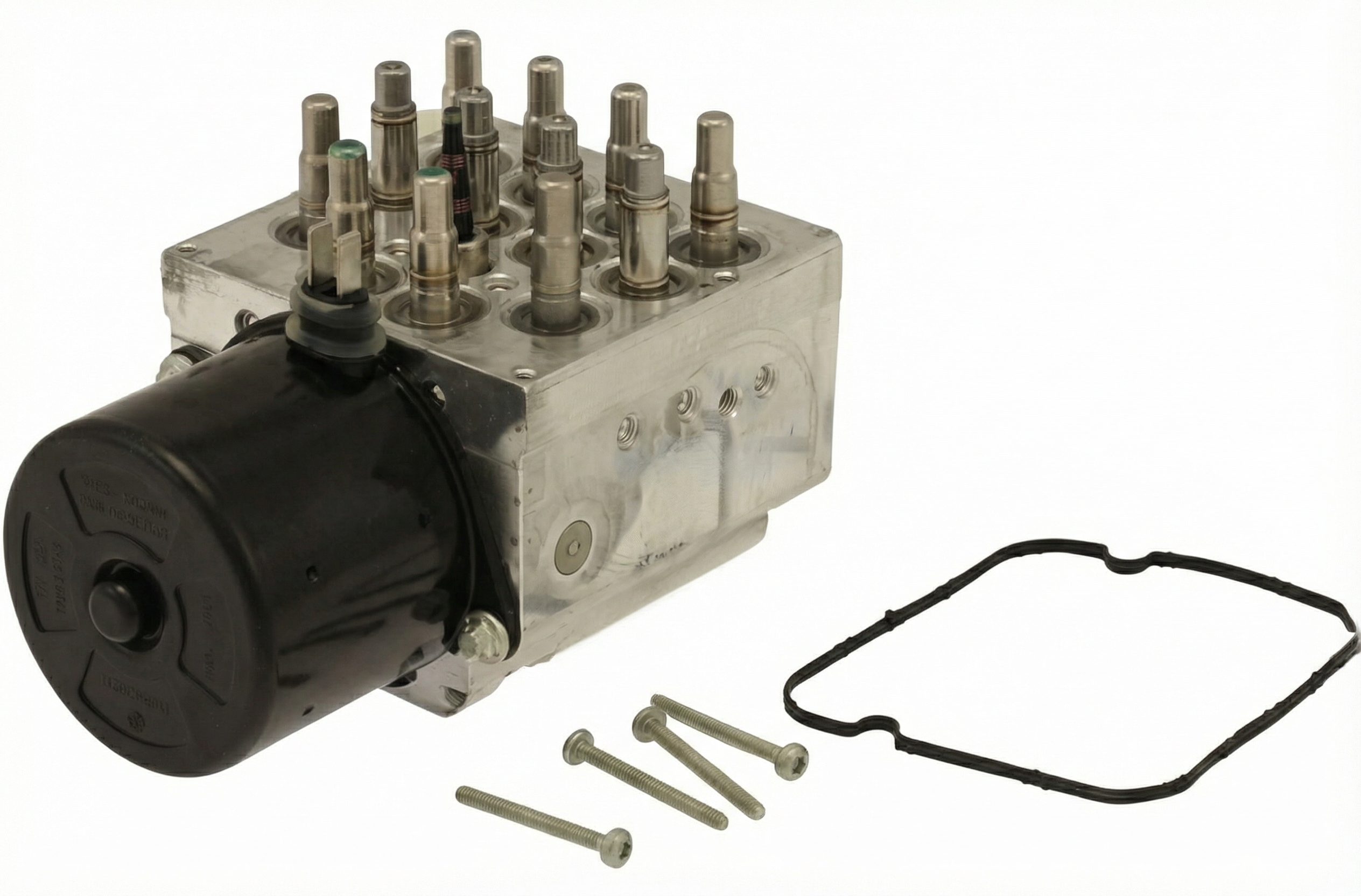
Typical fix: Remove the electronic portion of the ABS module (the black box) and send it to a specialized electronics remanufacturer for repair and reinforcement of the internal connections. A replacement module (new or used) must be programmed to the car with a Tech 2 scan tool, making repair of the original the preferred option.
Est. part cost: $150-$300 for remanufacturing service. - Poor Power or Ground to ABS Module ⚪ Low Probability → Shop ABS Control Module
How to confirm: Check the fuses labeled for the ABS/ESP/TCS system in the engine bay fuse box. Use a multimeter to verify a stable 12V+ supply and a solid ground connection at the appropriate pins on the ABS module's electrical connector using a wiring diagram.
Typical fix: Replace blown fuses. Clean corroded ground points (a common one is under the battery tray at location G2) or repair the power/ground wire in the harness.
Est. part cost: $1-$20 - Damaged CAN Bus Wiring or Connector ⚪ Low Probability
How to confirm: Visually inspect the wiring harness leading to the ABS module for any signs of chafing, breaks, or corrosion. Check the main connector for green corrosion, bent, or pushed-out pins. Advanced diagnosis involves measuring the resistance between the CAN High and CAN Low wires (should be ~60 ohms with the battery disconnected).
Typical fix: Repair the damaged section of the wiring harness. Clean or replace the connector pins.
Est. part cost: $10-$100
Rare But Worth Checking
- Low Battery Voltage: → Shop Vehicle Battery Saabs are known to be sensitive to low voltage. Before complex diagnostics, ensure the battery is fully charged (12.4V+ with engine off) and the alternator is charging correctly (13.7V+ with engine on). A weak battery can cause random communication codes across various modules.
Diagnosis Steps
- Check the battery. Ensure it has a static charge of at least 12.4 volts and that the charging system is working properly (13.7V+).
- Scan for codes with a Saab-capable scanner (like a Tech 2). Note if U0121 is the only code, or if other 'U' codes are present. Attempt to communicate directly with the ABS module. If it's unreachable, this is a key symptom.
- Perform the 'Wiggle Test': Locate the ABS module in the engine bay, on the driver's side. With the key on, firmly wiggle the large electrical connector. Listen for clicks or watch the dashboard for any change in warning lights. If the car has a no-crank issue, see if wiggling the connector allows it to start.
- Inspect and test the ABS-related fuses in the engine bay fuse box (check owner's manual for exact locations, often F1, F19, F26).
- If wiggling the connector had no effect, disconnect it (battery should be disconnected first) and inspect for any green corrosion, bent pins, or moisture damage.
- Using a multimeter and a wiring diagram, confirm that the module is receiving battery power and has a good connection to chassis ground at the connector pins. The primary power/ground pins are 1, 2, 13, and 14.
- If power, ground, and the connector are all good, the ATE Teves Mk60 ABS module itself is almost certainly faulty and requires remanufacturing or replacement and programming.
Parts You'll Likely Need
- ABS Control Module Remanufacturing Service
(OEM #Varies by year/options. Common P/Ns include 12773673, 13509221AE, 93196759. The module is an ATE Teves Mk60.)— This is the most common failure. The service corrects the internal cracked solder joints/bond wires that cause the loss of communication.
Trusted brands: Xemodex, ModuleMaster, BBA Reman, ECU Testing
OEM price range: N/A
Aftermarket price range: $150-$300
Related Codes That Often Appear With This One
- U0073 — Control Module Communication Bus 'A' Off. This is a generic code that often accompanies U0121, indicating the entire CAN bus network was disrupted, likely because the gateway ABS module went offline.
- U0212 — Lost Communication with Column Integrated Module (CIM). Because the ABS module is a gateway, its failure can disrupt communication with other modules like the CIM, leading to multiple 'U' codes being stored. Conversely, a failing CIM can also cause widespread communication issues.
Platform-Specific Known Issues
- A known design flaw in the ATE Teves Mk60 module where internal power supply bond wires or solder joints crack over time, leading to intermittent or total loss of communication.
- The failure of the ABS module can interrupt the CAN bus network, preventing the car from starting, a symptom not common to ABS failures on many other vehicle brands.
Mechanic-Grade Diagnostic Values
- CAN Bus Network Resistance — expected: ~60 Ω between CAN-H and CAN-L pins at the DLC with the battery disconnected.. Failure: A reading of ~120 Ω indicates one of the two terminating resistors (or the wiring to it) is offline. A reading near 0 Ω indicates a short between the CAN lines.
- CAN Bus Voltage (P-Bus) — expected: With key on, engine off, approximately 2.5V on both CAN-H and CAN-L lines relative to ground.. Failure: Voltages that are stuck high (5V) or low (0V), or do not mirror each other during communication, indicate a wiring fault or a module pulling the bus down.
- ABS Module Power Supply Pins — expected: 12V+ (battery voltage) at pins 1 and 13 of the ABS module connector with key on.. Failure: Less than battery voltage indicates a problem in the power supply wiring or fuses.
- ABS Module Ground Pins — expected: Near 0 Ω resistance to a known good chassis ground at pins 2 and 14 of the ABS module connector.. Failure: High resistance (more than a few ohms) indicates a corroded or broken ground connection, a common issue.
Scan Tool Commands That Help
- Saab Tech 2: All Systems DTC Scan / Read Fault Codes — This is the first step. For U0121, the key result is not a sub-code, but the scanner reporting "No Communication" with the ABS/TCS/ESP module, while still communicating with other modules like the ECM and CIM.
- Saab Tech 2: Add/Remove Module (Programming) — This function is required if you install a new or used (not remanufactured original) ABS module. The replacement module must be programmed to the car's VIN and configuration to function.
Wiring & Ground Locations
- ABS Module Connector Pins 1, 13 — On the large electrical connector that plugs into the ABS control module in the engine bay.. These are the main power supply pins for the module. The internal solder joints for these specific pins are the ones that crack, causing the loss of power and communication.
- ABS Module Connector Pins 2, 14 — On the large electrical connector that plugs into the ABS control module.. These are the main ground pins for the module. The internal failure is linked to the power supply circuit, which includes these grounds.
- G2 — On the side of the left-hand chassis structure strut by the connector bracket, near the battery.. This is a primary chassis grounding point for components in the engine bay. Corrosion or looseness at G2 can cause a poor ground for the ABS module, mimicking an internal module failure.
Real Owner Repair Stories
- ScannerDanner Forum user (2006 Saab 9-3) — No crank, no start. No communication with any modules using Tech 2 clone or BlueDriver scanner.
❌ Tried (didn't work) Jumping pins on the ABS module connector (temporary bypass that previously worked)., Installing a used ABS module., Sending the original ABS module for professional repair and reinstalling it.
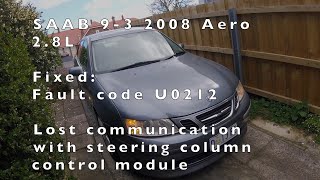
✅ What actually fixed it The issue persisted after the common ABS module repair. The Tech 2 displayed a message 'check continuity of DLC pin 1 to CIM', indicating the root cause was a deeper CAN bus wiring fault between the diagnostic port and the Column Integrated Module (CIM), not the ABS module itself. - YouTube user 'Saab 9-3 Aero V6' (2008 Saab 9-3 Aero 2.8L V6) — Intermittent no-start condition. Fault code U0212 (Lost Communication with CIM) was present, but wiggling the ABS module connector would allow the car to start.
❌ Tried (didn't work) Replacing the battery (fault returned immediately).
✅ What actually fixed it The owner removed the electronic part of the ABS module, opened it, and re-soldered the main power and ground pins on the circuit board. This permanently fixed the no-start issue, demonstrating the symptom overlap between ABS and CIM communication codes. - YouTube user 'Dirt Road Auto Repair' (Saab 9-3 (2003-2012)) — ABS, Traction Control, Stability Control Failure lights on the dash.
❌ Tried (didn't work) Considered replacing the entire wheel hub/bearing assembly.
✅ What actually fixed it Instead of replacing the expensive hub, the owner tested for continuity on the wires between the wheel speed sensor connector and the next junction point in the harness. He found one broken wire, ran a new wire to bypass the break, and all faults cleared.
When the Usual Fixes Don't Work
- In one documented case, a 2006 Saab 9-3 with a no-start condition and no communication on the CAN bus did not get fixed by having the original ABS module professionally remanufactured. The problem persisted, and further diagnosis with a Tech 2 scanner pointed to a wiring fault between the diagnostic port and the Column Integrated Module (CIM). This shows that while the ABS module is the most likely culprit, it is not the only possible cause, and a deeper network diagnosis may be required if the standard fix fails.
OEM Part Supersession History
93185678, 93190837→93196759— Part revision and consolidation by the manufacturer.
Heads up: Part numbers are highly specific. Compatibility depends on model year, drivetrain (FWD vs. XWD), and options like Electronic Stability Program (ESP) and Hill Start Assist. Always match the part number from the original module.ATE Teves Mk60→ATE Teves Mk60E1 / Mk60E5— Evolution of the ABS/ESP system by ATE.
Heads up: While physically similar, the internal electronics and software differ. An E1 or E5 module may not be backwards compatible without specific programming or may have different features (e.g., number of internal pressure sensors).
Model Year Variations Within This Range
- 2003-2007 vs 2008-2012: The major facelift in 2008 introduced changes to the electrical system, including wiring and potentially module software. While the core ABS failure is the same, wiring diagrams and diagnostic paths for secondary issues may differ.
- 2006-2011: Specific part numbers for the ABS module are often cited for this range, and compatibility is critical. For example, a common module fits only FWD, 4-cylinder models with ESP but *without* Hill Start Assist, highlighting the need for precise part matching.
- All: Modules differ between 4-cylinder (B207), V6 (B284), FWD, and XWD (AWD) models. Accessing the module for removal is also easier on the 4-cylinder engine than on the V6 or diesel models, which may require removing the battery and tray.
Diagnostic Flowchart
Other Known Issues on This Vehicle
Issues unrelated to this code that are worth knowing about as an owner of this generation:
- Column Integrated Module (CIM) Failure 🔴 High — Very common. Can occur at any mileage, but more frequent on cars over 80,000 miles. Symptoms include horn not working, steering wheel controls failing, airbag light, and key/starting issues.
- Rear Coil Spring Fracture 🟠 Medium — Extremely common, especially in regions with harsh weather or salted roads. Springs often fracture on the bottom coil.
- Intake Valve Carbon Buildup (2.8T V6 & early 2.0T) 🟠 Medium — Common on the 2.8L V6 Turbo and to a lesser extent on direct-injected 2.0T engines, typically becoming noticeable after 60,000-80,000 miles. Causes rough idle, misfires, and loss of power.
- Convertible Top Hydraulic Leaks/Sensor Failures 🟠 Medium — Common on convertible models as they age (typically 5-10 years). Hydraulic lines can leak, and position sensors or the control module can fail, preventing the top from operating.
- Automatic Transmission Valve Body Issues (5-speed) 🔴 High → Shop Transmission Assembly — Affects the Aisin-Warner AW55-50/51SN 5-speed automatic transmission used in earlier models (approx. 2003-2006). Can cause harsh shifting, flaring between gears, or getting stuck in one gear. Often occurs around 80,000-120,000 miles.
Used vs. New Parts: Buying Guide for This Vehicle
When a used part is the smart pick: For this specific U0121 failure, a used ABS control module is almost never a smart choice. The failure is a known design flaw, meaning a used part from a donor vehicle is highly likely to have the same internal defect or develop it soon after installation.
What to inspect on the donor part:
- Not applicable, as used modules are not recommended.
OEM-only on this vehicle (don't cheap out):
- While a new OEM module is an option, the most recommended and cost-effective solution is not a new part, but rather having the vehicle's **original** module professionally remanufactured. This preserves the original programming, avoiding the need for expensive and tool-specific 'marrying' of a new module to the car with a Saab Tech 2.
Aftermarket brands forum-validated for this vehicle:
- For remanufacturing services: Xemodex, ModuleMaster, BBA Reman, and ECU Testing are frequently cited by owners as providing reliable repairs for the original module.
Brands owners have reported issues with on this vehicle:
- Unknown eBay or Amazon sellers offering 'repaired' or used modules without a lifetime warranty and a clear explanation of the repair process should be avoided. The risk of receiving a part that still requires programming or will fail again is very high.
Real Owner Stories
Aggregated from forums and TSBs cited above. Mileages and costs reflect what owners reported in those sources.
2006 Saab 9-3
Symptoms: The car would not crank or start, and the scanner showed a U0121 code with no ability to communicate with the ABS/TCS module.
What fixed it: The community confirmed the symptoms pointed to the common internal module failure and recommended sending the original module out for repair.
Source hint: SaabCentral Forums - Thread titled '06 9-3 No Crank/No Start, No Comm with ABS/TCS Module'
Saab 9-3
Symptoms: The problem started with the ABS, ESP, and TCS warning lights coming on, and later progressed to the speedometer not working at all.
What fixed it: The issue was diagnosed by other owners as the common internal failure of the ABS control module.
Source hint: SaabScene Forums - Thread 'ABS/ESP/TCS lights on & speedo not working'
Saab 9-3
Symptoms: A 'Stability Control Failure' message appeared on the display, leading to confusion about whether the cause was the Column Integrated Module (CIM) or the ABS module.
What fixed it: The discussion highlighted the diagnostic challenge, as both a failing CIM and a failing ABS module can produce similar warning messages.
Source hint: Reddit r/saab - Post 'Do these symptoms point to CIM failure?'
Related OBD-II Codes
Frequently Asked Questions
My 2007 Saab 9-3 won't start and just shows 'Stability Control Failure'. Could the ABS module cause a no-crank issue?
Is there a simple test I can do at home to confirm the ABS module is the problem before taking it to a mechanic?
If I buy a used ABS module from a junkyard, can I just install it myself to fix the U0121 code?
My speedometer has stopped working and my key is stuck in the ignition. Are these symptoms related to the ABS/TCS warning lights?
What is the specific part that fails inside the ATE Teves Mk60 ABS module on these Saabs?
What is the estimated cost to fix the ABS module if it's an internal failure?
I've heard a bad CIM can also cause 'Stability Control Failure' messages. How do I know it's the ABS module?
Helpful Videos
We Have This Part in Stock

The information in this article is provided for general reference and educational purposes only. Vehicle specifications, procedures, and part compatibility can vary by production date, trim level, and region. Always consult your vehicle's factory service manual and verify part numbers before purchasing or performing repairs. Safety-critical components such as airbags, seat belts, and braking systems should be installed by a qualified professional.
- Saab 9-3:
- 🧭 Diagnostic Flowchart
- 🎬 Helpful Videos
- 🛍️ Shop This Part
- What's Unique About the 2003-2012 Saab 9-3
- Symptoms You May Notice
- Most Likely Causes
- Rare But Worth Checking
- Diagnosis Steps
- Parts You'll Likely Need
- Related Codes That Often Appear With This One
- Platform-Specific Known Issues
- Mechanic-Grade Diagnostic Values
- Scan Tool Commands That Help
- Wiring & Ground Locations
- Real Owner Repair Stories
- When the Usual Fixes Don't Work
- OEM Part Supersession History
- Model Year Variations Within This Range
- Other Known Issues on This Vehicle
- Used vs. New Parts: Buying Guide for This Vehicle
- Real Owner Stories
- 2006 Saab 9-3
- Saab 9-3
- Saab 9-3
- Related OBD-II Codes
- Frequently Asked Questions
- 🎟️ Get 5% Off